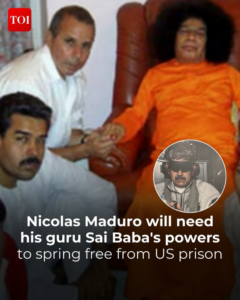
Global coverage of Venezuelan leader Nicolás Maduro’s detention in New York drew attention not only to the spectacle of a high-profile “perp walk,” but also to an overlooked personal dimension: his long-standing spiritual connection with Sri Sathya Sai Baba. Footage of Maduro greeting onlookers with a cheerful "happy new year" contrasted sharply with the gravity of the charges and the intensity of American carceral power.
Media discussions quickly resurfaced well-documented aspects of Maduro’s spiritual life: his 2005 visit to Puttaparthi (Prasanthi Nilayam), his reference to Sri Sathya Sai Baba in public life, and the observance of national mourning in Venezuela upon Baba’s passing in 2011. These facts have sometimes been used to imply a hidden “Global Hindutva” influence, a narrative that oversimplifies complex spiritual affiliations and reduces nuanced cross-cultural ties to conspiratorial rhetoric.
In parallel, Prime Minister Narendra Modi’s address at the Shri Ram Janmabhoomi Mandir Dhwajarohan Utsav called for India to “completely break free” from the residues of British colonialism in the coming decade. This call resonates with many in the global Indian diaspora who recognise how a colonial mindset can quietly shape cultural self-perception and media framing. The moment offers a useful lens through which to evaluate how Indian and international newsrooms cover Hindu spirituality, and, by extension, other dharmic traditions such as Buddhism, Jainism, and Sikhism.
A recent Times of India column on Maduro’s Sai Baba connection concluded with the suggestion that the couple would need “divine blessings and powers to spring free” from prison. The framing landed as glib to many readers, collapsing a globally respected Hindu teacher and a living community of faith into an ironic punchline. It also typifies a recurring pattern in which Hindu spiritual figures are presented with an undercurrent of exoticism or skepticism rarely applied to Western religious leaders in comparable geopolitical contexts.
Mischaracterising Hindu spirituality in this way is not a neutral stylistic choice; it signals a hierarchy of religious legitimacy in mainstream journalism. The tone transforms a serious subjecthow faith shapes public lifeinto a spectacle. By doing so, news coverage risks reinscribing a Western-centric bias that implicitly positions dharmic traditions as curiosities rather than as robust, living philosophies with complex theologies, institutions, and social-service legacies.
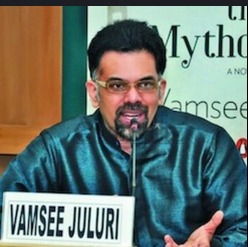
Language choices matter. Descriptors such as “fuzzy-haired,” used to refer to Cilia Adela Flores in one discussion of these events, add nothing to political analysis while echoing racialized aesthetics long weaponized to diminish dignity. Such terms unsettle readers who have experienced coded language as a subtle instrument of bias. Scholars like Professor Vamsee Juluri describe this pattern in Indian English discourse as “self-orientalism,” wherein elite media adopt externally derived tropes to mock or marginalize their own civilizational traditions.
One recurrent marker of this discourse is the trigger word “Godman.” Deployed with clockwork regularity, it functions less as description and more as insinuation: a compact stereotype evoking cultism, irrationality, or danger. Crucially, this shorthand is not applied evenly across religions. When Western or Abrahamic leaders face scrutiny, mainstream outlets typically use formal titles and institutional affiliations, allowing facts to drive interpretation rather than priming readers to dismiss the subject as inherently suspect. This asymmetry is what many describe as Hinduphobia.

When Indian or international media lean on such shorthand, the result resembles cultural policing rather than reporting. It signals distance, superiority, and a performative cosmopolitanism that uses irony as a credential. As Juluri and others argue, this is not secular rigor; it is elite insecurityan anxiety that taking Hindu and broader dharmic traditions seriously could jeopardize standing in a global discourse still shadowed by colonial hierarchies.
It is important to distinguish critique from caricature. Within Hinduismand across dharmic traditionsskepticism, debate, and ethical accountability are integral. Calling out wrongdoing where evidence exists is not only legitimate but necessary. The problem arises when contempt is smuggled in through vocabulary that nudges readers to conflate ancient philosophies, social-service institutions, and lived devotion with a single mocking label.
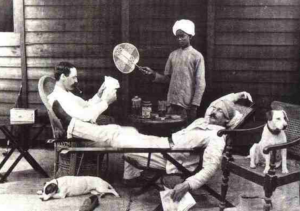
Why this matters is straightforward: words shape perception. Persistent ridicule of Hindu spirituality and its teachers normalizes the view that a billion people’s traditions are quaint or primitive. Over time, this erodes cultural literacy and reduces space for fair discourse. The implications extend beyond Hinduism to the broader dharmic familyBuddhism, Jainism, and Sikhismwhose pluralistic ethos and shared civilizational heritage deserve the same respect accorded to other world traditions.
Responsible journalism about religion, particularly in geopolitically sensitive contexts, rests on three practices. First, adopt a respectful tone free of belittling descriptors. Second, provide contextual understanding of the traditions discussed, including institutional history and social impact. Third, avoid racialized language and tropes that reproduce Hinduphobic or broader civilizational stereotypes. These standards do not curtail critique; they elevate it.
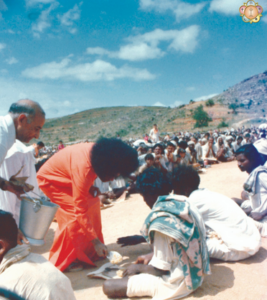
A deeper editorial challenge lies in target selection. It is easier to lampoon a faith figure than to interrogate carceral power, diplomatic leverage, or international legal frameworks. Yet reducing Sri Sathya Sai Babaor any dharmic teacherto a punchline turns faith into spectacle and deflects attention from substantive questions. A decolonized approach to reporting would resist this impulse and pursue analysis that is rigorous, balanced, and culturally literate.
There are constructive paths forward. Newsrooms can update style guides to replace pejorative shorthand with precise descriptors of role and institution. Editors can commission explainer pieces on dharmic traditionsHinduism, Buddhism, Jainism, and Sikhismthat foreground theology, ethics, social service, and community practice. Journalists can consult area experts and scholars when faith intersects with geopolitics to ensure coverage is both accurate and appropriately framed.
Public discourse benefits when media critique power without sneering at belief. It gains credibility when reporting avoids racialized or colonial residues and instead models fair-minded scrutiny. In moments like thesewhere geopolitics, detention, and faith intersectmoral seriousness requires language that clarifies rather than caricatures, and analysis that informs rather than inflames. Such an approach not only strengthens journalism; it advances cultural understanding and unity among India’s dharmic traditions.
For readers seeking context, extensive documentation exists on Sri Sathya Sai Baba’s social-service initiatives in healthcare and education, as well as public speeches by PM Narendra Modi on decolonizing the national mindset. These sources illustrate that dharmic traditions continue to contribute meaningfully to public life in India and abroad. When covered with care and rigor, they enrich rather than polarize the global conversation.
Inspired by this post on Hindu Human Rights Blog.