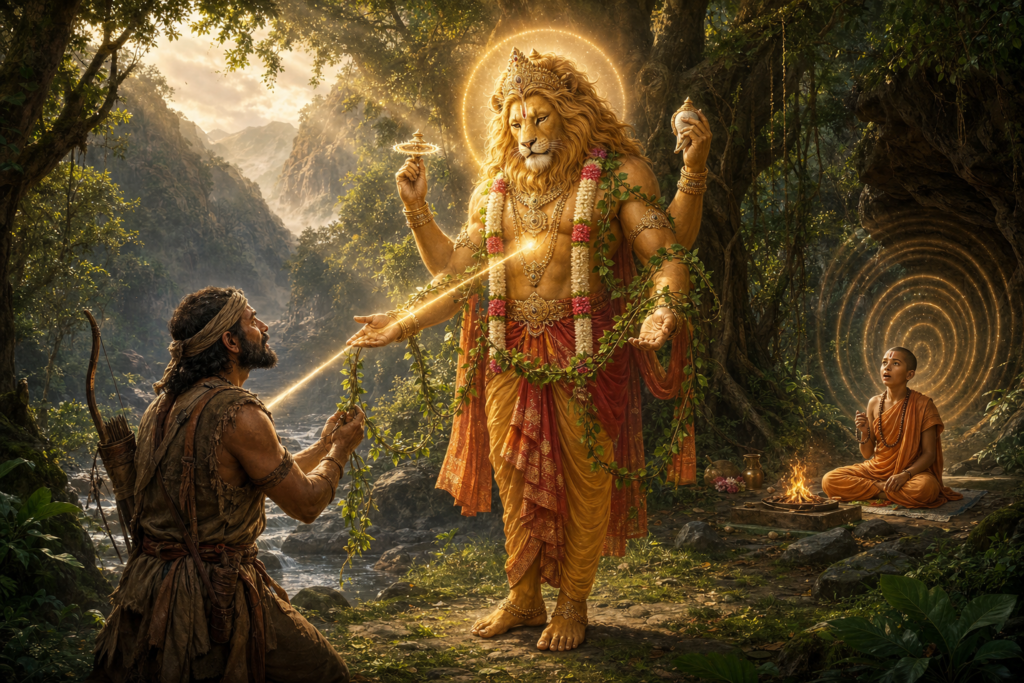
The contrast between a “sage on the stage” and a “guide by the side” is a familiar challenge across the Guru-Shishya Relationship in Hinduism, Buddhism, Jainism, and Sikhism. Dharmic Traditions consistently uphold humility, integrity, and seva as the basis of spiritual guidance, yet social expectations and inner conditioning can pull practitioners toward performative authority rather than compassionate mentorship.
In many communities, “humble junior” practitioners look up to seniors as advanced Vaisnava or seasoned sadhakas. At times, because of strong previous lifetime advancement and sincerity, these juniors move swiftly in sadhana and occasionally surpass their mentors. When that occurs, some find themselves caught in the mesh and mess of prior conditioning while still feeling compelled to act as a “sage on the stage,” sustaining a Paundraka-like facade of advancement. This dynamic is not merely interpersonal; it reflects deeper tensions between ego (asmita) and the dharmic call to truthfulness (satya), humility, and lokasangraha.
Performative spiritual leadership can erode trust, obscure clarity, and inadvertently limit a student’s growth. It also burdens mentors with the anxiety of maintaining appearances rather than deepening sadhana. Dharmic perspectives across Hinduism, Buddhism, Jainism, and Sikhism emphasize that spiritual authority is validated by inner transformation, compassion, and transparent conduct, not by titles or roles. In Buddhist kalyanamitra traditions, the friend-in-dharma supports without overshadowing; in Jain upadhyaya lineages, disciplined humility and self-restraint remain central; Sikh Gurmat and the sangat model shared learning; and in Hindu paramparas, the Guru’s role includes knowing when to step back so the shishya can advance.
Shifting from “sage on the stage” to “guide by the side” begins with practical commitments: celebrating a student’s progress, acknowledging personal limits, and referring seekers to more suitable teachers when required. It involves prioritizing listening over lecturing, inquiry over assertion, and shared study (svadhyaya) over one-way discourse. Regular introspectionasking, “Where am I attached to the role of ‘sage’?”helps dissolve subtle egoic patterns. Sustained seva, consistent personal practice, and transparent communication with the community reinforce integrity and model the unity-in-diversity inherent to Dharmic Traditions.
Relatable experiences abound: mentors sometimes feel both pride and vulnerability when students grow rapidly; juniors may hesitate to outpace seniors out of respect. Naming these emotions, offering gratitude, and aligning action with dharma helps both remain grounded. When growth is honored without rivalry, the Guru-Shishya Relationship becomes a living embodiment of interfaith harmony within the broader dharmic familyaffirming that wisdom is a shared inheritance rather than a personal possession.
Ultimately, authentic leadership in Dharmic Traditions is measured by the capacity to support what is true, not what flatters the self. Choosing the “guide by the side” ethos safeguards spiritual integrity, strengthens community trust, and accelerates collective uplift. In this way, humility, sincerity, and compassionate guidance become the pathway by which allteachers and students alikeadvance together.
Inspired by this post on Dandavats.