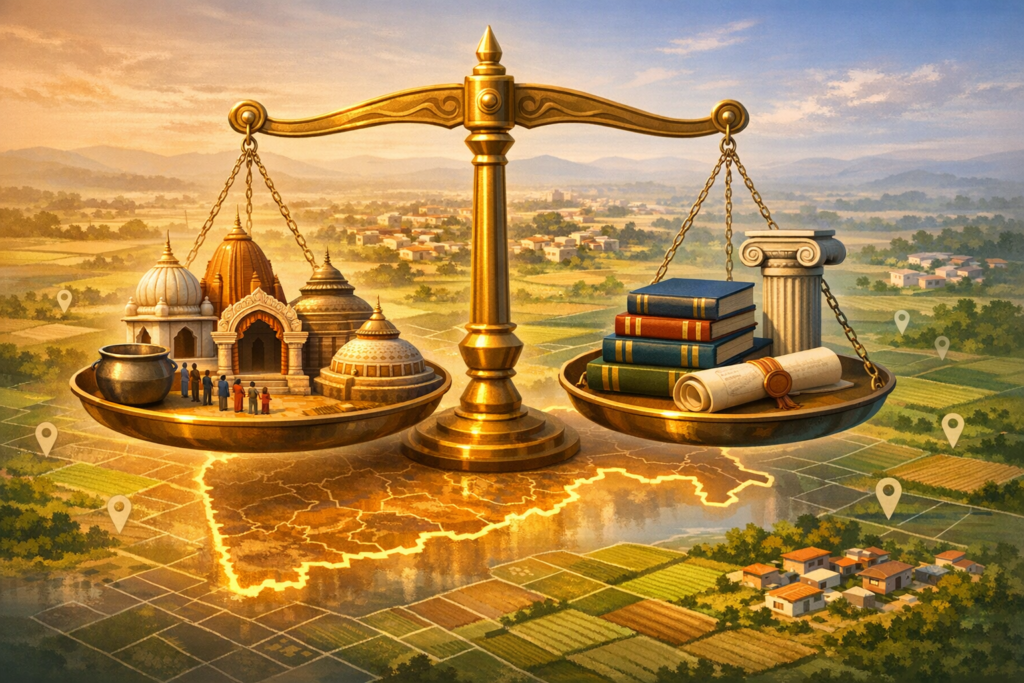
In India’s capital (New Delhi), saints, seers, and Dharma-minded professionals convened to articulate a shared civilizational vision. Framed as a clarion call for Bharat’s enduring identity—often described as “Sanatan Rashtra”—the assembly emphasized Sanatan Dharma as a plural, ethical foundation that embraces Hinduism, Buddhism, Jainism, and Sikhism.
Rather than advocating a theocratic model, speakers focused on cultural preservation, social harmony, and constitutional citizenship. “Sanatan Rashtra” was repeatedly presented as a cultural-ethical commonwealth grounded in Dharma—Ahimsa, Seva, Satya, and mutual respect—compatible with India’s democratic framework and the ethos of Unity in Diversity.
Participants from monastic orders and civic organizations highlighted practical priorities: safeguarding temples and sacred sites, conserving manuscripts and oral histories, revitalizing festivals as inter-community bridges, and strengthening dharmic education for youth. Digital archiving, local heritage stewardship, and diasporic collaboration were identified as scalable pathways for cultural heritage protection.
The choice of New Delhi carried symbolic weight: the capital functions as a meeting point for multiple regional cultures, languages, and faiths. Attendees described an atmosphere that was at once solemn and aspirational, marked by shared recitations, reflective silence, and a commitment to interfaith dialogue within the dharmic family.
Several voices underscored Ishta-based pluralism—the freedom to approach the Divine through one’s chosen path—as intrinsic to Sanatan Dharma. This theological openness, they argued, has historically enabled coexistence across Hindu sampradayas, Buddhist and Jain traditions of non-violence, and Sikh practices of seva and community justice.
Policy-oriented interventions proposed at the gathering included civic training in cultural heritage laws, documentation of endangered rituals, community service initiatives aligned with dharmic ethics, and city-level forums for conflict resolution. Such measures were framed as non-partisan, citizen-led, and verifiable through transparent metrics.
Beyond policy, the event’s lasting impression lay in its emotional resonance: a renewed sense of belonging to a civilizational continuum and a shared responsibility to safeguard it. The call from New Delhi thus read as an invitation to collective guardianship—protecting Sanatan culture while deepening harmony among all dharmic traditions.
Inspired by this post on Hindu Jagruti Samiti.