
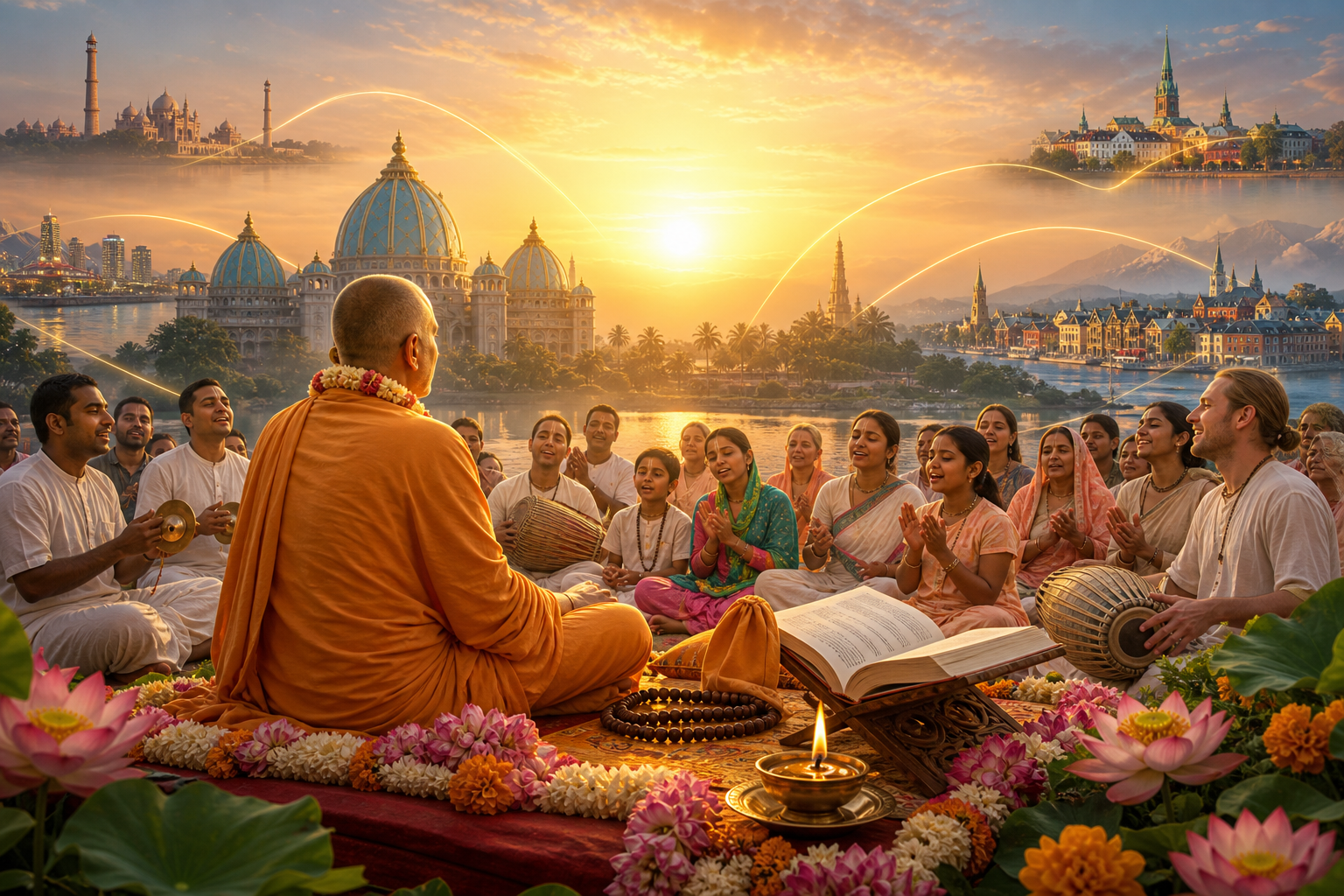

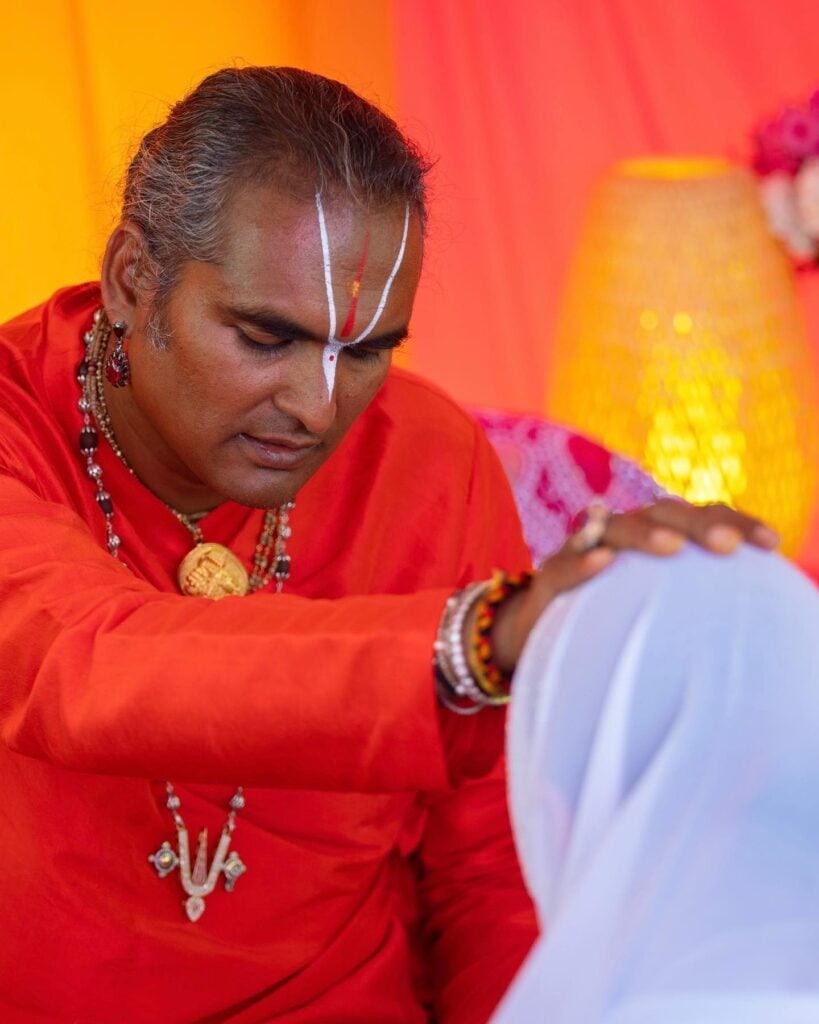
The passing of His Holiness Dhirasanta Dasa Goswami marks a solemn moment for devotees, disciples, followers, and well-wishers connected with the Hare Krishna movement and the wider dharmic world. According to the official announcement shared by his disciples and followers, Maharaja left his physical body in an atmosphere of sacred chanting, spiritual peace, and loving remembrance. In the language of Gaudiya Vaishnava devotion, such a departure is not described merely as death, but as the soul’s continued journey toward the eternal service of Lord Krishna.
The announcement expresses the grief of a community that saw him not only as a teacher, but also as a spiritual guardian. It offers humble obeisances to Srila Prabhupada and frames HH Dhirasanta Dasa Goswami’s life within the disciplic current of service, instruction, and devotional practice. This is an important point, because in the Vaishnava understanding the guru is not honored as an isolated personality, but as a transparent representative of a sacred lineage that carries knowledge, discipline, compassion, and devotion across generations.
HH Dhirasanta Dasa Goswami received initiation from Srila Prabhupada in 1972, placing his spiritual life within one of the most formative decades of the International Society for Krishna Consciousness, commonly known as ISKCON. The early 1970s were a period of rapid expansion for the movement, as Srila Prabhupada’s disciples worked to establish temples, communities, publishing programs, educational initiatives, and devotional practices across India and abroad. Within that wider history, Maharaja’s service stands out for its long duration, international reach, and pastoral depth.
His service in India is remembered with particular reverence. The announcement notes that he was among the early foreign devotees who helped establish ISKCON centers in Mayapur, Delhi, and Bombay. These locations were not simply administrative sites. Mayapur is deeply connected with Sri Chaitanya Mahaprabhu and the Gaudiya Vaishnava tradition; Delhi represents a major public and cultural center of modern India; and Bombay, now Mumbai, became one of the most visible urban platforms for Krishna consciousness. To assist in building devotional life in such places required conviction, endurance, discipline, and sensitivity to India’s sacred geography.
In later decades, HH Dhirasanta Dasa Goswami dedicated substantial energy to preaching and community development across Europe, especially in Scandinavia and the Baltic states. This aspect of his work reflects one of ISKCON’s defining historical features: the translation of bhakti, kirtan, prasadam, temple worship, scriptural study, and disciplined sadhana into diverse social and cultural environments. His preaching was not merely the transmission of doctrine; it involved building communities where families, children, adults, seekers, and long-standing practitioners could find spiritual structure and belonging.
The official remembrance emphasizes his educational projects for both children and adults. This detail deserves careful attention. In dharmic traditions, education is never limited to information. It includes character formation, ethical refinement, memory of sacred texts, reverence for teachers, disciplined conduct, and the cultivation of service. A spiritual teacher who invests in education is therefore shaping not only individual belief, but the continuity of a living tradition. Through such work, HH Dhirasanta Dasa Goswami contributed to the intergenerational preservation of Vaishnava practice.
His followers also remember his exceptional fatherly care. This phrase carries emotional and theological significance. In the guru-shishya tradition, instruction is most powerful when it is joined with responsibility, patience, and compassion. A teacher may explain scripture, but a spiritual mentor also observes the struggles of disciples, steadies them through doubt, guides them through personal difficulty, and helps them connect daily life with higher purpose. For many devotees, this fatherly presence becomes one of the most tangible forms of grace.
The passing of a guru often creates a profound inner silence within a devotional community. Disciples may remember lectures, private guidance, shared kirtans, temple programs, festivals, pilgrimages, letters, personal corrections, and moments of encouragement that shaped their spiritual lives. Such memories become a form of continuing association. In the Vaishnava tradition, remembrance is not passive nostalgia; it is a practice of gratitude that helps disciples deepen their own commitment to the teachings they received.
The announcement states that Maharaja departed surrounded by the chanting of the holy names. In the Hare Krishna tradition, this detail is central. The chanting of the maha-mantra, the names of Krishna, and devotional sound are understood as spiritually purifying and as the heart of bhakti practice. A life concluded amid sacred sound reflects the ideal that the final moments should be connected with divine remembrance. For devotees, this is both a theological affirmation and a deeply human consolation.
His legacy also belongs to the larger story of Hindu spirituality’s global movement in the twentieth and twenty-first centuries. Srila Prabhupada brought Gaudiya Vaishnava teachings to the West in 1965 and founded ISKCON in 1966. His disciples then carried those teachings into new regions, languages, and communities. HH Dhirasanta Dasa Goswami’s life represents that historical process in embodied form: a disciple receiving instruction, serving in India, preaching abroad, nurturing communities, and leaving behind a network of disciples shaped by devotion and discipline.
From an academic perspective, his work illustrates how modern Vaishnava movements combine traditional authority with global mobility. Temple worship, guru-disciple transmission, scriptural study, sankirtan, pilgrimage, and community education remain rooted in inherited dharmic forms. At the same time, these practices adapt to new languages, climates, family structures, and cultural expectations. The durability of such communities depends heavily on leaders who can preserve theological clarity while offering practical care. Maharaja’s decades of service show why such figures become central to religious continuity.
His life also speaks to unity among dharmic traditions. While he served specifically within the Gaudiya Vaishnava and ISKCON tradition, the values associated with his service are recognizable across Hinduism, Buddhism, Jainism, and Sikhism: reverence for the teacher, disciplined practice, compassion, community service, sacred sound, humility, and the pursuit of spiritual realization. In this sense, remembering him is not only an act of sectarian devotion, but also an opportunity to honor the wider dharmic principle that spiritual wisdom must be lived, taught, protected, and transmitted with integrity.
The announcement also notes that details regarding Samadhi rituals, viewing times, and official memorial programs will be shared separately. Samadhi, in this context, refers to the sacred rites associated with the departure and resting place of a renounced spiritual teacher. These observances allow disciples and followers to gather, chant, offer respects, remember teachings, and reaffirm their responsibility to continue the mission. Such rituals provide both theological meaning and communal healing.
For devotees grieving HH Dhirasanta Dasa Goswami’s departure, the most enduring tribute will be the continuation of the principles he embodied: devotion to Lord Krishna, loyalty to Srila Prabhupada’s mission, care for community, education for the next generation, and compassionate guidance for seekers. A spiritual teacher’s physical absence is deeply felt, yet the teachings, memories, and devotional culture he nurtured remain active through those who carry them forward.
HH Dhirasanta Dasa Goswami’s departure is therefore a moment of mourning, gratitude, and reflection. His disciples and followers remember a life given to bhakti, service, preaching, education, and spiritual care. His legacy now rests in the hearts of those he guided and in the communities he helped strengthen across India, Europe, Scandinavia, and the Baltic states. Hare Krishna.
Inspired by this post on Dandavats.



Leave a Reply
You must be logged in to post a comment.