Vaishno Devi video controversy: why ritual protocols matter and how temples must respond
·6 min read
A widely circulated video, purportedly depicting the Chief Executive of the Shri Mata Vaishno Devi Shrine Board retaining footwear during a ritual observance, has triggered intense public concern and debate. The episode has drawn attention to the centrality of ritual protocols in Hindu temples, the responsibilities of religious governance bodies, and the sensitivities of millions of devotees who undertake the Vaishno Devi Yatra with deep faith. While emotions are understandably strong, a careful, evidence-based appraisal is essential to preserve institutional credibility and communal harmony across dharmic traditions.
At the time of writing, independent verification of the video’s full context and chain-of-custody remains limited in open sources. In such circumstances, the most constructive response is to treat the matter as an allegation pending formal clarification by the Shrine Board, supported by timestamped footage, eyewitness accounts from ritual functionaries (archakas), and documented standard operating procedures (SOPs). This approach avoids premature judgments while upholding the public’s legitimate expectation of transparency.
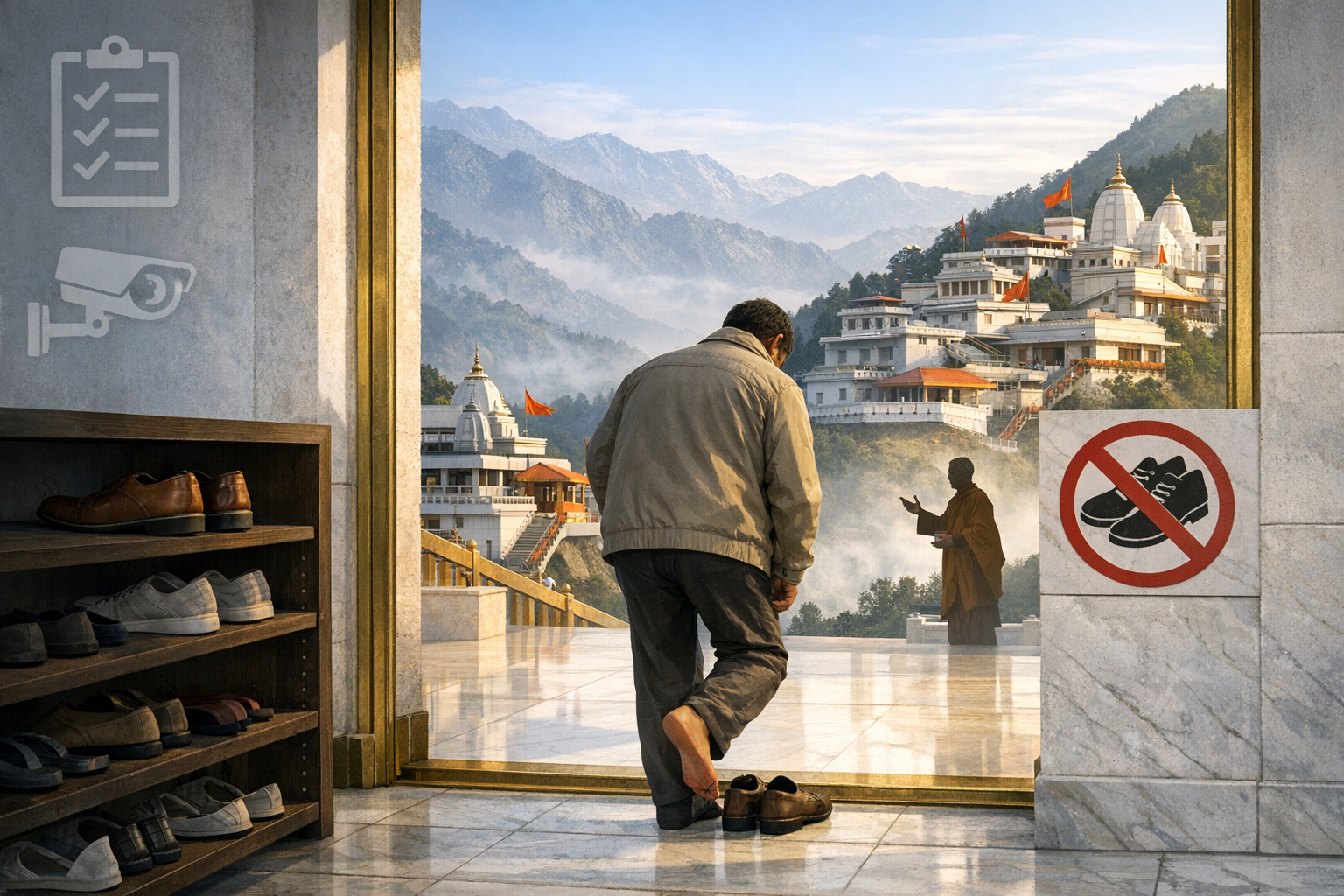
Footwear protocols are not a peripheral detail; they are embedded in the logic of Hindu rituals and temple etiquette. Textual traditions that guide temple practiceoften summarized under the umbrella of Agama shastras and allied priestly conventionsplace emphasis on pavitrata (ritual purity), sthala-shuddhi (sacral cleanliness of place), and maryada (customary order). Removing footwear within sanctified precincts signifies humility before the divine, a symbolic shedding of worldly dust that resonates with the devotee’s inner disposition of reverence. For many, such observances are integral to the experience of darshan and seva.
These sensibilities are shared across the broader dharmic family. In gurdwaras, for instance, the removal of shoes and the washing of feet are coupled with head coverings as expressions of equality and humility before the Guru Granth Sahib. Jain and Buddhist sacred spaces likewise customarily require footwear removal, underscoring a pan-dharmic ethic of respect, non-injury, and mindful conduct. Recognizing this common ground strengthens mutual understanding and unity among Hindus, Buddhists, Jains, and Sikhs.
The Shri Mata Vaishno Devi Shrine Boardestablished under the Jammu & Kashmir Shri Mata Vaishno Devi Shrine Act, 1988bears statutory responsibility for managing the Yatra, maintaining the Bhawan and ancillary facilities, and safeguarding ritual protocols that align with the temple’s established maryada. In most Hindu temples, SOPs stipulate that footwear must be removed before entry into sanctified interiors and ritual spaces; where health or safety exceptions are necessary, they are ordinarily handled with explicit, documented accommodations that preserve the spirit of the rules.
Public trust in religious governance hinges on visibly even-handed adherence to norms. When perceived lapses involve senior administrators or VIP visitors, devotees often experience them as a breach of parity and propriety, particularly after undertaking long ascents and queues with meticulous observance of rules. In such settings, leaders are expected to model best practice, thereby affirming that ritual discipline is not selective but universal.
Pilgrims frequently describe the Vaishno Devi Yatra as a transformative journeyphysically exacting, emotionally uplifting, and spiritually centering. The ascetic symbolism of bare or sock-covered feet on cool stone is for many a tangible reminder of devotion and surrender. This lived experience explains why allegations of protocol violations evoke strong reactions; they are felt not merely as procedural lapses but as injuries to a shared sacral ethos.
Social media accelerates outrage cycles, often outpacing verification. Partial clips, contradictory captions, and algorithmic amplification can entrench narratives before institutions have a chance to investigate and communicate. To counter this dynamic, religious institutions benefit from pre-defined crisis communication templates that commit to a timeline for fact-finding, interim updates, and a final, document-backed report.
From a governance standpoint, Shrine Boards and temple trusts can codify dignitary and administrator protocols in a manner that is both respectful and unambiguous. Effective SOPs typically include: advance briefing on temple maryada; a no-exceptions footwear rule in sanctified zones, paired with clearly documented medical accommodations; the presence of a ritual liaison (a senior archaka) to guide movements; and real-time compliance recording by designated staff. Such measures reduce ambiguity while elevating accountability.
Accessibility must be handled compassionately and systematically. Where medical needs necessitate foot protection, temples can adopt clean-room grade overshoes, sanitized socks, or designated assistive aids vetted by the priestly council and custodial staff. Labelling such accommodations as exceptions approved by the appropriate authority maintains transparency and preserves ritual sanctity without excluding those with legitimate needs.
A robust fact-finding model includes secure retrieval and retention of CCTV footage; witness statements from pujari, security, and protocol officers; a written timeline of movement within the temple; and review against the current SOP. The final note should specify whether the alleged conduct occurred within a sanctified perimeter or in an adjoining non-ritual area, since the maryada and expectations can differ by zone.
Clear communication serves both institutional integrity and public sentiment. A concise initial statement acknowledging the video, an estimated window for investigation, and a commitment to release findings can defuse speculation. If corrective action is warranted, outlining proportionate stepstraining, censure, or revision of SOPsdemonstrates seriousness without sensationalism.
Training is an enduring solution. Induction modules for administrators, security personnel, and liaison officers can cover Agama-guided norms, local temple maryada, comparative etiquette across dharmic traditions, and scenario-based rehearsals. Periodic refreshers ensure that protocol literacy remains high even as personnel rotate.
The ethical dimension is straightforward: in sacred spaces, leadership is service. Administrators and dignitaries signal respect for devotees when they adhere, without exception, to the same rules that govern the community. This shared humility not only protects institutional reputation but also reaffirms the inclusive spirit at the heart of Hindu temples.
Legal and constitutional contexts also matter. Article 25 protects freedom of conscience and the right to freely profess and practice religion, subject to public order, morality, and health, while shrine and endowments laws empower boards to frame and enforce ritual and administrative protocols. Within this framework, clear, consistently applied rules are both lawful and necessary.
Measuring and improving compliance is practical. Temples can track a footwear-compliance rate in sensitive zones, conduct micro-surveys on the clarity of signage, and audit VIP visits for protocol adherence. Publishing anonymized quarterly dashboards builds public confidence and institutional learning.
More broadly, the controversy invites a constructive, unifying response across the dharmic family. Shared valuesshraddha (faith), seva (service), and maryada (order)offer a common grammar for respectful practice in Hindu, Buddhist, Jain, and Sikh spaces. Cross-institution workshops and peer learning can surface effective solutions that honor tradition while addressing contemporary administrative realities.
Two outcome pathways must be contemplated with equal clarity. If a verified breach occurred within a sanctified zone, proportionate, well-documented disciplinary action and SOP refinement are appropriate. If the allegation is not substantiated, a transparent explanationsupported by evidenceshould be communicated promptly to prevent lingering mistrust.
Ultimately, the Vaishno Devi video controversy underscores a simple truth: ritual protocols are not mere formalities but touchstones of meaning for devotees. By strengthening SOPs, investing in training, improving communications, and embracing pan-dharmic solidarity, religious institutions can protect the sanctity of worship while responding to modern expectations of accountability. Such a path preserves reverence, fosters unity, and upholds the dignity of Shri Mata Vaishno Devi and of all dharmic places of pilgrimage.
The article discusses a widely circulated video purportedly showing the Chief Executive of the Shri Mata Vaishno Devi Shrine Board retaining footwear during a ritual observance. It stresses that the video’s full context and chain of custody were not independently verified in open sources at the time of writing.
Why do footwear protocols matter in Hindu temples?
The post explains that footwear rules are tied to pavitrata, sthala-shuddhi, and maryada, or ritual purity, sacral cleanliness, and customary order. Removing footwear symbolizes humility before the divine and is part of the experience of darshan and seva for many devotees.
How should a shrine board respond to an alleged ritual protocol breach?
The article recommends evidence-based fact-finding through timestamped footage, eyewitness accounts, documented SOPs, CCTV retention, and a written timeline. It also calls for a final report explaining whether the alleged conduct occurred inside a sanctified perimeter or in a non-ritual area.
How can temples handle medical or accessibility exceptions to footwear rules?
The piece suggests clean-room grade overshoes, sanitized socks, or designated assistive aids when medical needs require foot protection. Such accommodations should be documented, approved by appropriate authorities, and handled transparently while preserving ritual sanctity.
What SOPs can help prevent future temple protocol disputes?
Suggested measures include advance briefing on temple maryada, clear footwear rules in sanctified zones, a ritual liaison to guide movements, real-time compliance recording, and induction training. The article also recommends periodic refreshers on Agama-guided norms and comparative dharmic etiquette.
Why does the article connect this issue with other dharmic traditions?
The post notes that shoe removal and related etiquette also appear in Sikh, Buddhist, and Jain sacred spaces. It frames these practices as part of a shared ethic of humility, respect, non-injury, and mindful conduct across dharmic traditions.
What outcomes does the article recommend after verification?
If a breach is verified within a sanctified zone, the article recommends proportionate disciplinary action and SOP refinement. If the allegation is not substantiated, it calls for a prompt evidence-supported explanation to prevent lingering mistrust.