Kanchipuram, celebrated as one of Hinduism’s Sapta Puri, distills millennia of sacred memory into stone, ritual, and living heritage. Within this city’s grand ensemble stands Sri Ekambaranathar Temple, a monumental Shaiva shrine whose precincts unexpectedly also shelter a revered Vaishnava sanctumthe Nilathingal Thundam Perumal Divya Desam. This “temple within a temple” does more than intrigue architectural historians; it models the civilizational harmony that has long animated India’s dharmic traditions.
Nilathingal Thundam Perumal (also written as Nilathunda Perumal) is one among the 108 Divya Desamsthe sacred Vishnu temples praised in the Nalayira Divya Prabandham by the Alvars. Its location inside Ekambaranathar Temple Kanchipuram makes it a rare witness to Shaiva–Vaishnava amity. Here, the theological and ritual textures of two great sampradayas interweave without friction, a reality that visitors sense in the shared courtyards, echoing chants, and converging processions.
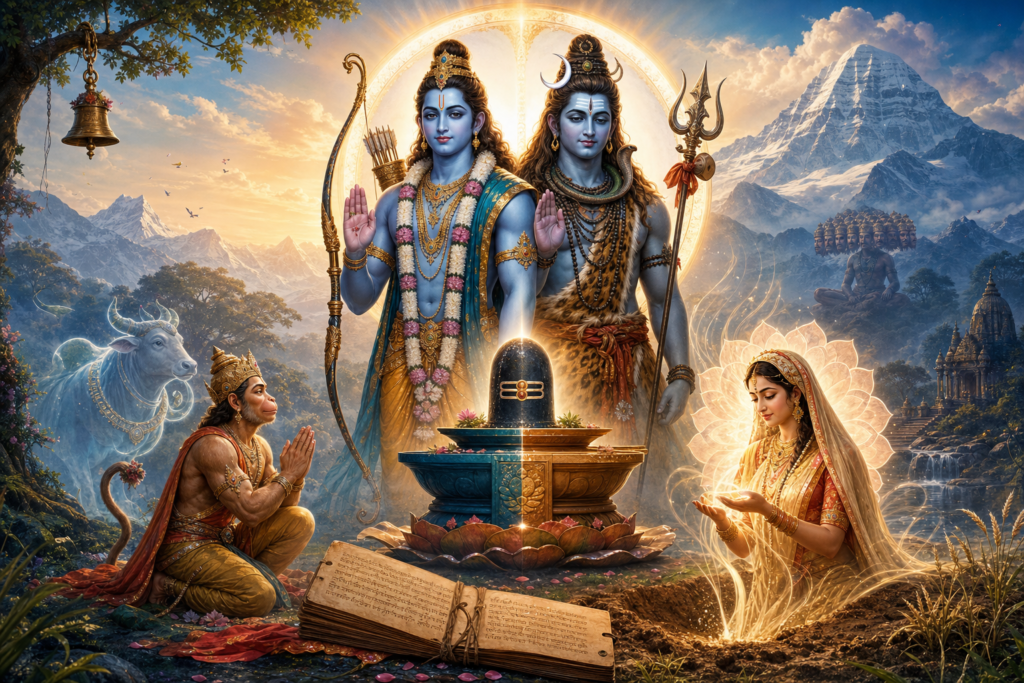
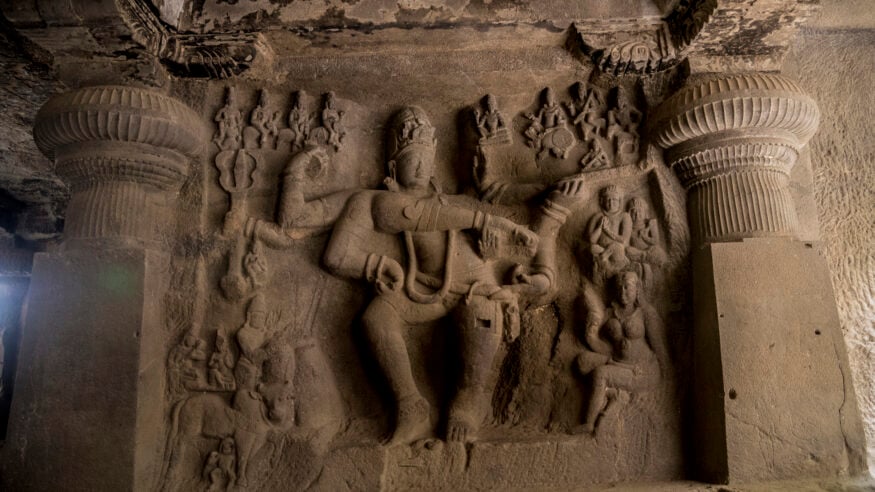
Local sthala-purana narrates the celebrated episode often summarized as “Where Shiva healed Vishnu.” During a moment of trial, Shiva is said to have cooled and healed Vishnu with the gentle radiance of the moon (Chandra) he bears. The epithet “Nilathingal Thundam” is read as the sanctum “illumined or soothed by a fragment of the moon,” a poetic crystallization of the legend’s healing motif. The narrative is frequently paired with Parvati’s penance beneath the ancient mango tree (the sthala-vriksha that gives Ekambaranathar“Lord of the Mango Tree”his name), reinforcing the site’s integrative sanctity.
Across Kanchipuram’s sacred landscaperich with Vishnu and Shiva templesthis symbiosis is not incidental. Nilathingal Thundam Perumal stands as a theological bridge: Vaishnava devotion (bhakti to Vishnu as Perumal) flourishes within a Shaiva kshetra renowned for Parvati’s austerities and Shiva’s grace. The lesson is civilizational and contemporary: plurality within Hinduism is not a tension to be managed but a potency to be honoredan ethos in consonance with the broader dharmic family of Buddhism, Jainism, and Sikhism, which likewise elevates compassion, self-discipline, and inner transformation.
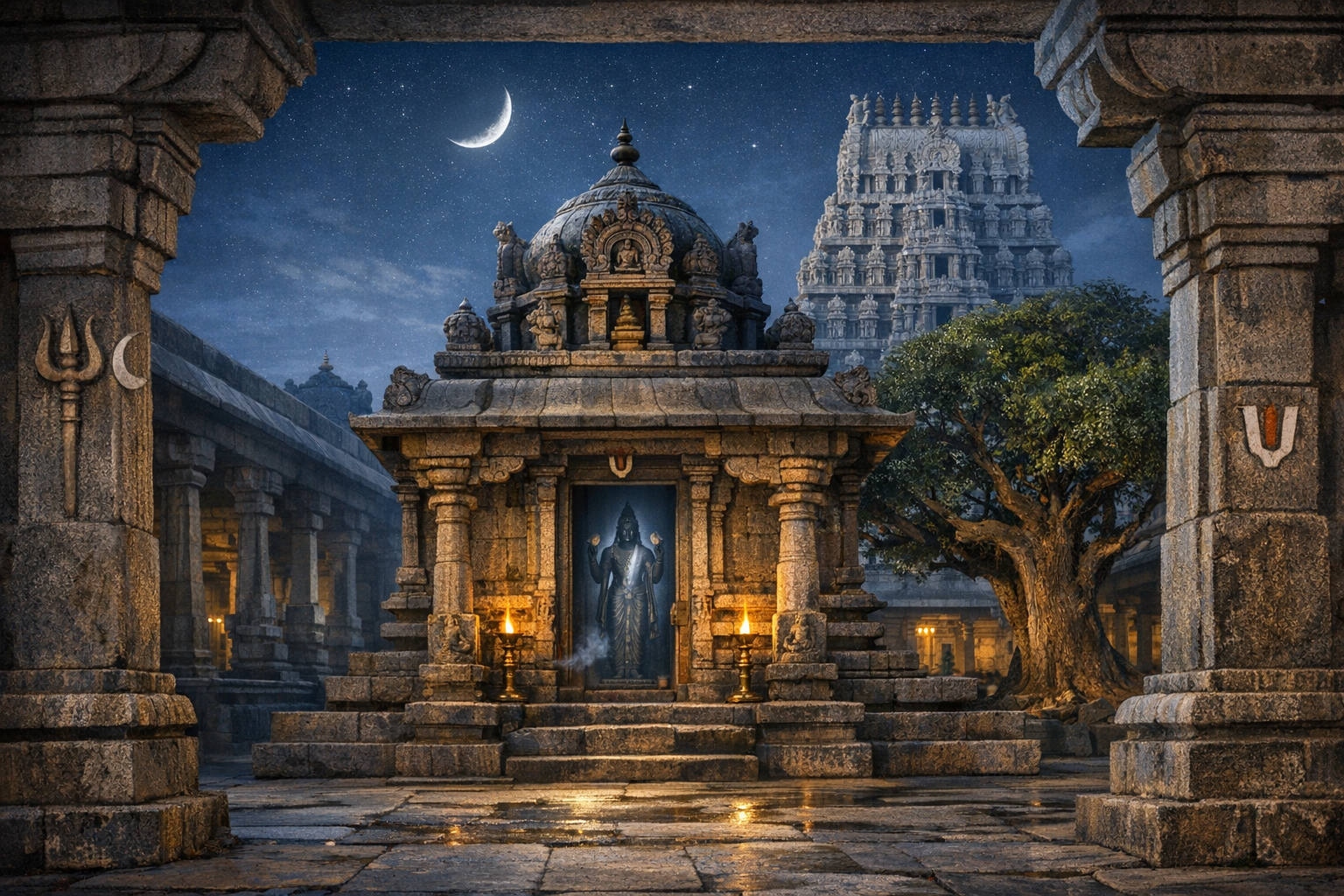
Iconographically, Nilathingal Thundam Perumal is enshrined in a compact Dravidian sanctum (garbhagriha) integrated into the inner prakara of Ekambaranathar. Devotees commonly note the deity in a standing posture (sthana), holding shankha and chakra, radiating the serenity characteristic of Vaishnava murtis. Lakshmi is revered here as Nilamangai Thayar by local tradition, and together the divine pair communicates the site’s gentle, restorative characterconsistent with the moonlit healing embedded in the temple’s name.
Architecturally, the shrine sits within an urban-temple complex whose macro-form was shaped across Pallava, Chola, and Vijayanagara interventions. Ekambaranathar’s towering raja-gopuram and vast mandapas speak to imperial patronage, while the embedded Perumal sannidhi exemplifies an additive, non-destructive approach to sacred space-making. Inscriptions from the medieval and early-modern eras, known elsewhere across Kanchipuram, document endowments to both Shaiva and Vaishnava institutionsevidence of a historical economy that supported multiple ritual publics within one sacred geography.
The ritual life of Nilathingal Thundam Perumal follows Vaishnava Agamic protocols, with daily puja cycles, recitation of Divya Prabandham, and observances such as Vaikunta Ekadashi. These layer over and alongside Ekambaranathar’s Shaiva festivalsmost notably Panguni Uttiramwithout mutual disruption. The effect, especially during festival seasons, is a living palimpsest: bells, veda-ghosham, tulasi and bilva fragrances, and the mingled mantra-streams of “Om Namo Narayanaya” and “Om Namah Shivaya.”
For students of religion and heritage, the site opens several interpretive avenues. First, it challenges simplistic sectarian readings: Nilathingal Thundam Perumal shows how shared precincts can nurture distinct identities while reinforcing common ethical grounddharma, ahimsa, and bhakti. Second, it provides a comparative axis with other shared sitessuch as Govindaraja Perumal within Chidambaramthus contributing to a broader cartography of sacred coexistence across South India.
Etymology and poetics are integral to understanding the shrine’s name. “Nila” and “Thingal” (moon) and “Thundam” (fragment/piece) intimate a soft, cooling light that restores equilibriumprecisely the theological work ascribed to Shiva’s moon-crown in Shaiva imagery and here extended to the healing of Vishnu. The epithet therefore encodes a doctrinal statement: grace (anugraha) transcends sectarian demarcations.
Visitor experience within Ekambaranathar Temple Kanchipuram often follows a meaningful circuit: entering beneath the Vijayanagara raja-gopuram, traversing pillared halls, and approaching the monumental Shiva linga before turning toward the Nilathingal Thundam Perumal sannidhi nestled along the inner prakara, near the venerable mango tree. The shift in spatial scalefrom monumental to intimatemirrors a movement from cosmic to contemplative. Many pilgrims describe a felt wholeness only upon paying respects at both shrines.
From a conservation standpoint, the temple exemplifies layered stewardship. Material conservation of stone, stucco, and timber coexists with intangible custodianshiparchaka lineages, ritual know-how, hymnody, and local oral histories. Sustained attention to both is essential to keep the complex’s Shaiva–Vaishnava ecology vibrant for future generations.
For scholars, Nilathingal Thundam Perumal rewards interdisciplinary approaches: epigraphy and art history clarify chronology; performance studies illuminate festival dramaturgy; textual study of the Divya Prabandham and Shaiva Agamas reveal the theological syntax of coexistence. The site thus functions as a living archive for understanding how Dharmic pluralism is practicednot merely proclaimed.
Practical notes for darshan enhance the visit. Temple hours in Kanchipuram generally follow morning and evening bands; schedules vary during utsavams, so verification on-site is prudent. Modest attire, observance of queue systems, and attentiveness to sanctum thresholds (do not cross drawn lines) are appreciated. Photography may be restricted near sancta; inquiry with temple staff avoids inadvertent breaches of decorum.
Beyond Hindu intra-tradition resonance, the shrine’s gentle thesishealing, reciprocity, and respectechoes across the dharmic constellation. Buddhism’s karuna, Jainism’s ahimsa, and Sikhism’s seva each affirm that spiritual life matures through inner refinement and service. In this light, Nilathingal Thundam Perumal can be read not only as a Vaishnava jewel within a Shaiva crown, but as a shared civilizational meditation on unity amidst diversity.
As a Kanchipuram Vishnu Temple recognized among the 108 Divya Desams, Nilathingal Thundam Perumal inside Ekambaranathar endures as a touchstone for seekers, historians, and architects alike. Its moonlit legend, graceful iconography, and integrated ritual calendars offer a rare, tangible grammar for coexistencetimely for contemporary conversations about pluralism and timeless as a pathway to inner peace.
Inspired by this post on Hindu Blog.