Krodha Bhairava stands as a formidable form of Bhairava, the awe-inspiring and protective manifestation of Shiva venerated in Shaiva and Tantric lineages. Within the ashtashta bhairavasthe sixty-four Bhairavas arranged in eight groupsKrodha Bhairava is widely recognized as the leader of the fourth circle. This position encodes both his cosmological role and his ritual agency: he concentrates energies of fierce protection (raudra), channels wrathful compassion toward the restoration of order (dharma), and serves as a threshold guardian between the sacred and the profane.
Across Shaiva Tantra, Bhairava embodies a paradox central to Hindu spirituality: the terrifying face of grace. That paradox is heightened in Krodha Bhairava, where wrath (krodha) is not a moral defect but an instrument of compassionate intervention. Devotees, artists, and temple communities often describe the experience of this image as simultaneously unsettling and reassuringan encounter designed to awaken vigilance, dispel fear, and assert the inviolability of sacred boundaries.
The sixty-four Bhairavas are commonly presented in eight circles (or sets), each circle presided over by one of the Ashta Bhairavas. In numerous textual and liturgical traditions, Krodha Bhairava presides over the fourth set. Such grouping is not merely enumerative; it supports temple architecture, festival ordering, and mantra-paddhati sequences in which each circle modulates a specific spectrum of energies from benign to intensely transformative.
In directional mappings used by several Agamic and paddhati traditions, Krodha Bhairava is frequently associated with the southwest quadrant, a liminal direction linked to boundary-keeping and ancestral memory. While regional lineages vary on directional attributions, the thematic core remains stable: Krodha Bhairava governs thresholds and transition zones where vigilance, clarity, and decisive protection are most needed.
Key textual anchors for Bhairava iconography arise from the Agamas and Shilpa Shastras, supplemented by Puranic echoes (for example, in the Skanda Purana) and regional sthala-purana traditions. The Kamika and Suprabheda Agamas, together with manuals such as the Mayamata and Manasara, inform artists and priests on pratimā-lakṣaṇa (iconometric canons), mudra, āyudha (weapons), vāhana, and consecration protocols. These sources converge on a consistent grammar of the fierce (ugra) form, while allowing for significant local idioms.
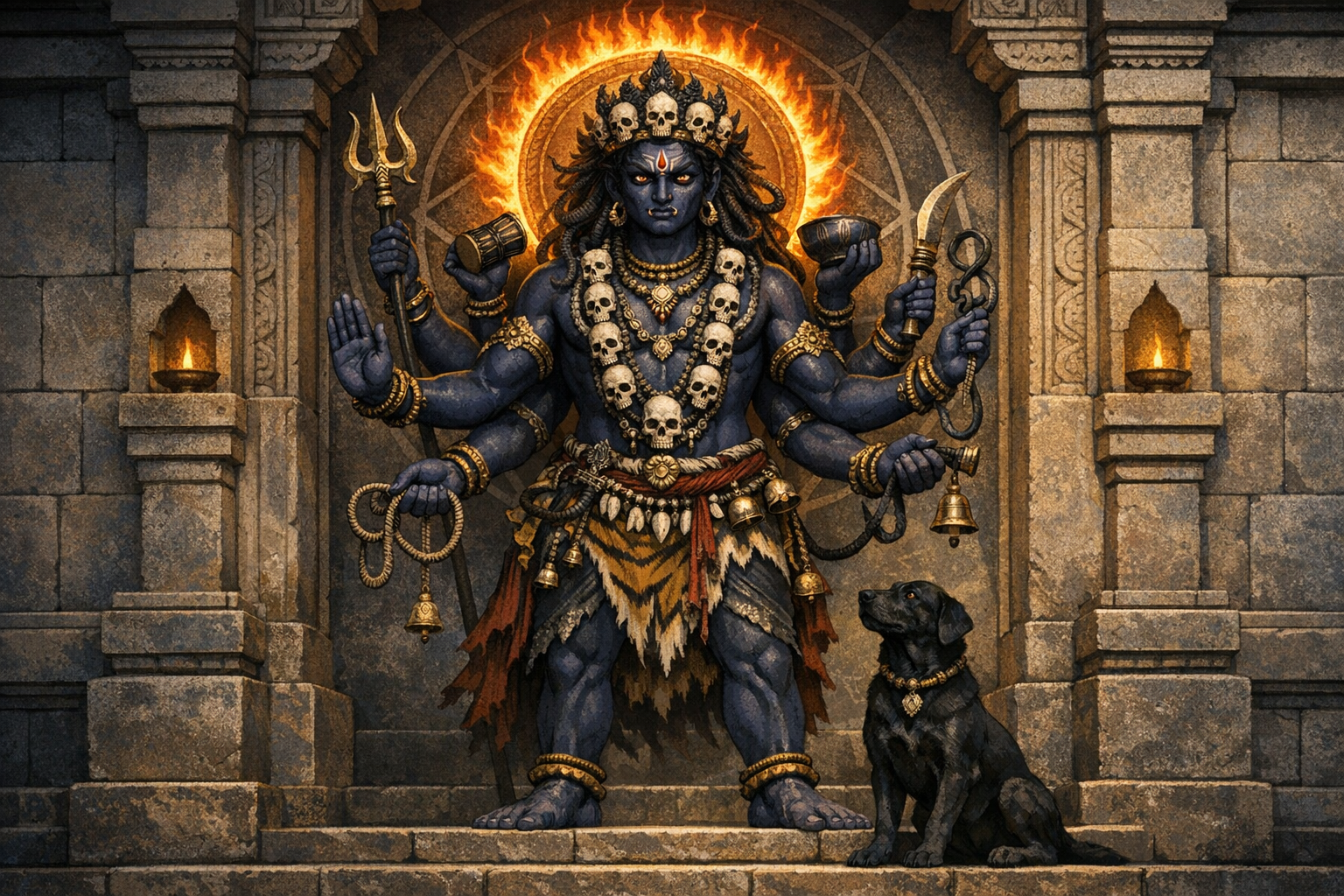
As an ugra-tattva, Krodha Bhairava’s visage is meant to be arresting. The complexion is most often depicted as coal-black or deep indigo, occasionally with a ruddy or fiery undertone. Three blazing eyes signal omniscience and time-transcendence; the gaze is intensified, with pupils accentuated to convey unblinking awareness. Eyebrows are arched; the mouth shows slightly protruding fangs, and the lips may be parted to suggest mantra-syllables released into the cremation-ground wind.
The hair is shown as a wild jata-bhara or a jatamukuta, sometimes interlaced with serpents or crowned with a kapāla-frieze. The crown can be skeletal (munda) or five-crested, referencing sovereignty over the five elements and five streams of cognition. A luminous prabhāmaṇḍala or prabhāvali often encircles the head, its tongues of flame articulating radiance that burns through ignorance.
Krodha Bhairava wears the iconic munda-māla (garland of skulls) and bone ornaments (aṣṭhi-bhūṣaṇa) that affirm sovereignty over mortality and rebirth. Serpents coil as yajnopavita and armlets; anklets, bracelets, and girdles can be rendered in bronze or stone with a deliberately austere finish. The torso is typically ash-smeared, evoking the cremation ground (śmaśāna) as the field of ultimate truth.
Attire frequently includes a tiger-skin waistcloth, with the claws and tail stylized to accentuate rhythmic movement of the stance. In some bronzes, a short kilt with beadwork is used, especially in South Indian idioms. The somatic modeling should convey tensile energy rather than bulk, making evident the immediacy of protective response.
Postures vary by lineage and period. Common stances include pratyālīḍha or ālīḍha (dynamic warrior postures) and utkutikāsana (squatting with one knee raised), each signalling readiness and grounded power. Dancing variants appear in regions where Bhairava participates in tāṇḍava cycles; here, the torsion of hips and shoulders should be tightly coordinated to the drum rhythm encoded in the composition.
The number of arms is not absolutely fixed. Four-armed images are frequent in stone, while eight- or ten-armed bronzes appear in Tantric settings. A representative array of āyudhas includes triśūla, khaḍga, ḍamaru, kapāla, pāśa, aṅkuśa, ghantā, and agni. Gestures such as abhaya and varada may be present even in fierce forms, quietly asserting refuge and boons alongside terror’s corrective power.
The vāhana is most commonly the śvan (dog), either standing alert or seated with raised head, reinforcing Bhairava’s role as kṣetrapāla (guardian of the precinct). The dog embodies loyalty, liminality, and nocturnal vigilance; in sculptural programs it also signals the continuity between the deity’s protection and the community’s moral watchfulness. Attendant bhūtas and yoginīs may flank the image in temple or processional contexts, their gestures amplifying the central figure’s command.
Pedestals frequently carry cremation-ground motifsfunerary pyres, jackals, or skeletal florarendered symbolically rather than naturalistically. Backplates display a ring of flames, often segmented to choreograph light-and-shadow movement as oil lamps flicker at twilight. The overall result is a visual mandala in which the devotee stands momentarily at the axis of dissolution and awakening.
Shilpa Shastra proportioning (tāla, aṅgula) remains crucial. Fierce faces require calibrated exaggeration: widened eyes, sharpened canines, and muscular jawlines must be balanced so that power does not collapse into caricature. In bronze (pañcaloha) casting, thin walls around the abdomen and shoulders can preserve kinetic lightness; in basalt or schist, crisp undercutting in the ornaments prevents visual heaviness from overpowering the expression.
Within temple architecture, Bhairava shrines often anchor liminal locationsnear gopura thresholds, in corner shrines along the prākāra, or in spaces associated with night vigils. While Kala Bhairava is the most ubiquitous kṣetrapāla in many regions, Krodha Bhairava receives dedicated attention in lineages where the sixty-four Bhairava mandala is ritually active. Processional routes on Bhairava Aṣṭamī may include a pause before Krodha Bhairava, underscoring the fourth circle’s role in the ritual arc.
Ritual life centers on abhiṣeka, dīpa offerings, and mantra-japa. Traditional paddhatis prescribe sesame or mustard oil lamps, black til, and certain seasonal flowers. Feeding and protecting dogs is encouraged in many communities as an ethical extension of Bhairava’s guardianship. Even in fierce worship, the underlying orientation is restorative: obstacles are burnt away so that clarity and right action can flourish.
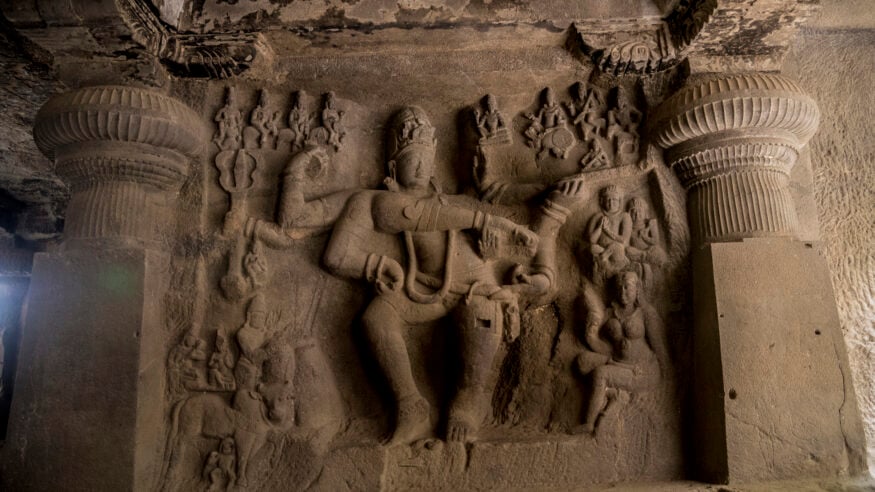
Regional idioms enrich the core grammar. Nepalese Bhairab masks amplify ocular intensity and flaming aureoles; South Indian Chola-period bronzes favor taut musculature and rhythmic drapery; eastern Indian stone idioms work with dense, textural backgrounds to heighten the deity’s emergence from the śmaśāna field. Each school remains faithful to Agamic principles while cultivating distinctive visual poetics.
Conservation and ritual care require sensitivity to both material and meaning. Stone icons benefit from gentle cleaning that preserves chisel crispness; bronzes acquire devotional patina that should not be stripped. Ritual abhiṣeka with pañcāmṛta, followed by careful drying and oiling, sustains both the icon’s longevity and the community’s tactile relationship to the deity.
For museum visitors, devotees, and students of Temple Architecture alike, reading a Krodha Bhairava image becomes an exercise in layered attention. First register the stance and gaze; then let the hands, weapons, and ornaments guide interpretation. Finally, notice the vāhana and base motifs: they complete the narrative of boundary-keeping, ethical vigilance, and swift protection that defines this form’s place within the Sixty-Four Bhairavas.
This iconography also resonates across dharmic traditions in meaningful, unifying ways. In Vajrayāna Buddhism, wrathful protectors such as Mahākāla channel compassion through fierce form; in Jain traditions, kṣetrapālas and certain yakṣa-yakṣī figures embody vigilant guardianship of the sacred; in Sikh thought, the valorous force of bir ras affirms righteous protection of the just. These convergences affirm a shared civilizational intuition: fierce imagery can serve love, truth, and communal well-being.
As a guardian of thresholdsritual, ethical, and architecturalKrodha Bhairava’s image speaks to contemporary concerns with clarity. It reminds communities that protection and compassion are not adversaries but partners: one clears the way; the other fills the path with purpose. For artists and iconographers, the form offers a disciplined grammar through which power can be shown without sensationalism. For devotees, it offers refuge and resolve.
Situated as the leader of the fourth circle, Krodha Bhairava integrates the metaphysics of Shaiva Tantra with the craft of Hindu sculptures, shaping how temples choreograph space, time, and emotion. The result is an image that is technically exacting, ritually potent, and spiritually unifyinga living testament to the breadth of Hindu iconography and its deep kinship with the wider family of dharmic traditions.
Inspired by this post on Hindu Blog.