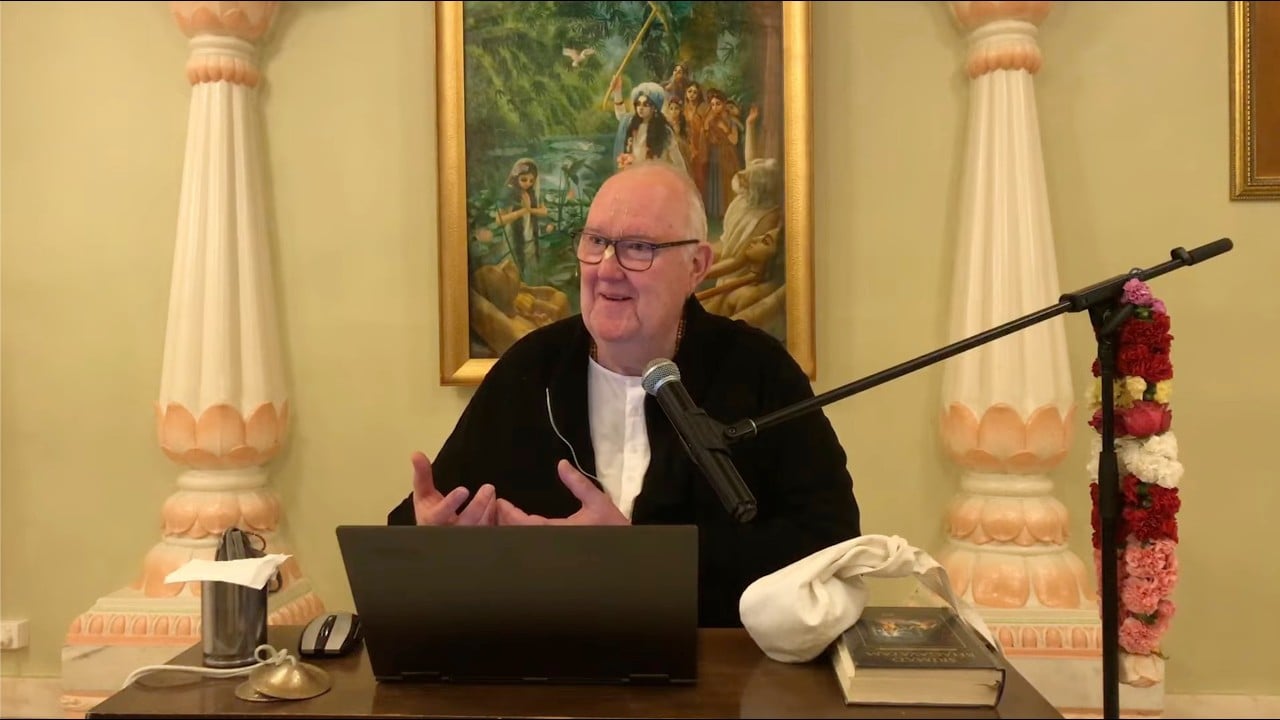
On 30 May 2026, the Śrīmad Bhāgavatam morning class at Hare Krishna Melbourne examined SB 10.6.22–23 under the guidance of HG Bhakta Prabhu. Situated within the celebrated Pūtanā episode of the Bhagavata Purana, these verses illuminate how Vraja responds to crisis, how divine protection operates amid danger, and how communal rites restore sanctity in the aftermath of a sudden existential shock. The session unfolded with the measured clarity of a traditional śāstric exposition while remaining closely attuned to the lived realities of contemporary practice.
Verses 22–23 occur immediately after the deceiver Pūtanā is unmasked and falls, returning Gokula from apparent serenity to collective alarm. The narrative foregrounds the community’s rush to safeguard the infant Kṛṣṇa and to stabilize a shaken sacred order. While the later verses of the chapter detail elaborate purification procedures, 10.6.22–23 fix the lens on the threshold moment between calamity and restorationon the ethical and ritual reflexes of a society formed by dharma and nourished by bhakti.
Three interlocking themes frame the discussion. First is divine rakṣaṇa (protection): Kṛṣṇa’s presence neutralizes peril without diminishing the agency and responsibility of the community. Second is vatsalya (the maternal and communal tenderness that envelops the child), which becomes a theological lens for understanding the reach of compassion in Vraja. Third is śuddhi (purification), a set of rites and sensibilities that transforms polluted space back into a field of grace. HG Bhakta Prabhu’s treatment wove these strands into a coherent theological grammar.
From a literary standpoint, SB 10.6 employs a dramatic arc: intrusion, revelation, collapse, communal response, and reintegration. Verses 22–23 concentrate on the pivot where fear gives way to coordinated action. The gopīs, elders, and cowherds emerge not as passive onlookers to a miracle but as ritual custodians who steward place, body, and memory back to equilibrium. This narrative economy underscores the Bhāgavata’s larger method: divine intervention does not abolish human responsibility; it clarifies and elevates it.
The commentarial tradition enriches these verses. Śrīla Prabhupāda’s purports to this chapter consistently highlight that the Supreme’s protection does not negate the appropriateness of rakṣoghna (protective) mantras, vrata, and śuddhi-karma; rather, such practices are harmonious expressions of devotion aligned with the Lord’s will. Jīva Gosvāmī, in Krama-sandarbha, and Viśvanātha Cakravartī Ṭhākura, in Sārārtha-darśinī, elucidate how communal care in Vraja functions as a theologically charged pedagogy: love acts, organizes, remembers, and ritually heals.
Ritual detailthough described more fully in subsequent versesforms the conceptual horizon of 10.6.22–23. Vedic domestic codes (Gṛhya Sūtras) and Vaiṣṇava praxis often prescribe pañcagavya, sacred ash, go-rāja (the dust of cows), and mantras as agents of purification. Beyond symbolism, these rites encode a sophisticated ecology of sanctity that links person, land, animal, and community under a single dharmic canopy. In the Bhāgavata’s moral universe, purity is neither merely hygienic nor merely legalistic; it is relational and devotional, restoring right relationships among beings and with the Divine.
Ethically, the Pūtanā narrativeinto which 10.6.22–23 are carefully setculminates in a startling claim developed later in the chapter: even a hostile intruder, by tangential motherly contact with Kṛṣṇa, receives an unexpected benediction. Read against the communal response in these verses, the point is not to romanticize harm but to magnify the reach of grace. The community still acts decisively to protect life and to purify space; divine compassion expands the moral horizon without suspending justice or prudence.
Psychologically, the transition captured in 10.6.22–23 may be read allegorically as the moment when inner toxins are named and faced. Calamity often unmasks hidden poisonsfear, pride, and negligence. The Bhāgavata’s pedagogy insists on a double movement: confidence in divine rakṣaṇa and disciplined participation in śuddhi. The text thus refuses both fatalism and self-reliance absolutized; it cultivates courageous dependence and responsible agency.
Comparative dharmic perspectives enhance this reading and affirm a unitive vision that honors Hinduism, Buddhism, Jainism, and Sikhism. The ethic of protection in Vraja resonates with Sikh daya and seva, where safeguarding the vulnerable is integral to spiritual maturity. The Bhāgavata’s radical compassion toward even an offender mirrors Buddhist karuṇā and mettā, which recognize the possibility of transformation beyond present conduct. The ritual and ethical emphasis on non-harm and purification harmonizes with Jain ahimsa and internal tapas, while the plurality of valid practices reflects anekāntavāda’s many-sided truth. In each tradition, community, compassion, and disciplined practice converge toward liberation-oriented living.
Practically, the class underscored four disciplines that the Bhāgavata cultivates: svādhyāya (serious study of śāstra), nāma-kīrtana (sound-centered remembrance), seva (service that safeguards persons and places), and saṅga (community coherence). The morning setting fosters sattva, steadies attention, and habituates the mind to receive śāstra as pramāṇa (reliable knowledge) guiding thought and conduct. While miracles punctuate the narrative, daily disciplines consolidate their meaning.
Historically, the Vraja community’s immediate response exemplifies a resilient social architecture: elders lead, mothers encircle, and the entire settlement reasserts dharma through swift, codified action. Such choreography is not incidental; it is the fruit of a culture where tradition is remembered, taught, and enacted. The Bhāgavata thereby functions as both scripture and social blueprint, offering templates for crisis response that are ethically sound and ritually intelligent.
For students of the Bhagavata Purana, SB 10.6.22–23 thus serves as a precision lens: it tightens focus on the liminal seconds when fear begins to become faith-formed action. Read with the rest of the chapter, these verses chart a movement from shock, to safeguarding, to sanctification, and finally to theological wonder at compassion’s reach. The session at Hare Krishna Melbourne made this movement legible, connecting the text’s ancient dramaturgy with contemporary life-worlds.
Ultimately, the class affirmed a unifying axiom of dharmic civilization: true spiritual communities protect life, purify space, and expand compassionwithout collapsing discernment. The Śrīmad Bhāgavatam presents this not as sectarian triumphalism but as a human vocation. Approached in this spirit, SB 10.6.22–23 does more than recount a crisis; it trains vision and character for crises yet to come, inviting all dharmic paths to stand together for protection, purity, and peace.
Inspired by this post on Dandavats.