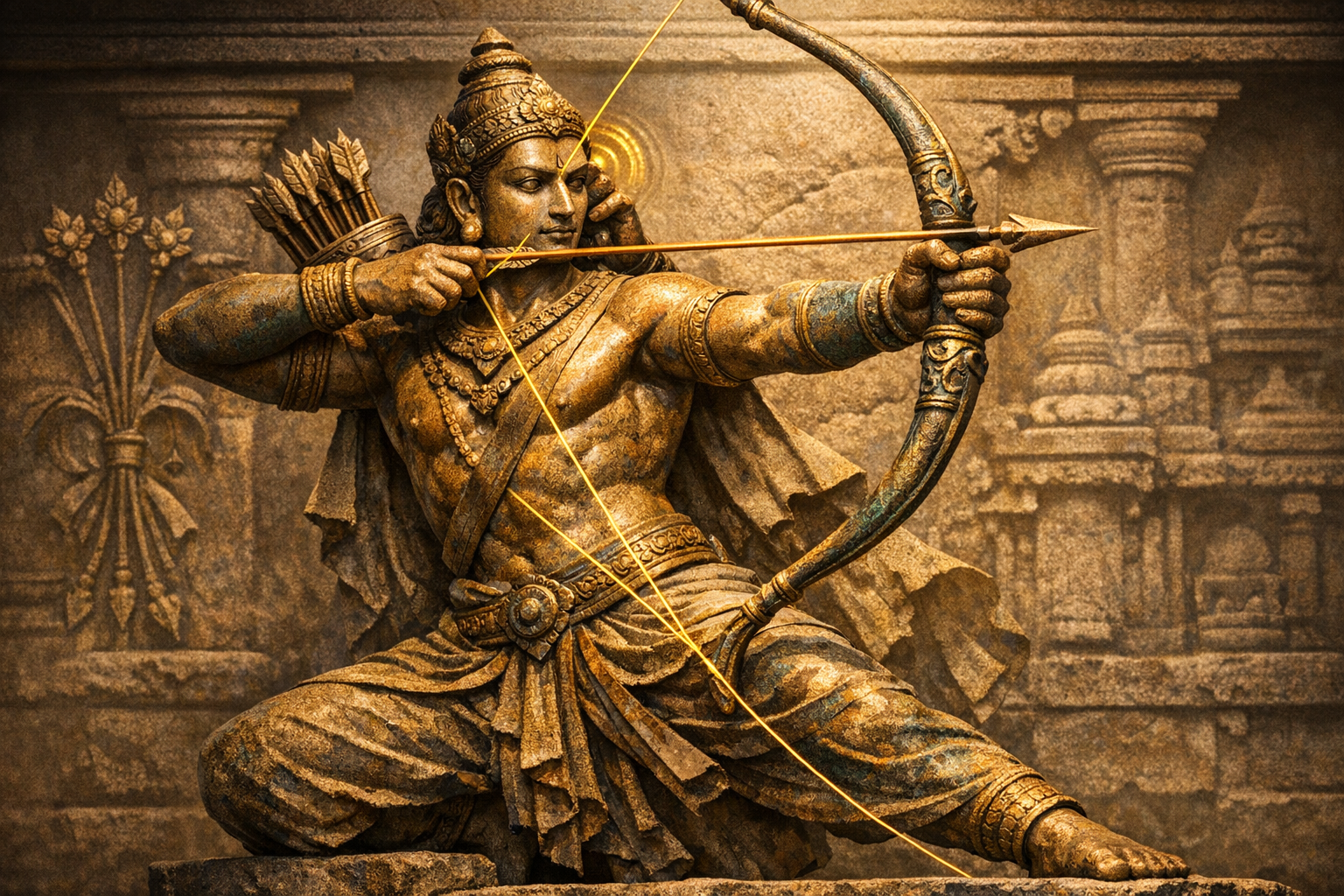
Akarṇa Mudrā in Hindu iconography condenses the energy of readiness, focused intent, and sacred agency into a single, compelling moment: the archer’s draw. Etymologically, ā-karṇa“toward the ear”names the precise phase in which the string is pulled back to the ear, the eye aligns with the arrow’s tip, and purpose is held in stillness before release. Sculptors across the subcontinent captured this liminal instant to communicate not only martial skill but also ethical resolve (dharma), one-pointed awareness (ekāgratā), and poised action (kriyā-śakti). In temples, bronzes, and reliefs, the gesture functions as a visual sutra that connects embodied discipline to the pursuit of a righteous aim.
Although often described colloquially as a “mudrā,” Akarṇa in sculptural practice is a composite gesture integrating hand positions, torso twist, and stance. It synthesizes the archer’s manual configuration (hasta), the dynamic stance known from performance treatises (e.g., ālīḍha and pratyālīḍha), and narrative context (who holds the bow, what bow it is, and which episode is implied). In this way, Akarṇa operates as a full-body iconographic code rather than as an isolated hand sign, allowing viewers to decode intention and character from posture alone.
Viewed closely, Akarṇa Mudrā is marked by a consistent visual grammar. The bow-holding hand stabilizes the arc before the torso; the drawing handoften the right in Indic conventionhooks and retracts the string to the ear, compressing the shoulder girdle and subtly rotating the chest. The face or gaze tracks the arrow’s line of flight, while the lower body settles into an ālīḍha-like stance: one knee flexed, weight grounded, hips angled to absorb recoil. Even where metal bowstrings have been lost to time, the geometry of intent remains legible through the angles of wrists, clavicles, and hips.
The semantic power of Akarṇa arises from this poised instant, a threshold between potential and kinetic action. Sculptors favored the “held breath” before release because it reveals consciousness at workekāgratā made visible. In aesthetic terms (rasa), the gesture primarily evokes vīra (heroic energy), but can modulate into raudra (fierce) when deployed in cosmic or demon-subduing contexts, and into śānta (tranquil resolve) when the bow-bearing figure is a dharmic exemplar acting in measured restraint.
Classical image-making manuals (śilpa-śāstras) emphasize pramāṇa (proportion), śarīra-lakṣaṇa (anatomical markers), and bhāva (expressive tenor) to fix such gestures with precision. While terminology varies across texts, the archery draw harmonizes principles from the Nāṭya Śāstra and allied abhinaya treatiseswhere ālīḍha/pratyālīḍha stances and hand positions such as śikhara, tripatāka, and kaṭaka-mukha code the mechanics of grasping, notching, and aiming. In sculptural practice, these codifications are adapted to structural constraints, narrative legibility, and the need for enduring forms in stone and bronze.
Deity identification within Akarṇa scenes is typically secured by the bow’s identity and ancillary attributes. Śiva’s Pināka, Viṣṇu’s Śārṅga, Rāma’s Kodaṇḍa, and Arjuna’s Gāṇḍīva are not mere props, but narrative vectors: each recasts the archer’s draw in a distinct theological register. Śiva as Tripurāntaka, for example, embodies cosmic rectification, the Akarṇa moment poised on a metaphysical axis between dissolution and renewal; Rāma’s Akarṇa aligns heroic action with dharma-yuddha, the rule-governed conduct of war; Arjuna’s Akarṇa is often read as disciplined skill in the service of difficult ethical choice.
Shakta iconography adds further nuance through the sugarcane bow (ikṣu-dhanuḥ). Devatās such as Lalitā Tripurasundarī and Kāmadeva hold or draw floral arrows, reframing Akarṇa as the aiming of subtle, attractive, or consciousness-transforming forces rather than lethal ordnance. This substitution of materials transforms the same geometric draw into a different doctrinal message: intent governs instrument, and the realized archer discriminates appropriate means (upāya) for the chosen aim (lakṣya).
Across the history of Hindu sculptures, Akarṇa proliferates in narrative panels and independent icons. Early reliefs at Buddhist and Hindu sites such as Sanchi and Deogarh (Gupta era) document archers in episodic storytelling; medieval South Indian temples under Pallava, Chola, Hoysala, and Kakatiya patronage elaborate the theme in high-relief battle friezes and bronze utsava-mūrtis. Odisha’s monumental programs, notably at Konark, parade archers in dynamic cavalcades, while Himalayan bronzes from the Malla period favor refined, tensile depictions of the poised draw.
Southeast Asian adaptations further attest to the motif’s reach and interpretive range. At Angkor Wat and related Khmer sites, Ramayana cycles teem with archers, and sculptors showcase the Akarṇa draw to choreograph massed action with legible lines of force across long friezes. The continuity of the archery draw’s visual grammar across geographies reflects a shared Indic performative vocabulary transmitted through pilgrimage, guild networks, and textual exchange.
Technical fidelity in Akarṇa depictions signals the sculptor’s grasp of Dhanurveda practice. The three-finger draw, shoulder depression on the drawing side, subtle counter-rotation of the pelvis, and the balancing vector in the planted footthese micro-gestures translate the physics of archery into stone. When bows and strings in metal were once affixed and later lost, holes, mortises, and quiver remnants often remain, allowing archaeologists and conservators to reconstruct the original Akarṇa configuration with reasonable confidence.
Museum contexts alter perception: under controlled lighting and without ritual ambiance, the archer’s draw can appear purely kinetic. Yet even in vitrines, viewers frequently report a felt sense of suspended time while contemplating an Akarṇa icon. That experiential pauseattention held, breath softenedmirrors the internal state the gesture signifies, making Akarṇa a pedagogical device that transmits praxis (how to aim attention) as much as it narrates myth.
The ā-karṇa phrase also hints at “hearing” (karṇa) as much as “toward the ear,” suggesting a hermeneutic pairing: to aim is also to listen. In dharmic praxis, action is ideally cued by inner discernment (buddhi) clarified by śravaṇa, manana, and nididhyāsana (hearing, reflection, assimilation). Akarṇa thus allegorizes ethical readiness: the string is drawn only after listening closely to conscience and context, a principle visible in the storied restraint of Rāma and the deliberative struggle of Arjuna.
The unity of dharmic traditions is legible in how the bow-and-draw motif encodes focused intent across Hinduism, Buddhism, Jainism, and Sikhism. Tibetan Buddhist depictions of Kurukullā, for example, show the goddess drawing a bow of flowers toward the ear, aiming transformative compassion rather than harman Akarṇa of non-violent subjugation of conflict. Sikh artistic memory, especially in frescoes and manuscripts celebrating the Khalsa ethos, frequently presents the poised archer as disciplined, ethical strength; and while Jain tīrthaṅkaras are non-weapon-bearing, associated yakṣa-yakṣiṇī and hero-stone (vīra-gal) traditions preserve the language of the archer’s stance to valorize protection of community and principle without glorifying wanton violence.
In performance, the same grammar of readiness traverses forms such as Bharatanatyam, Kathakali, and Chhau, where dancers employ ālīḍha-like stances and hastas (e.g., tripatāka for the arrow and śikhara for the string) to enact Ramayana and Mahabharata episodes. The theatre’s codified body becomes an interpretive key for sculpture, and sculpture, in turn, immortalizes the theatre’s fleeting gestures. This reciprocal loop between śilpa (image-making) and nāṭya (performance) is foundational to South Asian aesthetic systems.
Yoga disciplines echo the same insight in Akarṇa Dhanurāsana, where the practitioner draws the foot toward the ear like a bowstring, training balance, hip opening, and focused steadiness. While distinct from liturgical iconography, the asana’s somatic logicgathering energy, aligning gaze, stabilizing breathreplays the ethical dramaturgy of Akarṇa in the body’s present tense. Across ritual, art, and practice, the message is consistent: mastery couples attention with purpose.
Narrative specificity allows Akarṇa to be read at a glance. Quiver placement and arrow count can signal imminent action; the deity’s crown, hair treatment, and vahana refine identification; and the bow’s morphologycrescent for sugarcane, massive recurves for Pināka, elegant arcs for Kodaṇḍa or Śārṅgaanchors theological meaning. Contextual figures (e.g., Mārīca as golden deer, Lakṣmaṇa with protective vigilance, or demonic opponents) further tune the rasa of the draw from serene assurance to righteous ferocity.
Architecturally, temple designers choreographed the viewer’s encounter with Akarṇa. Placing archers along pradakṣiṇā paths stages a rhythmic alternation between blessing mudrās (abhaya, varada) and action gestures (Akarṇa), reminding devotees that compassion and courage are complementary limbs of dharma. On gopura bases and maṇḍapa friezes, serial archers build narrative tension, culminating near sanctum thresholds where inward listening culminates in vision.
Conservation has its own Akarṇa ethics: readiness without overreach. When replacing lost bowstrings or reattaching arrows, best practice privileges minimal intervention, reversible materials, and documentary clarity so that future scholarship can reassess earlier choices. Transparent mounts that suggest the original line of draw allow the public to intuit the gesture while preserving the integrity of the surviving sculpture.
For field identification, several cues are dependable even in fragmentary conditions. A raised forearm approaching the ear, a stabilized contralateral hand before the chest, angular hips, and a forward-weighted stance together strongly signal Akarṇa. Quiver stubs, arrow sockets, and mortise holes for a removed bow confirm the reading; when combined with iconographic attributes (e.g., matted locks and crescent moon for Śiva; royal coiffure and kiriṭa for Rāma; warrior diadem and chariot traces for Arjuna), identification becomes secure.
Ethically, Akarṇa dramatizes the doctrine that intent precedes impact. The drawn-but-unreleased arrow affirms that force must remain governed by discrimination (viveka). In this sense, the gesture is less about violence than about responsibility: it images the power to act, held in check by awareness, and released only in alignment with dharma. The unity of the dharmic family is precisely hereacross Hindu, Buddhist, Jain, and Sikh traditions, disciplined readiness is valued when yoked to compassion and justice.
Scholarly study of Akarṇa benefits from triangulating textual sources (śilpa, nāṭya, and dhanu texts), technical anatomy, and regional style history. Pallava and Chola ateliers, for example, favored tensile torsos and crisp clavicular lines that make the draw’s vector palpable; Hoysala carvers, with their penchant for filigreed ornament, thread the draw through lavish jewelry and textile motifs; Kalinga sculptors balance mass and motion on broad plinths to channel the draw’s momentum along extended friezes. Each school refines the same grammatical core in a distinct dialect of stone.
Emotionally, viewers often experience Akarṇa as a mirror-neuron script for composure. Standing before an Akarṇa icon, attention narrows and steadies, the shoulders settle, and breath naturally suspends at end-inhalea physiological echo of the sculpted archer’s inward poise. This resonance, repeatedly observed in galleries and temple corridors, is not incidental; it is the pedagogical design of Indic art to transmit embodied states through form.
When curating or teaching, presenting Akarṇa alongside blessing mudrās foregrounds a vital dharmic synthesis: courage without kindness becomes cruelty; kindness without courage becomes impotence. The two togetherabhaya/varada and Akarṇamap an ethics of protection rooted in care and competency, a theme deeply shared across the dharmic spectrum. Such juxtapositions cultivate both interfaith understanding and intra-dharmic unity by celebrating convergent virtues rather than sectarian difference.
In contemporary practice, artists and photographers have revived Akarṇa to explore focus and agency through new media. Dancers stage still photographs that freeze the exact millisecond of the draw, while sculptors in metal and mixed media extrapolate the absent bowstring as a luminous arc of light. These modern experiments reaffirm the gesture’s timeless grammar: the body’s alignment of awareness and will, committed to a chosen good.
Ultimately, Akarṇa Mudrā in Hindu sculptures is a visual doctrine of sacred resolve. It teaches that listening (karṇa) and aiming (lakṣya) must coincide; that strength becomes just only when bridled by attention; and that right action ripens in the stillness before release. Read in this wayand read together across Hindu, Buddhist, Jain, and Sikh contextsthe poised draw becomes a shared emblem of disciplined compassion and ethical power.
Inspired by this post on Hindu Blog.