Hindu temple architecture is a deliberate science of sacred space. Within this living tradition, the placement of the Navagrahas occupies a pivotal role, aligning the embodied journey of devotees with the celestial choreography of time. More than a set of auxiliary icons, the Navagraha mandala is a spatial and symbolic interface that translates the rhythms of Surya, Chandra, Mangala, Budha, Guru, Shukra, Shani, Rahu, and Ketu into an architectural language of order, balance, and ethical orientation.
The Navagrahas are the nine planetary deities known across the Indic world through Jyotiṣa, Purāṇic lore, and temple ritual. In temples, their presence complements the Garbhagṛha, Maṇḍapa, and Prakāras by acknowledging cosmic causality alongside divine grace. As spatial markers of time and karma, the Navagrahas guide devotees in situating personal destinies within dharma, while ensuring that the temple complex mirrors the universe (Brahmāṇḍa) in miniature.
Indic traditions share a broad cosmological vocabulary that makes such planetary symbolism intelligible beyond sectarian lines. Hindu, Buddhist, and Jain sources have variously encoded planetary and calendrical principles in art and ritual; Sikh teachings honor the cosmic order while centering remembrance of Nām above astrology. The temple’s Navagraha space thus serves not as a sectarian boundary but as a cultural hinge, expressing a civilizational unity in diversity across dharmic pathways.
Textual guidance for Navagraha placement is drawn from the intertwined canons of Sthāpatya-śāstra and Āgama-śāstra, alongside the architectural treatises Mayamata and Mānasāra and the astral-literary insights of Varāhamihira’s Bṛhat Saṁhitā. Śaiva Āgamas (such as Kāmikāgama and Suprabhedāgama) and Vaiṣṇava traditions (Vaikhānasa and Pāñcarātra) inform regional practice. These sources set principles rather than one-size prescriptions, expecting the sthapati (architect) to reconcile cosmology, site conditions, and local paramparā.
The governing template is the Vāstu Puruṣa Maṇḍala, a geometric grid that maps cosmic intelligences onto the site. The Navagraha mandala, whether explicitly gridded or implied, participates in this geometry so that planetary deities are not decorative add-ons but functional nodes in the temple’s sacred circuitry. Their spatial logic reinforces the temple’s east–west solar axis and the circumambulatory experience of sacred time.
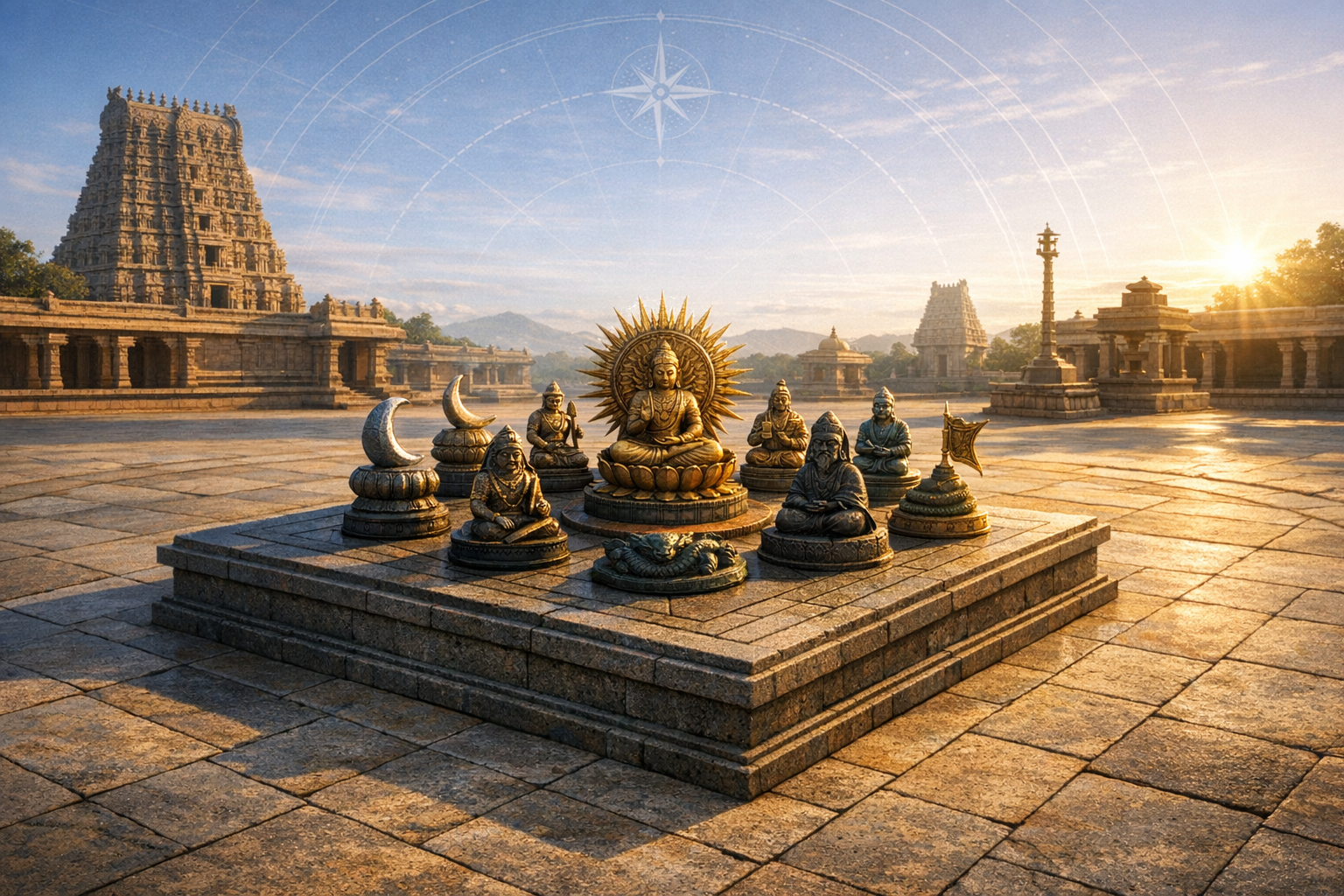
In most South Indian temples, the Navagrahas are housed in the outer prakāra for easy access without disturbing the sanctum’s core liturgical sequence. This siting respects hierarchynever competing with the mūla-vigrahawhile acknowledging the devotee’s practical need to perform graha-śānti and vratas before or after the main darśana. In some complexes, they occupy a distinct sub-shrine; in others, they rest upon a unified plinth in the open air.
Three arrangement archetypes are widely encountered. The first is a central mandala: Surya stands or sits at the center, surrounded by the remaining eight grahas in a circular or square array. The second is a linear prastāra, a measured row often placed along a prakāra wall. The third is a clustered corner layout within the outer precinct, used when circulation and sightlines require compactness. Each adheres to agamic priorities of access, hierarchy, and directional harmony.
Sequence typically follows the canonical orderSurya, Chandra, Mangala, Budha, Guru, Shukra, Shani, Rahu, Ketuechoing liturgical recitation and weekday associations. In the central mandala type, Surya anchors the composition; the other grahas are positioned around, with local traditions governing exact quadrantal placement. In the linear type, the order proceeds left-to-right from Surya, enabling an intuitive pradakṣiṇa and individual salutations.
Orientation reflects cosmological intent and practical viewing. Surya often faces east to greet the rising light, while the surrounding grahas are oriented so that devotees meet each gaze while circling the plinth. Regional paramparā regulate exceptions; what remains uniform is the principle that the arrangement supports unimpeded circumambulation, coherent symbolism, and the primacy of the main deity’s axis.
Iconographically, Surya is commonly depicted with full-bodied radiance and lotuses, Chandra with cool grace, Mangala with martial poise, Budha with youthful clarity, Guru with the serenity of a preceptor, Shukra with ascetic wisdom, Shani with austere gravity, Rahu with a serpent-inflected form above the torso, and Ketu with a serpent tail and a banner motif. While attributes vary in style, the ensemble balances complementary guṇasillumination and shadow, motion and restraintwithin a single sacred composition.
Material and finish subtly reinforce meaning. Shani’s image is often realized in darker stone to convey sobriety; Surya’s surfaces may invite light with polished planes; Chandra’s calmer tones complement a soothing presence. Scale is typically restrained to maintain humility before the sanctum, with plinth heights calibrated for safe pradakṣiṇa and offerings. The resulting tactile field invites both reverence and thoughtful movement.
Ritually, Navagraha worship integrates with the temple’s nitya (daily), naimittika (occasional), and kāmya (wish-fulfilling) practices. Graha-śānti, homas, japa, and annadāna linked to lunar days (tithis), weekdays, and eclipses are woven into the liturgical calendar without eclipsing the temple’s primary deity. The architecture supports this rhythm by providing clear approach paths, offering shelves, and drainage to protect sanctity and stone.
Devotees often begin at Surya and move through the sequence, concluding with Rahu and Ketu, before proceeding to the main sanctum. This embodied circuit is not mere custom; it rehearses a cosmology of responsibility, suggesting that karma is neither fatalistic nor arbitrary but intelligible and transformable through right orientation, prayerful effort, and ethical living.
From a design standpoint, the Navagraha zone performs important environmental work. Placement in ventilated precincts accommodates lamp heat and incense, while canopy decisions balance shade with the need for open sky during certain observances. Floor gradients preserve the sanctity of ablutions; sightlines avoid visual competition with the Dhvaja-stambha or Bali-pīṭha. In sum, sacred geometry is inseparable from sacred ergonomics.
Regional patterns show principled diversity. In Tamil Nadu, a raised plinth with Surya central and eight grahas around is common in Śaiva and Vaiṣṇava temples. In Karnataka and Andhra traditions, compact clusters appear near outer corridors to streamline festival flow. In Maharashtra, open-air ensembles are frequently integrated into courtyards. Odisha’s idiom, shaped by distinct Kalinga canons, often reserves tighter inner precincts for parivāra devatās, shifting Navagraha clusters outward. These are not contradictions but authentic adaptations of shared rules to local circumstances.
Agamic primacy ensures that the Navagraha complex never rivals the sanctum’s axis. Height, massing, and ornament are moderated; no vimāna rises above the mūla-sthāna. Where space is constrained, architects favor a single, well-proportioned plinth with clear circulation over scattered pedestals, maintaining ritual clarity and safety during crowded observances.
The geometric substructure is legible to trained eyes. Many complexes quietly index the nine to a 3×3 schema analogous to the Vāstu Puruṣa Maṇḍala, locating Surya in the bindu-like center and articulating the others across cardinal and inter-cardinal nodes. Even when the array appears circular, underlying right angles and measured arcs govern module sizes, offsets, and approach paths, preserving both symbolism and structural coherence.
Contemporary temple projectsincluding those in the diasporabenefit from reconciling canonical intent with modern codes. Non-slip stone, accessible ramps, and low-glare lighting respect present-day needs without diluting tradition. Wayfinding panels can present the Sanskrit namesSurya, Chandra, Mangala, Budha, Guru, Shukra, Shani, Rahu, Ketualong with succinct notes on meaning, enabling visitors of all backgrounds to understand the ensemble’s purpose.
Seen through a civilizational lens, the Navagraha ensemble is a point of contact among dharmic traditions rather than a line of division. Newar Buddhist art, for instance, preserves planetary iconography in toranas and ritual diagrams; Jain texts meticulously track calendrical and astral timings for vows; Sikh scripture speaks to cosmic order while directing seekers to transcendental remembrance. The shared acknowledgment of cosmic law, accompanied by diverse spiritual emphases, enriches the Indic tapestry and deepens mutual respect.
Common misunderstandings arise from mistaking flexibility for arbitrariness. While exact positions and facings vary by āgama and region, the constants are unmistakable: Surya’s centrality, the ninefold integrity of the set, secondary status to the presiding deity, and support for unbroken circumambulation. Where a shrine diverges from local custom, consultation with custodial scholars and sthapatis restores both orthodoxy and contextual wisdom.
For temple committees and conservation teams, a prudent approach begins by mapping the existing precinct to the Vāstu grid, confirming ritual circulation, verifying height hierarchies, and assessing environmental factors such as drainage and shade. Enhancements should privilege clarity over complexity, ensuring that the Navagraha mandala remains legible, safe, and theologically aligned. Educational signage that references Jyotiṣa and Sthāpatya principles strengthens continuity with textual canons.
Ultimately, positioning the Navagrahas in Hindu temple architecture is a study in sacred geometry, ritual ecology, and living tradition. The ensemble orients the devotee to time without surrendering to it, honors causality without capitulating to fatalism, and affirms that cosmic harmony is accessible through right relationof space to star, of human action to dharma, and of diverse dharmic paths to a shared civilizational horizon.
Inspired by this post on Hindu Blog.