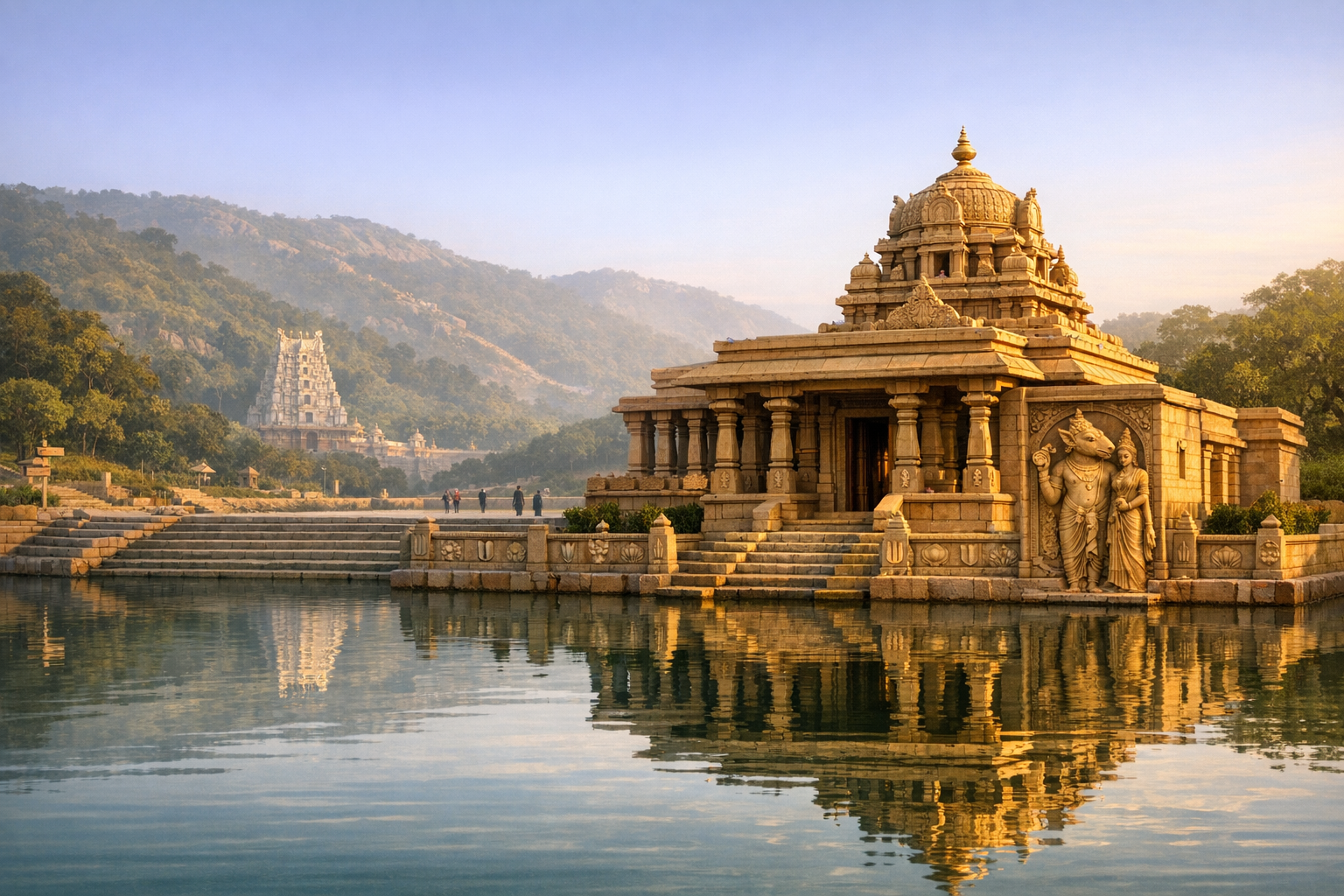
Sri Varahaswami Temple in Tirumala, Tirupati (Chittoor district, Andhra Pradesh) stands on the northern bank of Swami Pushkarini, just north of the Sri Venkateswara Temple. Revered as a primordial shrine within the sacred Tirumala complex, it anchors the ritual and narrative memory of the hill as Adi Varaha Kshetra and continues to shape the lived experience of Hindu pilgrimage in South India.
According to the Sthala Puranam, Tirumala was originally Adi Varaha Kshetra, sanctified by Sri Varaha, the Varaha (boar) avatara of Lord Vishnu who restored Bhūdevi (the Earth) from cosmic submergence. This narrative positions Varaha as the earliest divine resident of Venkatadri, making the site’s sacrality fundamentally Vaishnava while simultaneously expressing a pan-dharmic reverence for the Earth and all beings.
A widely cherished legend explains the ritual precedence accorded to Varaha in Tirumala: Varaha grants the hill to Srinivasa (Venkateswara) on the condition that Varaha receives first worship and a share of all offerings. In practice, many pilgrims honor this covenant by visiting Sri Varahaswami Temple before proceeding to the main sanctum of Sri Venkateswara Temple, a sequence that symbolically re-enacts the covenant and deepens theological continuity.
Textual attestations of this sacrality appear in the Venkatachala Mahatmya sections associated with the Varaha Purana and Padma Purana, where Tirumala’s sanctity is extolled as inseparable from Varaha’s presence. The Tamil Alvar hymns that celebrate Tiruvengadam further situate the hill in a devotional geography where Varaha’s protection and Sri Venkateswara’s grace are perceived as mutually reinforcing currents of the same Vaishnava stream.
Iconographically, Sri Varaha is typically represented in anthropomorphic form with a boar head and human body, often accompanied by Bhūdevi. The image emphasizes cosmic recovery and grounded guardianship: the conch (shankha) and discus (chakra) invoke Vishnu’s sovereignty, while the Varaha form highlights the rescue of Earth and the promise of stability. Local tradition venerates the deity as Sri Bhu Varaha Swami, underscoring the inseparability of the Lord and the Earth Goddess in the Tirumala landscape.
Architecturally, Sri Varahaswami Temple participates in the Dravida idiom characteristic of Tirumala’s sacred topography. The compact garbhagriha (sanctum), transitional antarala, and modest mandapa frame a focused darshan, while the temple’s adjacency to Swami Pushkarini integrates water symbolism with sacred space. The result is an immersive “temple-and-tank” ensemble in which ritual ablutions, recitations, and offerings flow naturally into contemplative viewing of the deity.
Daily worship follows standard Vaishnava upacharas—alankara (adornment), archana (mantra-based worship), and naivedya (food offerings)—along with periodic abhishekam in accordance with TTD protocols. While schedules may vary, the emphasis remains on simplicity, textual fidelity, and unbroken continuity, allowing pilgrims to experience the theological heart of Tirumala through a serene and relatively less crowded darshan at Sri Varahaswami Temple.
Festivals at Sri Varahaswami Temple include special observances on Varaha Jayanti, when the salvific role of the Varaha avatara is celebrated through heightened worship and scriptural recitations. During the broader temple festive calendar in Tirumala, Swami Pushkarini assumes ritual centrality, and the presence of Varaha—guardian of the kshetra and the tank—lends theological coherence to water-centered rites that symbolize renewal and collective purification.
The recommended pilgrimage sequence in Tirumala often begins at Swami Pushkarini. Where permitted and practical, pilgrims may perform a symbolic purification by the tank, then have darshan of Sri Varahaswami, and finally proceed to the main Sri Venkateswara Temple. This order encapsulates the sacred narrative arc—cosmic restoration (Varaha), guardianship of the kshetra (Pushkarini), and divine grace (Venkateswara)—in a single, integrated experience.
Swami Pushkarini is more than a temple tank; it is a theological mirror of the cosmos within the Tirumala precincts. Reverence for the water body entails careful conduct: maintaining cleanliness, following TTD instructions, and honoring shared space with quietude. The tank’s ritual ecology—its ability to gather, purify, and reflect—complements the introspective quality of darshan at Sri Varahaswami Temple.
Visitor information is best confirmed through Tirumala Tirupati Devasthanam (TTD) announcements, as darshan timings and access protocols can change due to festivals and crowd management. Traditional attire is encouraged, baggage is regulated for security, and photography is generally restricted within sanctified spaces. Early mornings and non-peak windows can offer a calmer devotional rhythm at Sri Varahaswami Temple.
Reaching the shrine is straightforward once at the Tirumala hilltop: the temple sits on the northern bank of Swami Pushkarini, close to established pilgrim pathways that are clearly marked by TTD signage. Those ascending by the Alipiri or Srivari Mettu footpaths often find that beginning the day near the Pushkarini—before entering the larger queues—provides an unhurried devotional cadence and frames the remainder of the pilgrimage with clarity and gratitude.
The conservation ethos in the precinct naturally extends to Sri Varahaswami Temple: pilgrims are encouraged to minimize plastic use, respect queue discipline, and preserve the sanctity of water edges around Swami Pushkarini. Such practices harmonize with the temple’s core narrative—Varaha’s protection of Earth—and transform individual devotion into collective custodianship of a living heritage site.
Across Hinduism, Buddhism, Jainism, and Sikhism, a shared respect for life, land, and ethical restraint resonates with the Varaha narrative’s affirmation of Earth. The maxim “Vasudhaiva Kutumbakam” finds contextual expression here: the temple’s devotional current invites all to perceive the Earth as kin, to act with ecological mindfulness, and to cultivate inter-traditional solidarity rooted in compassion and truth.
Culturally, Tirumala’s sacred music and literature—from temple recitations to compositions attributed to saint-poets such as Annamacharya—interlace Varaha’s guardianship with Srinivasa’s grace. The result is a continuous strand of devotion in which Sri Varahaswami Temple functions as prologue and principle, orienting both the ritual calendar and the emotional life of the devotee.
Pilgrimage etiquette reinforces this integrative vision: maintain silence in mandapas, avoid obstructing sanctum thresholds, offer naivedya through authorized channels, and give priority to elders and those with special needs. These small disciplines sustain a shared atmosphere of care that enables every pilgrim to encounter Sri Varahaswami with composure and reverence.
Observed over time, devotees and researchers alike note how the temple’s intimations of stillness complement the grandeur of the main sanctum. The proximity to water, the concise scale of the shrine, and the clarity of its narrative produce a contemplative balance: restoration precedes aspiration, guardianship accompanies grace, and the Earth’s well-being is felt as integral to spiritual progress.
In sum, Sri Varahaswami Temple offers an academically rich and experientially resonant entry into Tirumala’s sacred world. Rooted in the Varaha Purana and Padma Purana, embodied within a classic temple-and-tank ensemble, and enlivened by TTD’s living ritual order, the shrine affirms Adi Varaha Kshetra as the theological foundation of Tirumala. For the conscientious pilgrim, beginning here aligns devotion with narrative truth—and turns every subsequent step toward Sri Venkateswara into an act of remembered gratitude.
Inspired by this post on Hindu Pad.