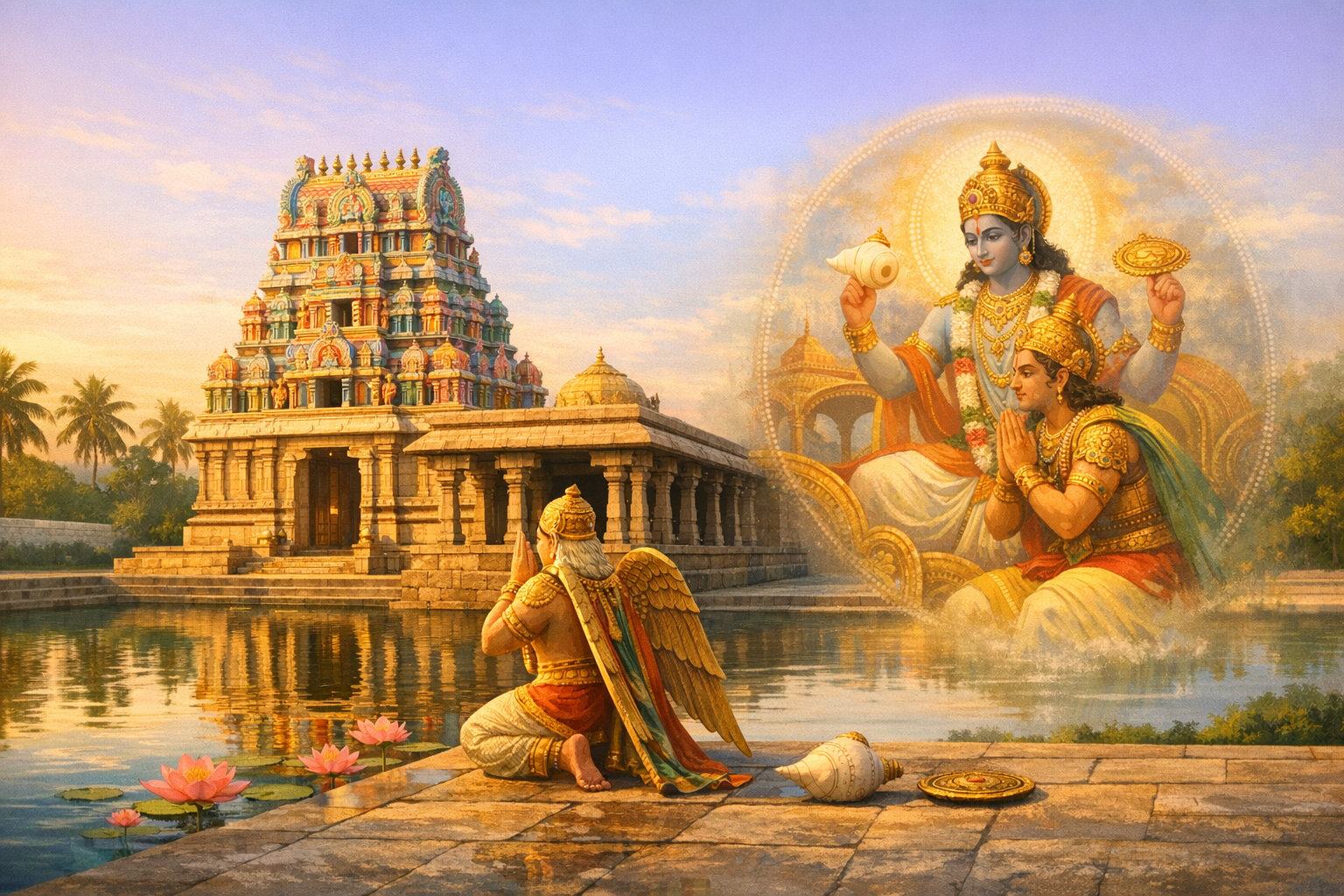
Among the eleven sacred Thirunangur Divya Desams of Tamil Nadu, the Parthan Palli Parthasarathy Perumal Temple holds a distinctive renown as a kshetra of divine instruction and spiritual awakening. Situated near Thiruvenkadu, the Budhan Sthalam, and approximately fifteen kilometers from Sirkazhi along the Poompuhar road, this Vaishnavite shrine preserves an enduring local memory: it is the place where Arjuna (Partha) received transformative, divinely guided knowledge from Sri Parthasarathy (Krishna as the charioteer). This legend frames the temple as a living classroom of dharma, where human confusion yields to insight under the compassionate guidance of the Divine.
The very toponymParthan Palliencodes the site’s identity. In classical Tamil usage, palli can signify a place of learning or instruction, and, here, it evokes a sanctified gurukula in which Arjuna’s doubts are resolved. By rooting the universal drama of inquiry and revelation in the Tamil sacred landscape, Parthan Palli demonstrates how the pan-Indian spiritual imagination continually localizes and renews timeless wisdom for pilgrims and practitioners.
In Vaishnava tradition, Parthasarathy represents Krishna’s compassionate role as charioteer and mentor, guiding Arjuna through moral perplexity to clarity of duty and devotion. While the Bhagavad Gita’s dialogue is classically situated at Kurukshetra, the sthala purana of Parthan Palli venerates the same eternal upadesa, celebrating the moment when knowledge dispels indecision. The temple thus invites reflection on the Gita’s core teachingskarma-yoga, bhakti, and the discernment of atmanthrough a distinctly Tamil temple idiom.
The Divya Desam status of Parthan Palli situates it within the luminous corpus of the Nalayira Divya Prabandham. The Thirunangur cluster is especially associated with Tirumangai Alvar, whose devotional hymns sanctified these kshetras for posterity. Recitation of the Divya Prabandham in the daily liturgy preserves the classical Tamil bhakti voice and binds contemporary worship to the Sri Vaishnava theological continuum that flourished across centuries in this region.
Architecturally, Parthan Palli reflects the intimate scale characteristic of several Thirunangur temples, with a garbhagriha for Parthasarathy Perumal, a shrine for the Divine Consort (Thayar), and a prakara that guides circumambulation and contemplation. The iconography of Parthasarathy commonly highlights conch and discus, and the presence of Garuda exemplifies Vaishnava symbolism of service and steadfast devotion. A temple tank in the vicinitytypical in the Cauvery delta’s temple-urbanismsupports ritual purity and seasonal festival observances.
The temple’s ritual life generally follows established Vaishnava Agamic traditions (Vaikhanasa or Pancharatra), with daily puja cycles, alankara, and naivedya integrated with Divya Prabandham chanting. Visitors often describe the ambience as contemplative and restorative: the measured cadence of mantras, the cadence of bells, and the fragrance of lamps collectively foster the inner poise needed for dharma-reflection. Pilgrims traveling from Thiruvenkadurenowned as Budhan Sthalamfrequently link astrological remedies with Vaishnava worship here, weaving together regional practices in a manner long characteristic of Tamil sacred geography.
Among the most celebrated events is the annual Thirunangur Garuda Sevai, traditionally held in the Tamil month of Thai. On this occasion, the utsavar images from the eleven Thirunangur Divya Desams assemble in magnificent pageantry, and Tirumangai Alvar’s pasurams for each kshetra are joyously recited. For many devotees, this is a profound lesson in unity-in-diversity: distinct temples and deities converge around a shared ocean of devotion, reinforcing the integrative spirit of the Sri Vaishnava sampradaya.
As a pilgrimage node, Parthan Palli benefits from the Sirkazhi–Poompuhar corridor, allowing practical itineraries that include Thiruvenkadu, the other Thirunangur Divya Desams, and coastal sites resonant with Sangam and medieval Vaishnava heritage. The compact geography enables sustained, reflective temple-going, aligning well with the contemplative ethos these shrines encourage. The journey itself often becomes a sadhana, teaching patience, attention, and gratitude.
Philosophically, the Parthan Palli narrative foregrounds conversations that resonate across the dharmic world. Arjuna’s inquiry and Krishna’s guidance mirror the dialogical quest found in the Upanishads, the Buddhist sutta tradition’s emphasis on investigating suffering and right action, Jain anekantavada’s insight into the many-sidedness of truth, and Sikh emphasis on the Guru’s liberating guidance through the Shabad. The shared commitment to ethical action, inner discipline, and compassionate wisdom underscores a civilizational kinshipunity of purpose expressed through diverse practicesthat this temple beautifully embodies.
For cultural historians, Parthan Palli illuminates how sacred memory, literary canon, and ritual practice cohere in the Cauvery delta. The Sri Vaishnava presence, Alvar poetry, and regional festivals articulate a living archive of Tamil religiosity and aesthetics. The shrine’s ongoing stewardship by local communities exemplifies how intangible heritagesongs, stories, and seasonal ritessustains the tangible edifice of temple culture.
Practical pilgrimage considerations are straightforward. Sirkazhi functions as a reliable base town, with road connectivity to Thiruvenkadu and the Thirunangur belt along the Poompuhar road. Travel outside the high-heat window eases temple rounds; modest dress and unhurried time for darshan deepen the experience. During Thai’s Garuda Sevai, crowds and devotional energy increase markedly, so arriving early and allocating generous time supports a more contemplative visit.
In sum, Parthan Palli Parthasarathy Perumal Temple is a luminous classroom of dharma in the Thirunangur constellation, where the memory of Arjuna’s instruction inspires continued study, practice, and service. Its lore, liturgy, and landscape together model how Sanatana Dharma transmits knowledge: through compassionate guidance, poetic revelation, and disciplined ritual. As a Thirunangur Divya Desam, it welcomes all seekers into a tradition that honors both the unity of truth and the diversity of paths that lead toward it.
Inspired by this post on Hindu Blog.