Kalyana Varada Shasta stands among the most auspicious and comparatively rare manifestations of Lord Ayyappa—revered across South India as Dharma Shasta and celebrated in theology as Hariharaputra, the son of Hari (Vishnu) and Hara (Shiva). In this ten-armed iconographic form, the deity is presented as the supreme protector and benevolent granter of prosperity, embodying both the serenity of a compassionate teacher and the vigilance of a guardian of dharma. The form’s very title—Kalyana Varada, the bestower of auspicious well-being—signals an emphasis on grace, stability, and the righteous flourishing of household and community life.
Etymologically, Shasta denotes the teacher or guide who upholds dharma. As Dharma Shasta, Lord Ayyappa integrates Shaiva and Vaishnava currents into a single, harmonizing presence, thereby affirming a civilizational principle foundational to the broader dharmic family: paths may differ, yet ethical intent and spiritual aspiration align in truth-seeking. This integrative vision resonates with kindred virtues across Hinduism, Buddhism, Jainism, and Sikhism—compassion, ahiṃsā, self-discipline, and seva—encouraging mutual respect and reinforcing the unity of purpose that undergirds diverse spiritual disciplines.
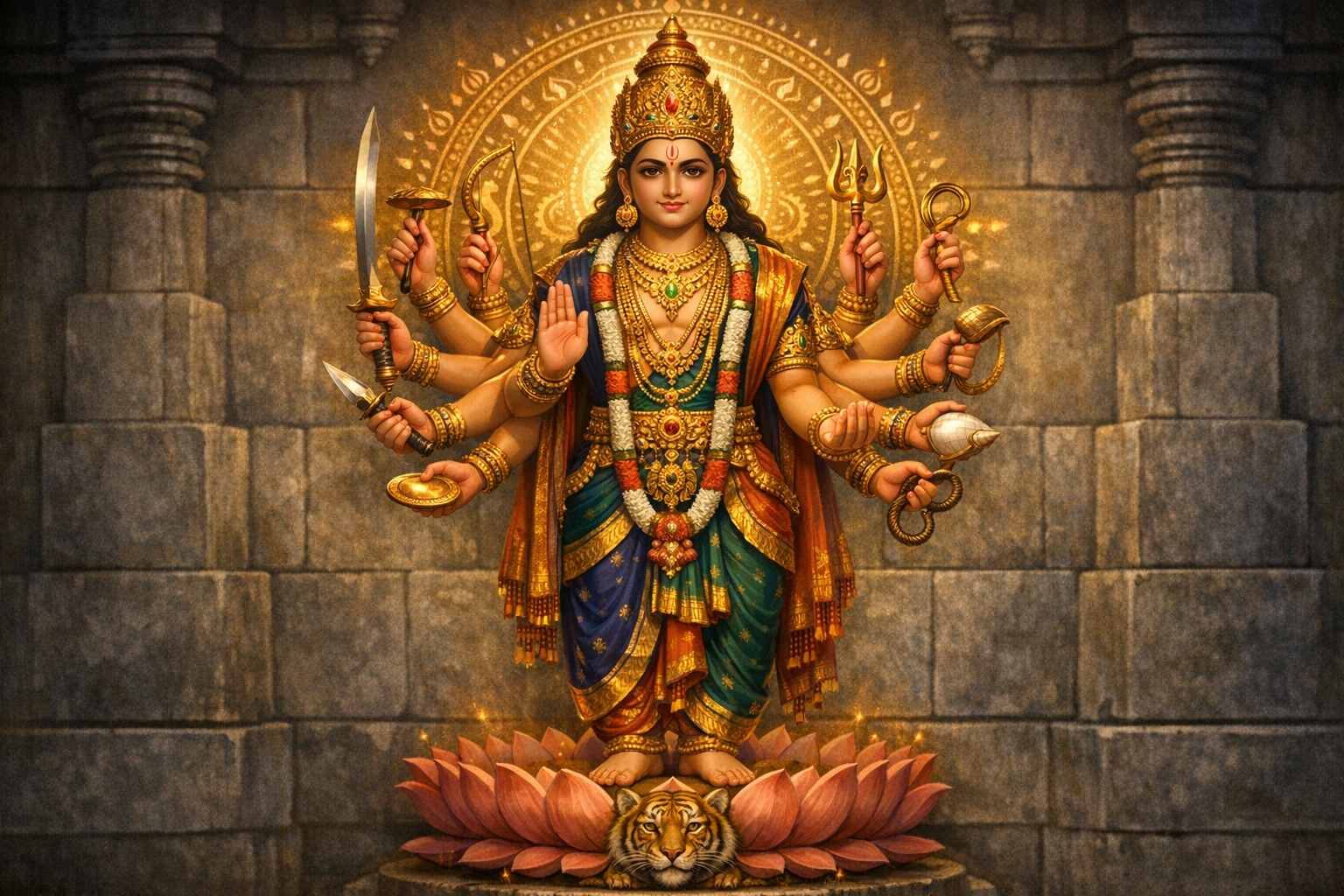
Iconographically, the ten-armed (daśa-bhuja) Kalyana Varada Shasta communicates a balanced synthesis of śānta (tranquil) and vīra (protector) rasas. The face is typically composed and benevolent, the gaze steady and compassionate. The body may be rendered in samabhanga (a poised, balanced stance) or seated in a dignified posture appropriate to royal ease, signaling effortless mastery over the senses and circumstances. The visual grammar concentrates on intelligibility: multiple hands indicate multiple capacities, while the calm visage reassures that these powers are employed in the service of dharma and the welfare of beings.
While regional and Agamic traditions vary, several attributes (āyudhas) recur in this form to convey both Ayyappa’s guardianship and his role as a bestower of felicity. Common combinations include the sword (khaḍga) and shield (kheṭaka), bow (dhanus) and arrow (bāṇa), trident (triśūla), noose (pāśa) and goad (aṅkuśa), conch (śaṅkha) and discus (cakra), and sometimes the thunderbolt (vajra) or drum (ḍamaru). The presence and precise selection of these attributes reflect local transmission lines—Kerala Tantram, Śaiva and Vaiṣṇava Āgamas, and regional śilpa traditions—underscoring how Dharma Shasta’s worship is both rigorously codified and culturally responsive.
Each attribute lends itself to a layered hermeneutic. The bow and arrow signify vigilance, focus, and swift protection of the righteous; the sword, sharpened by viveka (discrimination), severs ignorance; the shield represents sanctuary and moral courage; the noose binds wayward impulses and the goad directs the mind toward right effort; the trident points to mastery over the three guṇas (sattva, rajas, tamas) and time’s threefold divisions; the conch heralds the auspicious vibration of dharma; the discus, as the wheel of order, affirms cosmic law and the rectification of adharma. Together these emblems articulate an ethic wherein power is never detached from responsibility, and prosperity is inextricable from righteousness.
In Kalyana Varada Shasta, the hand-gestures (mudrās) are crucial to theological messaging. The right hand frequently displays abhaya (fearlessness), assuring refuge and safety, while another often shows varada (boon-bestowal), signaling the conferral of auspicious outcomes—health, harmony, and righteous prosperity. Remaining hands cradle the āyudhas with elegant clarity, usually distributed to achieve visual balance and to communicate that protection and grace are continuous, simultaneous functions of the same compassionate divinity.
The posture and proportioning follow śilpa-śāstra canons (tāla-māna), ensuring idealized symmetry and readability. Artists may choose a dignified seated pose upon a simhāsana (lion-throne) for stately benevolence, or a poised standing form for accessible immediacy. Ornaments such as the kirīṭa-makuṭa (crown), makara-kuṇḍala (ear ornaments), yajnopavīta (sacred thread), and uḍarīya (upper garment) are deployed to emphasize royal authority and moral sovereignty without distracting from the primary message of compassion and ethical guidance.
Vāhana depictions for Dharma Shasta vary by sthala-tradition. In many South Indian contexts, the tiger (vyāghra) is emblematic of fearless guardianship; elsewhere, iconographers prefer a dignified, unmounted presence that concentrates attention on the blessing and teaching functions. Attendant figures may include bhūta-gaṇas or devotees, but Kalyana Varada Shasta often retains a focused presentation that centers the worshipper’s encounter on fearless refuge and gracious benediction.
In several traditions, Dharma Shasta appears with the consorts Pūrṇa and Puṣkalā, especially in Tamil and Kerala iconographies related to Aiyanar/Ayyanar and Śāstā temples, connoting completeness (pūrṇatā) and abundance (puṣṭi, śrī). While the Sabarimala tradition venerates Ayyappa as a naiṣṭhika brahmacārī (strict celibate) in yogic posture, other sthalas emphasize the householding (gṛhastha) aspect of the same tattva through Kalyana Varada, underlining a crucial dharmic insight: a single truth can be expressed through multiple legitimate forms, each illuminating a distinct pathway—yogic discipline or auspicious household harmony—without contradiction.
Materially, Kalyana Varada Shasta sculpture and utsava-mūrtis are fashioned in stone or pancaloha (five-metal alloy), with finishing that preserves clarity of attributes and stability in ritual use. The prabhā-maṇḍala (aureole) often frames the deity, reinforcing the luminosity of compassion and strength. Iconographers pay careful attention to the articulation of each hand, the precise tilt of the head, and the composure of the torso, ensuring that viewers intuitively receive the dual assurance of protection and blessing.
Ritual life around Kalyana Varada Shasta reflects the form’s thematic emphasis. Abhiṣekam (ritual bathing), alaṅkāram (adornment), and archana (offering of names/mantras) foreground auspiciousness, especially in sankalpas related to harmonious unions, familial stability, ethical livelihoods, and community well-being. Devotees often narrate a felt sense of emotional steadiness during darśan: fear softens under the abhaya mudrā, while anxieties about livelihood, relationships, or health are reframed as opportunities for dharmic resolve under the varada promise of grace paired with right action.
Geographically, the Kalyana Varada form is encountered in select Śāstā/Ayyappa shrines across Kerala and Tamil Nadu, and in related guardianship cults where Ayyanar/Śāstā traditions interface with village protection and communal ethics. Liturgical lineages may draw from Kerala Tantram, Śaiva and Vaiṣṇava Āgamas, and local paddhatis, creating a richly layered but internally coherent ritual culture. In all cases, the pastoral and urban alike approach the daśa-bhuja icon as both sentinel and well-wisher—a visible assurance that prosperity is safest when secured by righteousness.
Textually, Dharma Shasta’s presence is remembered in Purāṇic references and later regional compendia, while guidelines for embodiment draw on śilpa treatises such as the Mānasāra and Śilparatna alongside temple manuals. While precise prescriptions vary by sampradāya, the governing principle is consistent: attributes and gestures must teach. In Kalyana Varada Shasta, teaching proceeds through the rhetoric of compassion wedded to principled strength, a combination whose familiarity is immediately legible to worshippers across the dharmic spectrum.
Comparison with other prominent Ayyappa modes clarifies the unique contribution of the Kalyana Varada aspect. The yogic Sabarimala form, still and inward-turned, instructs through renunciation, discipline, and inner silence. Vīra-oriented Śāstā images emphasize dynamic protection and boundary-keeping. Kalyana Varada occupies a complementary space: it affirms the moral beauty of stable, flourishing relationships and societies, extending the sanctuary of dharma from the ascetic’s cell to the household and the marketplace. The three, taken together, chart a whole-life pedagogy—renunciation, protection, and auspicious sustenance—appropriate to a civilization that honors many valid routes to the one goal of liberation-supported-by-duty.
From a civilizational perspective, Kalyana Varada Shasta illustrates an ethic shared across Hinduism, Buddhism, Jainism, and Sikhism: prosperity devoid of ethics corrodes; ethics sustained by compassion ennobles. Compassion (karuṇā), non-harm (ahiṃsā), truthfulness (satya), self-mastery (samyama), and service (seva) coil through the icon as meanings of the ten arms, where each implement reminds that enduring well-being emerges not from coercion but from inner discipline and mutual care. In interfaith and intrafaith contexts alike, such imagery encourages dialogue rooted in shared virtues rather than division.
Practically, the form speaks to householders, students, professionals, and public servants facing the frictions of daily life. The shield calls for safe spaces and moral courage; the sword of discernment urges clarity amid information overload; the conch rallies communities around ethical causes; the discus circles back to accountability; the noose and goad recollect personal vows; the bow and arrow consolidate attention on priority and timing; the trident steadies action in the crosswinds of temperament. Devotees often carry home this pedagogy as a lived sādhanā: disciplined work, compassionate relationships, and principled resilience.
In temple settings, darśan of Kalyana Varada Shasta benefits from mindful preparation: a simple sankalpa to align personal intent with dharma, a few moments of quiet breath regulation, and the inner articulation of gratitude. Observing local codes of conduct, supporting the temple’s preservation of heritage, and participating in community-oriented seva extend the deity’s blessing into collective life. Such practices translate iconography into social ethics and move grace from altar to action.
Ultimately, Kalyana Varada Shasta communicates a complete teaching in a single, elegant image: power held in compassion; prosperity grounded in responsibility; diversity gathered into unity. The ten-armed Lord Ayyappa—Dharma Shasta, Hariharaputra—responds to the needs of a complex world not by narrowing spiritual pathways but by dignifying them under a shared canopy of dharma. In venerating this benevolent form, communities reaffirm a living truth of the dharmic traditions: that the many hands of wisdom are, in essence, the one hand of care.
Inspired by this post on Hindu Blog.