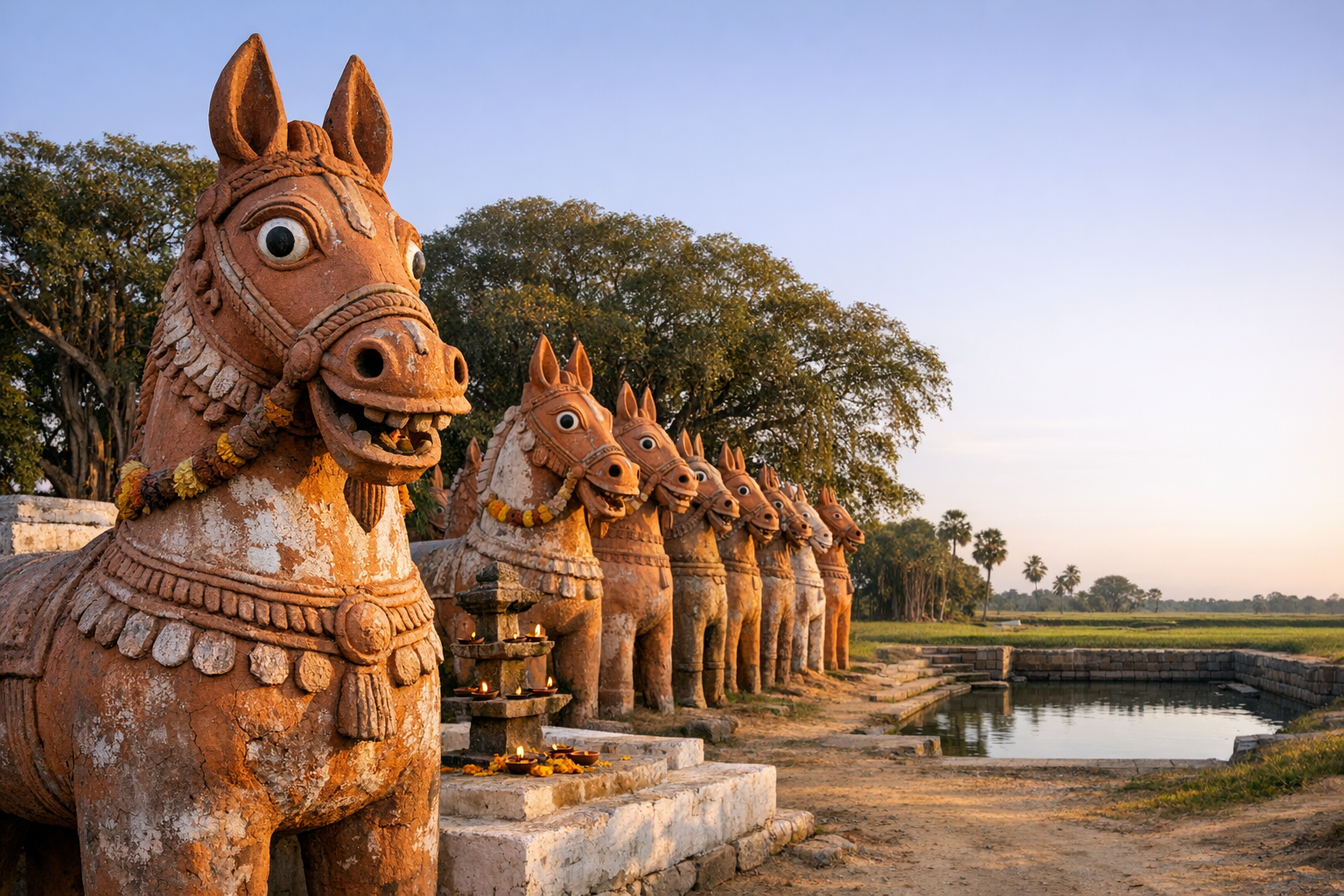
At the liminal edge of many Tamil villageswhere cultivated fields yield to scrub, grove, and open countrysiderise monumental terracotta horses, some soaring to heights of four to six meters. These striking forms are not merely sculptures; they are living votive presences dedicated to Ayyanar, the kāval deivam (guardian deity) of rural Tamil Nadu, whose protection is believed to encircle the settlement, safeguard its water, crops, and pathways, and uphold the moral order of communal life.
Viewed through the lenses of art history, anthropology, and religious studies, Ayyanar’s terracotta horses reveal a sophisticated synergy of ritual, material culture, environmental stewardship, and social organization. The tradition operates as a village-scale ecosystem: a shrine compound (often paired with a sacred grove and a water tank), craft communities that fashion and renew the votive horses, ritual specialists who coordinate offerings and processions, and lay residents who sustain a cycle of vows and gratitude. Together they compose a living heritage that is both profoundly local and emblematic of the plural, dharmic ethos of the subcontinent.
Ayyanar is widely understood in South Indian religious idiom as a boundary-keeper deity associated with vigilance, swiftness, and just order. In many regions he is linked with Śāstha and, by extension, shares theological resonances with Ayyappa, reflecting a broader dharmic continuum that integrates village traditions with temple networks. This integrative quality is important for understanding how Tamil folk religion coexists synergistically with pan-Indian Hindu practice, and how, in spirit, it aligns with the non-harm, guardianship, and community-centered ethics seen across Buddhist and Jain traditions.
The spatial grammar of Ayyanar shrines is deliberate. Shrines typically stand at thresholds, beside cart-tracks, near tanks, and at points where the cultivated gives way to the wild. The terracotta horses, aligned in rows or rings, reinforce this guardianship at the perimeter. The village thus declaresmaterially and rituallyits intent to live in right relation with surrounding land and life, embracing liminality as a sacralized zone of encounter rather than a space of threat.
The horses themselves serve as fulfilled vows (votive offerings) and petitions for protection. Devotees sponsor them on occasions such as harvest-time thanksgiving, family milestones, or collective vows for rains and health. Their scale signifies both the magnitude of gratitude and the desired potency of Ayyanar’s patrol. While iconographic details vary by district, the stylized eyes, flared nostrils, and high ears communicate alertness; harnesses and trappings are modeled in low relief; and some compositions include riders, attendants, or flanking guardian figures, evoking a mobile, watchful retinue.
Historically, the Ayyanar complex appears to consolidate multiple older strands of South Indian religiosity, including gramadevatā (village-deity) worship, hero-stone commemoration, and regional Śaiva-Śākta lineages. Epigraphic references to Śāstha from the Chola period and later Nayak patronage indicate a long-standing, evolving presence. Although the precise antiquity of monumental terracotta horses is debated, the repetition of forms and techniques across generations points to an established, self-renewing craft-ritual system by the late medieval era, with strong continuities into the present.
The craft tradition is associated with Velar/Kuyavar potters who have specialized knowledge of local clays, tempers, and firing regimes. Clay is typically levigated and tempered with sand or ground potsherd (grog) to improve strength and thermal shock resistance. Artisans build large horses as hollow, sectional volumes using coil-and-slab techniques over removable armatures or internal supports. Joints are keyed and luted with slip to ensure mechanical integrity. Surface finishing may include scraping, smoothing, and the addition of modeled ornaments, followed by a red slip or white lime wash after firing; in some regions, polychrome pigments highlight harness details and eyes.
Firing of such monumental figures is a technical feat. Open clamp kilns or temporary enclosures are stacked with fuel (wood, coconut fronds, husk) to achieve sustained temperatures. Controlled heating and cooling minimize cracking, and potters often calibrate wall thickness and venting to manage thermal gradients. The resulting earthenware is porous enough to breathe and withstand the monsoon cycle reasonably well, yet light enough for careful transport and ritual emplacement by teams of devotees.
Iconographically, the horse embodies speed and vigilancequalities essential to perimeter guardianship. Ayyanar’s attendants, sometimes represented as moustachioed warriors or fierce guardians, underscore the message of deterrence against disorder. Wide, unblinking eyes double as apotropaic motifs to deflect the “evil eye,” while rhythmic rows and escalating sizes of horses act as a visual crescendo, intensifying the perceived field of protection around the shrine compound and village boundary.
Ritual calendars vary by locale, yet many communities focus on post-harvest months (Maasi–Panguni), when new offerings are installed and processions encircle the village. Drumming, lamps, and vow-fulfillment acts (vazhipādu) bind households of diverse occupations into a shared ceremonial rhythm. Offerings remain varied across Tamil regions, but the underlying ethos is consistent: gratitude, ethical restraint, and collective welfare, values that resonate with the wider dharmic traditions of the subcontinent.
Socially, the Ayyanar complex operates as a durable contract among villagers: protection is framed not only as divine grace but also as the outcome of right conduct, mutual aid, and stewardship of land and water. Patronage relationships sustain the potters’ livelihoods; youths learn transmission protocolshow to approach, install, and later respectfully retire weathered figures; and elders arbitrate ritual correctness. This multi-generational choreography is a principal reason the tradition remains resilient in the face of modernization.
The environmental dimension is central. Many Ayyanar shrines include a sacred grove (kāvu) that functions as a micro-reserve for native flora and fauna and stabilizes local hydrology. By pairing guardianship with biodiversity refuges, the tradition exemplifies a dharmic environmental ethic shared in spirit with Buddhist and Jain reverence for living beings and habitats. Terracotta horses, in this view, are outward signs of an ecological covenant that privileges balance over extraction.
Regionally, the most renowned concentrations of Ayyanar terracottas are found across the Cauvery delta and adjoining districts of Tamil Nadu, including parts of Pudukkottai, Thanjavur, Sivaganga, Ramanathapuram, and Cuddalore. Stylistic vocabularies differ: some districts favor towering, elongated profiles with high collars and flared ears; others emphasize compact torsos, pronounced harnesses, or bold, geometric surface patterning. Such micro-styles function as recognizably local signatures while remaining legible within the broader Ayyanar aesthetic.
Comparatively, South Asia hosts other votive horse traditionsMolela in Rajasthan and Bankura in Bengal, for examplebut Tamil Ayyanar horses are unparalleled for their monumental scale and boundary-guarding role. The comparison highlights a key insight for art history and religious studies: similar votive forms can serve distinct ritual ecologies, reflecting regional theologies, landscapes, and social contracts.
Museums and research institutions have drawn sustained interest to this living heritage. Examples of Ayyanar guardian figures appear in major collections and exhibitions, including at international museums. Such visibility has aided conservation awareness while also prompting discussion on ethical collecting, contextualization, and the primacy of community custodianship over detached display.
Conservation challenges persist. Earthenware weathers under intense sun and monsoon rains; termite activity and invasive vegetation can hasten deterioration; and changing fuel and clay availabilities complicate large-scale firing. Some communities retire and replace horses cyclically, ensuring continuity while accepting material impermanence as part of the tradition’s rhythm. Where replacement knowledge wanes, documentation (drawings, photogrammetry, 3-D scans) and artisan training programs can stabilize transmission.
Sustainable preservation hinges on strengthening village-led stewardship and artisan economies. Priorities include soil and clay resource mapping, micro-credit for kiln infrastructure, apprenticeships with master potters, and heritage-sensitive tourism that respects local authority. Policy frameworks can further support this fabric by recognizing Ayyanar terracottas as intangible cultural heritage, investing in community archives, and facilitating scholarly-artisan collaborations for materials research and design innovation.
For visitors, a few practices sustain sanctity: seek local permission before photographing or approaching shrines; refrain from touching or climbing on terracottas; avoid moving votive objects; and offer contributions through approved community channels. Observing the threshold from a respectful distance allows the guardians to remain what they are meant to besentinels looking outward, not inward-facing exhibits.
Scholarly avenues abound. Archaeometric characterization of clays and tempers can identify sourcing territories; thermoluminescence and stylistic seriation may build firmer chronological models; GIS mapping of shrine-grove-tank triads can reveal environmental logics that underwrite settlement patterns; and ethnographic studies can trace how vows, processions, and craft cycles recalibrate in response to climate, migration, and market forces. The Ayyanar complex, in this sense, is an ideal laboratory for integrated heritage science.
Viewed within a wider dharmic frame, Ayyanar’s terracotta horses affirm values that Hindu, Buddhist, Jain, and Sikh traditions all uphold in kindred ways: guardianship of community, ethical conduct, reverence for life, and service to the common good. As material culture, they are majestic; as ritual ecology, they are sophisticated; as ethical pedagogy, they are quietly transformative. Their continued presence along the village edge testifies that protection, in the dharmic imagination, is a partnership between divine vigilance and human responsibility.
Inspired by this post on Hindu Blog.