
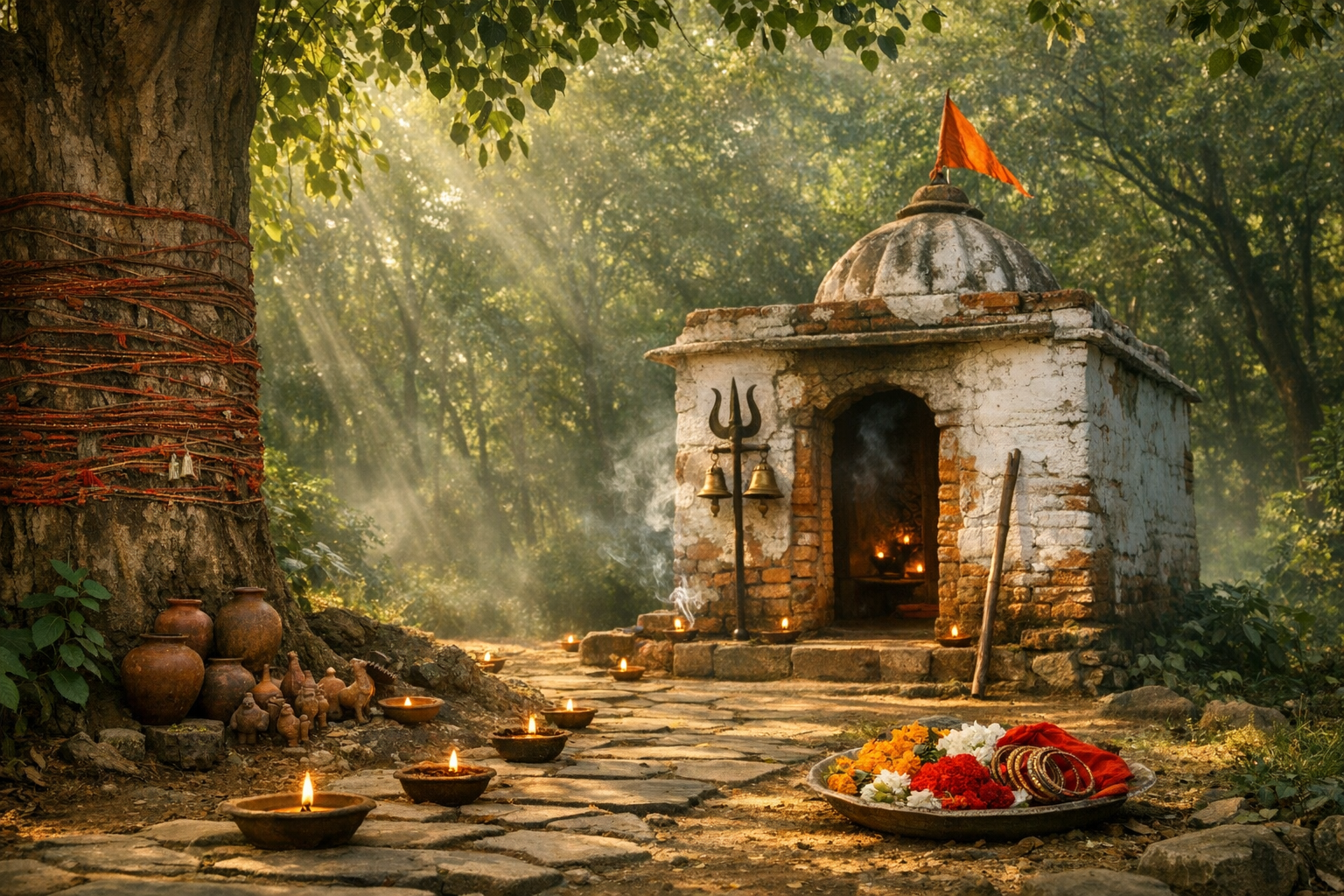
Set within the Kusmhi forest on the outskirts of Gorakhpur, Uttar Pradesh, the Budhiya Mai Temple is locally regarded as a heritage site of the Purvanchal region and is remembered in community narratives as a shrine with roughly six centuries of continuity. The temple is dedicated to Budhiya Mataunderstood in regional idiom as a protective grandmotherly presenceand functions as a living center of devotion where landscape, memory, and ritual converge.
The geographical setting matters. The Kusmhi forest occupies a transition zone of the eastern Gangetic plain near the Terai belt, where monsoonal rhythms and dense canopy have historically shaped settlement, mobility, and sacred geography. Forest-edge shrines such as this one often anchor wayfinding for villagers, travelers, and pastoralists, while structuring local calendars around seasonal gatherings, offerings, and vows. As a result, the Budhiya Mai Temple’s significance extends beyond theology to environmental and social histories of the Gorakhpur region.
According to oral tradition, the shrine was established in honor of a miraculous elderly woman dressed in white who moved with the help of a stickan image of compassion, resilience, and guardianship. The name Budhiya Mata encodes this persona: an elder figure who hears petitions, protects thresholds, and exemplifies the ethics of care. In Purvanchal vernacular religion, such benevolent maternal archetypes often assume the role of gram-devata (village protectress), absorbing local anxieties, hopes, and communal memory.
Anthropologically, the motif of the protective elder-woman appears widely in North Indian folklore, ballads, and shrine-legends, where the aged feminine is endowed with moral authority and liminal power. In these narratives, maturity signals not withdrawal but custodianshipan assurance that, even in marginal terrains like forests and riverine edges, the community remains watched over. The Budhiya Mata remembrance belongs to this broader repertoire of subcontinental sacred storytelling.
The commonly cited 600-year age of the Budhiya Mai Temple is best approached as an index of deep continuity rather than a fixed archaeological date. Rural shrines in eastern Uttar Pradesh rarely preserve long epigraphic series; dating therefore relies on layered methods: surveying surviving masonry and mortar phases, tracing archival references in revenue or pilgrimage records, conducting oral-history interviews with local lineages, and comparing ritual patterns across adjacent sites. In the absence of inscriptions, the community’s uninterrupted ritual memorytransmitted through vows (mannat), seasonal congregations, and custodial lineagesserves as a credible temporal anchor.
Within Purvanchal’s sacred geography, Budhiya Mai Temple stands alongside a dense constellation of Shakti spaces, memorial stones, and mathas, including the prominent Gorakhnath Math in the urban core of Gorakhpur. These nodes form a pilgrimage network where households routinely combine visits to major centers with darshan at smaller, forest-edge shrines, thus weaving grand traditions and local cults into one devotional itinerary.
Ritual life at small Shakti shrines in Purvanchal typically follows a familiar cadence. Devotees commonly offer red cloth (chunri), bangles, sindoor, and flowers, and may tie threads to sacred trees as vows mature and prayers are fulfilled. Seasonal peaks often align with Chaitra and Sharad Navratri and with local melas, when families bring newborns for blessings, merchants seek auspicious beginnings, and students request guidance before examinations. While practices at Budhiya Mai Temple vary across families and days, these regional patterns provide a reasonable frame for understanding how worship likely unfolds.
Material cues seen widely across village goddess templestridents (trishul), bells, votive lamps, and earthen or metal deepamssignal both the Shakti orientation and the participatory logic of worship. Ex-voto offerings (copper plates, miniature cradles for childbirth vows, or simple earthen pots) often accumulate over years, forming a grassroots archive of thanksgiving and testimony. Such objects are integral data points for heritage documentation because they mark the social history of devotion as concretely as any inscription.
Architecturally, small Purvanchal shrines commonly evolve incrementally: a sanctum over a plinth, brick masonry consolidated over time, lime or cement plaster repairs, and an open or semi-enclosed mandapa for congregational rituals. Roofing solutions range from simple sloped sheds to low shikharas added in later phases as patronage grows. Even without a formal blueprint, the built form and surrounding tree cover together choreograph movement, sound, and lightamplifying the forest’s hush during early morning aarti and evening lamp offerings.
The temple’s forest context underscores a long-standing South Asian theme: sacred ecology. Sites like Budhiya Mai mediate reciprocal obligationsdevotees care for the grove and water sources; the grove, in turn, offers shade, serenity, and a sanctified commons. Responsible visitation norms widely encouraged at forest shrines include minimizing plastic, avoiding loudspeakers except during authorized festivals, and respecting tree sanctitysimple practices that help sustain both biodiversity and the contemplative atmosphere central to worship.
Heritage stewardship here is primarily community-led, supplemented at times by municipal or district-level facilitation. Being regarded as a heritage site of Purvanchal signals cultural salience rather than an Archaeological Survey of India (ASI) protection category. Effective conservation therefore blends local custodianship with lightweight documentation: photographic surveys of fabric and votive objects, oral-history recording, maintenance logs, and basic disaster-risk mapping (drainage, fire safety, and vegetation control). These measures preserve authenticity while keeping ritual life uninterrupted.
The temple’s ethos resonates with shared values across dharmic traditions. The compassionate guardianship embodied by Budhiya Mata aligns with Buddhist karuna (compassion), Jain ahimsa (non-violence), and Sikh seva (selfless service). Such resonances illustrate how Hindu Shakti worship, Buddhist ethical universals, Jain vows, and Sikh community care can coexist and mutually enrich one anotheran expression of unity in diversity that characterizes the subcontinent’s spiritual tapestry.
Visitors often describe a distinctive experiential arc: the gradual dimming of urban noise as the forest canopy thickens; the scent of incense mingling with damp earth; the soft ring of a bell punctuating birdsong. For many families in Gorakhpur, a stop at Budhiya Mai Temple before milestonesschool admissions, new ventures, harvest cyclesoffers reassurance that their efforts are witnessed and blessed.
For researchers, the site presents a robust agenda: map the ritual calendar; catalogue offerings; record life histories of hereditary attendants (if present) and long-term devotees; correlate narrative variants of the elder-woman legend; and contextualize the shrine within Purvanchal’s network of Shakti sites and monasteries. Such documentation, undertaken collaboratively with the community, strengthens both scholarship and stewardship.
Interpreting Budhiya Mai Temple ultimately involves balancing myth and method. The legend of the white-clad elder with a stick is not a barrier to historyit is a historical source in its own right, encoding values, events, and aspirations that written archives may overlook. Read alongside the built fabric, ritual continuities, and the forested landscape, the narrative helps reconstruct a past that is less about dates than about durable ties between people, place, and the sacred feminine.
As a living heritage node of Gorakhpur and Purvanchal, the Budhiya Mai Temple demonstrates how devotion, memory, and ecology cohere in a shared sacred commons. Its endurance across centuries of change exemplifies a quietly powerful truth: when communities honor the protective ethic personified by Budhiya Mata, forests become sanctuaries, local identities deepen, and the broader dharmic familyHindu, Buddhist, Jain, and Sikh alikefinds common ground in compassion and care.
Inspired by this post on Hindu Blog.
