
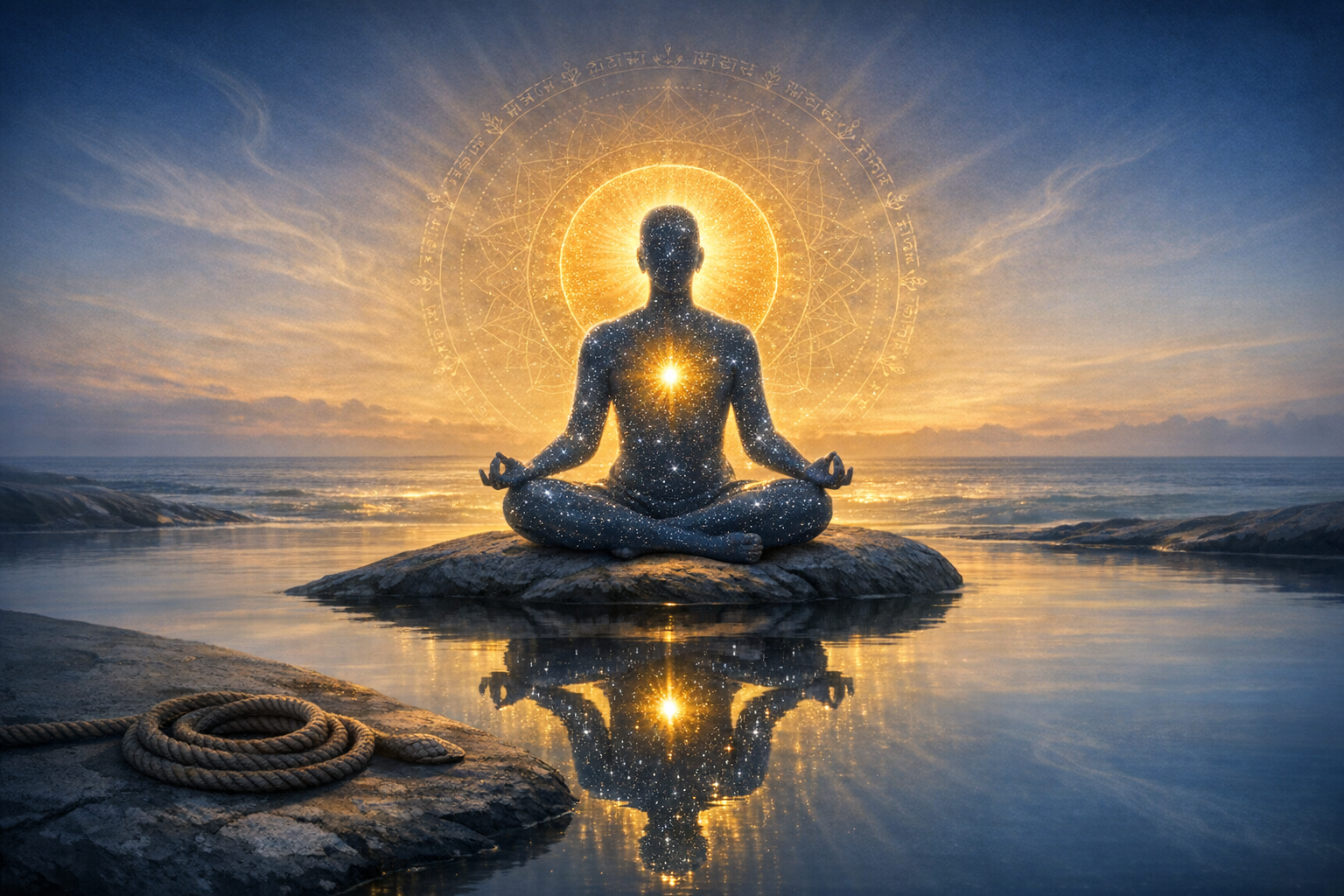
The phrase “He is myself and I am He” condenses a core intuition of Hindu philosophy: the identity of the innermost Self (atman) with the supreme reality (Brahman). This insight, articulated in the Upanishads and elaborated by Vedanta, frames liberation (moksha) as the recognition that consciousness is not a separate, finite entity but the very ground of being.
In Vedantic discourse, this equation is conveyed by the mahavakyas: “tat tvam asi” (Chandogya Upanishad 6.8.7), “aham brahmasmi” (Brihadaranyaka Upanishad 1.4.10), “ayam atma brahma” (Mandukya Upanishad 2), and “prajñanam brahma” (Aitareya Upanishad 3.3). The phrase “He is myself and I am He” resonates with “so’ham” (the natural mantra of the breath), affirming non-duality (advaita) not as a metaphysical abstraction but as an immediate fact of awareness accessible through disciplined inquiry.
The pronoun “He” often denotes Ishvara, the personal aspect of the Absolute, or Brahman considered with attributes (saguna). “Myself” signifies atman, pure witnessing consciousness. Advaita Vedanta clarifies that the apparent separation arises from ignorance (avidya) through superimposition (adhyasa)the way a rope is misperceived as a snake in dim light. When knowledge dawns, the false appearance is sublated; the rope was always a rope, just as atman is always Brahman.
Shankara’s method proceeds via adhyaropa-apavada (provisional attribution and subsequent negation), leading the seeker from conceptual supports to formless truth, summarized by the apophatic formula “neti, neti” (not this, not this). The teaching distinguishes levels of reality: empirical (vyavaharika), where difference and duty operate, and absolute (paramarthika), where only Brahman is. Liberation, therefore, is not a change of state but the removal of a veilrecognizing what has ever been the case.
Advaita’s soteriology culminates in jivanmukti, freedom while living. The embodied person continues to act within dharma, yet is no longer bound by the sense of doership (kartṛtva) or enjoyership (bhoktṛtva). Such freedom is stabilized by nididhyasana (deep contemplation) after systematic study (sravana) and reasoning (manana), supported by ethical preparation (sadhana-chatushtaya: viveka, vairagya, shatsampat, mumukshutva).
Other Vedantic schools interpret the same intuition without collapsing difference. Vishishtadvaita presents a unity-in-difference (bhedabheda) model grounded in the sharira-shariri relation: all selves and nature are the “body” of the Divine, while the Divine is the indwelling ruler (antaryamin). In this view, “He is myself and I am He” can be read as intimate indwelling and inseparability rather than strict identity, sustaining deep bhakti while affirming cosmic oneness through dependence.
Dvaita emphasizes real and eternal difference between jiva and Ishvara. Yet it still preserves closeness: the self belongs to the Divine, draws life from the Divine, and is fulfilled in devotion. The phrase thus points to existential proximity rather than ontological identity, cultivating humility, service, and unwavering remembrance of God.
Gaudiya Vaishnavism articulates acintya-bhedabheda, the “inconceivable simultaneous oneness and difference.” It avoids reductionism by affirming that the self is of the nature of the Divine (one) yet remains a distinct locus of love and service (different). The power of the phrase “He is myself and I am He” lies here in evoking devotion suffused with metaphysical intimacy.
In Kashmir Shaivism, pratyabhijña (recognition) discloses that one’s own awareness is Shivaever-vibrant (spanda), self-luminous, and creative. The journey is a recognition, not an acquisition: realizing that the “I” that knows is non-different from the universal I-consciousness. This aligns experientially with non-dual Vedanta while employing a distinct Shaiva metaphysics and praxis.
Across these streams, pramana (valid means of knowledge) is threefold: sruti (scriptural revelation), yukti (reasoning), and anubhava (direct realization). Sruti provides the foundational vision; yukti removes conceptual obstacles; anubhava verifies the teaching in lived awareness. The Upanishadic “neti, neti” is not nihilism but a careful peeling away of non-essential identifications so the essential Self shines.
Practical realization integrates multiple yogas. Jnana Yoga refines inquiry: “Who am I?” stripped of changing attributes. Bhakti Yoga melts separation through surrender and loving remembrance of the Divine Name. Karma Yoga purifies the mind by consecrating action to the Divine without clinging to results. Raja Yoga stabilizes attention through meditation, breath awareness, and subtle energy harmonization, making contemplative insight steady and luminous.
Contemporary practitioners frequently report that simple, consistent disciplines open the door to this insight. Daily recitation of mahavakyas, attentive breath-based japa with the natural “so’ham” rhythm, and reflective reading of the Bhagavad Gita and primary Upanishads gradually reorient identity from the periphery of experience to the witnessing center. Over time, ethical sensitivity deepens, reactivity subsides, and a non-reactive clarity takes root.
The phrase also resonates across Dharmic traditions, reinforcing unity rather than division. Buddhism, while denying a permanent, independent atman (anatta), guides practitioners to realize emptiness (shunyata) and the luminous, non-clinging nature of mind. Experientially, the dissolution of egoic fixation reveals boundless compassion and interdependencea convergence in transformative outcome with the Vedantic recognition of non-separateness.
Jainism affirms jiva as pure consciousness capable of kevala-jnana (omniscient awareness) when karmic accretions are shed. Anekantavada (many-sidedness) encourages humility about metaphysical claims and fosters pluralism. Read through this lens, “He is myself and I am He” can symbolize the unveiling of intrinsic purity and knowledge, harmonizing with Jain ethics of ahimsa and self-mastery.
Sikhism proclaims Ik OnkarOne Reality permeating all. Spiritual maturation is described as the dissolution of haumai (ego) through Naam Simran (remembrance of the Name), revealing the Divine Light within. The affirmation that the innermost essence is one with the One mirrors the experiential heart of the Vedantic statement while retaining Sikh theology’s distinctive devotional orientation.
Ethically, acknowledging non-separateness transforms conduct. The Bhagavad Gita describes the realized person as “sarva-bhuta-hite ratah,” delighting in the welfare of all beings. The maxim Vasudhaiva Kutumbakam“the world is one family”ceases to be a slogan and becomes a moral intuition: compassion, non-violence, fairness, and ecological responsibility follow naturally from seeing self in all and all in self.
Several misconceptions deserve clarification. Non-duality is not solipsism; it does not deny the empirical world but understands it as dependent on, and illumined by, consciousness. It is not quietism; disciplined insight often increases, not decreases, responsible action. Nor is it license for ethical laxity; self-knowledge traditionally rests on a bedrock of truthfulness, non-injury, self-restraint, and service.
From a philosophical-psychological angle, non-dual contemplation can be framed as a training in meta-awareness and de-identification from transient mental contents. Modern studies associate such practice with reduced rumination, enhanced well-being, and greater resilience. While scientific models remain provisional, they converge on an observation long preserved in the Upanishads: stable attention and insight into the nature of experience lessen suffering at its roots.
Serious study benefits from a canon of sources and a coherent method. The Upanishads (especially Chandogya, Brihadaranyaka, Kena, Mandukya with Gaudapada’s Karika), the Bhagavad Gita with classical commentaries, and foundational Vedanta texts provide doctrinal clarity. Contemplative assimilation through sravana, manana, and nididhyasana integrates understanding with lived awareness, transforming knowledge from information to realization.
Practice ripens through ordinary life. Offering one’s work in a spirit of Karma Yoga, keeping a short daily window for mantra japa and silent sitting, and returning to inquiry when reactive patterns arise gradually shifts identity from contracted ego to open presence. The phrase “He is myself and I am He” becomes less a proposition to defend and more a lens through which perception, emotion, and action are harmonized.
For interfaith and intrafaith dialogue, the teaching suggests a grammar of reverence: many paths, one reality; many practices, one liberation. Hinduism’s inclusivityechoed by Buddhism’s compassion, Jainism’s non-violence, and Sikhism’s remembranceinvites a shared ethic and a shared aspiration. Differences in doctrine need not fracture unity when oriented toward the common aim of freedom from suffering and the flowering of wisdom and love.
Ultimately, the value of “He is myself and I am He” is existential. It repositions the search for fulfillment from acquiring external conditions to recognizing intrinsic wholeness. As this recognition deepens, fear loosens, gratitude grows, and service becomes spontaneous. In that clarity, the promise of the Upanishads takes form in daily life: the essence of every being is divine, and realizing this unity is liberation.
Inspired by this post on Hindu Blog.
