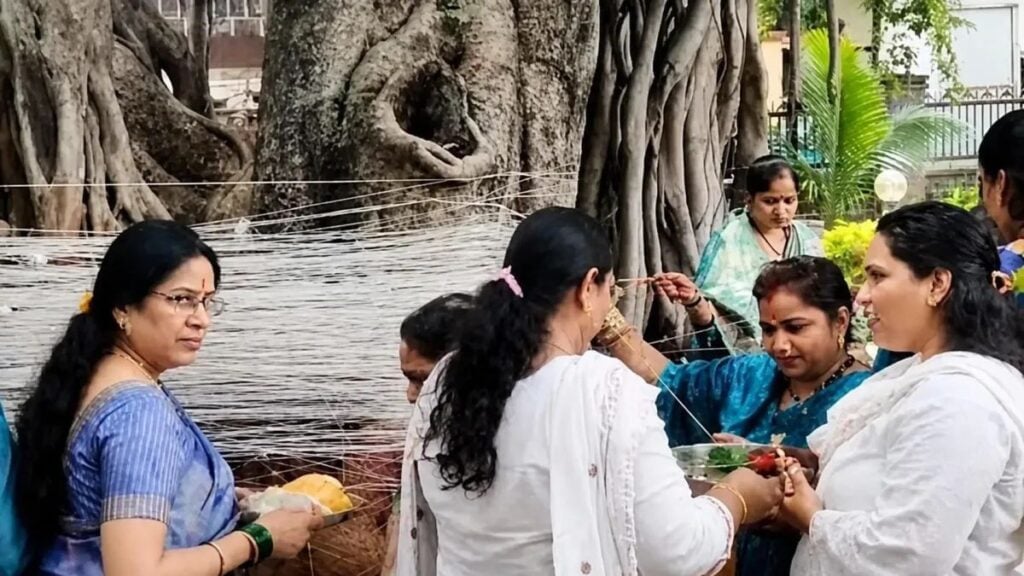
On a bright and sunny Sunday, Bhaktivedanta Manor welcomed Konda Surekha Garu, Cabinet Minister for Endowments, Forest and Environment from the Indian state of Telangana, who attended with her family. The visit offered a meaningful moment of engagement between a leading public steward of religious endowments and environmental policy in India and one of the United Kingdom’s most vibrant Krishna temple communities.
As one of Europe’s most active Krishna temple campuses, Bhaktivedanta Manor serves as a spiritual home for the UK’s Hindu diaspora and a center of Gaudiya Vaishnava practice under ISKCON. Established in 1973 with the support of musician George Harrison, the Manor pairs devotional worship with education, community service, and cultural heritage programming that reaches tens of thousands annually, particularly during Janmashtami. Its role in cultural preservation, volunteer mobilization, and interfaith outreach makes it a living laboratory for community-led heritage stewardship.
The Telangana Endowments portfolio is central to the governance of Hindu temples and related trusts across the state, overseeing thousands of institutions that safeguard sacred sites, ritual continuity, lands, and community services. In parallel, diaspora temples such as Bhaktivedanta Manor operate within robust charity governance frameworks that emphasize fiduciary responsibility, financial transparency, safeguarding, and measurable social impact. The intersection of these governance worlds creates opportunities for comparative learning on transparent endowments administration, digital record-keeping, ethical fundraising, and public accountability.
The Minister’s additional responsibilities for Forest and Environment underscore a complementary policy lens that is highly relevant to sacred geographies. Across India and the diaspora, temples and monastic sites are often embedded within ecologically significant spaces such as sacred groves, temple tanks, riparian corridors, and agrarian landscapes. Aligning environmental conservation with religious endowments management can protect biodiversity, improve water security, and enhance climate resilience while preserving ritual and cultural life.
Themes of environmental stewardship resonate strongly with dharmic ethics at Bhaktivedanta Manor and similar Krishna temple communities, which emphasize values such as ahimsa, seva, and responsible care for the natural world. Practical expressions of these values include mindful land use, soil and water conservation, biodiversity gardening, ethical procurement for prasad and festivals, and conscientious care for cows and other animals aligned with go-seva traditions. Such practices exemplify how environmental conservation and spiritual life can reinforce each other in daily operations.
Equally significant is the visit’s alignment with the shared ethical foundations of the broader dharmic family. Hinduism, Buddhism, Jainism, and Sikhism converge on principles of compassion, truthfulness, self-restraint, generosity, and service to society. In the UK context, these traditions often collaborate on food relief, youth development, interfaith dialogue, and cultural education. The spirit of unity in spiritual diversity reinforces social cohesion and amplifies community impact across these interconnected traditions.
For devotees, volunteers, and well-wishers, the presence of a public servant entrusted with both religious endowments and environmental stewardship offered a powerful affirmation of the twin responsibilities of heritage and habitat. Many observers read the moment as an invitation to deepen partnerships that honor sacred spaces while advancing sustainability, thereby ensuring that temples continue to inspire devotion, learning, and public service across generations.
From a technical perspective, Green Temple frameworks can help operationalize this vision. Practical pathways include energy audits and efficiency retrofits; on-site renewables aligned to local planning rules; rainwater harvesting and smart metering; circular approaches to prasad, flower, and packaging waste; nature-positive landscaping; low-impact mobility planning for major festivals; and ethical, local-first procurement. These approaches can be aligned with recognized management systems for continual improvement and transparent reporting of environmental outcomes.
Heritage conservation likewise benefits from established international good practice. Priority measures include digital documentation of movable and immovable heritage, preventive conservation for wood, metal, stone, and textiles, robust fire safety and disaster risk reduction plans, climate risk assessment for collections and structures, and visitor flow modeling to protect both people and fabric. Complementary attention to intangible heritagesuch as kirtan traditions, Sanskrit and regional-language learning, and craft knowledgeensures that living practices remain at the heart of preservation efforts, resonating with global norms on safeguarding intangible cultural heritage.
Endowments governance can be further strengthened through digitized inventories of endowed lands and properties, GIS-based mapping of assets, open-data registers of leases and tenancies, time-bound resolution of disputes, and transparent dashboards of income and expenditure. Community oversight committees, periodic independent audits, and clearly defined service-level agreements for temple trusts build public confidence while supporting priests, volunteers, and administrators in delivering high-quality worship and community services.
Pilgrimage and festival management offer another valuable avenue for knowledge exchange. Indian endowments bring expertise in large-scale darshan logistics, sanitation, and safety engineering, while diaspora temples contribute insights on accessible design, volunteer-driven crowd management, safeguarding protocols, and multi-agency coordination with local authorities. Evidence-based crowd sciencespanning queue systems, timed-entry where appropriate, and non-intrusive securitycan enhance both safety and the devotional experience.
Education and youth engagement are long-term pillars of dharmic continuity. Partnerships that connect devotional learning with language education, arts and music, environmental clubs, and service-learning projects foster leadership rooted in ethics and public-mindedness. Such integrated programs help young people translate dharma into daily life, whether through academic achievement, civic volunteering, or professional excellence guided by values.
In the civic sphere, Bhaktivedanta Manor’s experience of working with councils, faith networks, and local charities illustrates how religious institutions can serve the common good while honoring distinctive traditions. These collaborations strengthen community resilience, reduce social isolation, and contribute to a healthier public square. Similar models can be adapted for Indian contexts to complement state and local efforts in social welfare, health, and education.
In sum, the visit of Konda Surekha Garu to Bhaktivedanta Manor highlighted a powerful confluence of responsibilities and aspirations: safeguarding religious endowments, advancing environmental conservation, and nurturing unity across the dharmic traditions of Hinduism, Buddhism, Jainism, and Sikhism. By combining rigorous governance with compassionate service and ecological care, dharmic institutions at home and abroad can deepen their role as custodians of cultural heritage and as partners in building sustainable, harmonious communities.
Inspired by this post on Dandavats.