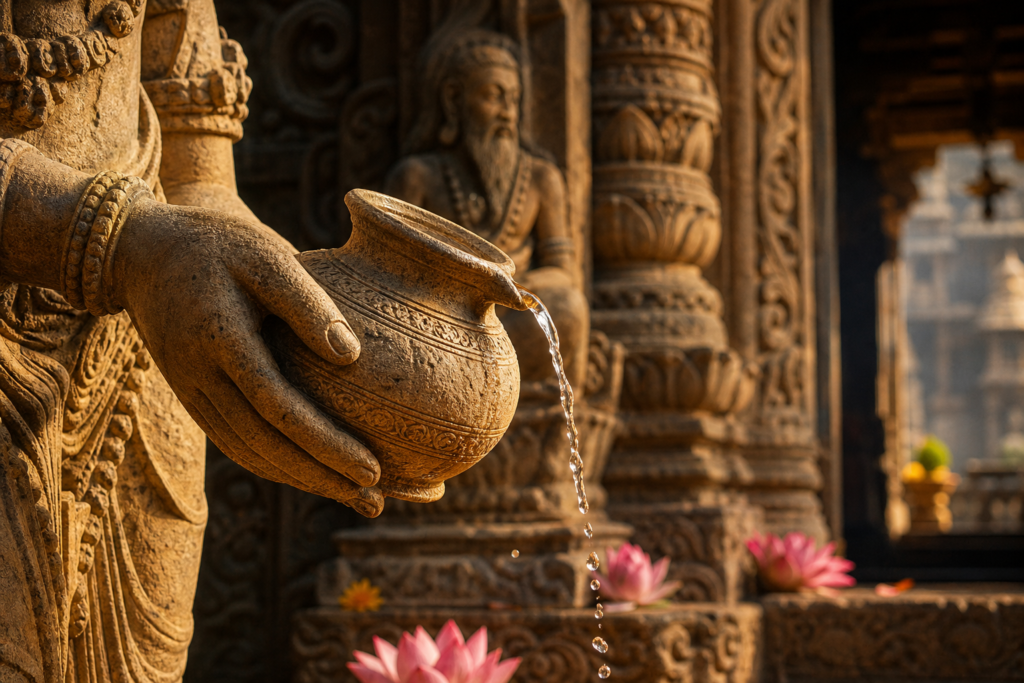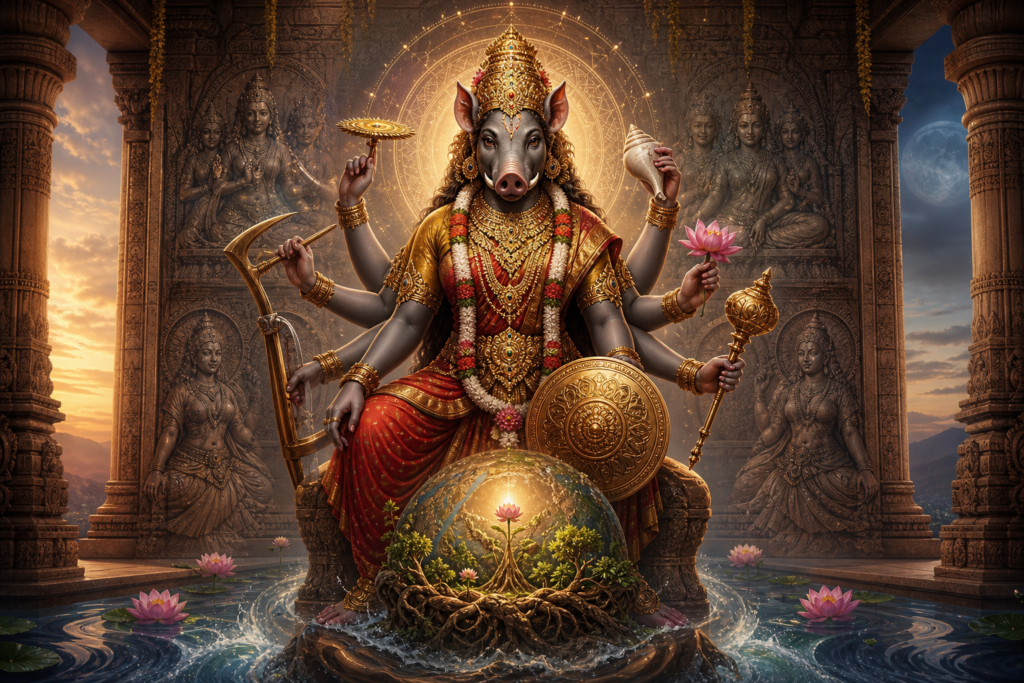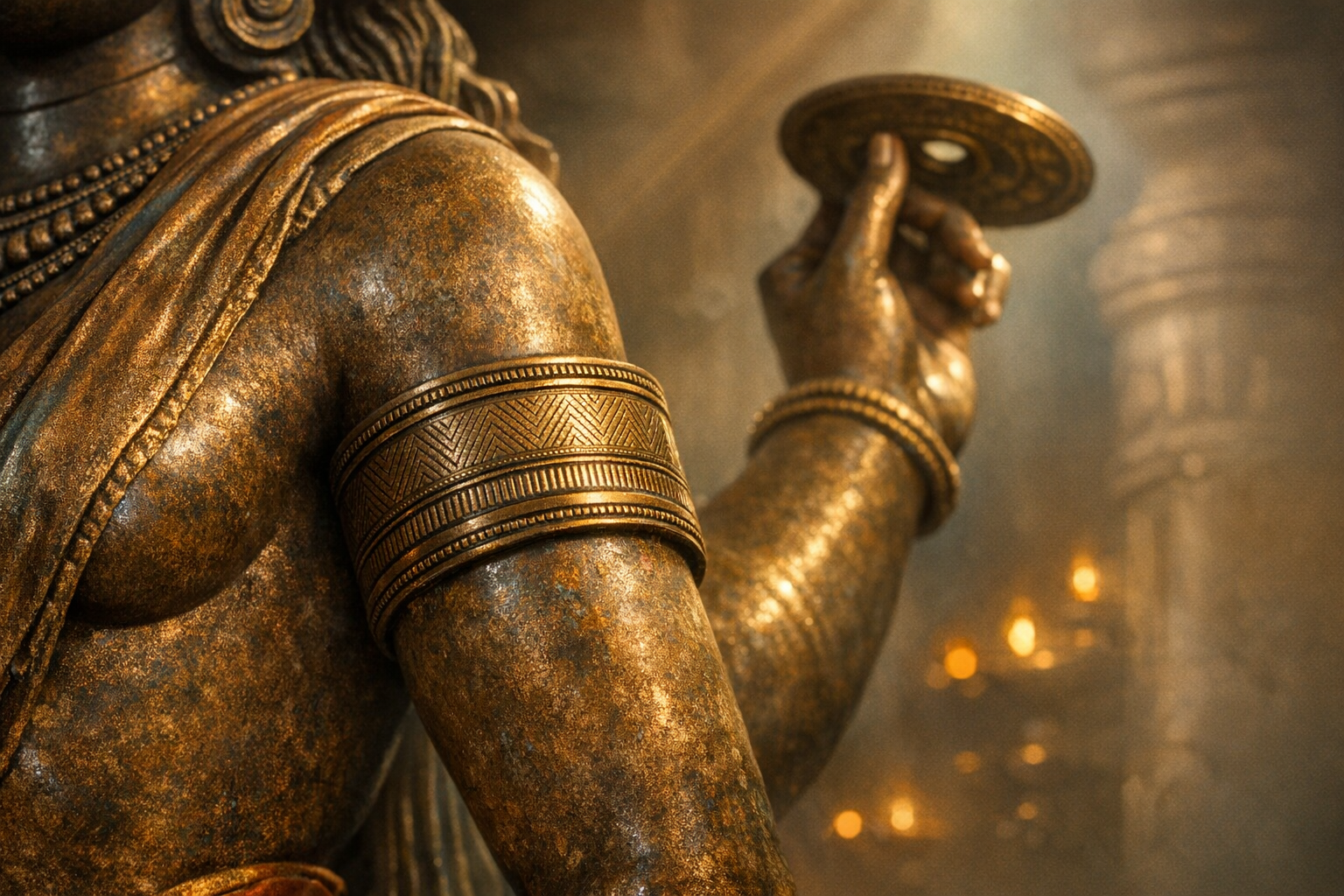
Bahuka designates a distinctive, cylindrical upper arm ornament in Hindu iconography, typically rendered as a solid cuff worn just above the elbow. In temple sculpture and bronze imagery, its compact mass, strict geometry, and palpable visual weight set it apart from the more delicate circular bahuvalaya and the tied, textile-referencing bahubandha. Across regions and centuries, the bahuka communicates stability, restraint, and embodied vigor, qualities that align closely with divine strength, martial virtue, and the disciplined ethos of kshatra.
Terminologically, bahuka functions within a larger family of arm ornaments that also includes keyura and kankana. While keyura often appears as a more articulated or torc-like armlet and bahuvalaya as ring-like jewelry, the bahuka is identifiable by its unbroken cylindrical profile and condensed proportions. Unlike the strap-evoking bahubandha that is depicted as a tied band, the bahuka reads as a rigid, cast or hammered cuff, its substance emphasized by sculptors through crisp edges and planar surfaces.
Formally, bahuka cuffs in stone and bronze show three recurring traits: a straight or slightly tapered cylinder; reinforced rims that may be plain, beaded, or ribbed; and surface treatments such as incised chevrons, horizontal fluting, or punctate borders. The absence of visible clasps in sculpture implies a continuous hoop in the representational code, even if historical metal prototypes may have included hinges or openings. This economy of line and volume communicates an aesthetic of containment, firmness, and readiness.
Craft and material inference from sculptural rendering points to metalworking traditions in which artisans could cast or shape substantial cuffs. Lost-wax casting, repoussé, and lathe-turning are credible techniques for historical prototypes in copper alloys, silver, or gold; in some contexts, hard organics like ivory or dense woods are also plausible. Although the bahuka reads as ornament rather than armor, its compact cylinder recalls the logic of protective gear, bridging jewelry and function in the visual language of power.
Chronologically, robust upper arm cuffs appear in pan-Indic imagery from at least the early historic period, develop through the Gupta and post-Gupta centuries, and become particularly emphatic in early medieval and medieval idioms. South Indian bronzes of the Chola and later Vijayanagara periods frequently privilege strong arm ornaments, while stone ateliers of the Hoysala realm elaborate cuff details with fine ribbing and beading. In eastern India, Pala-Sena bronzes and Odisha’s Kalinga stone workshops also sustain the motif, adapting its profile to local canons of proportion.
Associationally, the bahuka aligns with deities and iconographic moods that foreground valor, divine sovereignty, and active guardianship. Shaiva forms such as Bhairava and martial Shakta forms like Durga frequently carry more assertive armlets; Vaishnava imagery in heroic modes, including Narasimha and Vishnu as the victorious wielder of the chakra, also tends toward denser ornaments. The cuff’s mass operates as a visual metonym for embodied strength, complementing weapons, vahanas, and dynamic postures that signal protection and righteous power.
Function within the iconographic syntax extends beyond mere adornment. The bahuka adds a stabilizing accent to the upper arm, visually anchoring limb movement at a point just above the elbow. In compositions where the forearm executes a powerful gesturebrandishing a trident, drawing a bow, or raising a conchthe cylindrical cuff acts like a fulcrum of authority, tightening the narrative of controlled force. Viewers often report an intuitive sense that the cuff concentrates energy and intent in the divine figure’s limbs.
Differentiation from adjacent types helps field identification. The bahuvalaya reads as ring-like and typically lighter, sometimes repeated in multiples; the bahubandha shows tied or strap-like logic with visible ribboning or central bosses; keyura may present as a more open, torc-like loop or intricately modeled band. The bahuka, in contrast, is categorical for its unambiguous cylinder, compressed height relative to diameter, and a sculptural emphasis on mass over filigree.
Regional style inflects details but not the core identity of the bahuka. Chola bronzes often prefer smooth, lustrous cylinders with pronounced rims; Hoysala stone sculpture explores micro-ribbing and fine beading; Odisha workshops introduce fluted bodies and crisply cut borders; western Deccan idioms might add alternating bands of incised motifs. Across these schools, the bahuka remains compact and volumetric, signalling the same semantic field of steadiness and potency.
In the broader dharmic visual ecosystem, cognate cuffs appear on Buddhist bodhisattvas and Jain yaksha-yakshi figures, reiterating a shared South Asian aesthetic in which arm ornaments signify dignity, agency, and compassionate protection. While Jain Tirthankaras are rendered without ornaments in canonical modes, attendant deities and donor figures sustain the ornamental vocabulary. This continuity across Hindu, Buddhist, and Jain imagery underscores a unifying artistic grammar in the subcontinent, strengthening inter-traditional understanding rather than separation.
Ritual and social resonances add further depth. In courtly and martial cultures, upper arm ornaments historically connoted status, initiation, vows, and kinship bonds. The bahuka’s solidity can be read against this background as a visual oath of service and guardianship, particularly apt for deities who uphold dharma through protective action. Such readings supplement, rather than replace, the formalist and stylistic analysis of the ornament itself.
A practical field guide for observers can be distilled into three cues: identify the position above the elbow; confirm the continuous cylindrical profile without straps or visible tie-ends; and read for compact height with weighty rims or surface bands. When these features co-occur, the ornament is credibly classified as bahuka rather than as bahuvalaya, bahubandha, or keyura. Careful attention to lighting and shadow on sculpture will often reveal the cylinder’s edges and surface treatments that are otherwise easy to miss.
Museological and conservation contexts benefit from consistent nomenclature. Labeling the bahuka precisely prevents conflation among armlet types and enriches audience comprehension of how ornaments participate in divine identities. Digital documentationmacro-photography, 3D scans, and reflectance imagingcan capture ribbing, incisions, and edge profiles with fidelity, enabling cross-regional comparisons and sharper chronologies for stylistic variants of the cuff.
From a design history perspective, the bahuka sits at the intersection of adornment and performative embodiment. It frames the kinetic arc of the arm, punctuates sacred gesture, and declares the sanctified body as both beautiful and capable. Because it unites aesthetics with discipline, the ornament’s appeal is as emotional as it is formal; many temple-goers intuitively experience the cuff as an assurance of safety and righteous resolve radiating from the deity.
Understanding the bahuka also refines readings of narrative panels and processional bronzes. In scenes of battle, demon-subjugation, or royal consecration, the cylindrical cuff acts as a small but legible sign of readiness, often complemented by heavier girdles, anklets, and weapon suites. In quieter, blessing-oriented images, its presence tempers gentleness with authority, signaling that compassion and strength are not opposites but mutually sustaining virtues in dharmic traditions.
As a symbol, the bahuka synthesizes form, function, and feeling: a firm cylinder that visually concentrates power, a cultural artifact rooted in accomplished metalwork, and a sign that communities across Hindu, Buddhist, and Jain contexts have long associated with protection and dignity. Recognizing it in temple sculpture deepens appreciation for the craft intelligence of historical ateliers and invites a more nuanced encounter with divine images that continue to inspire unity, courage, and ethical action.
Inspired by this post on Hindu Blog.