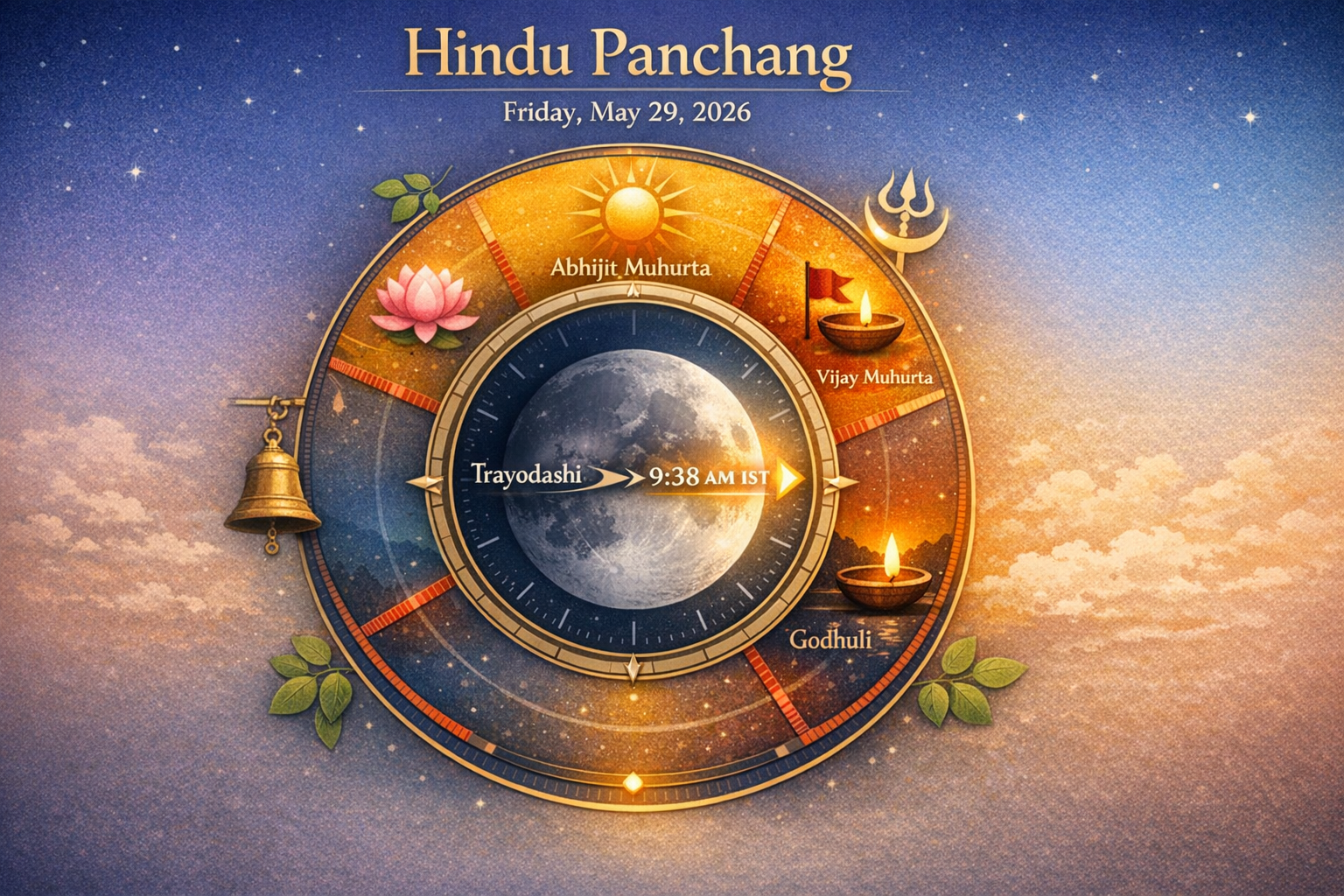
Friday, May 29, 2026 in the Hindu calendar (Panchang) begins with Shukla Paksha Trayodashi (the thirteenth lunar day of the waxing phase) and transitions to Shukla Paksha Chaturdashi (the fourteenth lunar day of the waxing phase) at approximately 9:38 AM on May 29, in most Indian almanacs based on IST. Because Tithi is a lunar measure, exact change times can shift across regions and time zones; users outside India should adjust to local sunrise and time standards.
Tithi denotes a 12-degree elongation between the Sun and the Moon and is one of the five primary limbs of the Panchangthe others being Vara (weekday), Nakshatra (lunar mansion), Yoga, and Karana. Since lunar motion is not uniform, a Tithi’s duration varies (it does not map neatly to civil-clock days), which explains why changeovers can occur at any hour. This precision is central to Muhurta (electional astrology) in the Hindu calendar and to decisions about ritual timing, fasting, and community observances.
On this date, the day opens under the spiritual tenor of Shukla Paksha Trayodashi and moves into Shukla Paksha Chaturdashi before midday. For most daily observances, the effective Tithi at the time of an action is what matters; hence, tasks performed before 9:38 AM partake of Trayodashi’s quality, whereas those afterward align with Chaturdashi. This shift is noteworthy for devotees planning specific sadhanas or temple visits.
Within the Panchang framework, Vara offers weekday color (Friday customarily favoring gentle beginnings and Venus-governed aesthetics), while Nakshatra provides the lunar backdrop for the mind and activity, and Yoga and Karana further nuance the day’s auspiciousness profile. Together, these five limbs form an integrated decision system for the Hindu calendar, guiding everything from personal vows to community festivals.
Shukla Paksha Trayodashi is traditionally associated with Shiva upasana and, when aligned with the Pradosh period (sunset window), gives rise to Pradosh Vrat. Because Trayodashi ends by about 9:38 AM (IST) on May 29, Pradosh observance for this fortnight will generally have aligned with the prior evening in many regions; those planning vrata-s or temple participation should verify Pradosh against the local sunset-bound rule used by their sampradaya or regional almanac. In practical terms, early-morning Shiva abhishekam, mantra-japa, and light sattvic routines harmonize well with Trayodashi’s contemplative tone.
Shukla Paksha Chaturdashi, beginning after the Trayodashi end time, continues the strong Shiva orientation found across all Chaturdashi Tithis (the monthly Krishna Paksha Chaturdashi being the famed Shivaratri). While not universally prescribed for major samskaras (many classical texts avoid Chaturdashi for marriage), the Tithi is spiritually potent for vrata, japa, and inner purification. Devotees often notice that meditation, stotra patha, and quiet seva feel especially anchored during this phase.
Auspicious and widely used windows (“Good Time”) that require only local sunrise/sunset and not the exact Nakshatra include: (1) Brahma Muhurtaroughly 1 hour 36 minutes to 48 minutes before local sunrisehighly beneficial for meditation, mantra, and study; (2) Abhijit Muhurtacentered on local solar noon, about 24 minutes before and after itregarded as a generally auspicious period for initiating tasks when other Muhurtas are unavailable; (3) Vijay Muhurtalate afternoon, often about 1.5–2.5 hours before local sunset, used for endeavors seeking success and resolution; and (4) Godhuli Belaaround sunsetsuitable for light, devotional undertakings. These practical anchors help align daily life to the Hindu calendar without needing full ephemerides.
Time windows to avoid for initiating important activities on Fridays are given by the weekday patterns of Rahu Kalam, Yamaganda, and Gulikai Kalam. For a notional 12-hour day (e.g., 6:00 AM–6:00 PM), the Friday segments are approximately: Rahu Kalam ~ 10:30 AM–12:00 PM; Yamaganda ~ 3:00 PM–4:30 PM; Gulikai Kalam ~ 7:30 AM–9:00 AM. For accurate use, compute the daylight duration (sunset minus sunrise), divide by eight, and scale each segment to the day’s actual length; then map the Friday pattern to those scaled blocks. These intervals are traditionally avoided for starting travel, contracts, or first-time actions, though routine continuation is generally acceptable.
Nakshatra and Rashi (Moon sign) provide fine-grained personalization. The Moon’s Nakshatra, when combined with Tarabalam and Chandrabalam, guides individual suitability for actions; the Chandra Rashi shapes mood and outcome tendencies. Because Nakshatra and Rashi on May 29, 2026 depend on exact location and time of observation, practitioners should consult a reliable regional Panchang or an ephemeris-based almanac for their city. Once known, the day’s Nakshatra can be integrated with the Trayodashi→Chaturdashi transition to refine Muhurta decisions (e.g., ideal start windows for study, puja, or travel).
Across Dharmic traditions, this lunar reckoning offers a shared rhythm. Many Hindu households align sadhana with Tithi and Nakshatra; Buddhists mark Uposatha observances by lunar phases; Jains plan fasts and pratikraman by Tithi; and several Sikh commemorations historically referenced the Bikrami (Vikram Samvat) cadence. Recognizing this common celestial framework fosters unitydiverse practices move in step with the same Moon, affirming a civilizational coherence that values plural paths and shared timekeeping.
Practical planning for May 29, 2026 thus benefits from a two-step view: (1) acknowledge the core Tithi flowShukla Paksha Trayodashi until about 9:38 AM (IST), then Shukla Paksha Chaturdashi; and (2) anchor activity in robust daily Muhurtas (Brahma Muhurta, Abhijit, Vijay Muhurta) while sidestepping Friday’s Rahu Kalam, Yamaganda, and Gulikai segments. Many practitioners report that beginning reflection, japa, or study before sunrise lends unusual clarity, while initiating work near Abhijit or in the late-afternoon Vijay Muhurta supports steady progress and favorable closure.
Accuracy notes: The 9:38 AM Tithi change is based on most Indian Panchangs using IST and sunrise conventions; outside India, Tithi boundaries and Pradosh placement may differ. For sacred vows, marriage, property transactions, or community ceremonies, one should confirm with a local, tradition-consistent Panchang to ensure that Tithi, Nakshatra, Yoga, and Karana align with the sampradaya’s Muhurta rules. Used with that care, the Hindu calendar becomes an effective compass for both spiritual depth and practical success.
Inspired by this post on Hindu Blog.