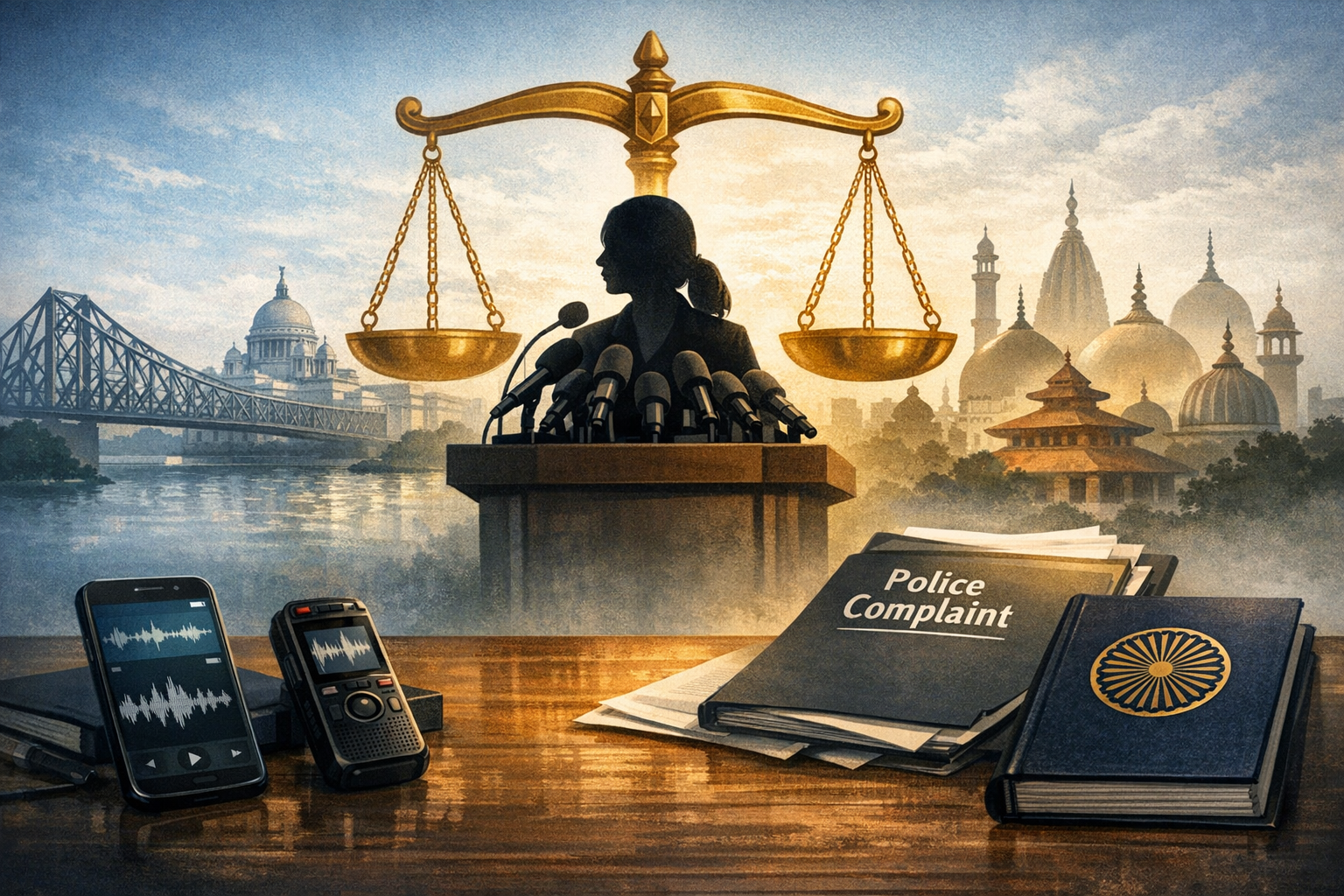
A police complaint has reportedly been filed against Trinamool Congress leader Mamata Banerjee over alleged remarks considered derogatory to Hindu Dharma and suggestive of “instilling fear of Muslims” among Hindus. The complaint has transformed a routine news cycle into a high-visibility legal and political flashpoint in West Bengal, sharpening public focus on the balance between free political expression, protection of religious sentiments, and communal harmony.
Beyond the immediate headlines, the matter sits at the intersection of constitutional guarantees and statutory restraints. India’s constitutional architecture protects freedom of speech (Article 19(1)(a)) and freedom of religion (Article 25), while expressly permitting reasonable restrictions on speech in the interests of public order, decency, and morality (Article 19(2)). Allegations of insulting religion or promoting enmity between groups commonly invite scrutiny under provisions of the Indian Penal Code (IPC), but prosecution requires a high bar of evidence and intent tested within well-settled judicial frameworks.
Several IPC provisions are typically examined in such situations: Section 295A (deliberate and malicious acts intended to outrage religious feelings), Section 153A (promoting enmity between different groups), Section 505(2) (statements creating or promoting enmity, hatred, or ill-will between classes), Section 298 (uttering words with deliberate intent to wound religious feelings), and, depending on facts, Section 504 (intentional insult to provoke breach of peace). Each demands context-specific analysis of content, intent (mens rea), and likely impact on public order.
The Supreme Court has clarified the thresholds that separate protected expression from punishable hate speech. In Ramji Lal Modi v. State of UP (1957), the Court upheld Section 295A, emphasizing that only “deliberate and malicious” insults to religion fall within its scope. Later, in S. Rangarajan v. P. Jagjivan Ram (1989), the Court underlined that mere fear of disturbance cannot be grounds to suppress speech unless there exists a close and direct nexus to public disorder. More recently, in Amish Devgan v. Union of India (2020), the Court articulated a multi-factor testcontext, intent, content, and likely harmguiding police and courts in distinguishing robust political critique from unlawful incitement.
Procedure matters. A police complaint is an initial step; it may or may not culminate in a First Information Report (FIR). Under Lalita Kumari v. Government of UP (2013), police must register an FIR for cognizable offences, but may conduct a brief preliminary inquiry in certain categories of cases to verify the basic facts. If the alleged remarks are based on audio or video recordings, admissibility and reliability rest on proper certification and chain-of-custody under Section 65B of the Indian Evidence Act. The Supreme Court in Anvar P.V. v. P.K. Basheer (2014) and Arjun Panditrao Khotkar v. Kailash Kushanrao Gorantyal (2020) clarified that a valid 65B certificate is ordinarily mandatory for electronic evidence.
Arrest is not automatic. In Arnesh Kumar v. State of Bihar (2014), the Supreme Court mandated that for offences punishable up to seven years, police should ordinarily issue a notice under Section 41A CrPC rather than making immediate arrests. Most speech-related IPC provisions in this domain carry maximum sentences within that threshold, reinforcing a due-process-first approach and aiming to curb unnecessary custodial action.
Sanction for prosecution is another crucial checkpoint. Under Section 196 CrPC, prior governmental sanction is required to prosecute offences under Sections 153A, 295A, and 505. This mechanism ensures executive oversight where speech and public order intersect, and it serves as an institutional filter against frivolous or politically motivated prosecutions without precluding genuine grievances from proceeding to trial.
From complaint to courtroom, the pathway can take several routes. Police may (a) close the complaint if no cognizable offence is made out; (b) register an FIR and investigate; or (c) refer parties to a Magistrate for further directions. Complainants can also approach a Magistrate under Section 156(3) CrPC to seek an order for investigation. Conversely, an accused may move the High Court under Section 482 CrPC to quash proceedings if the ingredients of the offence are not disclosed on the face of the complaint or if protected speech is being chilled without legal basis.
Context in West Bengal is significant. The state’s political competition is intense, and language in public rallies or interviews often travels widely, sometimes clipped or decontextualized on social media. For communities rooted in neighborhood pujas, langars, bauddha vihāras, and jain derasars, rhetoric perceived as communal can feel personal. Families in Kolkata, Siliguri, and Asansol navigate these episodes with a mix of civic pride, caution, and hope that leaders will respect both Dharma and constitutional civility in equal measure.
The complaint’s phrasingalleging insult to Hindu Dharma and “instilling fear of Muslims” among Hindusinvokes the core of Sections 295A and 153A/505(2). Yet courts insist on precise proof of intent and effect. Political critique, even sharp or unwelcome, is ordinarily protected; it crosses the legal line only when deliberately and maliciously targeted to outrage religion or when it demonstrably promotes enmity, hatred, or ill-will between groups in a manner proximate to public disorder. That legal precision, while sometimes frustrating for complainants and respondents alike, protects both civic harmony and democratic speech.
Defences in such matters often include: lack of malicious intent; fair comment on matters of public interest; contextualized statements misreported or selectively edited; and, in some cases, clarifications or apologies that mitigate perceived harm. Courts evaluate not only the literal words but also the setting, audience, and likely impact. Where doubt exists, judicial practice tends to avoid criminalizing political speech unless the statutory elements are clearly satisfied.
Institutional actors may also weigh in. High Courts, including the Calcutta High Court, have previously balanced free expression against the duty to prevent communal flare-ups, sometimes issuing directions for restrained reporting or for expedited, fair investigations. Such oversight reinforces that legal outcomes are not preordained by the political prominence of the parties involved but by established evidentiary and constitutional standards.
Responsible civic conduct is essential in such flashpoints. Citizens and community organizations are best served by verifying full-context transcripts or videos; avoiding the amplification of edited or decontextualized clips; and relying on formal legal avenues rather than rumor or provocation. Fact-checking, preserving original media for forensic authentication, and engaging legal counsel early tend to produce more meaningful and durable outcomes than online escalations.
Media literacy complements the rule of law. Editorial diligencepresenting contested speech with context, publishing clarifications prominently when warranted, and foregrounding court-tested factsreduces the risk of communal mistrust. Journalistic prudence aligns with constitutional values by informing rather than inflaming, especially where Dharmic communities coexist in close civic spaces.
The broader Dharmic lensshared by Hinduism, Buddhism, Jainism, and Sikhismplaces ahiṃsā (nonviolence), karuṇā (compassion), maitri (friendship), and satya (truth) at the center of social life. In that spirit, community leaders can model restraint in rhetoric, create interfaith and intrafaith listening circles, and issue joint statements affirming that political disagreements must not be allowed to fracture neighborhood bonds or shared festivals. The ideal remains simple and exacting: strong views, expressed with responsibility; spirited debate, free from denigration.
Pragmatically, several outcomes are possible once evidence is reviewed: the complaint may be closed if legal thresholds are unmet; an FIR may be registered leading to investigation; or a negotiated de-escalation, including clarifications, may restore calm. Each pathway benefits from transparent procedures, certified electronic evidence, and timely communication to the public to prevent rumor cascades.
Legally, this episode will likely revolve around three questions. First, do the words, in full and fair context, satisfy the deliberate and malicious intent required by Section 295A? Second, do they promote enmity or ill-will between groups with a proximate risk to public order under Sections 153A/505(2)? Third, does the overall context (event type, audience, timing) convert otherwise protected political speech into punishable advocacy of hatred? Courts will align answers with constitutional doctrine rather than popular temperature.
This balanced approach serves a practical civic purpose. It demonstrates that safeguarding Hindu Dharma’s sentiments and protecting inter-community trust are not mutually exclusive. By insisting on due process and high evidentiary standards, the legal system preserves room for robust political debate while shielding society from speech that crosses into targeted denigration or calls to hostility.
For residents and the diaspora alike, the lived experience of unityshared markets, schools, processions, and ritualsremains stronger than any single speech controversy. The guiding ethic of Vasudhaiva Kutumbakam and the constitutional promise of equality before the law converge in moments like this, calling for patience, precision, and principled engagement.
In sum, the complaint against Mamata Banerjee has become a case study in how Indian law navigates contested speech at the fault line of religion and politics. The outcome will depend on verifiable evidence, proof of intent, and careful judicial reasoningnot on partisanship. Whatever the legal result, the broader civic task is constant: to uphold Dharma-inspired compassion and constitutional civility together, ensuring that disagreements, however vigorous, do not break the bonds that hold West Bengal’s diverse communities as one.
Inspired by this post on Struggle for Hindu Existence.