The enduring practice of offering twenty-one blades of durva grass to Ganesha stands at the intersection of story, symbol, and spiritual insight. Within Hindu traditions, this seemingly simple ritual encodes sophisticated philosophical ideas about the senses, the mind, and cosmic harmony, while also conveying a deeply relatable lesson: humility and sincerity often resolve what grandeur cannot.
Across Puranic and regional retellings, the legend of Analasura provides the narrative backdrop. Analasura, a demon of searing ferocity, terrorized the three worlds with an unbearable, all-consuming heat. Celestial beings turned to Ganesha, the remover of obstacles, whose calm resolve and protective compassion are celebrated throughout Hindu Stories.
Ganesha confronted Analasura and, in many accounts, subdued him by swallowing him whole. Yet the demon’s fiery energy continued to blaze within, making even the cosmos feel the intensifying heat. Deities attempted remedies—cooling substances, sacred symbols, and celestial interventions—yet the heat persisted, underscoring a profound motif in Hindu symbols: immense power sometimes yields only to unassuming grace.
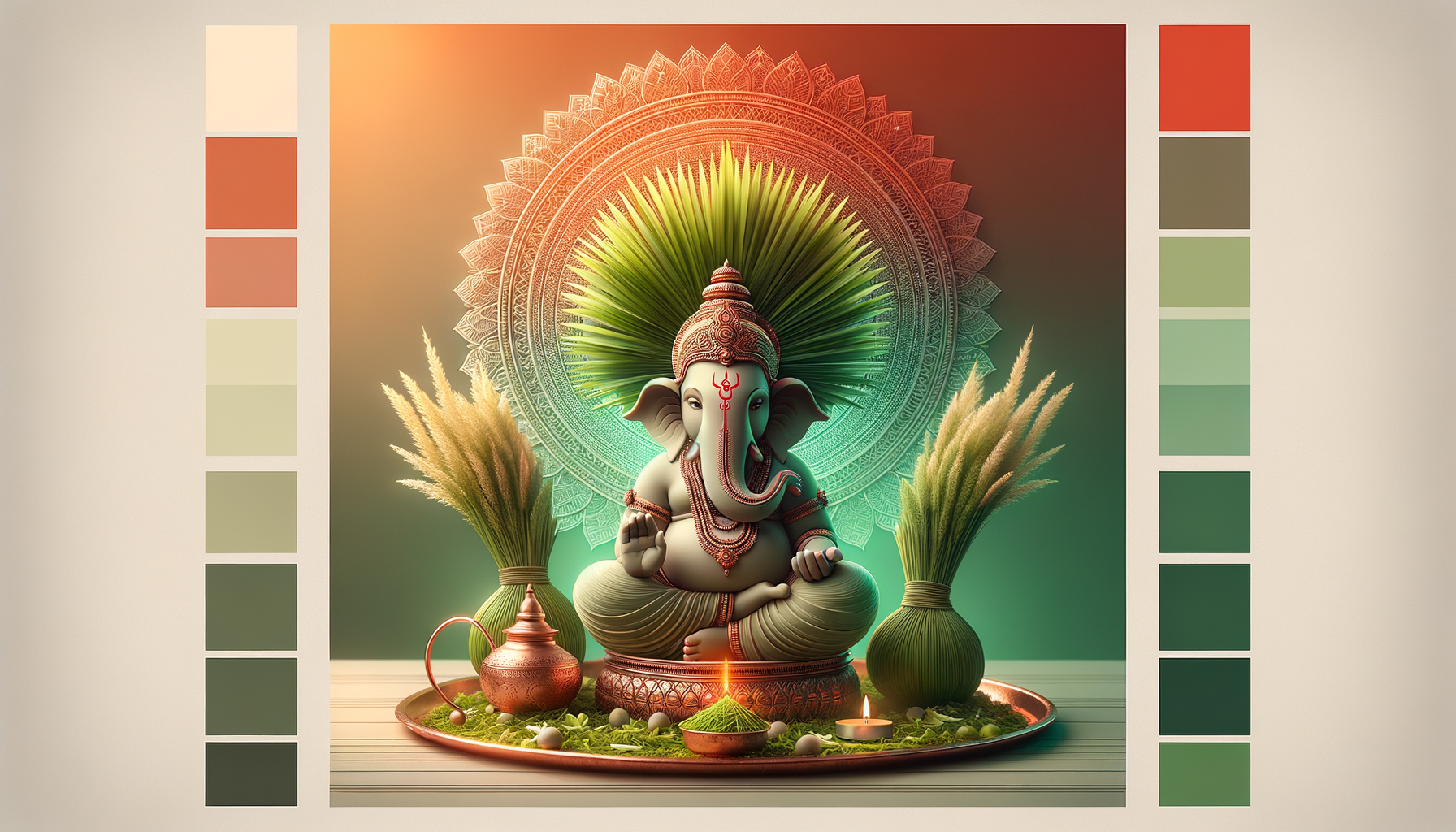
The turning point arrives when a humble offering of durva (Cynodon dactylon) is placed upon Ganesha—often described as twenty-one blades gathered and offered with devotion. At once, the unbearable heat subsides. The message is as evocative as it is elegant: it is not opulence but purity of intent, expressed through nature’s simplest gifts, that restores balance. This is why, even today, twenty-one durva blades are offered to Ganesha in homes and temples across India.
Symbolically, the number twenty-one is interpreted in several complementary ways within Sanatan Dharma. One widely shared explanation views the offering as a surrender of the individual’s twenty-one facets to the Divine: the five jñānendriyas (organs of knowledge), five karmendriyas (organs of action), five prāṇas (vital energies), the four components of the inner instrument (manas, buddhi, ahaṁkāra, citta), and the fundamental duality of puruṣa–prakṛti—together totaling twenty-one. Another traditional mapping sees twenty-one as a cosmological whole: the eight directions, the five great elements (pañca-mahābhūtas), the three guṇas (sattva, rajas, tamas), the three states of consciousness (jāgrat, svapna, suṣupti), and the unifying presence of ātman, again summing to twenty-one. In both readings, the devotee offers the entirety of embodied experience and environment to Ganesha.
Durva itself carries layered meaning. Botanically resilient and cooling by Ayurvedic understanding, it is associated with steadiness, vitality, and freshness. Its sattvic character and ubiquity make it an ideal, ecologically sensitive offering: accessible to all, gentle toward the environment, and emblematic of the dharmic ethic that honors nature as sacred. In this way, the ritual harmonizes spiritual symbolism with sustainable practice.
In practice, devotees typically gather fresh, green durva—often with three nodes per strand—and gently bind them into twenty-one blades. The offering is placed upon the head or trunk of Ganesha, accompanied by a simple mantra such as ‘Om Gam Ganapataye Namah’. Many describe a palpable quieting of the mind during this act, as if the heat of restlessness yields to a cool clarity.
Viewed through a broader dharmic lens, the story and the offering exemplify values shared across Hinduism, Buddhism, Jainism, and Sikhism: humility over pride, the power of inner discipline, compassion for all beings, and reverence for the natural world. While liturgical forms differ among these traditions, the underlying ethos—simplicity in practice, self-mastery, and service—converges in ways that nurture social harmony and spiritual well-being.
For contemporary life, the ritual speaks with renewed relevance. In an age enamored with excess, the twenty-one blades of durva propose a counter-ideal: minimal, mindful, and meaningful. The practice invites practitioners to integrate body, breath, senses, and mind into a single, steady intention—offering the whole of oneself to a higher purpose and, in doing so, finding balance amidst intensity.
Thus, the offering of twenty-one durva blades to Ganesha, rooted in the Analasura legend, is more than a story. It is a living pedagogy—an experiential teaching that transforms myth into method, symbol into self-reflection, and devotion into a gentle, cooling insight that all paths of dharma can recognize and affirm.
Inspired by this post on Hindu Blog.