Vamavarti Ganesha, also known as Vamavarta Ganapati, refers to the form of Shri Ganesha whose trunk turns to the left. In Indic languages, vama denotes the left side, and varti indicates “turned toward,” yielding a precise iconographic description. Within Hindu traditions, the leftward turn is associated with gentle, auspicious, and nurturing energies, making this form especially harmonious for the household altar and daily grihastha life.
Understanding why the leftward trunk is regarded as saumya (benign) benefits from both symbolic and yogic perspectives. In the subtle-body framework of yoga, the left channel (Ida nadi) is lunar, cooling, and inward-facing, associated with calm focus and receptivity. The left-curving trunk consequently signifies moderation, serenity, and steady grace—qualities that align with the rhythms and responsibilities of family life.
By contrast, the right-curving trunk (often termed Dakshinavarti in Sanskrit and Valampuri in Tamil) is traditionally linked with the solar, heating Pingala nadi and with more exacting ritual disciplines. That form is deeply revered but generally recommended under consistent, prescribed worship regimens. The Vamavarti form, in turn, is widely preferred for homes because it communicates auspiciousness without imposing strict ritual obligations that many householders may find difficult to maintain daily.
The benefits associated with Vamavarti Ganesha, as preserved in temple practice and household experience, cohere around harmony and clarity. Devotees associate this form with the softening of interpersonal friction, smoother beginnings for new endeavors, stable learning environments for children, and a general reduction in mental strain. In this reading, “obstacle removal” is not merely external problem-solving; it is the quiet reordering of one’s inner landscape—attention, patience, and resilience—so that life’s tasks proceed without unnecessary turbulence.
Agamic and Shilpa Shastra traditions recognize distinct Ganapati iconographies to guide worship. While the Puranas present Ganesha as the compassionate remover of obstacles and patron of learning, the Mudgala Purana, in particular, classically describes eight primary manifestations of Ganesha—each illuminating a specific mode of overcoming hindrances. Against this broader backdrop, the left-curving trunk (Vamavarti) is received as an emblem of the gentler stream of grace (anugraha) that suits families, students, and practitioners seeking sattvic stability in everyday life.
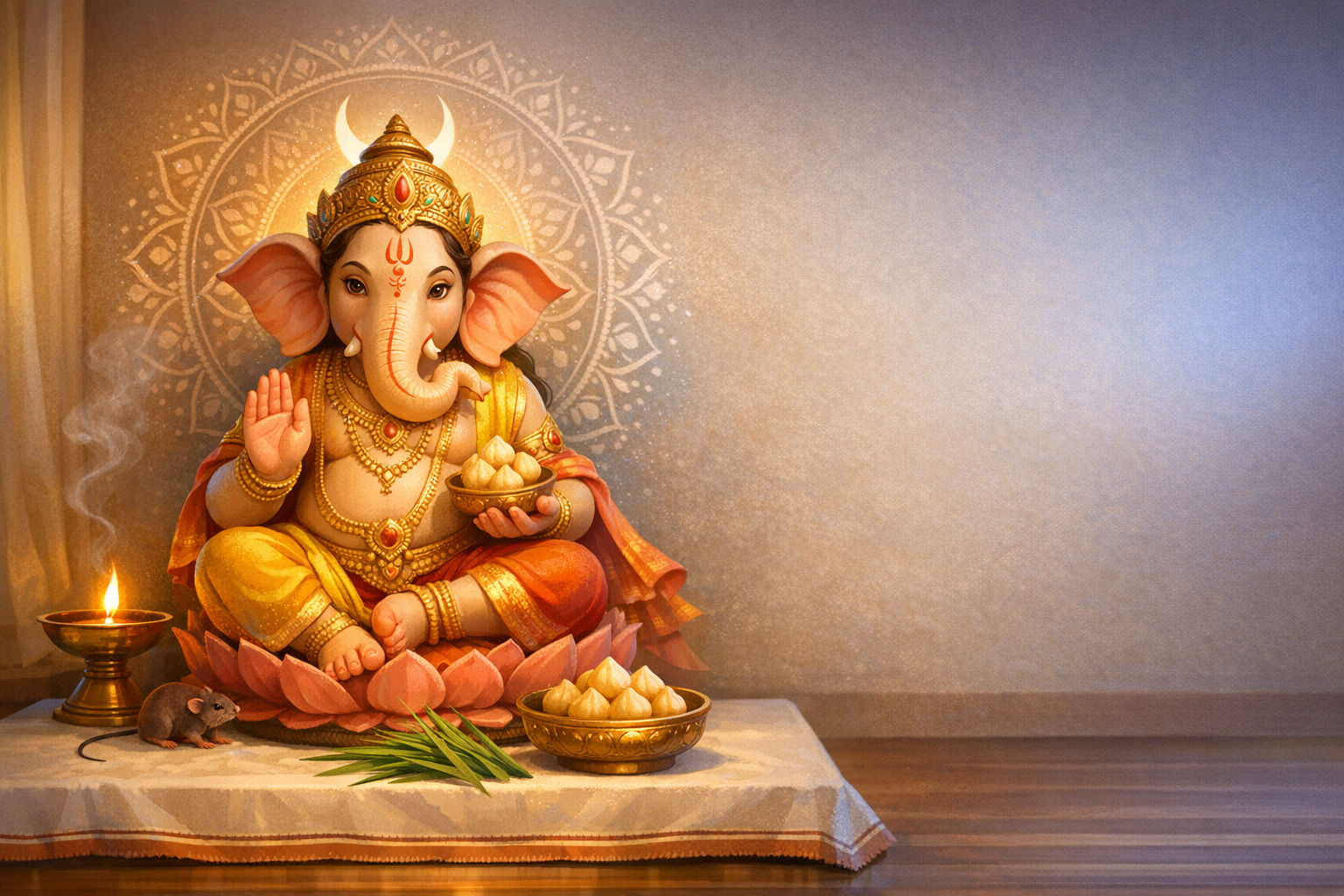
The iconography of Vamavarti Ganesha rewards close attention. The large head suggests expansive intelligence and the capacity to synthesize knowledge; the broad ears evoke discernment and the willingness to listen well; the small eyes indicate one-pointed concentration; and the long trunk symbolizes adaptability—the ability to attend to both the subtle and the practical. The modaka cupped in the hand expresses the sweet reward of sadhana, while the mushika (mouse) denotes restless desire refined into a capable vehicle when harnessed by wisdom.
Within household worship, a seated Vamavarti Ganesha in lalitasana (royal ease) is commonly recommended for its visual language of composure and approachability. Materials such as stone, wood, or clay are favored for their natural qualities; metal murtis are also widely used. For domestic shrines, moderate sizes facilitate daily care and respectful handling. Cleanliness, a raised platform, and a dedicated cloth or asana for the murti help maintain sanctity.
Vaastu-minded placement typically favors the puja space in the Ishana (northeast) quadrant or a calm, well-ventilated, and uncluttered area of the home. The murti should rest on a stable pedestal or altar, not directly on the floor, and not share a wall with a bathroom. Placing one primary Ganesha murti in the household altar is customary, as multiplicity can diffuse focus. Ensuring that worshippers can comfortably face east during puja is a time-tested practice aligned with sunrise and fresh prana.
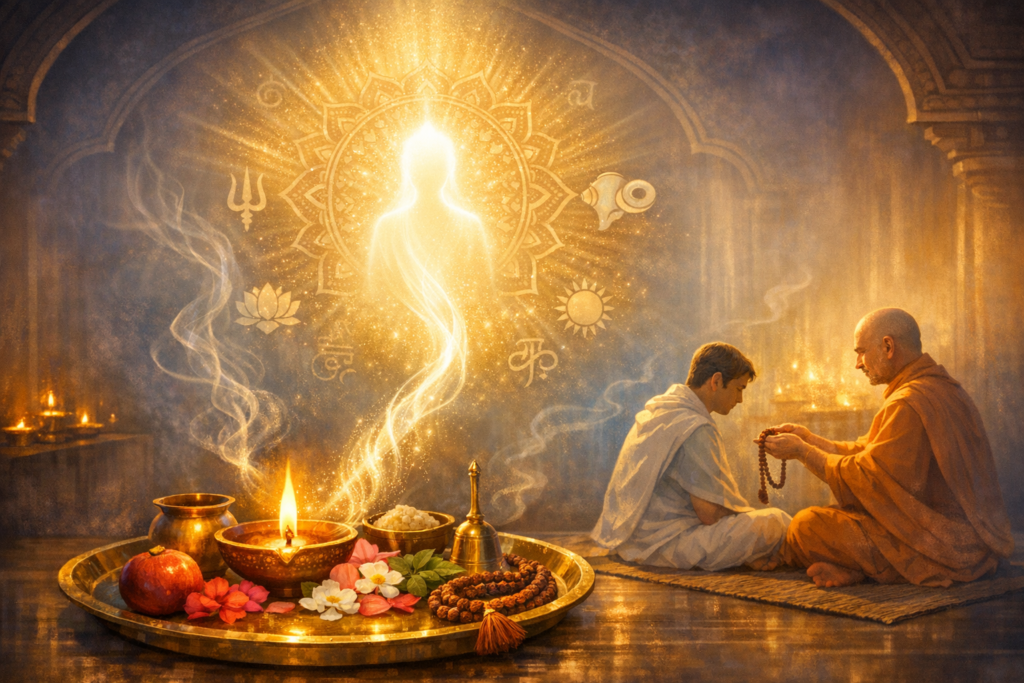
A concise household puja-vidhi for Vamavarti Ganesha weaves devotion with simple structure. After light purification (achamana) and sankalpa (setting intent), one may offer a seat (asana), invite presence (avahana), and perform a brief abhishekam. This is followed by gandha (fragrant paste), akshata (grains), pushpa (flowers, especially durva), dhoopa (incense), deepa (lamp), and naivedya (e.g., modaka or laddu). A concluding arati and pranam seal the worship with gratitude.
Mantras anchor attention and stabilize the mind. The seed mantra “Om Gam Ganapataye Namah” is straightforward and powerful for japa, whether 11, 21, or 108 repetitions, depending on time. The Ganesha Atharvashirsha, a revered hymn, deepens meditative absorption and articulates Ganesha’s all-pervading presence in Vedic language. Many households also recite “Vakratunda Mahakaya” before studies, journeys, or new ventures to invite auspicious beginnings.
Durva grass holds a distinctive place in Ganapati worship. Popular Puranic narrations recount that after subduing a fiery asura, the cooling potency of durva soothed Ganesha’s intense heat—a mythic way of extolling its sattvic, pacifying quality. Offering fresh, clean durva (often as tri-blades) to Vamavarti Ganesha aligns with the left-trunk’s cooling, lunar symbolism and is cherished as an expression of simplicity and devoted attention.
Naivedya is chosen for purity and care. Modaka or laddu symbolize the sweetness of realized knowledge; fruit such as banana, pomegranate, or coconut reflect fertility and wholeness; a little jaggery or rock sugar embodies wholesome nourishment. In every case, the attitude of heartfelt offering matters more than elaboration. After arati, prasada is shared to distribute the blessing across the household, reinforcing unity and goodwill.
Timing further enhances resonance. Daily worship at dawn or early evening settles the mind’s transitions. Monthly Sankatahara Chaturthi (the Krishna Paksha Chaturthi) is observed for Ganesha’s aid in dissolving difficulties, while Bhadrapada Shukla Chaturthi (Ganesh Chaturthi) joyfully marks Ganesha’s festival of arrival. Tuesdays and Chaturthi tithis are particularly popular for additional japa, simple vrata, or a special offering of durva and modaka.
Abhishekam may be as simple as pure water with a few drops of rose water, or, when appropriate for the murti’s material, a gentle panchamrita (milk, curd, ghee, honey, and sugar) offering. Many householders reserve more elaborate abhishekas for temple settings and keep domestic worship modest yet consistent, aligning with the Vamavarti ideal of quiet auspiciousness sustained over time.
Clarity around right- and left-trunk forms helps practitioners choose responsibly. The Dakshinavarti (right-trunk) form is held to a higher ritual standard; it is beloved in many temples and homes but traditionally approached with disciplined nitya-puja. The Vamavarti form, by contrast, is widely regarded as ideal for households seeking a steady, compassionate current of grace in the midst of work, education, care-giving, and community participation.
From a dharmic well-being perspective, the benefits attributed to Vamavarti Ganesha flow through several domains: steadier attention and learning for students, calmer dialogue for couples and families, greater patience and clarity for professionals and entrepreneurs, and a general atmosphere conducive to ethical conduct and mutual support. Many householders describe a distinctive sense of “ease” that greets them at the altar—subtle but reliable—encouraging small daily acts of devotion that strengthen resilience.
These outcomes are also read through the lens of guna theory. Leftward, lunar symbolism harmonizes with sattva—luminosity, balance, and insight—rather than with agitation (rajas) or inertia (tamas). Over time, regular engagement with mantra, lamp-lighting, and prasada-sharing collaborates with this symbolism to refine habits, steady emotions, and orient choices toward dharma in practical, household-friendly ways.
Classical texts such as the Padma Purana and Skanda Purana praise Ganesha as the grantor of auspicious beginnings and the pacifier of obstacles, while the Mudgala Purana’s eight forms present a taxonomy of challenges and their transcendence. Within this wider scriptural canvas, the Vamavarti emphasis can be appreciated as a visual theology of grace—quiet, cooling, and consistent—especially fitting for domestic worship where continuity matters more than occasional grandeur.
In practice, a simple daily routine proves effective: light the lamp, offer a few blades of durva, chant “Om Gam Ganapataye Namah,” and sit for a minute of stillness. Such brevity does not diminish depth; rather, it keeps devotion sustainable. Families often invite children to place a single flower or sing a short prayer, allowing the altar to become a lived classroom where reverence, attention, and gratitude are learned by doing.
New ventures—whether signing a lease, commencing studies, or inaugurating a small business—are frequently dedicated to Vamavarti Ganesha. The gesture focuses intention and aligns action with values, which is precisely how “obstacles” are most often removed: by clarifying motivation, improving cooperation, and encouraging right timing. In that sense, Ganesha’s blessing is as psychological as it is metaphysical.
Care for the murti expresses care for the relationship. Periodic gentle cleaning, seasonal flower garlands, or a fresh cloth upon the altar keep the space vibrant. When travel or illness disrupts routine, a single lamp and mantra suffice to maintain continuity. The Vamavarti principle favors such constancy—the slow, steady cultivation of auspiciousness that families can sustain through changing circumstances.
Within the broader dharmic family—Hinduism, Buddhism, Jainism, and Sikhism—shared values illuminate convergences without requiring uniform rituals. Ganesha appears in South Asian Buddhist art and texts (as Ganapati), while Jain temple complexes historically include Ganesh iconography in certain regions as part of a broader sacred ecosystem. Sikh teachings emphasize wisdom, humility, seva, and overcoming inner obstacles—virtues that harmonize with the Ganesha ethos even when forms of worship differ. This unity in diversity underscores a civilizational commitment to mutual respect and spiritual growth.
Common questions arise around what to do if the trunk is centrally raised or only slightly leftward. Traditional guidance is practical: a gentle leftward inclination generally qualifies as Vamavarti for householders, and the spirit of devotion remains paramount. If there is uncertainty, consulting a knowledgeable priest or following family parampara ensures continuity with living tradition.
Ultimately, Vamavarti Ganesha brings together three streams—sound (mantra), form (murti), and intention (sankalpa)—into a quietly transformative household practice. The left-curving trunk’s symbolism of cooling grace becomes experiential over months and years, reshaping attention, speech, and action. As families learn to pause, listen, and proceed with clarity, auspiciousness reveals itself not as a fleeting event but as a cultivated way of life.
Key takeaways cohere simply: the left-curving trunk (Vamavarti) signifies gentle, auspicious, lunar energy aligned with grihastha life; daily worship can be brief yet consistent; durva, modaka, and the mantra “Om Gam Ganapataye Namah” remain time-honored; and respectful placement, cleanliness, and gratitude complete the practice. Grounded in scriptural memory and living custom, Vamavarti Ganesha offers a stable center for household well-being and a shared touchstone across dharmic traditions.
Inspired by this post on Hindu Blog.