
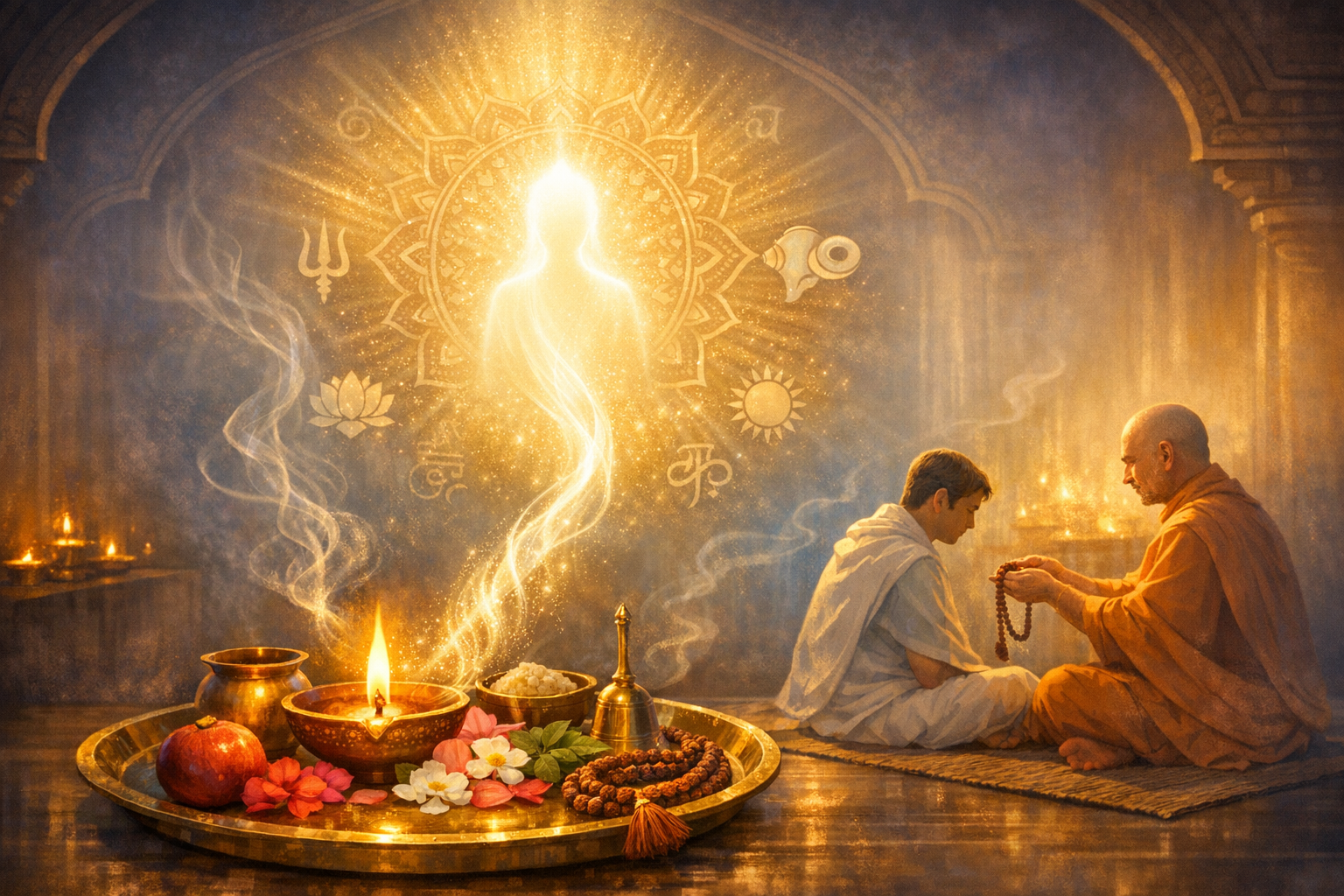
Ishta Devata and bhakti yoga stand at the heart of Hindu spiritual life, combining the intimacy of a chosen deity with a disciplined, ethically grounded path of devotion. Within this framework, rituals hold major importance, particularly in gauni bhakti (preparatory or instrumental devotion), which is explicitly oriented toward cleansing the mind (citta-śuddhi) and cultivating pure, one-pointed devotion. In this preparatory stage, the bhakta is trained to move beyond transactional prayers and to aspire toward disinterested love for Bhagavan, where devotion is practiced not as a means to acquire material benefits but as a direct, transformative relationship with the Divine.
Ishta Devata literally means “the chosen or cherished deity.” It is not merely a personal preference; it is a soteriological strategy that unifies spiritual focus, stabilizes attention, and anchors the emotions in a sacred form of saguna Brahman. In different schoolsSmarta, Vaishnava, Shaiva, and Shaktathe Ishta Devata embodies accessible divinity: a focal form for upāsanā (contemplative worship) that helps a seeker journey toward the formless (nirguna) Reality. The logic is both psychological and metaphysical: one form, approached with steadiness and reverence, becomes a gateway to the One Truth that transcends all forms.
Rituals in gauni bhakti are not perfunctory acts; they are carefully designed practices that refine the senses, steady the mind, and purify intention. Ablutions, ācamana, lighting of the lamp, recitation of mantras, archana with flowers or tulasi, and arati are progressive touchpoints for attention and feeling. When observed with mindfulness and sincerity, these practices convert scattered mental energy into ekāgratā (one-pointedness), enabling a deeper interiorization of devotion. Hence, gauni bhakti (preparatory) is meant for cleansing the mind and developing pure and intense devotion for God.
The classical ethos of bhakti yoga emphasizes that the bhakta must not pray to God for the fulfillment of selfish, material needs. This caution does not condemn human aspirations or distress; rather, it redirects spiritual intent from desire-driven ritualism (sākāma) to devotion free from personal bargaining (niṣkāma). As the inner motive becomes self-offering rather than self-advantage, devotion matures from gauni bhakti to para-bhaktipure love that delights in the Divine for its own sake.
Different traditions map this maturation with nuanced terminology. Many teachers explain a continuum from sādhanā-bhakti (cultivated practice) to bhāva-bhakti (spiritual sentiment) and prema-bhakti (divine love). The language of gauni bhakti versus para-bhakti presents a parallel arc: from instrumental devotion meant to purify, to ultimate devotion that is its own fulfillment. Across these schemas, the throughline remains consistentrituals educate the heart so that love outgrows need.
Bhakti yoga’s inner curriculum is further elaborated through the well-known navadhā-bhakti (nine modes of devotion): śravaṇa (listening), kīrtana (chanting), smaraṇa (remembrance), pāda-sevana (service), archana (worship), vandana (obeisance), dāsya (servitude), sakhya (friendship), and ātma-nivedana (self-surrender). These are not rigid steps but interactive dispositions that progressively transform cognition, affect, and volition. Rituals give form to these dispositions; contemplation and daily conduct give them depth.
For safety, clarity, and fidelity to lineage, bhakti yoga should place the bhakta under the guidance of a guru. A realized or at least well-trained guide is essential to ensure that practice is correctly transmitted, that mantras are appropriately received through dīkṣā, and that obstacles (physical, emotional, or doctrinal) are addressed with discernment. The Guru-Shishya Tradition safeguards continuity, corrects error, and protects the seeker from spiritual hazards such as pride, mechanical ritualism, or spiritual bypassing.
In practical terms, the role of the guru encompasses four interlocking functions: clarifying metaphysical orientation (siddhānta), prescribing a do-able regimen (anuṣṭhāna), monitoring progress and pitfalls (parīkṣā), and cultivating healthy integration of devotion, ethics, and everyday life (dharma-ācharaṇa). Authentic guidance also ensures that ritual forms remain living pedagogies rather than mere performance, and that the bhakta’s love is tethered to humility, service, and inner transformation.
The architecture of daily worship typically includes simple yet potent sequences. After a brief centering, the practitioner undertakes panchopachara (five offerings) or aṣṭopachara (eight offerings), sometimes extending to ṣoḍaśopachara (sixteen). Offerings of fragrance, lamp, water, and food are enacted with presence, gratitude, and mantra. Abhishekam (ritual bathing) is observed on specific days or festivals, but even in its absence, pure intent and careful attention to the Ishta Devata allow the bhakta to recreate the essence of consecration in the home shrine.
Japamantra repetitionlinks breath, sound, and attention into a single contemplative current. Practitioners often synchronize mala beads with inhalation and exhalation to align the nervous system and reduce mental rumination. Over time, japa becomes smaraṇa (constant remembrance), turning daily life into an extension of the shrine. As upāsanā matures into dhyāna (meditation), the ishta’s presence is felt not only before the mūrti but also within the quiet center of awareness.
Choosing an Ishta Devata can be guided by several dharmic considerations. Family tradition may introduce a Kula Devata, whose worship transmits ancestral bonds and continuity. Personal temperament (svabhāva) may incline one toward Śiva’s meditative stillness, Viṣṇu’s sustaining grace, Devī’s compassionate power, Sūrya’s clarity, or Gaṇapati’s wisdom. Sometimes, a decisive call arises during pilgrimage, through a dream, or in the presence of a guru. However chosen, the ishta functions as a stabilizing axis for the heart, allowing consistent practice despite life’s fluctuations.
Smartism’s pañcāyatana pūjā exemplifies how an ishta-centered practice coexists with a broad reverence for multiple deities. In this arrangement, one’s chosen deity is placed at the center of a five-deity mandalaŚiva, Viṣṇu, Devī, Sūrya, and Gaṇapatihonoring all while nurturing intimacy with one. This approach models spiritual pluralism without diluting personal depth, reinforcing that many forms can point to the One.
Vaishnava, Shaiva, and Shakta lineages each present robust pathways of ishta-centered devotion. A Vaishnava may approach Kṛṣṇa or Nārāyaṇa as the supreme refuge, a Shaiva may adore Śiva as the Lord of Yoga, and a Shakta may revel in Devī’s mahāśakti. Crucially, the ethos of “Unity in spiritual diversity” encourages honoring others’ devotions, seeing them as complementary rays of the same sun of Truth. This makes the inner conviction of the bhakta compatible with social harmony and shared sacred space.
The dharmic spirit of acceptance extends beyond Hindu denominations to related paths. In Buddhism, taking refuge in Buddha, Dharma, and Saṅgha provides a triple anchor akin to the focusing function of Ishta Devata. In Jainism, devotion to the Tīrthaṅkaras structures ethical purification and contemplative steadiness. In Sikhism, nām-simran and reverence for the Guru cultivate a personal, love-centered remembrance of the Divine. Each tradition values disciplined practice, compassion, and liberation, affirming a shared civilizational ethos of unity in spiritual plurality.
Ethics and devotion are inseparable. Bhakti devoid of yama–niyama (restraints and observances) risks volatility; ethics without devotion risks dryness. Ahimsa, satya, asteya, brahmacarya, and aparigraha align conduct with the heart’s aspiration, while śauca, santoṣa, tapas, svādhyāya, and Īśvara-praṇidhāna ensure that ritual practice translates into character. Thus, gauni bhakti purifies not only attention but also intention, behavior, and social relationships.
From a contemplative psychology perspectivelong recognized across dharmic traditionsritual structure supports attentional control, emotional regulation, and meaning-making. When repeated with awareness, ritual sequences serve as cognitive scaffolding: predictable forms hold space for unpredictable inner weather. Over time, this predictability builds trust in the path, allowing the bhakta to penetrate beyond form into the luminous essence that the form reveals.
Common misconceptions about Ishta Devata often conflate plurality of forms with polytheistic fragmentation. The Vedic insight“Ekam sat vipra bahudhā vadanti” (Truth is One, the wise speak of it in many ways)articulates a coherent metaphysic: the Divine’s infinity is better served by many symbols than by a single, restrictive representation. Personal devotion, therefore, is not sectarian isolation; it is a focused gateway into the boundless.
The social fruit of ishta-centered bhakti is inclusivity. By affirming another person’s chosen way of love, communities cultivate forbearance, shared pilgrimage, and intergenerational memory. Public festivals, kīrtan, and service (seva) become common ground where distinct devotions enrich rather than threaten one another. This aligns naturally with a broader civilizational commitment to harmony of faiths and to honoring the inner dignity of every seeker.
A sustainable daily rhythm is essential. Many practitioners establish morning pūjā, brief midday remembrance, and evening arati with a period of japa and dhyāna. Even when time is limited, a shorter, heartfelt sequencementally offering flowers, light, and food to the ishtakeeps the thread of remembrance intact. Regularity, sincerity, and the refusal to bargain for personal gain are the hallmarks of steady growth.
Challenges are part of the journey. Phases of dryness, distraction, or doubt test resolve. Here, guidance from a guru, scriptural reflection, and companionship with fellow seekers (satsaṅga) help restore clarity. Rituals may be simplified during difficult times, but they should not be abandoned; like breath during exertion, they sustain life while inner work continues.
In modern settings, devotion benefits from deliberate boundaries. Digital minimalism during pūjā, silence around the shrine space, and careful attention to the sensory field (lamp, fragrance, mantra) create conditions where the nervous system can settle. Over weeks and months, these gentle constraints accumulate into serenity, resilience, and a felt sense of the ishta’s nearness.
Markers of progress in bhakti are subtle and ethical rather than sensational. The mind becomes quieter without suppression, irritability gives way to patience, and relationships are less governed by egoic agendas. Compassion and gratitude begin to feel natural. Such changes signal that gauni bhakti is doing its essential workpurifying the citta and preparing the heart for para-bhakti.
Para-bhakti, described as unconditioned love, is the crown of this path. Here, the bhakta delights in Bhagavan without asking for anything in return. Service emerges spontaneously, forgiveness becomes easier, and even suffering is held within a larger confidence in the Divine’s presence. This maturation fulfills the civilizational ideal of Vasudhaiva Kutumbakamrecognizing all beings as members of a single, sacred family.
Scriptural moorings for Ishta Devata and bhakti are broad and deep. The Upaniṣads distinguish between saguna and nirguna approaches to Brahman, accommodating devotional and contemplative temperaments. The Bhagavad-Gita integrates devotion with wisdom and action, honoring diverse starting points and affirming the transformative power of remembrance and surrender. Purāṇic narratives further embody these teachings in living myth, giving the bhakta storied prototypes of courage, fidelity, and grace.
Swami Vivekananda’s articulation of Ishta as a framework for “my way” illumines the generous breadth of Hindu spirituality. By affirming the seeker’s right to a chosen focus while honoring others’ choices, this approach nourishes both personal depth and social concord. Within such a vision, spiritual diversity in Hinduism is not a liability to be managed but a gift to be cultivatedan ecology where many flowers bloom around one sun.
Bhakti yoga, when rightly understood, harmonizes with karma yoga, jñāna yoga, and rāja yoga. Devotion breathes spirit into ethical action, inquiry keeps devotion honest, and meditation steadies both. In practice, this means that a bhakta serves, studies, and sitsoffering work, thought, and silence to the Ishta Devata, and in doing so, discovering the One who underlies all duties, ideas, and states of mind.
Care must also be taken to keep devotional life simple, dignified, and non-commercial. The value of small, consistent offerings far exceeds elaborate display. Cleanliness, care for the shrine, and respectful handling of images and texts are themselves powerful sādhana, training the body to mirror the heart’s love.
In sum, rituals are of major importance in bhakti yoga. Rituals of gauni bhakti (preparatory) are meant to cleansing the mind and developing pure and intense devotion for God. The bhakta must not pray to God for the fulfillment of this selfish, material needs. Bhakta should try earnestly to develop disinterested love for Bhagavan. The bhakti yoga should place bhakta under the guidance of a guru who can illuminate the path, steady the practice, and nurture the transition from disciplined preparation to the effulgence of para-bhakti. Through this journey, the acceptance of diverse forms and the celebration of a common essence naturally support unity among Hindu, Buddhist, Jain, and Sikh pathsaffirming a dharmic tapestry woven from compassion, wisdom, and boundless love.
Inspired by this post on Hindu Blog.
