

If you are trying to decide what to believe about the Ghaziabad teenager’s killing, begin by resisting the pressure to choose between concern for the victim and concern for due process. You do not have to choose. Justice requires a complete homicide investigation, a disciplined examination of motive, and an independent review of the police encounter.
The right standard is demanding in both directions. An allegation of a brutal killing must not be diluted to avoid an uncomfortable communal question. A police encounter must not be accepted as the answer to that question merely because the dead man was accused of the earlier crime. Evidence must carry both conclusions.
Separate four questions before forming one conclusion
The currently reported sequence includes an alleged invitation connected to Bakrid, multiple abdominal stab wounds, and the later death of the principal suspect in a police operation. The bereaved family has reportedly sought photographic confirmation of the suspect’s death. These are serious claims, but they do not all answer the same question.
- What happened to the teenager? The post-mortem examination, injuries, clothing, blood evidence, scene documentation, and timeline must establish the manner and circumstances of death.
- Who participated? CCTV, location records, communications, witness accounts, fingerprints, DNA, and recovered objects must connect each alleged participant to particular conduct.
- Why was the teenager attacked? A communal motive, interpersonal dispute, retaliation, financial issue, or another explanation is a hypothesis until communications, conduct, victim selection, planning, or reliable testimony supports it.
- Was the police shooting lawful? That depends on the encounter scene, weapons, trajectories, forensic tests, police records, and an investigation independent of the officers involved. It does not depend on how strongly the public suspects the dead man of murder.
Keep these questions separate when you read a headline or watch a clip. Proof that a person was present does not automatically prove motive. A religiously framed invitation could become important evidence, but the invitation alone would not establish the purpose of the attack. The religious identities of the victim and accused may justify investigating a communal hypothesis; they cannot prove that hypothesis by themselves.
The same discipline applies to the encounter. Evidence that may implicate a suspect in the homicide does not establish what happened during a later confrontation with police. Conversely, unanswered questions about the encounter do not erase evidence lawfully collected in the homicide case. Treating one event as proof of the other is the central error to avoid.
The homicide case needs a chain of proof, not a compelling story
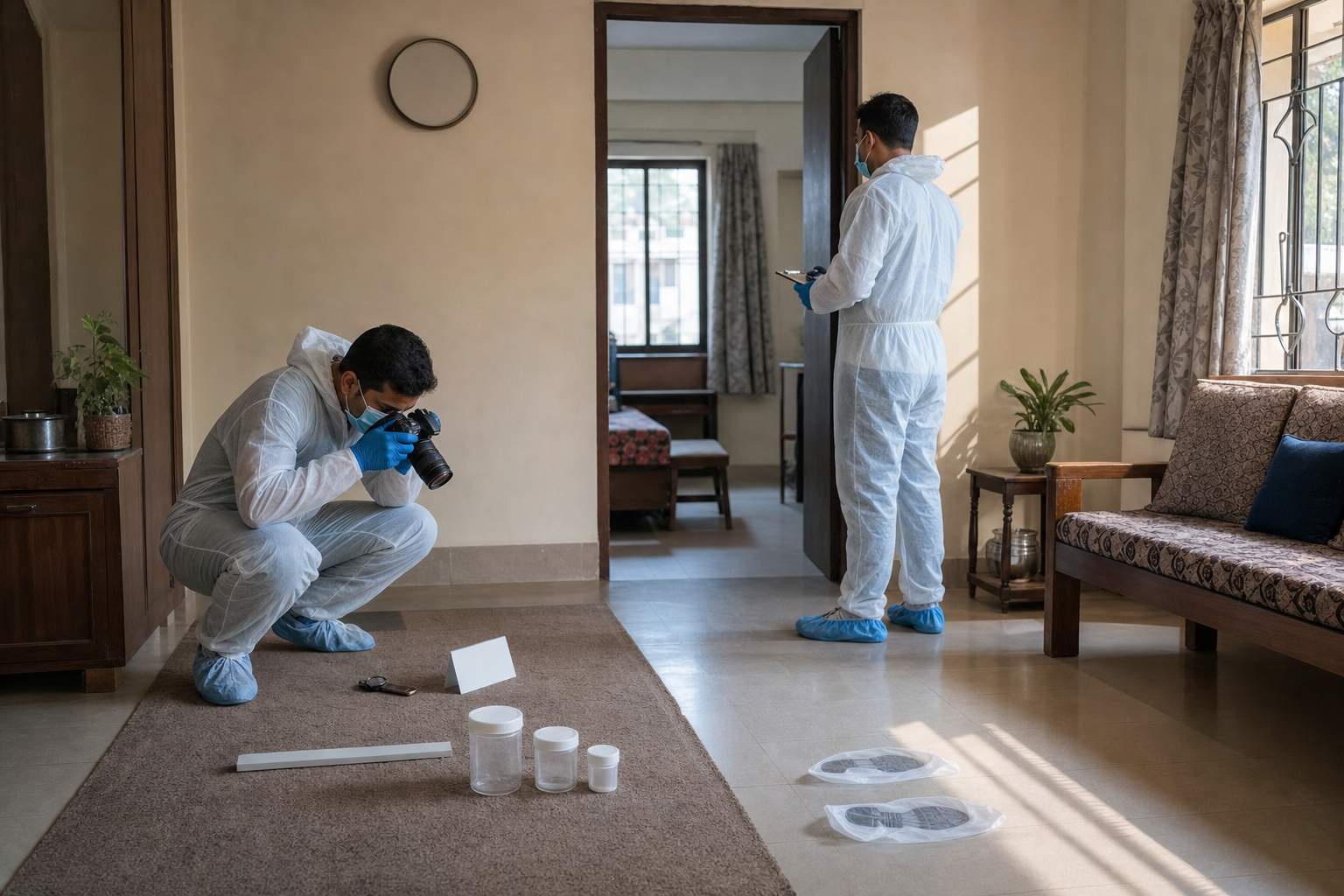
A trustworthy homicide case is built from records that reinforce one another. No leaked screenshot, unnamed witness, or isolated video clip should be asked to carry the whole case. The practical test is whether the physical, digital, medical, and testimonial evidence converges on the same sequence.
Start at the body and the scene
In a stabbing investigation, the autopsy should record the number and location of wounds, their depth and direction, possible hilt marks, and injuries to the hands or forearms that may indicate an attempt to defend against the attack. Cuts in the victim’s clothing should be compared with the wound paths. That comparison can expose a mismatch, clarify body position, or support a reconstruction of how the assault occurred.
The scene should have been secured, photographed, and videographed before material was disturbed. Every seized item needs an identifiable collection point, sealed packaging, and a documented chain of custody. Bloodstain patterns can help distinguish the primary assault location from a place to which the victim or an object was later moved. Trace material, DNA, and serology can connect people and objects, but only if collection and handling were controlled.
When officials provide an update, listen for procedural facts: whether the autopsy was videographed, whether wound and clothing examinations were correlated, which objects were sent to a forensic laboratory, and whether their seals and custody were documented. A press briefing need not reveal laboratory results prematurely, but it can confirm that the necessary work was done.
Make the digital timeline auditable
CCTV should be collected from the relevant route and locations before routine systems overwrite it. Investigators should preserve native files, record how they were obtained, and reconcile camera clocks that may not show the correct time. A compilation circulated on social media is not a substitute for the original recordings and their metadata.
Phones and other devices should be forensically acquired in a way that preserves their contents and permits later verification. Messages, call detail records, and cell-site information should be obtained through lawful process and certified as required by the applicable evidence law. Hash values for acquired data help demonstrate that an examined copy was not silently changed.
The useful product is a single timeline in which CCTV, calls, messages, device activity, cell-site information, witness accounts, and physical evidence are compared. A discrepancy is not automatically proof of fabrication; it is a question requiring resolution. You should be more confident when investigators acknowledge and test such discrepancies than when every uncertainty disappears from the public narrative overnight.
The encounter requires its own independent reconstruction
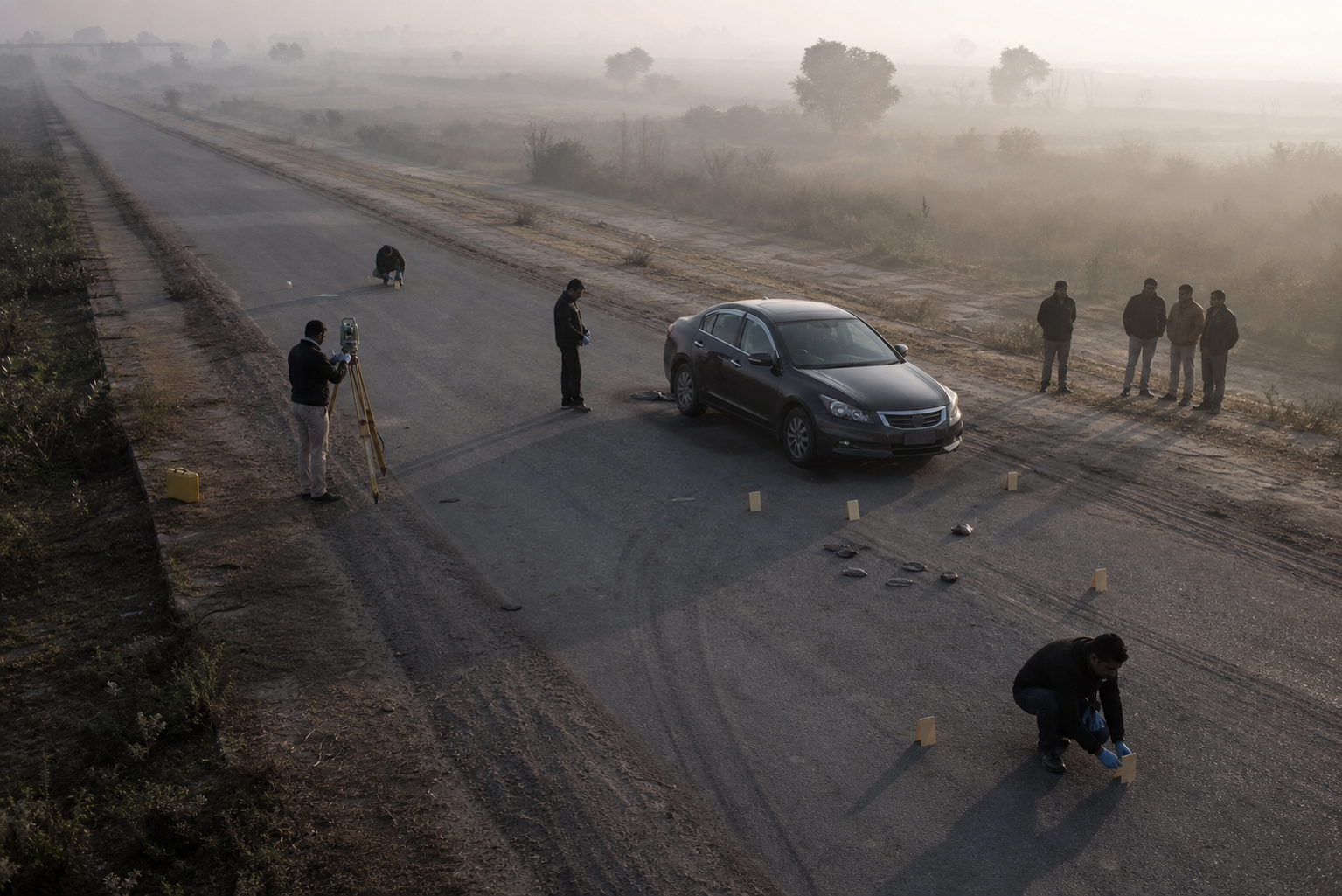
An encounter death is not a conviction. The dead suspect cannot be tried, challenge the evidence, or answer the accusation in court. His death therefore cannot serve as judicial proof that he committed the homicide. It also does not automatically prove police wrongdoing. The lawful conclusion must come from a separate investigation of the use of force.
The Supreme Court’s directions in People’s Union for Civil Liberties v. State of Maharashtra (2014), together with National Human Rights Commission guidance, make independent scrutiny central to deaths in police action. The public should receive clear procedural answers without demanding disclosure of sensitive case-diary material:
- Was an FIR concerning the police-action death promptly registered, and what occurrence does it record?
- Is the investigation being conducted by a unit other than the police personnel involved?
- Has the required magisterial inquiry begun, and what is its present procedural stage?
- Were the NHRC or the State Human Rights Commission notified?
- Was the body examined through a properly documented and videographed post-mortem process?
- Were every relevant weapon, cartridge, projectile, and service firearm sealed and sent for forensic examination?
- Were police vehicle logs, GPS information, control-room records, scene video, and body-camera footage preserved where those records existed?
The reconstruction should include gunshot-residue collection from the deceased and involved officers, distance-of-fire indicators such as sooting or stippling, bullet trajectories, positions of people and vehicles, and ballistic comparison of recovered projectiles with service weapons. Gunshot residue alone cannot explain who initiated an exchange or whether force was necessary. Its value depends on prompt collection, contamination controls, and consistency with the rest of the scene.
Do not settle for the circular claim that the encounter was justified because the deceased was dangerous, or that it was unlawful merely because it ended in death. Ask whether the physical findings fit the official sequence. If an officer’s account, a trajectory, a vehicle position, and a recovered cartridge cannot coexist, the inconsistency must be investigated rather than narrated away.
A pro-Hindu response must be pro-truth and victim-centred

A pro-Hindu position does not require pretending that a communal motive is impossible. It requires insisting that the possibility be examined seriously and proved through evidence. Explicit messages, statements made during planning or assault, a demonstrated pattern of selecting the victim, and corroborated conduct may bear on motive. A Muslim name attached to an accused person does not, by itself, do that work.
This distinction protects the victim’s case. An exaggerated claim gives defenders of the accused an easy target and can distract attention from stronger evidence. A careful claim identifies what is established, what remains alleged, and what record could decide the issue. It also refuses collective blame. Responsibility belongs to the people proved to have planned, carried out, assisted, or concealed the crime – not to an entire religious community.
Dharmic principles are practical here. Ahimsa does not demand silence about a killing; it rejects the creation of further harm through threats, retaliation, and reckless accusation. Karuna does not excuse an offender; it keeps the bereaved family from becoming material for graphic content or political spectacle. Dharma requires the state to investigate violence and also to account for force used in the state’s name.
For the family, transparency should be concrete and private where dignity requires it. Lawful identity confirmation, a redacted post-mortem summary where available, written procedural updates, and an explanation of the encounter inquiry are more responsible than circulating images of a body. Graphic photographs can violate dignity, intensify trauma, and contaminate public discussion without establishing the full encounter sequence.
A family representative working with qualified local counsel can maintain one dated chronology of requests and responses, preserve original messages and files, seek written acknowledgements when evidence is handed over, and ask about the applicable victim-compensation framework. Witnesses facing a real threat can seek protection under the Witness Protection Scheme, 2018. If the victim was legally a minor, the authorities should apply the relevant child-sensitive safeguards. Case-specific filings and disclosures should be decided with counsel; family members should not publish evidence or independently approach witnesses in ways that could endanger people or compromise the investigation.
You can help without becoming an investigator. Share a claim only when you can distinguish an allegation from a verified record. Do not publish a witness’s identity, a minor’s identifying details, an address, or unredacted personal data. Preserve a potentially relevant original file and provide it through a lawful channel instead of repeatedly forwarding a compressed copy. Report a specific threat; do not answer it with another threat.
Key takeaways for judging the case responsibly
- The homicide, the alleged motive, and the encounter are connected events but separate evidentiary questions.
- A Bakrid-linked pretext may warrant close investigation, but religious identity or context alone does not prove communal motive.
- The strongest homicide case will align autopsy findings, scene evidence, CCTV, communications, location data, and reliable testimony.
- The encounter must be tested through an independent investigation, magisterial scrutiny, human-rights notification, scene reconstruction, and ballistic evidence.
- The suspect’s encounter death is neither a criminal conviction nor automatic proof of unlawful policing.
- Support for the victim means seeking compensation, witness safety, dignified family communication, and a prosecutable case – not spreading graphic material or collective blame.
When the next confident claim appears, ask which of the four questions it actually answers and what primary record supports it. Demand scheduled procedural updates from the authorities, preserve relevant evidence, and leave guilt and lawful use of force to processes capable of testing both. That is how you defend the victim, restrain state power, and keep a demand for justice from becoming another source of injustice.
References
