
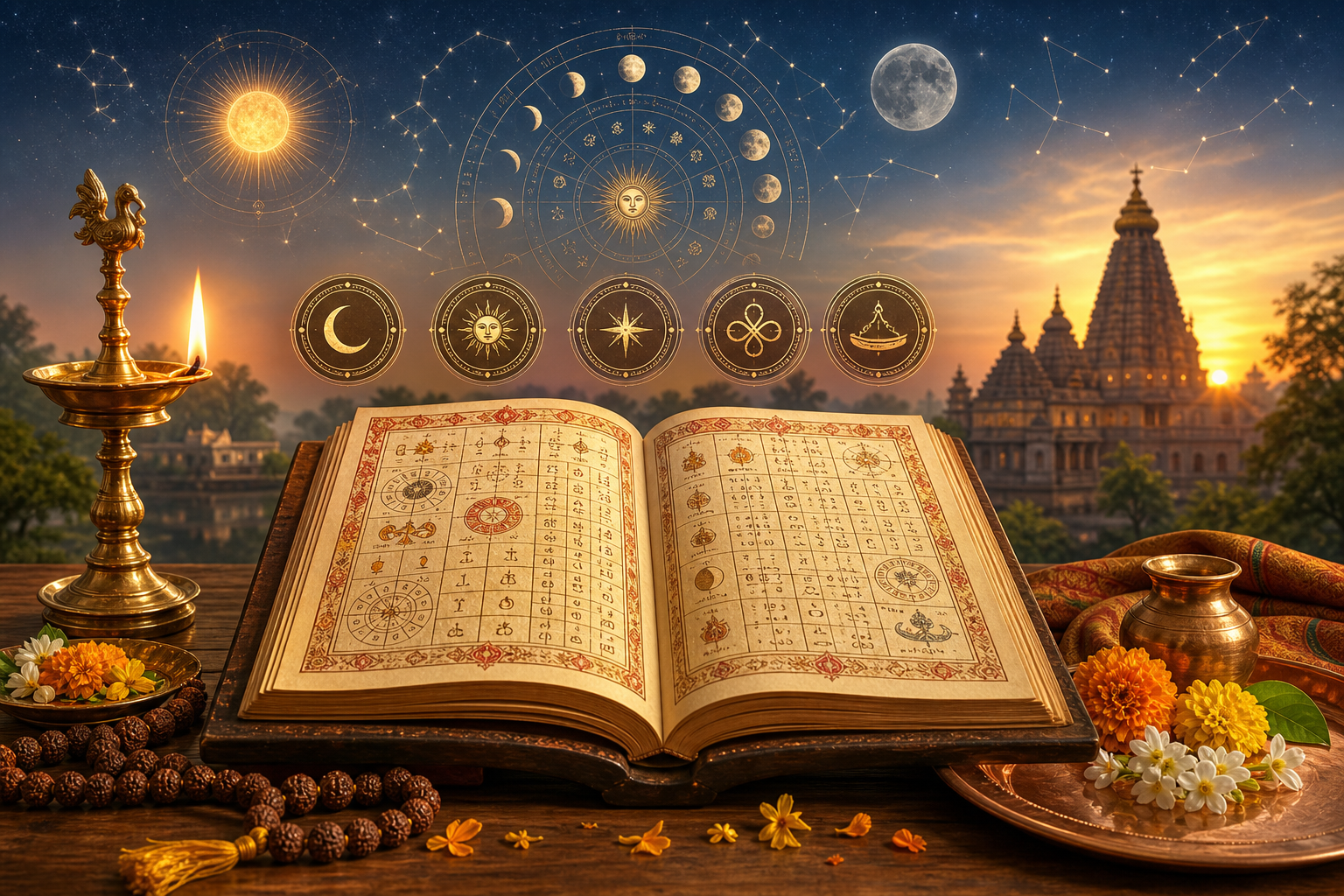
A Panchangam is a traditional Hindu calendar and almanac that organizes sacred time through astronomy, ritual practice, and inherited cultural memory. The term is also written as Panchang, Panchanga, Panchangamu, Pancanga, or Panchaanga, while in parts of eastern India the related almanac tradition is often called Panjika. At its most basic level, it gives the daily structure of time: the lunar day, weekday, nakshatra, yoga, karana, festival observances, vrata dates, and auspicious or restricted periods for specific activities.
The word Panchangam comes from the Sanskrit idea of pancha, meaning five, and anga, meaning limb. These five limbs are traditionally understood as Tithi, Vara, Nakshatra, Yoga, and Karana. Together they form a compact but sophisticated model of time, one that does not treat a day merely as a midnight-to-midnight civil unit, but as a living intersection of solar motion, lunar motion, local sunrise, ritual obligation, and community practice.
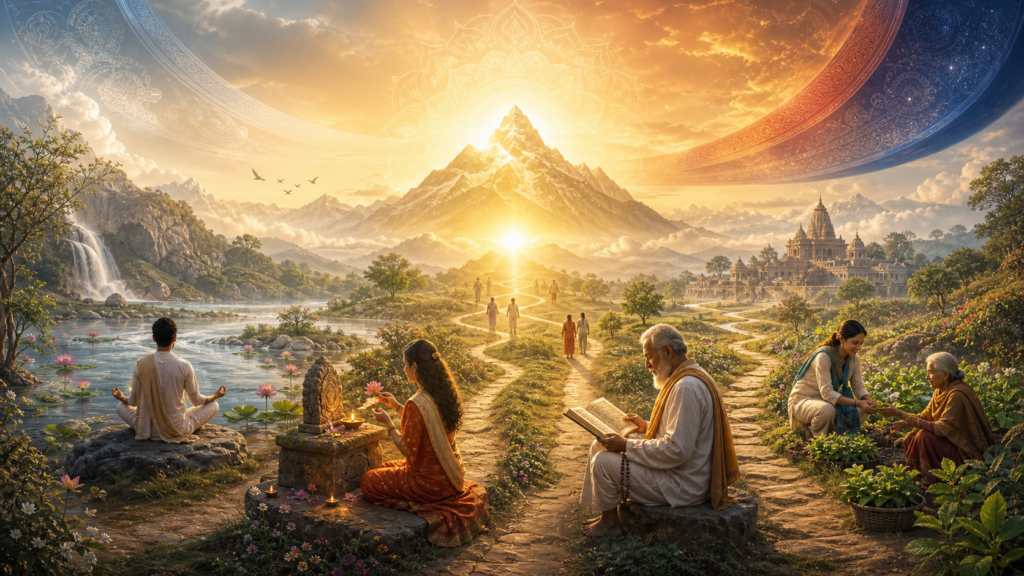
This is why the Panchangam occupies a special place in Hindu culture. It is not only a calendar hanging on a wall or a table of dates printed once a year. It is a bridge between observation and devotion, between mathematical astronomy and temple routine, between household rhythms and larger civilizational memory. In many homes, especially in India and the diaspora, consulting the Panchangam before a festival, puja, wedding, housewarming, pilgrimage, or vrata creates a sense of continuity with earlier generations.
The emotional power of the Panchangam lies in this continuity. A reader may remember elders checking a printed almanac before lighting a lamp, beginning a journey, fixing a marriage date, or observing Ekadashi. That ordinary domestic act carries more than superstition or habit; it reflects a worldview in which time is not empty. Time is patterned, meaningful, and worthy of attention.
Technically, the Panchangam is rooted in the long Indian tradition of Jyotisha, the discipline concerned with celestial calculation and time-reckoning. Classical works such as the Surya Siddhanta and later astronomical manuals influenced many regional calendar traditions. Over time, scholars, temple authorities, astrologers, mathematicians, and publishers developed Panchangams in Sanskrit, Hindi, Tamil, Telugu, Kannada, Malayalam, Marathi, Bengali, Odia, Gujarati, and other languages. This regional diversity explains why the same broad tradition appears in different names and styles across Bharat, Nepal, and South Asian communities abroad.
The first major limb is Tithi, the lunar day. A Tithi is based on the angular distance between the Sun and the Moon as seen from Earth. Each Tithi corresponds to a 12-degree increase in the separation between the Moon and the Sun. Since a full circle has 360 degrees, a lunar month contains thirty Tithis, divided into Shukla Paksha, the bright fortnight of the waxing Moon, and Krishna Paksha, the dark fortnight of the waning Moon.
This explains a common puzzle in Hindu festival observance: a festival does not always fall on the same Gregorian date each year, and sometimes it may be observed on different civil dates in different places. A Tithi begins and ends according to lunar motion, not according to midnight. If a Tithi prevails at sunrise in one city but changes before sunrise in another, the ritual date may differ. The Panchangam therefore requires local calculation, not merely a universal date copied from a civil calendar.
The second limb is Vara, the weekday. In modern civil use, weekdays run from midnight to midnight, but traditional reckoning often gives special importance to sunrise. Each weekday is associated with a planetary principle: Ravi or Surya for Sunday, Soma or Chandra for Monday, Mangala for Tuesday, Budha for Wednesday, Guru or Brihaspati for Thursday, Shukra for Friday, and Shani for Saturday. This framework is visible in ritual practice, fasting customs, temple visits, and devotional observances.
The third limb is Nakshatra, the lunar mansion. The sky along the ecliptic is traditionally divided into twenty-seven Nakshatras, each covering 13 degrees and 20 minutes. The Moon passes through these Nakshatras during its monthly cycle. Nakshatra is important in naming ceremonies, marriage matching, temple festivals, vrata observances, and muhurta selection. In many families, a person’s Janma Nakshatra, or birth star, remains a lifelong reference point for ritual and astrological purposes.
The fourth limb is Yoga. In Panchangam calculation, Yoga is not the same as the philosophical or physical discipline of Yoga. It is an astronomical factor derived from the combined longitudes of the Sun and Moon. The sum is divided into twenty-seven parts, each of 13 degrees and 20 minutes. The resulting Yoga is used in traditional assessments of the quality of a day and is often consulted in electional astrology, known as Muhurta.
The fifth limb is Karana, which is half of a Tithi. Since one Tithi is 12 degrees of separation between the Sun and Moon, one Karana corresponds to 6 degrees. Karanas recur in a structured sequence and are used to refine the reading of a day. While many casual readers focus mainly on Tithi and Nakshatra, traditional Panchangam reading treats Karana as one of the five essential components.
Different traditions sometimes describe the five limbs with slight variation, especially when explaining the role of Rashi, solar day, or weekday. Such differences should not be treated as contradictions that weaken the tradition. They show that the Panchangam developed across regions, languages, schools of calculation, and ritual communities. The central idea remains stable: sacred time is understood through a set of astronomical and calendrical indicators.
A typical Panchangam also includes many elements beyond the five limbs. It may list sunrise and sunset, moonrise and moonset, Rahu Kalam, Yamagandam, Gulika Kalam, Abhijit Muhurta, Durmuhurta, Amrita Kalam, Varjyam, Choghadiya, Sankranti, eclipses, planetary transits, festival dates, vrata rules, and temple observances. Some editions include Rashi Phala, yearly predictions, and practical guidance for marriage, Griha Pravesh, Upanayana, business openings, travel, and agricultural activities.
The mathematical foundation of the Panchangam is more complex than its everyday use may suggest. Accurate calculation requires attention to the apparent positions of the Sun and Moon, lunar speed, sidereal reference points, local latitude and longitude, sunrise time, and sometimes the chosen ayanamsa or correction for precession. Older almanacs often relied on inherited rule-based methods, while many modern Panchangams use observationally aligned or computer-assisted calculations.
This distinction is often described through the difference between traditional formulaic methods and Drik Ganita, or calculation based on observed astronomical positions. The practical result is that two Panchangams may occasionally differ in the ending time of a Tithi, the start of a Nakshatra, or the recommended festival date. Such differences can be frustrating for devotees, but they are usually the result of calculation systems, local sunrise rules, and regional ritual conventions rather than casual error.
The Government of India’s calendar reform efforts in the twentieth century reflected this concern for accuracy and national coherence. The Calendar Reform Committee, associated with scientific figures such as Meghnad Saha, examined the diversity of Indian calendars and recommended more standardized methods for civil and astronomical reckoning. The Indian national calendar was adopted in 1957 for official use, although regional Panchangam traditions continued to guide religious and cultural life.
The continued popularity of regional Panchangams is not a sign of disorder. It reflects the layered nature of Indian civilization. A Tamil Panchangam, a Telugu Panchangam, a Kannada Panchanga, a Malayalam Panchangam, a Marathi Panchang, a Gujarati Panchang, and a Bengali Panjika may share deep structural principles while preserving local festivals, month names, temple customs, and linguistic identity. Unity here does not require sameness; it is sustained through shared principles expressed in regional forms.
This point is especially important for understanding Dharmic traditions more broadly. Hinduism, Buddhism, Jainism, and Sikhism each developed distinctive calendrical practices, yet all are shaped in different ways by the rhythms of lunar months, solar transitions, seasonal festivals, pilgrimage cycles, and sacred memory. Jain observances such as Mahavir Jayanti and Paryushan, Buddhist observances such as Vesak or Buddha Purnima, Hindu observances such as Navaratri and Ekadashi, and Sikh commemorative traditions all show that sacred time is central to Dharmic civilization. The Panchangam should therefore be approached not as a narrow sectarian tool, but as part of a wider Indic respect for time, discipline, remembrance, and spiritual order.
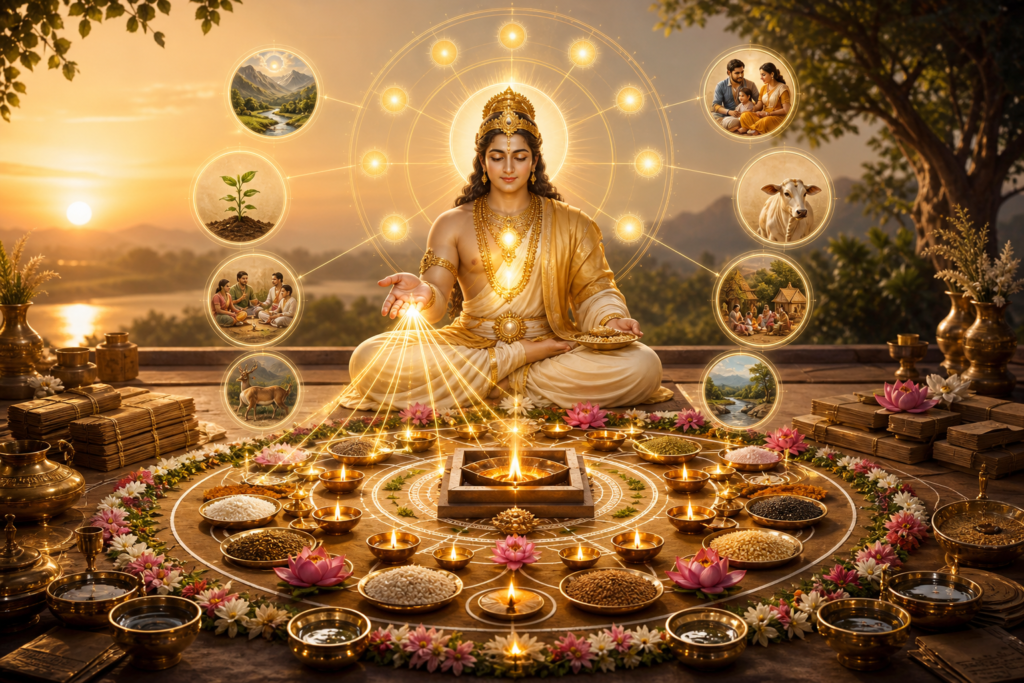
For household life, the Panchangam functions as a practical guide. It helps determine when to observe Amavasya, Purnima, Sankashti Chaturthi, Pradosh, Ekadashi, Navaratri, Maha Shivaratri, Sri Rama Navami, Krishna Janmashtami, Ganesh Chaturthi, Deepavali, and many other festivals. It also clarifies whether a vrata should be observed on the day when the Tithi prevails at sunrise, during a specific night period, or during a particular conjunction of Tithi and Nakshatra.
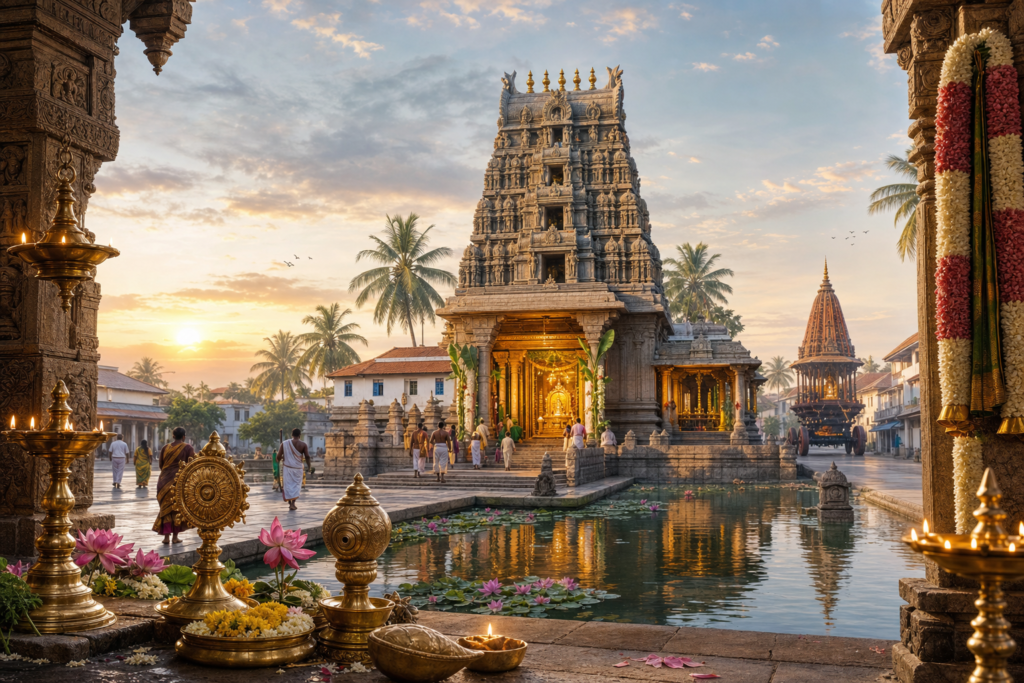
For temple traditions, the Panchangam is even more central. Daily puja schedules, Brahmotsavam dates, Abhishekam timings, Kalyanotsavam observances, lunar-month rituals, and annual festivals often depend on Panchangam calculation. A temple is not merely following a date; it is aligning ritual action with inherited rules of time. This gives temple life its rhythm and allows communities to gather around a shared sacred calendar.
For astrology, the Panchangam is a foundational tool rather than a decorative appendix. Muhurta selection depends on Panchanga Shuddhi, the purification or suitability of time through the five limbs and related factors. Astrologers may examine Tithi, Nakshatra, weekday, Yoga, Karana, Lagna, planetary transits, Tarabalam, Chandrabalam, and the purpose of the activity. A wedding muhurta, for example, is assessed differently from a travel muhurta, a naming ceremony, or a business inauguration.
At the same time, a careful academic reading must distinguish cultural meaning from empirical certainty. The Panchangam is invaluable as a religious, cultural, astronomical, and historical system. Its astrological use belongs to inherited practice and community belief. It should be respected within that framework, while practical decisions involving health, law, finance, safety, and public policy should also rely on appropriate professional knowledge.
One of the most useful ways to read a Panchangam is to begin with location. Since sunrise, moonrise, and Tithi prevalence can vary by place, a Panchangam prepared for Chennai may not always match one prepared for Delhi, Mumbai, Kolkata, Kathmandu, Toronto, London, or New York. Digital Panchangams have made location-based calculation easier, but the principle remains traditional: sacred time is experienced locally.
The next step is to identify the lunar month and Paksha. In many regions, lunar months follow either the Amanta system, where the month ends with Amavasya, or the Purnimanta system, where the month ends with Purnima. This is why Chaitra, Vaishakh, Jyeshta, Ashadha, Shravana, Bhadrapada, Ashwin, Kartika, Margashirsha, Pausha, Magha, and Phalguna may be reckoned slightly differently across regions. The Panchangam preserves these regional systems while keeping them intelligible to practitioners.
After the month and Paksha, the reader checks the Tithi and its ending time. This is often the most important line for festival observance. If the Tithi ends before sunrise, it may not govern the day. If it prevails during a required puja window, it may become ritually significant. This is why a calendar app that simply labels a Gregorian date without showing Tithi timing can be insufficient for serious practice.
The Nakshatra line gives another layer of meaning. For birth-star worship, temple utsavas, naming ceremonies, and many vratas, Nakshatra timing matters deeply. Some observances require the combination of a specific Tithi and a specific Nakshatra. When these overlap only briefly, the Panchangam helps identify the correct window.
Yoga and Karana refine the reading further. Although they are less familiar to casual readers, they are part of the technical grammar of the almanac. Their inclusion shows that the Panchangam is not a simple festival list. It is a layered system in which each day is described through several astronomical relationships.
The Panchangam also carries social memory. Printed almanacs often include stories, ritual instructions, lists of fasting days, temple festival notices, yearly predictions, and community-specific guidance. In this sense, the Panchangam has historically functioned as a household encyclopedia of sacred time. It helped families plan, remember, and participate in tradition before digital calendars made dates instantly searchable.
The older habit of keeping a trusted Panchangam at home has not disappeared. In some South Indian households, editions such as Pambu Panchangam are purchased soon after publication. In Bengal, the Panjika has long shaped festival planning, marriage dates, and domestic ritual life. In Maharashtra, Gujarat, Karnataka, Andhra Pradesh, Telangana, Tamil Nadu, Kerala, Odisha, Assam, and Nepal, comparable almanac traditions continue to reflect local forms of the same civilizational concern.
The phrase Palaya Panchangam, sometimes used colloquially to describe someone attached to old customs, reveals an interesting modern tension. A tradition can become a target of humor when modern life mistakes continuity for stagnation. Yet the Panchangam is not merely old; it is an evolving technical and cultural instrument. Its survival in print, temple administration, diaspora communities, and mobile applications shows that ancient time-reckoning can adapt without losing its identity.
Modern Panchangam use also raises an important educational opportunity. Younger readers may first encounter the Panchangam through festival reminders on phones, but deeper study reveals astronomy, Sanskrit terminology, regional history, mathematical reasoning, ritual law, and cultural anthropology. A single Tithi entry opens the door to lunar motion. A Nakshatra entry opens the door to sky mapping. A festival date opens the door to Puranic memory, temple practice, and family continuity.
For the Dharmic world, the Panchangam teaches disciplined pluralism. It allows many regions to observe time differently while remaining connected through shared cosmic markers. It respects the Moon and the Sun, the household and the temple, the scholar and the devotee, the mathematician and the priest. It shows that tradition need not be anti-intellectual and that calculation need not be spiritually empty.
The Panchangam is therefore best understood as a civilizational technology of time. It encodes astronomy, ritual, memory, and social coordination in a form that ordinary people can use. Its five limbs make time readable. Its regional editions make time local. Its festivals make time communal. Its calculations make time precise. Its devotional use makes time sacred.
When approached with respect and clarity, the Panchangam becomes more than an almanac. It becomes a reminder that human life is not isolated from the sky, the seasons, the community, or the ancestors. In that sense, the Hindu calendar, Hindu almanac, Panchang, Panchangam, and Panjika remain living instruments of cultural heritage and spiritual insight.
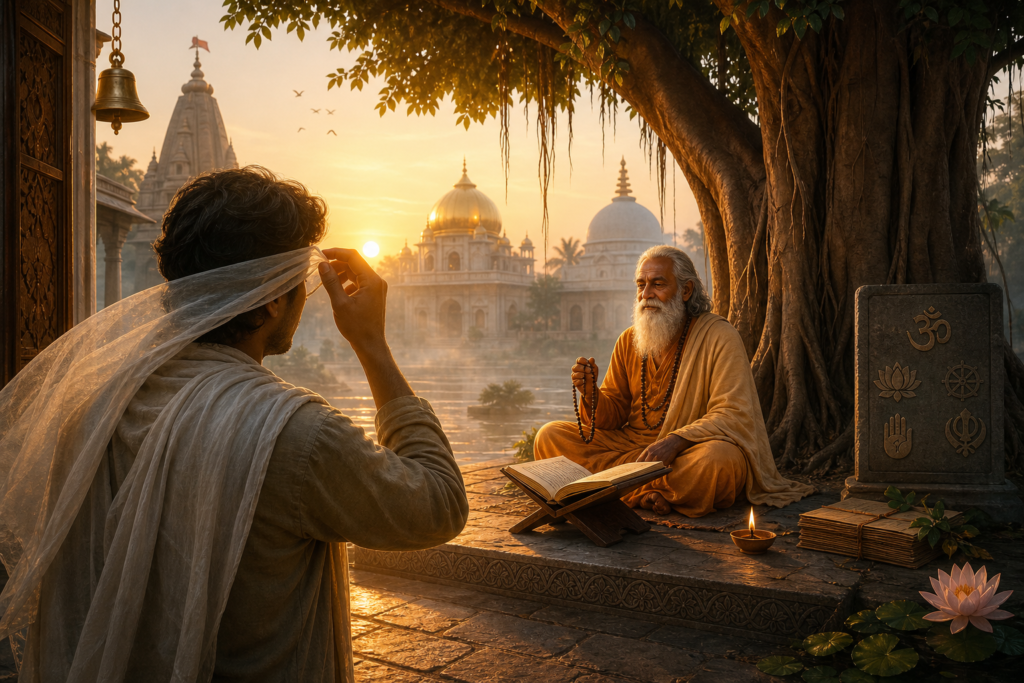
Traditional invocations such as OM SRI PANCHAPAKESAVAYA NAMO NAMAHA reflect the devotional atmosphere in which many readers approach the almanac. The scholarly reader may study calculation; the devotee may seek auspiciousness; the family may seek continuity. The Panchangam makes room for all three.
Reference context for further study includes the source discussion at HinduPad, the broader calendar history associated with the Indian national calendar, and general background on the Hindu calendar. These references help situate the Panchangam within both traditional practice and modern calendar reform.
Inspired by this post on Hindu Pad.

Leave a Reply
You must be logged in to post a comment.