
Hindu philosophy offers a profound account of the universe that moves beyond the simple opposition of creation and destruction. Its central insight is that existence is not a one-time event followed by a final collapse, but a continuous process of transformation. Forms arise, endure for a time, dissolve, and reappear in new configurations. This view gives Hinduism one of the world’s most sophisticated cosmological languages, where reality is understood through rhythm, continuity, causation, and sacred change.
In this framework, creation is not usually treated as the production of something from absolute nothingness. It is more often described as manifestation: the unfolding of what already exists in subtle, potential, or unmanifest form. Destruction, likewise, is not pure annihilation. It is dissolution, return, reabsorption, and preparation for another phase of becoming. The cosmos is therefore not a disposable object, but a living order whose visible and invisible dimensions remain linked through dharma, karma, time, and consciousness.
This perspective is visible across the Vedas, Upanishads, Puranas, Bhagavad Gita, and later schools of Hindu philosophy. These traditions do not always present one identical doctrine, yet they repeatedly return to the same civilizational intuition: change is not a defect in reality but one of its fundamental modes. The river, the flame, the seed, the body, the mind, and the galaxy all participate in a larger process in which continuity survives through transformation.
The Rig Veda’s famous Nasadiya Sukta, often associated with questions about creation, is especially important because it does not reduce cosmology to a simplistic formula. It asks what existed before the manifest world and approaches the mystery of origins with intellectual humility. This is not a weakness in Hindu thought; it is one of its strengths. The text recognizes that ultimate reality may exceed ordinary categories such as being and non-being, existence and non-existence, beginning and end.
The Upanishads deepen this inquiry by shifting attention from external creation to the nature of Brahman, Atman, and consciousness. The universe is not merely a collection of objects placed in space. It is a field of reality in which the individual self, the cosmic order, and the ground of being are philosophically examined together. The well-known Upanishadic emphasis on the unity of existence makes transformation meaningful because changing forms do not exhaust the depth of reality behind them.
Vedantic traditions interpret this relationship in different ways. Advaita Vedanta emphasizes Brahman as the ultimate, non-dual reality, while the changing world is understood through the language of appearance, name, form, and dependent experience. Vishishtadvaita and Dvaita provide other theological and philosophical models, giving greater emphasis to the relationship between the individual soul, the world, and the Supreme. Despite their differences, these traditions share the conviction that visible change must be understood in relation to a deeper metaphysical order.
Sankhya philosophy gives another technical vocabulary for understanding transformation. It explains the manifest world through the interaction of Purusha, the conscious principle, and Prakriti, the primordial matrix of nature. Prakriti evolves through the three gunas: sattva, rajas, and tamas. These are not merely moral categories; they describe tendencies of clarity, activity, and inertia within nature and human experience. Every movement of mind and matter can be read through their dynamic interplay.
Through this lens, transformation is not random. It follows patterns. The seed becomes a tree because potential unfolds under suitable conditions. A thought becomes an action because intention, memory, desire, and circumstance interact. A society changes because values, institutions, pressures, and choices accumulate over time. Hindu philosophy therefore treats change as both cosmic and intimate. The same principle that governs worlds also appears in daily conduct, spiritual discipline, and ethical responsibility.
The Puranic imagination expresses these ideas through powerful symbolic narratives. Brahma, Vishnu, and Shiva are often associated with creation, preservation, and dissolution, but this triadic model should not be misunderstood as a crude division of labor. The three functions are interdependent. Creation requires preservation to have continuity; preservation requires periodic renewal; dissolution clears the way for fresh manifestation. Together, they represent the cycle through which the cosmos remains alive.
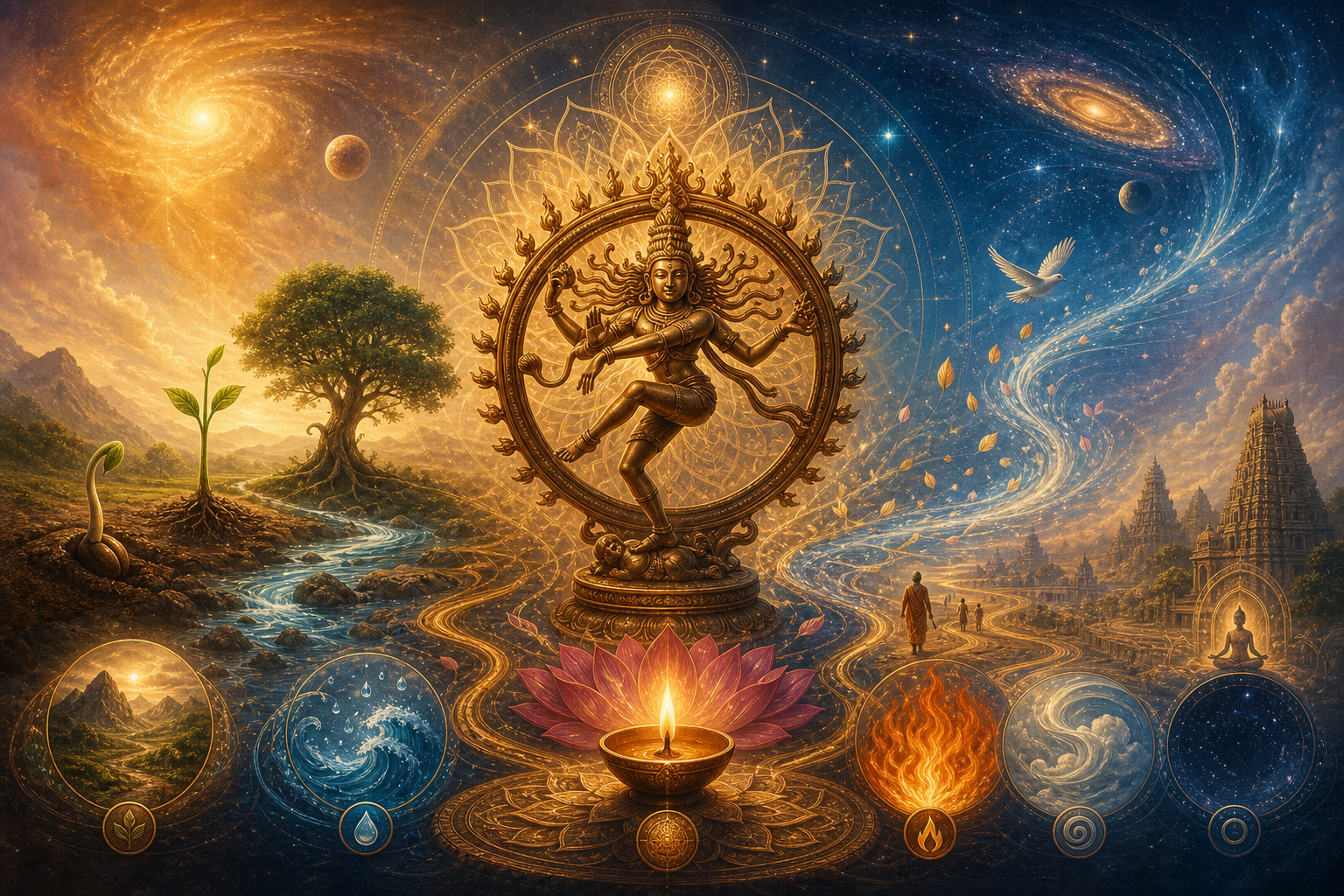
Shiva Nataraja, the cosmic dancer, offers one of the most memorable images of this doctrine. The dance of Shiva is not a spectacle of destruction alone. It is the rhythm of manifestation and withdrawal, concealment and grace, movement and stillness. The drum suggests emergence, the fire suggests dissolution, the raised foot suggests liberation, and the dance itself suggests that reality is never static. The image communicates philosophy through art, devotion, and metaphysical symbolism at once.
The Bhagavad Gita places transformation in an ethical and spiritual setting. It teaches that the embodied being passes through changing conditions, while the deepest self is not reducible to those changes. This does not encourage indifference to life. Rather, it invites disciplined action rooted in dharma. Human beings must act, but they are asked to act with clarity, restraint, and surrender of egoistic attachment to results. Transformation is therefore not only cosmic; it is moral and psychological.
Karma is essential to this understanding. It explains how actions participate in the shaping of future experience. Karma is not fatalism. It does not mean that life is mechanically predetermined or that suffering should be ignored. It means that actions have consequences, intentions matter, and ethical life is woven into the structure of reality. In a universe of transformation, every thought, word, and deed contributes to the movement from ignorance toward wisdom or from disorder toward harmony.
Samsara, the cycle of birth, death, and rebirth, gives this process an existential dimension. Life is not viewed as a single isolated episode. It is part of a broader journey shaped by learning, attachment, desire, responsibility, and spiritual maturation. Moksha, liberation from bondage, does not mean contempt for the world. It means freedom from the ignorance that mistakes temporary forms for ultimate reality. The transformative journey culminates in insight, not in mere escape.
Hindu cosmology also develops vast units of time, including yugas, manvantaras, and kalpas. These measures do more than create a grand mythic scale. They train the mind to think beyond the narrowness of a single lifetime or historical moment. Civilizations rise and fall, species appear and disappear, stars are born and collapse, yet the cosmic process continues. Such a vision can create humility, patience, and a deeper sense of responsibility toward the present.
The doctrine of pralaya, often translated as dissolution, is especially significant. Pralaya is not a meaningless end. It is a phase in which manifested forms return to a subtle condition. Just as sleep restores the individual and winter prepares the field for spring, cosmic dissolution prepares for renewed manifestation. The analogy is not exact, but it helps convey the underlying principle: endings are not always failures; they may be transitions within a larger order.
This way of thinking has practical value. Many people experience change as loss, uncertainty, or fear. Hindu philosophy does not deny those emotions. It places them within a wider pattern. The body ages, relationships change, ambitions shift, and social worlds transform. Yet these experiences can become occasions for viveka, discernment, and vairagya, disciplined non-attachment. The tradition teaches that wisdom begins when change is neither worshipped blindly nor resisted blindly, but understood.
The five elements, or pancha mahabhutas, also express the transformative nature of existence. Earth, water, fire, air, and space are not merely physical substances in a modern chemical sense. They are principles through which stability, flow, heat, movement, and openness are contemplated. Rituals, Ayurveda, Yoga, temple architecture, and meditative practices all draw upon this elemental understanding. The human body becomes a microcosm of the universe, and spiritual practice becomes a refinement of embodied life.
Yoga gives this philosophy a disciplined method. The fluctuations of the mind, described in classical Yoga as vrittis, are themselves forms of transformation. Practice does not destroy the mind; it clarifies it. Through yama, niyama, asana, pranayama, pratyahara, dharana, dhyana, and samadhi, the practitioner moves from scattered activity toward steadiness. The goal is not lifeless stillness, but a deeper alignment between consciousness, conduct, and truth.
Ritual life in Hinduism also reflects this principle. A lamp is lit, flowers are offered, water is poured, mantras are recited, and food becomes prasada. These acts do not merely decorate belief. They transform ordinary materials into vehicles of reverence. The transformation is not only external; the participant is invited to move from distraction to attention, from consumption to offering, and from isolation to sacred relationship.
The same civilizational insight appears in temple worship. A temple is not simply a building that houses an image. It is a carefully ordered sacred space where architecture, geometry, mantra, iconography, and community practice converge. The journey from the outer space of the temple toward the garbhagriha symbolizes inward movement from multiplicity toward centered awareness. Even stone, sound, and space are arranged as instruments of transformation.
Hinduism’s understanding of transformation also supports religious plurality. If reality is vast, and if human temperaments differ, then spiritual paths may legitimately vary. Bhakti, jnana, karma, raja yoga, temple worship, meditation, mantra, seva, and philosophical inquiry can all become valid disciplines when guided by dharma. This insight is important for unity among Dharmic traditions, including Hinduism, Buddhism, Jainism, and Sikhism, because each offers a serious path of ethical refinement, spiritual discipline, and liberation-oriented wisdom.
Buddhist reflections on impermanence, Jain teachings on karma and non-violence, Sikh emphasis on remembrance, seva, and truthful living, and Hindu teachings on dharma and moksha can be studied as distinct traditions without turning difference into hostility. Their vocabularies are not identical, and their metaphysical conclusions are sometimes different. Yet all recognize that human life must be transformed through discipline, compassion, truthfulness, and freedom from ego-centered ignorance.
This shared Dharmic orientation has contemporary relevance. Modern life often treats change as disruption, novelty, or market-driven progress. Hindu philosophy offers a deeper grammar. It asks whether change is aligned with dharma, whether desire has been disciplined by wisdom, whether technology serves human flourishing, and whether social transformation preserves dignity, memory, and ecological balance. In this sense, ancient Hindu thought remains intellectually alive rather than merely historical.
Environmental ethics can also be illuminated by this worldview. If the universe is an interconnected field of transformation, nature cannot be reduced to raw material for consumption. Rivers, mountains, forests, animals, and seasons are woven into sacred geography and ritual memory. The ecological crisis of the modern age reveals the danger of forgetting interdependence. Hindu philosophy encourages reverence, restraint, and responsibility, not as sentimental ideals but as civilizational necessities.
At the level of personal life, the doctrine of transformation offers a balanced path between despair and arrogance. No condition is absolutely final, so despair is philosophically incomplete. Yet no achievement is permanently secure, so arrogance is also irrational. This produces a mature spiritual realism. Success, failure, grief, joy, youth, age, honor, and loss are all passing states. Dharma is the discipline that helps the person move through them without losing inner orientation.
The Hindu view of creation and dissolution therefore should not be mistaken for mythology in the shallow sense of fantasy. It is a layered intellectual tradition using narrative, symbol, ritual, metaphysics, and contemplative practice to explore the structure of reality. Its language may differ from modern scientific cosmology, but its philosophical concern with process, cyclicality, causation, and transformation remains deeply serious.
There is also a subtle emotional power in this teaching. Many individuals intuitively know that life is not a straight line. Families change, communities migrate, traditions adapt, and identities mature. Hindu philosophy gives dignity to this experience by showing that transformation is not an accident outside sacred order. It is part of how existence breathes. The challenge is not to stop change, but to participate in it with wisdom.
For this reason, the Hindu understanding of the cosmos is best described as a continuous sacred process. Creation is manifestation. Preservation is dynamic balance. Dissolution is return. Liberation is awakening to the truth beyond compulsive attachment to changing forms. Together, these ideas form a comprehensive vision in which philosophy, spirituality, ethics, ecology, and daily life are inseparably connected.
The enduring value of this worldview lies in its ability to hold complexity without confusion. It honors the visible world while pointing beyond it. It accepts change while seeking the changeless ground of truth. It recognizes diversity while preserving unity through dharma. In a time marked by anxiety, fragmentation, and rapid transformation, Hindu philosophy offers a disciplined and compassionate way to understand both the cosmos and the human journey within it.
Inspired by this post on Hindu Blog.
