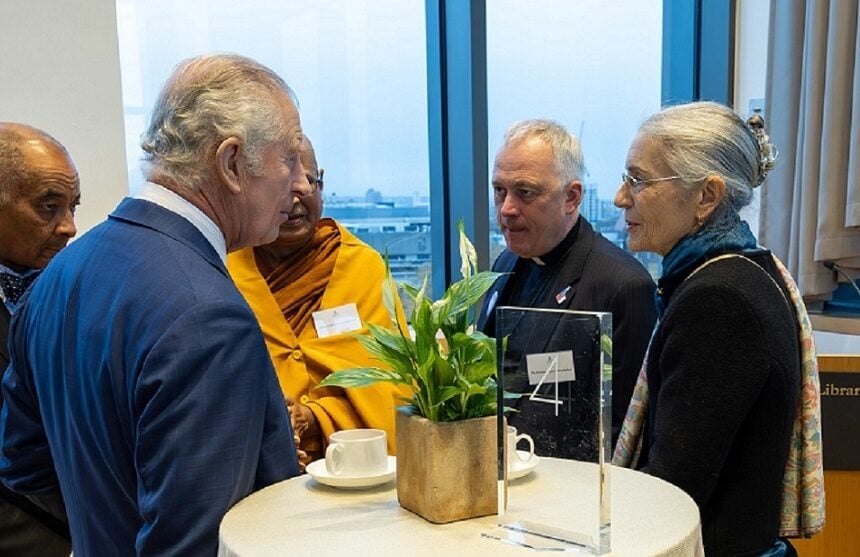
King Charles III convened approximately thirty leaders from Muslim, Sikh, Baháʼí, Christian, Hindu, and other faith traditions at the Lambeth Palace Library to deepen communication, mutual understanding, and interfaith harmony. The convening underscored the role that symbolic leadership can play in nurturing social cohesion and shared civic responsibility in a religiously diverse United Kingdom.
Lambeth Palace Libraryhome to one of the world’s great archives of Anglican and ecumenical scholarshipprovided a fitting context: a research-driven environment in which historic memory, institutional continuity, and contemporary dialogue can meet. Hosting the conversation in such a space framed interfaith engagement as a matter not only of ceremony but also of knowledge, documentation, and long-term stewardship.
Constitutionally, the British sovereign is the Supreme Governor of the Church of England and ‘Defender of the Faith’. In public statements over decades, King Charles III has signaled an inclusive ethosoften glossed as defending faithsconsistent with the Crown’s role as a non-partisan unifier of peoples. Without altering constitutional arrangements, convenings of this type translate that ethos into practical, outcomes-oriented dialogue.
Demographically, the case for structured interfaith dialogue in the UK is compelling. According to the 2021 Census for England and Wales, Christianity remained the largest affiliation (approximately 46.2%), ‘No religion’ rose to about 37.2%, and significant communities identify as Muslim (around 6.5%), Hindu (about 1.7%), Sikh (roughly 0.9%), Buddhist (near 0.5%), and Jewish (about 0.5%). London in particular is a hub where these communities live, work, and learn togethermaking evidence-based, good-faith engagement a public necessity.
From the perspective of dharmic traditionsHinduism, Buddhism, Jainism, and Sikhisminterfaith dialogue aligns with long-standing civilizational values. Shared commitments to ahiṁsā (non-harm), karuṇā/dayā (compassion), satya (truth), dharma (righteous duty), and sevā (service) provide a robust ethical grammar for coexistence. Concepts such as anekāntavāda (Jainism’s many-sidedness), sarva-dharma-samabhāva (equal regard for all paths), maitri and karuṇā (Buddhist friendliness and compassion), and sarbat da bhala (Sikh aspiration for the welfare of all) naturally orient these traditions toward pluralism.
A practical bridge between theology and public life can be drawn from Ishtaunderstood in Hindu thought as a chosen form or path that suits an individual’s nature. Read as a social ethic, Ishta encourages respect for diverse spiritual journeys while maintaining clarity about one’s own. In a multi-faith society, this becomes a disciplined practice of principled pluralism: honoring distinct convictions without erasing difference, and cooperating on shared civic goals.
Social psychology offers a tested framework for why convenings of leaders matter. Allport’s contact hypothesis emphasizes that intergroup contact reduces prejudice when four conditions are met: equal status among participants, pursuit of common goals, intergroup cooperation, and clear support from authorities and institutions. A palace-hosted summit with parity among leaders, a shared mandate for social harmony, structured collaboration, and visible institutional backing satisfies these criteria in form and intent.
To convert goodwill into measurable interfaith harmony, three types of outcomes merit emphasis. First, relationship outcomes: sustained channels between faith councils, temples, gurdwaras, mosques, churches, synagogues, monasteries, and community organizations. Second, programmatic outcomes: joint service (langar-inspired community meals, prasāda distribution adapted as inclusive community kitchens, blood donation drives, and mental-health peer support circles). Third, policy outcomes: advisories to local councils on festival infrastructure, security coordination, and anti-hate protocols.
Public safety and dignity provide an immediate horizon for collaboration. Home Office data in recent years have shown that religiously motivated hate incidents remain a concern across communities. Coordinated interfaith responsesshared incident reporting standards, de-escalation training, interfaith rapid-response messaging, and liaison with police and councilscan reduce harm while signaling a united civic front against bigotry.
Education is another high-impact lever. Co-designed curricula that introduce students to dharmic traditions (Hinduism, Buddhism, Jainism, Sikhism) alongside Abrahamic and other world traditions can be anchored in primary sources and lived practices rather than stereotypes. Teacher training modules, interfaith school exchanges, and heritage-site visits (temples, gurdwaras, monasteries, churches, synagogues, and community centers) build cultural literacy and reduce social distance at an early age.
Health and well-being provide fertile ground for shared service. Faith-informed mental health outreachmindfulness and meditation groups, kīrtan-based community singing, seva-led volunteering, and chaplaincy partnerships in hospitalshas demonstrated value for loneliness, grief, and stress. Cross-faith teams can codify referral pathways, translate resources, and ensure cultural competence, with attention to dietary practices, bereavement rites, and festival calendars.
Climate action and environmental stewardship naturally resonate with dharmic ethics of reverence for life and restraint. Interfaith tree-planting, river-and-park clean-ups, food-waste reduction during festivals, and energy-saving commitments by places of worship exemplify how symbolic action can scale into neighborhood-level impact. Shared dashboards that track participation and emissions reductions can keep efforts transparent and cumulative.
Sequencing matters. Convenings are most effective when followed by a compact governance architecture: a steering circle of senior faith leaders; a technical working group of educators, social workers, and security liaisons; and a youth council. Quarterly objectives, public communiqués, and an annual review hosted by a neutral institution (a university, museum, or library) can institutionalize momentum beyond any single news cycle.
Measurement should blend qualitative and quantitative indicators. Suggested metrics include: number and diversity of joint programs; volunteer hours; reduction in inter-community incidents; survey-based shifts in trust; school participation in interfaith modules; and media sentiment analysis. Case studiessuch as a successful multi-faith festival stewarded by local councilsadd narrative depth to numerical change.
Risks are real: performative symbolism without follow-through, token representation, or avoidance of difficult conversations about prejudice within one’s own group. Mitigation entails clear objectives, rotating facilitation, transparent minutes, and agreed norms of discourse that separate principled conviction from disparagement of the other. The goal is not syncretism but civic friendshipunity in spiritual plurality grounded in mutual dignity.
Scenes from gatherings of this kind illustrate the human texture behind the policy language: a Sikh granthi describing langar as a grammar of equality; a Buddhist monastic reflecting on mettā for those one disagrees with; a Hindu paṇḍit invoking the Bhagavad Gītā’s call to see the same divinity in all beings; a Muslim imam emphasizing raḥma (mercy) as a civic anchor; a Christian bishop reading the Beatitudes; a Baháʼí representative affirming the oneness of humanity. Shared food, shared silence, and shared concern for the vulnerable make abstraction tangible.
In this light, the Lambeth Palace Library convening of roughly thirty leaders functions as a track 1.5 intervention: not governmental policy-making, yet endowed with high symbolic capital and the ability to catalyze track-2 collaborations in neighborhoods. It aligns with the civilizational vision of Vasudhaiva Kutumbakamthe world as one familywhile remaining grounded in the UK’s legal and civic framework.
If sustained with humility and rigor, such interfaith dialogue can reinforce social cohesion, protect religious freedom, and amplify the service ethic that dharmic traditions share with other faiths. The most durable legacy of a king’s convening power will not be a photograph but the everyday cooperation it enableschildren learning together, neighbors serving together, and communities standing together in times of need.
Inspired by this post on Dandavats.