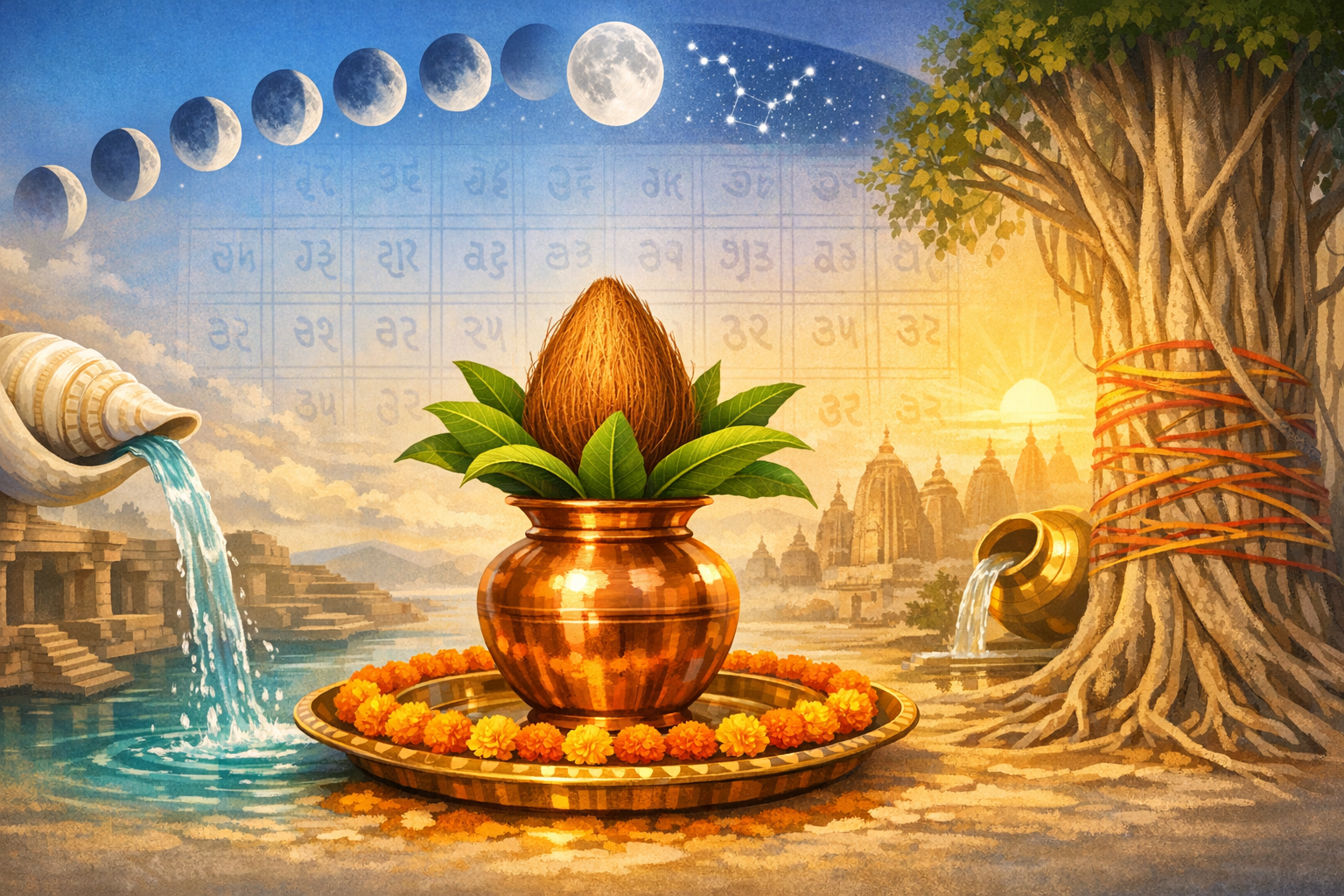
Jyeshta Maas 2026known locally in Gujarat as Jeth Mahinooccupies a central place in the Gujarati Panchang as the eighth month of the Vikram Samvat year. In 2026, this period aligns with the intense heat of Grishma Ritu and frames several high-significance vratas and festivals that emphasize water-conservation, ethical restraint, and gratitude. Within the Gujarati calendrical conventions, Jeth serves as both a seasonal and spiritual waypoint, when households recalibrate routines, temple schedules, and community service around the lunar rhythm.
As per most standard Gujarati amanta Panchangs, Nija Jeth (the regular Jyeshta month) in 2026 begins on 15 June 2026 and ends on or around 14 July 2026, concluding with Jeth Vad Amavasya. Because Gujarati almanacs compute festival assignment by the tithi prevailing at local sunrise, and because longitude and sunrise times vary across cities such as Ahmedabad, Surat, Rajkot, and Vadodara, slight one-day shifts can occur. For temple planning and vrata observance, checking a locally compiled Gujarati Panchang remains best practice.
Intercalation is a key feature of 2026. Many authoritative Panchangs indicate the occurrence of Adhik Jyeshta Maas (Adhik Jeth) immediately preceding Nija Jeth, likely spanning mid-May to 14 June 2026. Adhik Maas is inserted whenever no solar sankranti (Sun’s ingress into a new rashi) falls within a lunar month, thereby maintaining long-term harmony between the lunar months and the solar year. In Adhik Jeth, households typically emphasize dana, japa, and vrata, while deferring some life-cycle functions until Nija Jeth or later, in keeping with regional custom.
Technically, the Gujarati Panchang follows the amanta system, wherein a lunar month begins the day after amavasya and ends on the next amavasya. The month’s name is associated with the full moon that falls near the eponymous nakshatrain this case, Jyeshtha (Antares, α-Scorpii). Day-to-day reckoning uses the Gujarati terms Jeth Sud (Shukla Paksha, the waxing half) and Jeth Vad (Krishna Paksha, the waning half), with tithis assigned by the sunrise rule.
Astronomically and seasonally, Jeth aligns with Grishma Ritu’s peak. The Sun completes its transit of Vrishabha (Taurus) and enters Mithuna (Gemini) around mid-June (Mithuna Sankranti), while the Moon’s phases anchor the devotional cadence of the month. Traditional observances such as jal-arpan to Surya at sunrise, worship of Varuna, and collective water stewardship initiatives resonate strongly in this season, especially across semi-arid zones of Gujarat.
Among the month’s major observances, Nirjala Ekadashioccurring on Jeth Sud Ekadashi (Jyeshta Shukla Ekadashi)is particularly prominent. It is renowned as a penance of utmost discipline, with practitioners who are medically able observing a waterless fast for spiritual merit. In 2026, Nirjala Ekadashi will fall within Jeth Sud; exact civil dating depends on the tithi at local sunrise. Traditional guidance emphasizes balanced observance, charitable distribution of water and cooling foods, and appropriate modifications for health needs.
Ganga Dussehra, observed on Jyeshtha Shukla Dashami, venerates the descent of the sacred Ganga. Devotees chant hymns such as the Ganga Stotra and offer jal-daan, invoking purification and collective well-being. Even far from the river’s banks, communities across Gujarat mark the occasion through water-conservation drives and symbolic worship that center the sanctity of all life-giving water sources.
Dev Snan Purnima (Deva Snana Purnima) on Jyeshtha Purnima is another focal point, most famously associated with the ceremonial bathing of the murtis of Shri Jagannath, Balabhadra, and Subhadra at Puri. In Gujarat, temples often observe the day with abhisheka, special puja, and kirtana, reflecting a pan-Indian devotional rhythm tied to the lunar cycle and celebrated across linguistic and regional communities.
Vat Purnima (Vat Savitri) is widely observed in Gujarat and Maharashtra on Jeth Purnima. Married women worship the vat (vad) tree, circumambulating its trunk and tying protective threads while recalling the Savitri–Satyavan narrative that extols steadfastness, wisdom, and the triumph of dharma. The vow centers family harmony and longevity and is often accompanied by communal satsang and charitable acts.
Jeth Vad Amavasya concludes the month. The day is traditionally associated with pitru tarpan and quiet introspection. In some traditions, when calendrical parameters align, Shani Jayanti is also associated with the Jyeshtha Amavasya; however, assignments vary by region and Panchang school. Observers are therefore encouraged to use a trusted local almanac for precise scheduling in 2026.
Across dharmic communities, the Gujarati Vikram Samvat calendar’s lunar rhythm fosters shared cultural ground. Many Jain communities in Gujarat use the same month names and tithi logic for their observances, aligning with the larger ethos of ahimsa, dana, and tapas. Buddhist and Sikh households, while following distinct liturgical calendars, often participate in water-conservation initiatives and community service aligned with the season, underscoring a living unity of values around compassion, restraint, and reverence for nature.
Key computational notes assist accuracy and planning. A tithi corresponds to each 12-degree increase in the Moon–Sun angular separation, and festival assignment generally follows the tithi present at sunrise in the observer’s locality. Time-zone and longitudinal differences can therefore shift civil dates. For most of Gujarat, Panchangs compiled for Ahmedabad or other major cities provide reliable reference. Daily muhurta selection often draws on Choghadiya, while larger samskara events follow comprehensive muhurta calculations that incorporate tithi, nakshatra, yoga, and karana.
Vikram Samvat alignment merits attention. In June–July 2026, Jeth falls within the Gujarati Vikram Samvat 2082, reflecting Gujarat’s Kartak-based year count that commences at Diwali. This differs from the Chaitra-based Vikram Samvat used elsewhere in India (which is 2083 during this time), a distinction useful for record-keeping and interregional coordination.
In practical terms, families and temple committees in Gujarat often concentrate annadanam, jal-daan, and community health initiatives during Jeth’s peak heat, while scheduling larger ceremonies with sensitivity to climate and muhurta. Traditional guidance balances vrata rigor with well-being; for instance, those observing Nirjala Ekadashi are advised to consult elders and physicians where needed, ensuring that devotion remains aligned with health and dharma.
In summary, 2026 presents a two-step Jyeshtha sequence for many Gujarati Panchangs: Adhik Jeth likely from mid-May to 14 June 2026, followed by Nija Jeth from 15 June 2026 to about 14 July 2026. Within this window fall Nirjala Ekadashi, Ganga Dussehra, Dev Snan Purnima, and Vat Purnima, each reinforcing the month’s ethical corerestraint, service, reverence for water, and familial strength. As communities observe Jeth Mahino with precision and inclusivity, the shared dharmic fabric across Hindu, Jain, Buddhist, and Sikh traditions is strengthened in spirit and practice.
Ultimately, Jyeshtaliterally the “eldest” or “venerable”invites reflection on endurance, gratitude, and stewardship. By honoring its vratas and festivals with careful Panchang-based timing and ecologically mindful action, households in Gujarat embody a season of heat transformed into a season of virtue.
Inspired by this post on Hindu Pad.