Chandra Darshan on 16 June 2026 (often referred to regionally as Ashada Maasa Chandra Darshanam) marks the first visible sighting of the waxing crescent Moon immediately after Amavasya for most observers across India. In regional reckoning, this observance falls in Nija Jyeshta (Jyeshta Masam) for North India, Andhra Pradesh, Telangana, and Karnataka due to the intercalary month sequence in 2026. In the solar calendars, it coincides with Aani Masam in the Tamil calendar, Mithunam in the Malayalam calendar, and Ashar (Asharh) in the Bengali Panjika. Devotees commonly gather after sunset to witness the delicate first crescent, a moment celebrated for its auspiciousness, serenity, and a sense of renewed beginnings.
Chandra Darshan is the first-moon sighting that inaugurates Shukla Paksha (the bright fortnight). The practice is steeped in the Hindu calendar (Panchang) tradition, where the Moon’s visibility after the New Moon signifies the return of light and the mind’s steadying (Chandra being the karaka of manas/mind in classical texts). The observance emphasizes mindful attention, quiet gratitude, and a simple offering (arghya) to Chandra Deva, integrating astronomy, astrology, and devotional sentiment into a single, contemplative act.
For 2026, the evening of 16 June marks Chandra Darshan for most locations in India. In practice, the sighting window begins shortly after local sunset and extends until moonset, with the best visibility typically occurring 20–60 minutes after sunset when the thin crescent becomes perceptible just above the western horizon. Because the Moon’s elongation, local weather, and latitude/longitude strongly affect visibility, devotees are advised to consult a reliable regional Panchang for the precise Chandra Darshan muhurta and to account for sky conditions.
The calendrical context in 2026 is noteworthy. An intercalary month (adhimāsa) arises when no solar saṅkrānti (Sun’s ingress into a new rāśi) occurs during a lunar month. That lunar month becomes Adhik, and the subsequent month that does include a saṅkrānti is Nija (regular). In 2026, the additional month is Adhik Jyeshta (Adhik Jyeshta Maas 2026), followed by Nija Jyeshta. Consequently, Chandra Darshan on 16 June 2026 falls in Nija Jyeshta for regions using both the Amānta system (Andhra Pradesh, Telangana, Karnataka) and the Pūrṇimānta system (much of North India).
Regional solar calendars mark the same evening differently, reflecting India’s plural calendrical heritage. Tamil Nadu observes this date in Aani Masam (mid-June to mid-July), Kerala in Mithunam (the Malayalam solar month concurrent with the Sun’s transit through Gemini), and Bengal in Ashar (Asharh) per the Bengali Panjika. This cross-mapping illustrates the harmonization between lunar observances like Chandra Darshan and regional solar month nomenclature.
Two lunar reckoning systems are commonly referenced. The Amānta system counts months from Amavasya (New Moon) to Amavasya, while the Pūrṇimānta system counts from Purnima (Full Moon) to Purnima. Despite these structural differences, both systems converge on the same tithi event for Chandra Darshan, namely the evening of Shukla Paksha’s onset when the crescent becomes optically visible.
Across dharmic traditions, reverence for the lunar cycle serves as a shared cultural thread. Hindu families observe Chandra Darshan as a gentle re-entry into the bright fortnight; many Buddhist communities mark full-moon days (such as Poya) with reflective practice; Jaina traditions maintain lunar fasts and observances that structure the spiritual calendar; and Sikh communities, while following the Nanakshahi calendar today, retain historical memory of Bikrami lunar observances in several gurpurabs. The common honoring of lunar time fosters inter-traditional understanding, unity, and respect for diverse yet kindred ways of living by the rhythm of the cosmos.
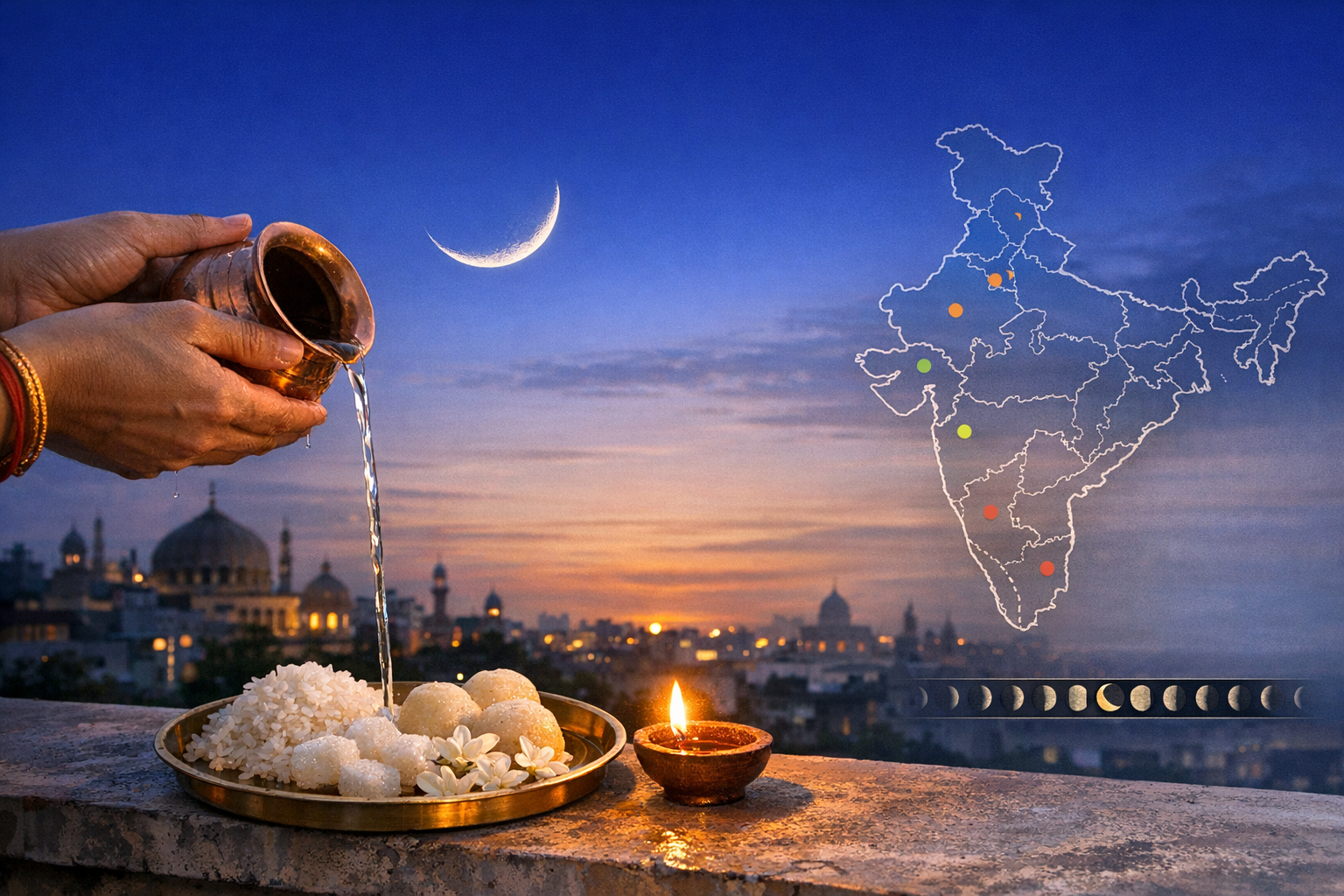
Vrata and Puja Vidhi for Chandra Darshan is straightforward and accessible. Many devotees observe a daytime upavasa (fast) or take a light sāttvika meal, maintain calm speech and conduct, and prepare a small plate with white offerings symbolic of Chandra’s cooling quality (e.g., raw rice, sugar, milk-based sweets). At the first sight of the crescent, an arghya is offered with water, sometimes infused with a few drops of milk, while facing the Moon and reciting mantras to Chandra Deva. The vrata is then concluded with prasad distribution.
Mantras traditionally associated with this observance include “Om Som Somāya Namah” and “Om Chandrāya Namah.” Many also recite the Chandra Gayatri: “Om Kshīra-putrāya Vidmahe Amrita-tattvāya Dhīmahi Tanno Chandra Prachodayāt.” These mantras are praised for steadying the mind and invoking clarity, devotion, and emotional balancequalities culturally linked with Chandra in the shāstric tradition.
The arghya is offered with humility. Devotees stand facing the Moon and slowly pour water (often with a few drops of milk) from a small vessel, allowing it to fall onto the earth or into a designated bowl, while mentally offering gratitude for coolness, calmness, and mental harmony. White flowers, white til, or white cloth may be offered as per family tradition, and some observe a brief dhyāna in silence to internalize the moment of first light.
Dāna is commonly performed on Chandra Darshan to reinforce the vrata’s intent. Offerings may include rice, sugar, milk, or white cloth to those in need. The emphasis is on compassionate giving, undertaken without ostentation. Many households also share prasad with neighbors and friends, reflecting the social warmth and unity that festivals aim to cultivate.
Fasting practice varies. In several regions, a simple sunrise-to-moon-sighting fast is kept; in others, devotees choose partial fasting (phalahara) or a light sāttvika diet. Children, the elderly, and those with medical considerations are encouraged to observe only to the extent feasible and to prioritize health, which is consistent with the dharmic spirit of moderation and care.
Muhurta guidance (Shubh Muhurat 2026) is location-dependent. The Chandra Darshan window opens after local sunset when the Moon’s elongation exceeds the optical threshold for visibility. In coastal locations with lower western horizons, the crescent may be visible for a slightly longer duration; in urban centers with obstructed horizons or haze, visibility can be more challenging. Consultation of a trusted regional Panchang is recommended to identify the optimal window for one’s city.
Astronomical viewing tips improve the experience. The first crescent appears low in the western sky, near the ecliptic, setting relatively soon after sunset. A clear, unobstructed horizon is advantageous; rooftops, terraces, and open fields facing west help. Thin atmospheric haze can obscure the sliver; pausing and softening the gaze often allows the crescent to emerge from the twilight glow. Families frequently describe the shared search as a joyful ritual, with children excitedly spotting the Moon’s “first smile.”
If the Moon is not visible due to clouds or haze, several traditions counsel concluding the vrata after the prescribed Chandra Darshan muhurta or after moonset, offering water while facing the west and reciting Chandra mantras with sincere intent. Where community or family paramparā prescribes, the vrata may be closed the same evening in faith, with the recognition that visibility is a function of atmospheric circumstances rather than a lapse in observance.
From a classical jyotiṣa perspective, Chandra is associated with the mind, emotions, nourishment, and familial well-being. While Chandra Darshan is not an astrological remedy per se, gratitude offerings to Chandra Deva are culturally seen as supportive of mental composure and emotional steadiness. For those engaged in remedial practices under guidance, the evening’s quiet japa and arghya are aligned with the intention of cultivating inner calm.
Regional notes for 16 June 2026 reflect the diversity of practice. North India, Andhra Pradesh, Telangana, and Karnataka will note the observance in Nija Jyeshta, a detail shaped by the Adhik Jyeshta Maas 2026 sequence earlier in the year. In Tamil Nadu (Aani Masam), Kerala (Mithunam), and Bengal (Ashar per Bengali Panjika), households will map the same evening within their respective solar-month frameworks, demonstrating the seamless dialogue between lunar tithi-based observances and regional solar calendars.
Why is this observance sometimes described as “Ashada Month Chandra Darshanam” when the same date is identified as Nija Jyeshta elsewhere? The answer lies in nomenclature and system differences. Because the intercalary adjustment (adhimāsa) in 2026 shifts some month names, communities and publications may use month labels that reflect local panchang usage or solar-month associations. The underlying tithi-based eventfirst crescent visibility after Amavasyaremains the same.
Is fasting compulsory? Practice varies by region and family tradition. The essential core of Chandra Darshan is the mindful sighting of the first crescent, the arghya, and the offering of gratitude. Those who cannot fast for health or age-related reasons typically observe the puja with a simple, light diet and conclude with prasad, honoring the spirit of the vrata rather than its austerity.
Socially, Chandra Darshan fosters togetherness. In many cities and villages, families watch the twilight sky from courtyards and terraces, sharing stories about the Moon’s cycles and their place in the Hindu calendar. The moment of sighting is often met with quiet smiles, whispered mantras, and a modest, shared mealsimple acts that nurture intergenerational bonds and strengthen cultural memory.
In summary, Chandra Darshan on 16 June 2026mapped to Nija Jyeshta (Jyeshta Masam) in much of India, and to Aani, Mithunam, and Ashar in the Tamil, Malayalam, and Bengali calendarsoffers an accessible, contemplative observance at the threshold of the bright fortnight. By combining careful lunar timing (tithi and muhurta), gentle ritual (vrata, mantra, and arghya), and inclusive community spirit, this first-moon sighting honors the shared dharmic ethos of living in rhythm with the cosmos and cultivating a mind imbued with steadiness, gratitude, and peace.
Inspired by this post on Hindu Pad.