Jyeshtha Mahina (Jyeshtha Maas), the third month of the traditional Hindu lunar calendar as followed in Maharashtra (amanta system), occupies a distinctive position in 2026 because an Adhik Maas falls in Jyeshtha. This creates two consecutive lunar months bearing the same nameAdhik Jyeshtha followed by Nija (regular) Jyeshthaan astronomical adjustment that preserves the long-term harmony between the lunar and solar years in the Marathi Panchang.
In the amanta convention prevalent in Maharashtra, each lunar month begins the day after Amavasya and ends on the next Amavasya. The month’s name is linked to the full moon (Purnima) that falls within it. Adhik Maas occurs when the Sun does not change signs (no Sankranti) between two successive Amavasyas; by rule, such a month takes the same name as the following “regular” month (Nija Maas). This is precisely the configuration that arises in mid-2026, yielding Adhik Jyeshtha followed by Nija Jyeshtha.
Based on Indian Standard Time (IST) and standard Marathi Panchang calculations: Adhik Jyeshtha Maas 2026 begins on 17 May 2026 and ends on 14 June 2026; Nija (regular) Jyeshtha Maas 2026 begins on 15 June 2026 and ends on 14 July 2026. These civil-date ranges follow the tithi-at-sunrise rule commonly used in almanacs; minor regional variations may occur depending on local sunrise, time-zone differences outside India, and specific Panchang schools.
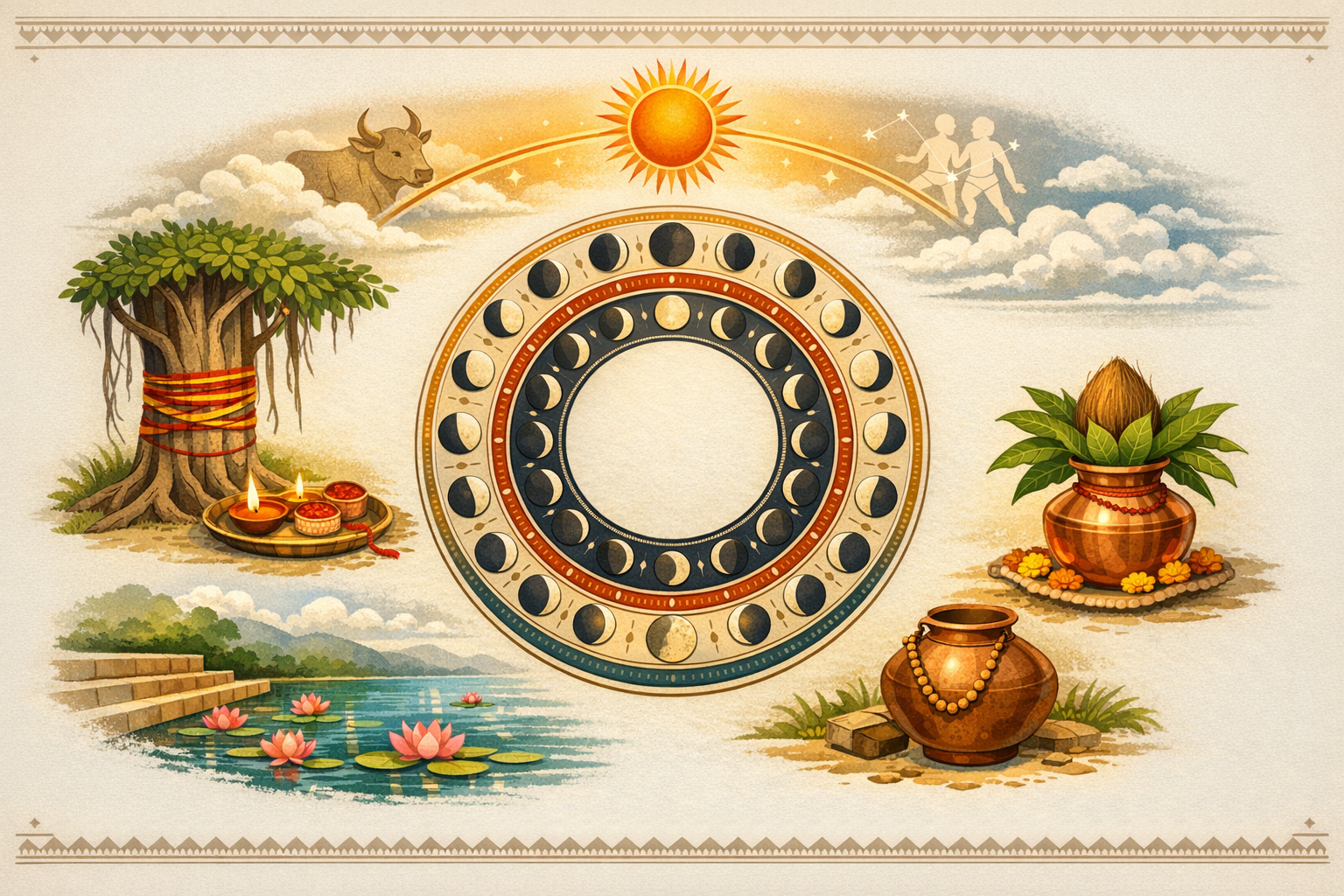
This outcome can be understood astronomically. The Amavasya that closes Vaishakha falls on 16 May 2026 (IST). From 17 May until the next Amavasya on 14 June 2026 (IST), the Sun remains in Vrishabha (Taurus), so there is no Sankranti within that lunationhence Adhik Jyeshtha. The next lunar month (15 June to 14 July) contains Mithuna Sankranti (around 15 June IST), and therefore it is designated Nija Jyeshtha. This neat alignment illustrates how the Marathi Panchang synchronizes lunar months with the Sun’s transit to maintain calendrical precision.
For household planning, the combined Jyeshtha period in 2026 therefore spans 17 May to 14 July (Adhik + Nija). Within this window, key vrats and observances typically associated with Jyeshtha align as follows in Maharashtra: Nirjala Ekadashi (Jyeshtha Shukla Ekadashi) is expected around 25 June 2026 (IST), Ganga Dussehra (Jyeshtha Shukla Dashami) approximately around 24 June 2026, and Vat Purnima (observed in Maharashtra on Jyeshtha Purnima) around 29 June 2026. Jyeshtha Amavasyaassociated in many traditions with Shani Jayantiis expected on 14 July 2026 (IST). As with all tithi-based observances, check a reliable local Marathi Panchang for exact sunrise-based assignments and for Smarta/Vaishnava variations in Ekadashi fasting dates.
Adhik Maas carries clear guidance in the Dharmashastra and Purana literature: it is a punya-kara (merit-enhancing) period recommended for japa, dana, snana, vratas, and scriptural study, while major samskaras (such as marriages, griha-pravesha, large-scale upanayana, and foundation-laying ceremonies) are typically deferred to non-Adhik months unless compelling exceptions apply. Ekadashi, Pradosha, Purnima, and Amavasya vratas continue as usual during Adhik Jyeshtha.
Jyeshtha’s lived texture in Maharashtra is marked by seasonal feeling as much as by tithis. Many households associate this time with the year’s first monsoon breaths, and the shade of the banyan (vat) tree becomes a resonant symbol during Vat Purnima. The vrat’s central motifsteadfastness, long-term well-being, and gratitudeechoes through recitation, circumambulation of the vat vriksha, and the sharing of prasada, binding families and communities to cyclical, earth-attuned rhythms.
The 2026 Adhik Jyeshtha also underscores a wider unity across dharmic traditions. The Punjabi month Jeth (coinciding with May–June), Jain observance cycles that track lunar tithis, and the broader Indic awareness of seasonal transition all reflect a common lunisolar sensibility. While specific liturgical calendars in Hinduism, Buddhism, Jainism, and Sikhism differ in structure and emphasis, the shared attentiveness to cosmic time, ethical self-discipline, and communal remembrance fosters harmony and mutual respect across these traditions.
For practical use of the Marathi Panchang in 2026, a few technical points are helpful. Festivals and vrats are fixed by tithi prevailing at local sunrise, so dates can shift by a day between locations and Panchang schools. Smarta and Vaishnava Ekadashi computations may also diverge, producing alternate fasting dates; following one’s sampradaya-specific or local almanac is advised. Outside India, time-zone offsets can move tithi boundaries across civil dates; diaspora communities should consult region-adjusted Panchang data.
In summary, Jyeshtha Mahina 2026 in the Marathi Panchang presents a textbook example of Adhik Maas harmonization, with Adhik Jyeshtha (17 May–14 June) followed by Nija Jyeshtha (15 June–14 July). Within this span fall the hallmark observances of the seasonNirjala Ekadashi, Ganga Dussehra, and, for Maharashtra, Vat Purnimaeach inviting contemplation, charity, and disciplined practice. Anchored in precise tithi-based astronomy yet rich in shared cultural meaning, Jyeshtha 2026 offers an opportunity to align daily life with the enduring cadence of the Vedic time-reckoning tradition.
Inspired by this post on Hindu Pad.