Goddess Jagadhatri, literally the “upholder of the world,” is revered in Bengal during Kartik Shukla Paksha Navami as a luminous manifestation of Adi Shakti. In this Shakta tradition, Jagadhatri embodies the sustaining power that nurtures cosmic order, guiding devotees toward humility, clarity, and inner steadiness.
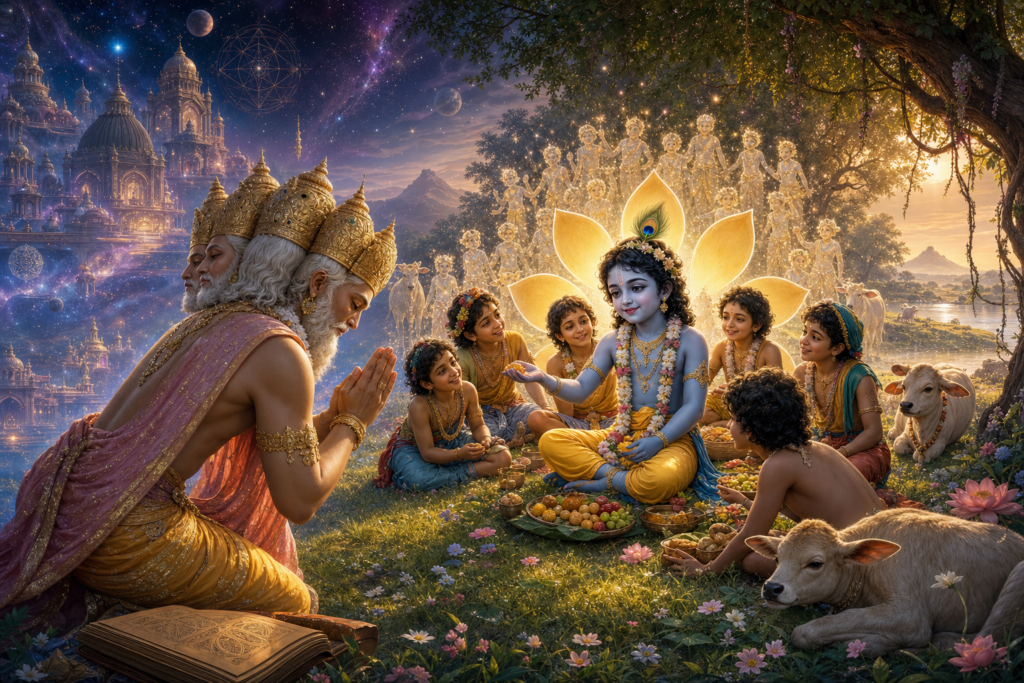
A key theological thread linked with Jagadhatri recalls a classical motif preserved in the Kena Upanishad: after the devas win a celestial victory, pride swells among them. A mysterious presence tests their powers, revealing their limitations; only upon receiving knowledge from Uma is the truth understoodthat the triumph belonged to the supreme Shakti, not to individual prowess. In Shakta exegesis of Bengal, this insight is refracted through the image of Jagadhatri: the Divine Mother who dissolves arrogance and restores balance.
Within this narrative arc, the humbling of Indra and the devas becomes a meditation on ego (ahamkara) and grace. Jagadhatri is the locus of the victory’s meaning, not its mere spectacle; she is the principle that upholds the world when will, intellect, and strength become unmoored by pride. In philosophical terms, the story points to the primacy of Shakti as the substratum of all capacities, reminding humanity that achievement without humility cannot sustain harmony.
Bengal’s Jagadhatri iconography deepens this teaching. The Goddess rides a lion and subdues an elephantan image widely read as dharma and awakened awareness mastering the heavy pull of ego. Her four hands typically hold conch (shankha), discus (chakra), bow, and arrow: the conch proclaims dharma and breathes pranic order, the discus symbolizes time and lucid awareness, while bow and arrow signify focus, restraint, and ethical intent.
Every visual detail is interpretive. The lion evokes fearless righteousness; the elephant, the inertia and self-importance that cloud discernment. The conch’s resonance is the call to inner alignment; the chakra’s rotation mirrors the cycles of time that no power can command. The bow and arrow, balanced tension and directed action, suggest that right effort arises only when guided by clarity and humility in equal measure.
Celebrated across Chandannagar, Krishnanagar, and many parts of Bengal, Jagadhatri Puja offers a contemplative complement to Durga Puja. Where Durga dramatizes the destruction of overt adharma, Jagadhatri illumines the subtler conquest of pride and presumption. Together they articulate a comprehensive vision of Shaktiforceful when needed, sustaining and educative always.
Philosophically, the humbling of Indra and the devas can be read as an inquiry into knowledge (vidya) versus power (shakti as capacity). Indra, emblematic of the mind’s sovereignty, recognizes through Uma-Jagadhatri that true sovereignty belongs to the consciousness that underwrites all faculties. This recognition transforms victory into wisdom, and prowess into service to cosmic order (rita).
The ethical implications are practical. Devotees often describe heightened self-reflection during Kartik Shukla Paksha Navami, using the festival as a rite of inner alignment: acknowledging achievements, naming blind spots, and committing to actions anchored in humility. Community service, shared learning, and silent contemplation become lived expressions of Jagadhatri’s sustaining grace.
Across dharmic traditions, this symbolism resonates. In Hinduism, it aligns with the overcoming of ahamkara and the harmonization of the gunas; in Buddhism, it parallels the taming of kleshas through mindful insight; in Jainism, it reflects disciplined restraint (samyama) and the gentle subdual of passions; in Sikhism, it echoes humility before hukam and the ethic of seva. The Goddess, in this inclusive lens, becomes a shared emblem of inner victory and compassionate strengthaffirming unity in diversity without erasing distinctions.
Read as cultural memory, the story also safeguards a plural vision of spiritual life. The devas’ pride dissolves not by coercion but by illumination. So too, plural paths in the Indian spiritual ecosystem are upheld by understanding and mutual respect, an ethos embodied in Jagadhatri’s very name: the One who upholds, sustains, and integrates.
For contemporary seekers, three reflections emerge: first, allow success to mature into gratitude; second, let knowledge temper power with responsibility; third, practice forms of service that restore balance in home, community, and environment. In each, the narrative’s core message endures: grace accompanies humility, and humility invites enduring strength.
In this way, the Bengal worship of Goddess Jagadhatri on Navami becomes both festival and philosophyan elegant synthesis of story, symbol, and sadhana. Through the humbling of Indra and the devas, the tradition articulates a timeless truth: only the sustaining Shakti holds all things together, and recognizing that truth is the beginning of wise action and lasting harmony.
Inspired by this post on Hindu Blog.