
Why Atmatattvaviveka Still Matters
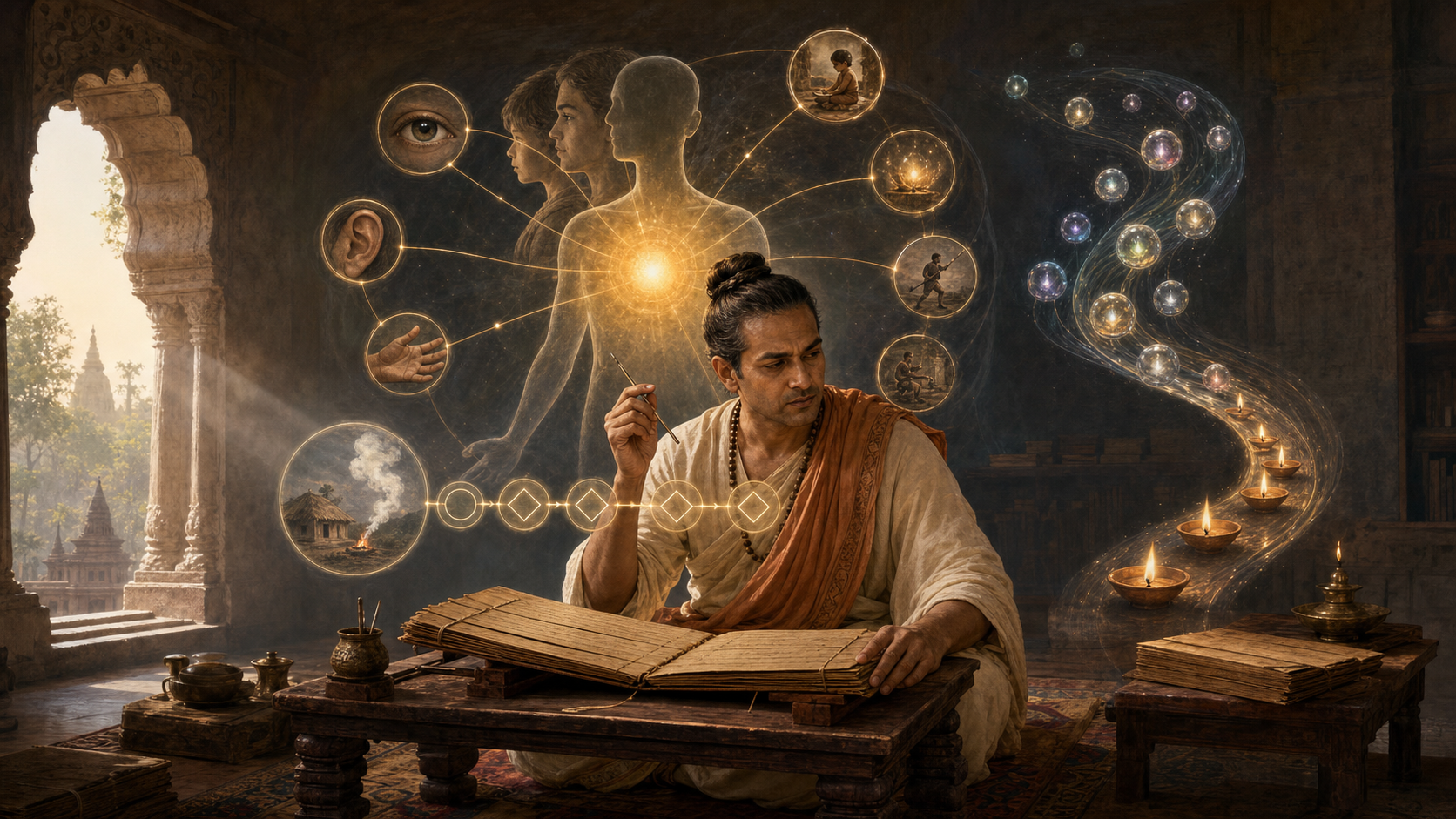
Atmatattvaviveka, also written as Atma Tattva Viveka, is a major Sanskrit work of Nyaya philosophy attributed to Udayanacharya. Its central concern could hardly be more intimate: what, if anything, remains the same through perception, memory, desire, action, sleep, bodily change, and the passage from childhood to old age? Udayanacharya approaches that question through disciplined argument rather than through biography, revelation, or devotional testimony alone. The result is a technically demanding defense of atman, an enduring self that serves as the subject of knowledge and experience.
The title joins three significant Sanskrit terms. Atman denotes the self; tattva signifies truth, reality, or the actual nature of something; and viveka means discrimination or careful discernment. The title may therefore be understood as a critical discernment of the reality of the self. This is not merely a declaration that the self exists. It is an inquiry into what would justify that claim, what kind of entity the self must be, and whether rival accounts can explain the same evidence without accepting an enduring subject.
That distinction gives the text its continuing philosophical force. A casual appeal to an inner feeling would not satisfy Nyaya standards of proof. Udayanacharya must examine cognition, memory, recognition, desire, agency, causation, and moral continuity while responding to sophisticated Buddhist theories that explain a person as a causally connected stream without a permanent soul. Atmatattvaviveka consequently belongs not only to Hindu philosophy but also to the broader history of rigorous debate among the Dharmic traditions of India.
Udayanacharya and His Intellectual Setting
Traditional accounts associate Udayanacharya with the village of Kariona in Mithila, a region celebrated for its traditions of Sanskrit scholarship, logic, jurisprudence, and debate. Personal details about his life remain sparse, but his writings reveal an exceptionally skilled philosopher working at a mature stage of the Nyaya-Vaisheshika tradition. He inherited centuries of reflection on valid knowledge and categories of reality, yet he did more than preserve that inheritance. He reformulated its arguments in response to powerful Buddhist criticism and helped prepare the conceptual ground from which later Nyaya developed.
The dates assigned to Udayanacharya require care. The biographical chronology supplied with this work places him around 1050–1100 CE, while many histories of Indian philosophy situate his activity nearer the late tenth or early eleventh century. One frequently cited chronological anchor is a date associated with his Lakshanavali, commonly converted to approximately 984 CE. Differences among manuscript traditions, era calculations, and later biographies make rigid birth-and-death dates less secure than the broader conclusion: Udayanacharya belonged to the decisive medieval period in which Nyaya and Vaisheshika were being systematically integrated.
Udayanacharya is also associated with works such as Nyayakusumanjali, Kiranavali, Lakshanavali, and Nyayavarttikatatparyaparisuddhi. These texts address subjects ranging from ontology and inference to the existence of Ishvara and the interpretation of earlier Nyaya authorities. This wider corpus matters because it shows that Atmatattvaviveka was not an isolated meditation. It formed part of a coordinated philosophical project concerned with knowledge, substances, causation, agency, moral order, and liberation.
Udayanacharya stands at an important historical threshold. Earlier Nyaya had already developed a sophisticated theory of knowledge, debate, inference, and fallacy, while Vaisheshika supplied a detailed ontology of substances, qualities, motions, universals, particularity, inherence, and absence. In Udayanacharya’s work, these resources increasingly operate together. That synthesis later became indispensable to the exacting analytical vocabulary of Navya-Nyaya, although Atmatattvaviveka itself belongs to the period before the full technical system associated with Gangesha.
The Printed Edition and Modern Scholarly Record
The work entered an important modern phase through the Bibliotheca Indica Edition published in Calcutta, now Kolkata, in 1939. This publication date must not be confused with the date of composition. The Sanskrit treatise is medieval; 1939 marks a modern editorial and printing event within the long transmission of the text through manuscripts, teaching lineages, commentaries, and scholarly institutions.
A summary by V. Varadacari was subsequently included in Volume II of the Encyclopedia of Indian Philosophies, edited by K. H. Potter. That volume, devoted to the Nyaya-Vaisheshika tradition up to Gangesha, helped make the structure and arguments of difficult Sanskrit works more accessible to modern researchers. Such summaries are valuable maps, but they do not replace the primary text. Dense arguments can turn on the interpretation of a compound, the scope of a negation, or an unstated premise supplied by a commentary.
The textual history therefore calls for a layered method of reading. The printed Sanskrit edition supplies the primary verbal form available to modern scholarship; commentarial material preserves earlier modes of interpretation; historical surveys locate the debate; and contemporary philosophical analysis can reconstruct the arguments in more familiar terms. Conclusions are strongest when these layers are compared rather than collapsed into a single paraphrase.
Nyaya as a Method of Rational Inquiry
Nyaya is sometimes reduced to formal logic, but its scope is considerably wider. It is a realist philosophical system concerned with how knowledge arises, how error can be diagnosed, what kinds of entities exist, and how reliable knowledge contributes to freedom from suffering. Logic is one of its essential instruments, but the larger objective is successful contact with reality.
Classical Nyaya recognizes four principal sources of valid cognition, or pramanas: perception, inference, comparison, and trustworthy testimony. Perception arises through appropriate causal relations involving a knower, mind, senses, and object. Inference proceeds from a sign whose invariable relation to a target property has been established. Comparison enables knowledge through relevant similarity, while testimony communicates knowledge through competent linguistic authority. The defense of the self draws especially on perception and inference, although language and remembered testimony also enter the broader discussion.
An inference is not accepted merely because its conclusion appears plausible. Nyaya asks whether the reason is present in the subject, whether it is pervaded by the property to be proved, whether counterexamples exist, and whether a hidden condition limits the claimed relation. It also classifies defective reasons, ambiguity, circularity, contradiction, and futile rejoinders. This culture of scrutiny explains why Atmatattvaviveka repeatedly considers how an opponent might reinterpret the evidence.
The familiar five-member Nyaya presentation includes a proposition, a reason, an example establishing the relevant universal relation, an application of that relation to the case under discussion, and a conclusion. Philosophical treatises often compress this form because trained readers can supply the missing stages. Recovering those stages is one of the most useful techniques for studying Udayanacharya: each argument becomes clearer when its thesis, evidence, universal rule, anticipated objection, and reply are written out separately.
What Nyaya Means by the Self
The self defended in Atmatattvaviveka should not be confused with personality, social identity, the body, the senses, or a continuous stream of thoughts. In the Nyaya-Vaisheshika account, the self is a real substance that supports changing qualities. Cognitions arise and cease; pleasures and pains vary; desires can be fulfilled or abandoned; and bodies grow, weaken, and perish. The subject to which these changing conditions belong is held to endure through them.
Nyaya ordinarily affirms a plurality of selves rather than one numerically identical empirical self shared by every being. Each embodied stream of experience is associated with its own self, mental organ, karmic history, and body. This differentiates the Nyaya view from nondual interpretations in which all selves are ultimately one, even though both may use the word atman. Indian philosophy cannot be understood accurately when the vocabulary of one school is assumed to carry the metaphysics of every other school.
A foundational Nyaya formulation identifies desire, aversion, effort, pleasure, pain, and cognition as signs of the self: iccha-dvesha-prayatna-sukha-duhkha-jnanany atmano lingam. These events are directly significant because they appear as related phases of a life rather than as an unrelated collection. Remembered pleasure can produce present desire; desire can generate effort; effort can move the body; and action can result in later pleasure or pain. Nyaya asks what makes this organized sequence the history of one subject.
The body cannot by itself perform the complete explanatory role assigned to the self. A body is composite, continually changing, and eventually destroyed. Its parts do not separately possess the unified awareness attributed to a person. The sense organs are also specialized: the eye discloses color but not sound, while the ear discloses sound but not color. Yet a person can recognize that the object seen is the same object later touched or heard. Nyaya treats such cross-modal coordination as evidence for a knower distinct from any single organ.
The internal organ called manas occupies an important intermediate position. It is not identical with the eternal self. Classical Nyaya describes it as a minute internal instrument that connects the self with a particular sense or mental content. The apparent non-simultaneity of ordinary cognitions is used as evidence for this selective connection: although several senses may be functioning, attention typically presents one determinate cognition at a time.
Nyaya also characterizes selves as pervasive rather than spatially confined inside the body. This initially seems puzzling: if a self is pervasive, why does it experience only one body? The traditional response appeals to the distinctive causal relation among a particular self, its manas, karmic dispositions, sense organs, and body. Pervasiveness does not entail omniscience, because cognition still requires the appropriate causal conditions. Individuality is established through distinct experiential and karmic histories, not by placing each self in a tiny physical compartment.
Consciousness, moreover, is treated in classical Nyaya as a quality of the self rather than as its unchanging essence. A self can endure when an ordinary cognition is absent, as the tradition maintains in dreamless sleep and in certain accounts of liberation. This sharply distinguishes Nyaya from Vedanta systems that define the deepest self in terms of consciousness itself. The difference is not verbal decoration; it changes how each tradition interprets sleep, self-knowledge, liberation, and the relation between awareness and its subject.
The Buddhist Challenge: Continuity Without a Permanent Self
The Buddhist positions addressed by Udayanacharya must be represented with care. The teaching of anatman or anatta does not ordinarily claim that nothing exists or that ethical life is meaningless. It denies that analysis reveals a permanent, independent, unchanging owner behind the psychophysical processes conventionally called a person. Different Buddhist schools explain those processes through aggregates, momentary events, dependent origination, causal continuity, conceptual construction, or consciousness streams.
Nor does the term Buddhism identify one uniform philosophical opponent. Abhidharma analysis, Madhyamaka reasoning, Yogachara theories, and the epistemological traditions associated with Dignaga and Dharmakirti differ significantly. Udayanacharya confronts arguments shaped by particular scholastic controversies, sometimes through the classifications employed by Nyaya itself. A historically responsible reading should therefore avoid presenting every Buddhist tradition as committed to every proposition discussed in the text.
The strongest Buddhist alternative does not need a permanent witness to connect two experiences. An earlier cognition can produce a disposition; that disposition can help cause a later memory; and each event can belong to one causal continuum without an unchanging substance passing through every stage. A flame can condition another flame, or one moment of a stream can condition the next, without numerical identity between the earlier and later events. This is a serious explanatory model, not merely a denial awaiting correction.
Udayanacharya’s task is therefore demanding. He must show either that causal continuity presupposes more unity than the Buddhist model admits or that certain phenomena cannot be explained adequately by a series of momentary events alone. The disagreement turns on the ownership of cognition, the relation between experience and memory, the unity of agency, and the difference between a sequence that is merely causally connected and a life genuinely belonging to one subject.
Memory and the Enduring Subject
Memory supplies one of the most accessible routes into the debate. A memory is not normally experienced as information about an entirely unrelated past event. It presents itself as a recollection of something previously encountered by the same subject. The remembered object may have disappeared, the body may have changed, and the original cognition is no longer occurring, yet the past experience is appropriated as part of a continuing life.
Nyaya explains memory through a residual disposition, or samskara, produced by an earlier cognition and retained in the self. When suitable conditions arise, that disposition generates recollection. The account connects the original experience, the latent trace, and the later memory through one enduring locus. A reader who recognizes a childhood event as personally remembered encounters the intuitive force of this proposal: the memory seems to carry not only content but also ownership.
The Buddhist reply is that a causal series can preserve information without a permanent container. A later event may count as memory because it was appropriately caused by an earlier event in the same continuum. Contemporary accounts of psychological continuity sometimes resemble this strategy. Udayanacharya must consequently establish why causal transmission alone does not explain the first-person structure of recollection.
The Nyaya response focuses on the relation expressed when a subject understands that the person who previously experienced an object is the person who now remembers it. A merely successive series may explain why a later representation resembles an earlier cognition, but Nyaya questions whether it can explain the judgment of numerical identity linking experiencer and rememberer. The argument is strongest when treated as a challenge about ownership and diachronic unity, not as the simplistic assertion that any memory automatically proves an eternal soul.
False memories do not immediately defeat the argument. Nyaya distinguishes the existence of a cognitive capacity from the truth of every cognition produced through it. An inaccurate recollection can still occur in a subject and can be evaluated against evidence. The more difficult question is whether the subject of true and false memory must be an enduring substance or can instead be analyzed as a causally ordered process. That is precisely where the rival ontologies divide.
Recognition and the Coordination of Experience
Recognition strengthens the Nyaya case by connecting cognitions across time and across sensory channels. A person may see an object, later touch it in darkness, and judge it to be the same thing. The eye does not touch, and the tactile organ does not see. Nyaya therefore posits a common subject capable of relating the outputs of distinct senses and forming the judgment that this is the object previously encountered.
The relevant phenomenon is sometimes discussed through ideas such as recollective connection and the synthesis of cognitions. Its importance lies not simply in the presence of several sensory events but in their integration. The subject compares, identifies, corrects, and sometimes rejects earlier appearances. For Nyaya, these normative acts are difficult to assign to isolated momentary cognitions that vanish before the later act occurs.
A defender of momentary continuity can answer that each event transmits causal information to its successor and that later cognition integrates inherited traces. Udayanacharya’s pressure point is the distinction between causal succession and conscious synthesis. If the earlier cognition no longer exists and the later cognition is numerically different, what grounds their presentation as experiences of one knower? The text presses this question without assuming that ordinary language alone has already settled it.
Desire, Effort, and Agency
Desire and action supply another line of reasoning. An experienced pleasure leaves a disposition; recollection of it generates desire; desire motivates effort; and effort initiates bodily action. Nyaya interprets this purposive chain as evidence that the enjoyer, rememberer, desirer, and agent are one enduring subject. Otherwise, one moment would experience, another would desire, and still another would labor for a result that none of them survives to receive.
The Buddhist model can describe each moment as causally conditioned by its predecessors, so the mere existence of a sequence proves little. The sharper Nyaya argument concerns rational coordination. Present effort is intelligible as action for the sake of a future condition because a subject treats past evidence, present intention, and anticipated result as belonging to one practical history. Udayanacharya asks whether this structure can be reduced without remainder to impersonal causal production.
Agency also carries moral significance. Praise, blame, obligation, merit, and demerit assume a meaningful relation between an act and the being who experiences its consequences. Nyaya locates karmic dispositions in the enduring self, thereby linking action to later embodiment and experience. Buddhist traditions preserve moral continuity through dependent causation rather than an eternal agent. Both systems protect ethical accountability, but they explain its metaphysical basis differently.
This comparison prevents a common misunderstanding. Acceptance of anatman does not eliminate karma, and acceptance of atman does not make every ordinary belief about personality correct. Both traditions distinguish deep causal and ethical continuity from attachment to a fixed social ego. Their disagreement concerns what ultimately bears or constitutes that continuity.
Momentariness, Permanence, and Causal Power
A central Buddhist objection holds that a permanent entity cannot perform genuinely different causal functions at different times. If it possesses a complete causal capacity, why does it not produce every effect immediately? If it acquires a new capacity, it has changed and is not permanent in the required sense. The theory of momentariness avoids this problem by treating each event as a distinct causal occurrence.
Nyaya answers by distinguishing a substance from its changing qualities and relations. Permanence does not mean that the self produces every cognition without assistance or remains unrelated to changing conditions. A cognition arises when the necessary complex is present: self, manas, sense organ, object, attention, and other causal factors. The self persists while connections and qualities arise or cease. On this account, the enduring subject need not be causally inert merely because it does not undergo destruction at every moment.
The dispute exposes two different models of change. The Buddhist model explains an apparent persisting thing as an ordered succession of events. The Nyaya model explains change as the acquisition and loss of qualities by a continuing substance. Each model must account for causal regularity, similarity, difference, memory, and practical identity. Atmatattvaviveka is valuable because it brings the costs of both positions into view.
Udayanacharya’s defense also depends on the possibility of real relations, universals, and enduring bearers of properties. A philosophy that rejects such categories will naturally resist the Nyaya inference. The debate about the self is therefore inseparable from wider questions: whether properties require substances, whether identity can persist through qualitative change, and whether causal continuity is ontologically basic or itself demands a supporting structure.
How the Self Is Known
Nyaya discussions do not always present knowledge of the self in exactly the same way. Some arguments emphasize inference from desire, cognition, memory, and effort. Others give a greater role to inward awareness mediated by manas. The tradition’s development should not be flattened into the single claim that the self is either directly seen or completely hidden. Different kinds of self-awareness may be involved.
A first-order cognition discloses an object, while a subsequent awareness can take the form “this object is known” or “there is knowledge of this object.” Later Nyaya uses the concept of anuvyavasaya for reflective cognition of a preceding cognition. Such awareness connects knowledge with a subject, but it remains open to analysis: does the reflexive structure reveal an enduring self, or can a later cognition represent an earlier one within a causal series?
Buddhist epistemologists often describe cognition as possessing some form of reflexive awareness, though the interpretation varies. Nyaya generally resists the claim that every cognition must illuminate itself in the same act. A lamp may illuminate objects, but the analogy between light and consciousness cannot decide the issue by itself. The two traditions disagree about whether awareness requires a separate reflective cognition and about what, if anything, unifies the sequence.
The word “I” also requires caution. Its ordinary use is evidence that experience is presented from a first-person standpoint, but grammar alone cannot prove a metaphysical substance. Language can preserve conventional designations even when philosophical analysis revises their meaning. Udayanacharya’s case is therefore cumulative: first-person awareness, memory, recognition, desire, and action are interpreted together rather than resting on a pronoun in isolation.
The Body, Mind, and Self Are Not Synonyms
The technical architecture of Nyaya becomes clearer when three levels are separated. The body provides an organized physical basis for embodied action. The senses connect particular bodily capacities with objects such as color, sound, taste, smell, and touch. Manas coordinates attention and inward cognition. The self is the subject in which cognition, desire, pleasure, pain, volition, and dispositions occur.
This model is not identical with modern mind-body dualism. The Nyaya self is not simply a private mental substance containing ideas, because manas is separately postulated as an internal instrument and cognition is treated as a quality produced under causal conditions. Nor is the self equivalent to the brain, personality, or autobiographical narrative. Direct comparisons with modern philosophy can illuminate the problem, but they should not erase the distinctive categories of Indian thought.
The model also avoids treating embodiment as irrelevant. Ordinary knowledge requires functioning causal relations among self, mind, senses, body, and environment. Damage to a sensory organ changes what can be perceived; distraction changes what enters awareness; memory depends on prior experience and suitable activating conditions. The metaphysical claim that the self is distinct from the body does not entail that embodied cognition proceeds independently of bodily conditions.
Self-Knowledge, Error, and Liberation
Nyaya philosophy connects metaphysical inquiry with liberation, or apavarga. Suffering is sustained by error, attachment, aversion, and action rooted in mistaken understanding. Reliable knowledge of the self and other objects of inquiry helps interrupt that sequence. The aim is not intellectual victory for its own sake but freedom from the conditions that perpetuate suffering.
Knowledge that the self differs from body, senses, and passing mental states weakens false identification. Pain remains a real event, but it need not define the entire nature of the subject. Pleasure is also impermanent and cannot provide final security. This analysis gives the text an existential resonance: experiences matter deeply, yet no single experience exhausts the reality of the one who undergoes it.
Classical Nyaya accounts of liberation often emphasize the complete cessation of suffering and of the causal conditions that generate embodied experience. The status of cognition and bliss in liberation received different formulations across Indian schools and historical periods. It is therefore misleading to import a Vedanta description of liberation into Nyaya without qualification. Shared terms such as moksha can conceal substantial philosophical differences.
The argument for the self should also be distinguished from Udayanacharya’s arguments concerning Ishvara in Nyayakusumanjali. The existence of an individual self, the persistence of moral dispositions, and the existence of a supreme cause are connected within his larger philosophy, but they are not one proposition. A reader may evaluate the defense of personal continuity without assuming that every separate theological argument has already been established.
A Dharmic Conversation Rather Than a Contest of Communities
Atmatattvaviveka emerged from a culture in which Hindu and Buddhist philosophers disagreed sharply while sharing standards of disciplined study, debate, inference, meditation, ethics, and liberation from suffering. Polemical language in premodern texts reflects real intellectual competition, but disagreement about a proposition should not be converted into hostility toward a living community. The most productive modern reading preserves the rigor of the arguments and the dignity of every tradition involved.
Hindu traditions themselves do not offer only one theory of self. Nyaya defends plural enduring selves whose consciousness arises as a quality. Advaita Vedanta identifies the deepest self with nondual consciousness. Vishishtadvaita and Dvaita articulate other relations among individual selves, the world, and the supreme reality. Samkhya distinguishes multiple conscious purushas from prakriti. These positions overlap in vocabulary while differing in ontology and soteriology.
Buddhist traditions analyze the person without affirming a permanent independent self, yet they preserve compassion, disciplined practice, karmic continuity, and liberation. Jain philosophy affirms a plurality of living selves, or jivas, while explaining bondage through karmic matter and presenting its own account of consciousness and liberation. These are not minor variations on one doctrine; they are carefully developed alternatives within the wider Dharmic intellectual world.
Sikh teachings arose centuries after Udayanacharya and should not be projected anachronistically into his debate. They nevertheless contribute another influential Dharmic vocabulary of atma, divine reality, ethical action, remembrance, grace, and liberation from ego-centered attachment. Comparison is valuable when chronology and doctrinal differences are respected.
Unity among Dharmic traditions does not require an artificial declaration that every school teaches the same doctrine. A more durable unity arises from honest comparison, intellectual hospitality, and recognition of a shared civilizational commitment to transforming ignorance and suffering. Udayanacharya’s arguments can therefore be studied alongside Buddhist, Jain, Vedanta, Samkhya, and Sikh perspectives without diminishing any of them.
Connections with Contemporary Philosophy of Mind
The questions raised in Atmatattvaviveka</em remain active in contemporary philosophy. Substance theories seek a persisting bearer of mental states; bundle and process theories understand a person through connected events; psychological-continuity theories emphasize memory, intention, and character; biological theories identify continuity with the living organism. Udayanacharya enters this conversation as a defender of a real subject that cannot be reduced to body or momentary cognition.
Modern neuroscience can describe correlations among brain activity, attention, memory formation, bodily regulation, and reported consciousness. Those findings are indispensable to any contemporary account of embodied cognition, but they do not automatically settle every metaphysical question about subjecthood or personal identity. Conversely, an ancient inference to an enduring self cannot replace empirical investigation. The two inquiries operate with different methods and must be related through argument rather than slogans.
Cases involving memory loss, divided attention, personality change, unconscious processing, and altered states place pressure on simple theories of a unified self. Nyaya can respond that changing cognitive capacities are qualities and conditions of an enduring subject, while a process theorist can argue that the cases reveal degrees rather than an indivisible unity. Atmatattvaviveka remains relevant precisely because it supplies a developed position against which these alternatives can be tested.
The text also anticipates a distinction between causal continuity and normative ownership. A device can preserve information, and one event can transmit a trace to another, but memory and responsibility appear to involve the further claim that an experience or action belongs to someone. Whether that apparent ownership requires an enduring substance remains contested. Udayanacharya’s achievement lies in identifying the explanatory burden with unusual clarity.
Strengths and Limits of Udayanacharya’s Case
The strongest feature of the Nyaya case is its cumulative structure. Memory, recognition, cross-modal awareness, desire, effort, responsibility, and reflective cognition reinforce one another. The self is proposed not as an invisible object arbitrarily added to experience but as an explanatory ground for the organized unity of experience and action.
A second strength is the distinction between persistence and changeless appearance. The self remains numerically identical while acquiring different qualities and relations. This allows Nyaya to acknowledge profound psychological and bodily change without concluding that no subject endures. It also gives a clear account of how one being can learn, regret, promise, and pursue liberation.
The principal challenge is that causal-process theories can explain more than a superficial reading admits. Information, dispositions, intentions, and behavioral coordination may be transmitted through a series without a permanent substance. Nyaya must show that first-person ownership and numerical identity cannot be reconstructed through such relations. Readers should therefore treat Udayanacharya’s arguments as sophisticated contributions to an open philosophical dispute, not as shortcuts that eliminate the need to understand the opposing position.
Another challenge concerns the explanatory work assigned to an imperceptible, pervasive self. If cognition depends on a body, senses, mind, objects, and prior dispositions, a critic may ask what additional prediction the self provides. Nyaya answers that qualities require a real locus and that the unity of cognition cannot belong to the physical instruments individually. Whether this inference succeeds depends partly on accepting the broader Nyaya theory of substances and qualities.
A Practical Method for Reading Atmatattvaviveka
The first step is to identify the proposition under examination. A passage may be defending the existence of a self, its permanence, its distinction from cognition, or its role as the locus of dispositions. These theses should not be treated as interchangeable. An argument sufficient to distinguish the knower from a sense organ may not yet prove eternality or pervasiveness.
The second step is to reconstruct the opponent’s position in its strongest form. A Buddhist philosopher does not need to deny continuity, memory, karma, or responsibility; the claim is that these can be explained without an eternal substance. Once that alternative is made explicit, Udayanacharya’s reply becomes more precise and intellectually rewarding.
The third step is to separate epistemology from ontology. A discussion of how the self is known is not identical with a discussion of what the self is. Inference, introspection, and reflective cognition concern knowledge of the self; substance, quality, permanence, plurality, and pervasiveness concern its nature. Many apparent contradictions disappear once these levels are distinguished.
The fourth step is to track technical terms consistently. Pramana means a reliable means of knowledge; prameya is an object to be known; dravya is substance; guna is quality; manas is the internal organ; samskara is a disposition or trace; smriti is memory; vyapti is the invariable relation supporting inference; and apavarga is liberation. A loose translation can obscure an argument that depends on the difference between these categories.
The fifth step is to compare translations and consult historical context. Sanskrit philosophical prose is compressed, and a single sentence may contain an objection, a provisional reply, and a rebuttal. The 1939 Bibliotheca Indica Edition, relevant commentarial traditions, and V. Varadacari’s summary in the Encyclopedia of Indian Philosophies provide complementary points of entry. No synopsis should be mistaken for the full argumentative detail of the Sanskrit text.
The Enduring Legacy of Atmatattvaviveka
Atmatattvaviveka deserves attention because it refuses to leave the self as a vague spiritual slogan. Udayanacharya subjects the concept to tests involving evidence, causal explanation, rival hypotheses, and logical consequence. Memory must be explained; agency must be located; changing cognitions must be related; and a permanent self must be shown capable of participating in a changing world.
The work also preserves an extraordinary record of inter-Dharmic philosophical exchange. Nyaya’s defense of atman became sharper because Buddhist philosophers developed formidable accounts of momentariness and selfless continuity. Buddhist reasoning, in turn, was repeatedly refined through encounters with realist critics. Intellectual disagreement functioned as a source of precision.
For contemporary readers, the deepest benefit lies in learning how to ask the question well. A person changes physically and psychologically, yet memories, commitments, grief, affection, and responsibility appear to form one life. Whether that unity belongs to an eternal self, a living organism, a stream of causally connected events, or another structure remains a profound problem. Udayanacharya’s answer is distinctly Nyaya, but the discipline with which he develops it belongs to the shared heritage of Indian philosophy.
Read in that spirit, Atmatattvaviveka becomes more than a historical defense of the soul. It is an invitation to distinguish intuition from proof, continuity from identity, consciousness from its conditions, and respectful disagreement from hostility. Its enduring lesson is that the search for truth becomes stronger when competing Dharmic perspectives are represented accurately, examined rigorously, and approached with intellectual humility.
Inspired by this post on Hindu Blog.
