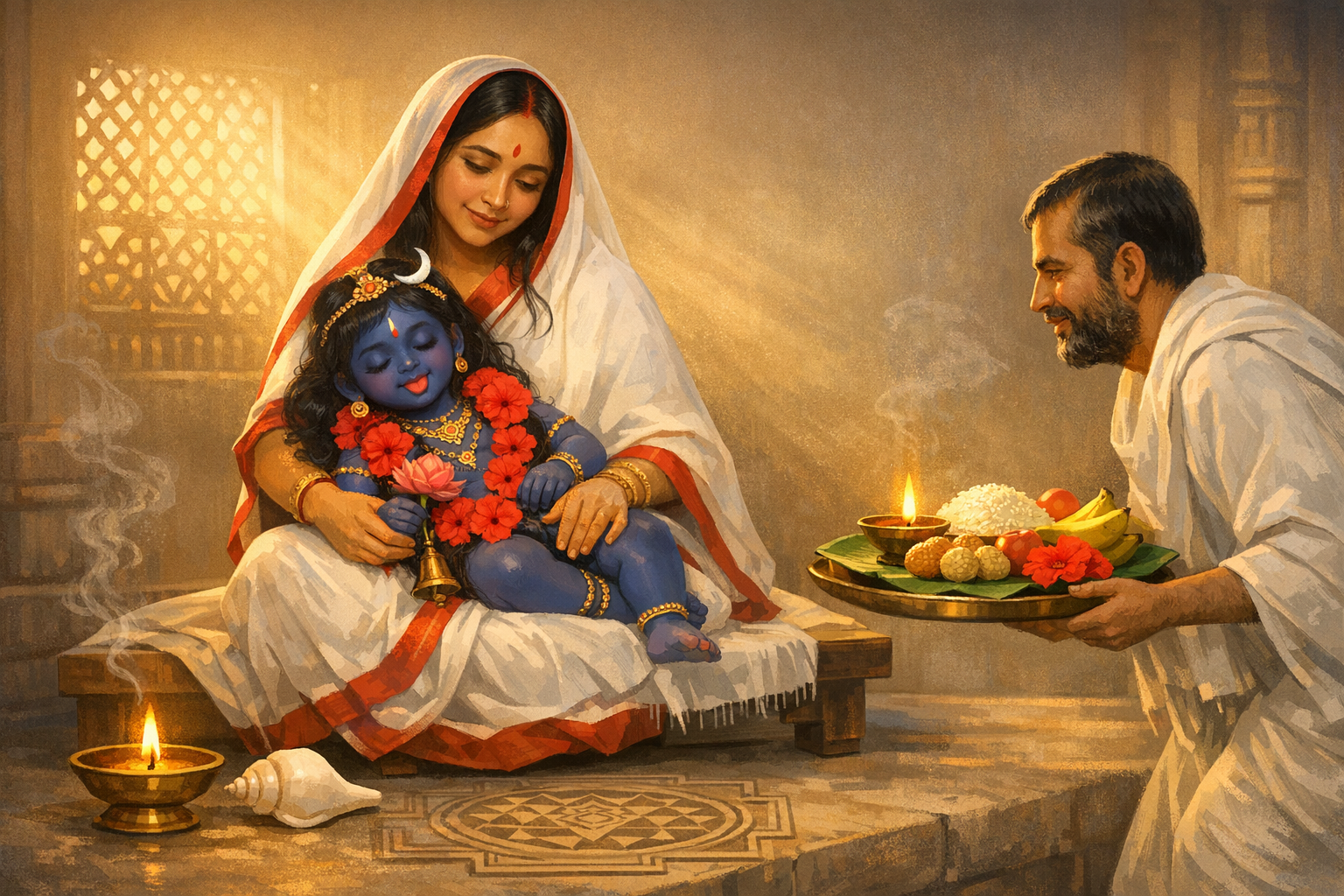
In the spiritual imagination of Sanatana Dharma, a striking tableau invites close study: Child Goddess Kali resting on the lap of Maa Sharda while Sri Ramakrishna approaches with food. More than devotional art, this configuration gathers multiple strands of Hindu symbols, Shakta Tantra, and bhakti psychology into a single living hermeneutic where fierceness meets maternal love through service.
Across the sacred vocabulary of Hinduism, Kali embodies a profound paradox. As a name derived from kala (time), Kali dissolves fear and attachment, unveiling the groundless freedom of reality; yet, in Bengal’s household piety, She is equally Shyama Ma, the most intimate Mother. The child form of Kali reorients attention from terror to trust, from awesome transcendence to approachable tenderness, without diminishing Her boundless Shakti.
Symbolism — Image Of Child Goddess Kali Sitting On The Lap Of Maa Sharda And Sri Ramakrishna Bringing Food For Goddess — signals a deliberate theological condensation. Here, Kali’s raudra (fierce) energy is enfolded within saumya (gentle) maternal grace, while seva (loving service) becomes the bridge that unites transcendence, immanence, and human devotion.
Historically, Sri Ramakrishna Paramahamsa (1836–1886) exemplified Sanatana Dharma’s inclusivity by practicing diverse sadhanas and experiencing samadhi in multiple bhavas. At Dakshineswar, he revered the Divine Mother as the sole agent of all action and, in a celebrated rite known as Shodashi Puja, worshiped Sarada Devi as the living Goddess. That lived recognition of Shakti in the human and the human in Shakti undergirds the vision depicted here.
The child-form of Kali foregrounds vatsalya-bhava, the devotional mood of protective, parental love. While widely known in Vaishnava traditions through Bala Krishna, vatsalya equally illumines Shakta experience: one nurtures the very Power that nurtures the cosmos. Divine play (lila) thus becomes reciprocal—human hands tend the Infinite, and the Infinite shelters the human heart.
Maa Sarada (often also rendered Maa Sharda) anchors this scene as the manifest axis of compassion. The maternal lap functions here as an embodied altar—an adharashakti or bearing support in which restless energies are stilled. When Kali the Child reclines in that field of care, theological abstraction becomes relational truth: Shakti is not merely cosmic potency but inexhaustible tenderness.
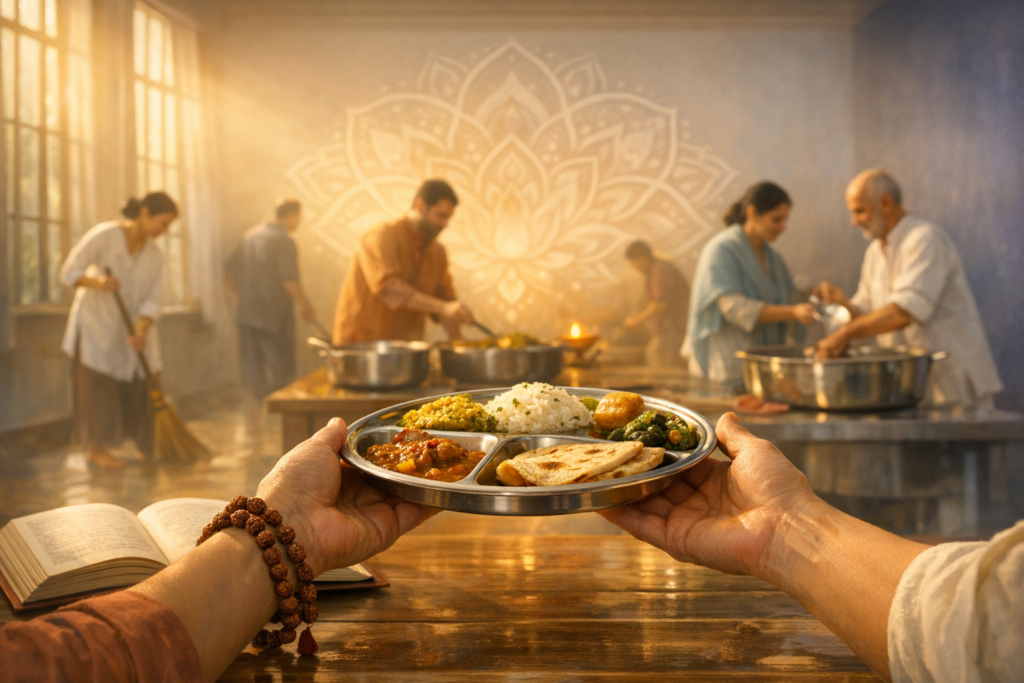
Sri Ramakrishna approaching with food (bhog, naivedya) embodies bhakti’s practical grammar—offer, receive, and return. Food is not a mere prop; it is annam, the sacrament of life, bridging the annamaya kosha (food sheath) with the heart’s devotion. In offering nourishment, service itself is transfigured into knowledge: jiva-seva becomes Shiva-seva, and daily acts acquire sacred density.
Taken together, the triad encodes a portable theology. Child Kali represents the raw, playful spontaneity of consciousness; Maa Sarada embodies boundless compassion as living sanctuary; Sri Ramakrishna personifies awakened service that consecrates the world. Power, care, and offering—three movements, one indivisible rhythm of Sanatana Dharma’s wisdom tradition.
Read through the lens of rasa and bhava, the image stages a movement from raudra to shanta and vatsalya. What appears fierce is not denied but metabolized by maternal presence and steady seva. Rather than opposing strength and softness, the composition reveals their deeper non-duality: fierceness that protects and tenderness that empowers.
Iconographically, Kali is often rendered with a garland of heads, a blood-red tongue, and a sword symbolizing the severance of ignorance, standing upon the stillness of Shiva. The child-form reframes these emblems not by erasure but by transformation: innocence replaces dread as the primary lens of engagement, and the sword’s meaning of discernment remains—now tempered by trust.
Ritually, the scene resonates with living practices such as Kumari Puja—where a young girl is honored as the Goddess—and household worship of Annapurna, the Giver of Food. Ramakrishna’s Shodashi Puja to Sarada Devi and his emphasis on seeing the Mother in all beings make this tableau more than allegory; it is a crystallization of a historical lineage in which devotion, Tantra, and Advaita cohere.
Philosophically, the image invites Advaita-inflected reading without denying devotion’s plurality. The same Brahman that is nirguna (beyond attributes) expresses as saguna (with attributes) for the devotee’s sake. Child Kali, Mother Sarada, and the serving Ramakrishna are not three ultimates but three pedagogies of one reality, reflecting the bhedabheda intuition of difference-and-non-difference.
Psychologically, the composition speaks to inner integration. Child Kali mirrors the fearless inner child, the creative impulse unconditioned by social masks; Maa Sarada’s lap symbolizes unconditional holding that permits the psyche to soften; Ramakrishna’s offering encodes disciplined action that sustains clarity. Together, they model how love steadies power and how service refines love.
Ethically, the scene translates into a program of action: let strength be guided by compassion and expressed through seva. Ramakrishna’s well-known emphasis on “Shiva-jnane jiva-seva” places the devotee’s duties within a universal frame—care for the world is care for the Divine. In that light, even small offerings become instruments of liberation.
Inter-dharmic resonances further deepen the image’s relevance. In Buddhism, Tara unites maternal mercy with the resolute courage of bodhisattva vows, while wrathful deities in Vajrayana transmute ignorance through fierce compassion. Jain traditions venerate yakshis such as Ambika and Padmavati as protective presences. Sikh scripture and tradition honor both daya (compassion) and bir ras (heroic energy), a polarity echoed in Chandi traditions. Across dharmic families, fierce grace and maternal love converge to guard wisdom and nourish beings.
Within Bengal’s devotional culture, Kali Puja on the new-moon night, the endearing name Shyama Ma, and the everyday idiom of offering bhog make the Goddess a member of the household rather than a distant absolute. Dakshineswar thus becomes a symbol of accessibility; sanctity is not sequestered from life but saturates it.
Comparative goddess imagery adds nuances. Annapurna, who feeds even Shiva, highlights the primacy of nourishment in spiritual life; Durga as mother of Kartikeya and Ganesha underscores that cosmic power also cradles vulnerability. In this image, the same truth takes a Shakta form: maternal embrace does not negate Kali’s power; it perfects its orientation toward compassion.
Semiotically, the lap is a liminal space—a threshold where the formidable becomes familiar. The body as altar reframes the metaphysical as interpersonal, while the act of feeding infuses time with sacrality: every meal is a rite, every gesture a mantra, every day a cycle of offering and return. Such is the grammar of Sanatana Dharma’s living symbolism.
From a soteriological angle, the food offering marks the descent of grace into the annamaya kosha and its re-ascent as prasad. Transformation travels both ways: the devotee is changed by the act of giving, and the world is changed by the circulation of sanctified care. In that reciprocity, bhakti, jnana, and karma find mutual completion.
A contemplative engagement with this image can proceed in three movements. First, rest attention on Child Kali and allow awe to soften into trust. Next, dwell with Maa Sarada’s lap as unconditioned welcome. Finally, contemplate Sri Ramakrishna’s offering as the resolve to serve, letting intention ripen into steady, compassionate action.
For contemporary seekers, the tableau offers a practical ethic: cultivate strength without harshness, love without possessiveness, and service without pride. The unity-in-diversity ethos of Sanatana Dharma is not an abstract slogan here; it is visibly enacted as Kali’s energy, Sarada’s compassion, and Ramakrishna’s seva harmonize.
Ultimately, the image teaches that what seems opposed—fierceness and tenderness, transcendence and immanence, devotion and knowledge—interpenetrates at every level of experience. Child Kali on the lap of Maa Sharda, with Sri Ramakrishna bringing food, is thus a compact theology of fierce grace: power secured by love, love expressed through service, and service illumined by wisdom.
Viewed through the wider lens of Hindu Art and Culture, this vision functions as a pedagogical emblem for unity among Hinduism, Buddhism, Jainism, and Sikhism, where protective courage and maternal compassion are universally cherished. It is a reminder that diverse spiritual paths within the dharmic family converge upon the same living truth—care is the form wisdom takes in the world.
Inspired by this post on Hindu Blog.