Among the innumerable honorifics of Sri Krishna, the name Murari commands a distinctive reverence. It preserves a concrete episode from the Puranas while signaling an enduring spiritual lesson: the victory of divine discernment over the forces of ego, delusion, and tyranny. For many families across South Asia, this name evokes the warmth of childhood bhajans, the glow of lamps on Naraka Chaturdashi before Deepavali, and the quiet discipline of Ekadashi fasting—lived practices through which narrative becomes inner transformation.
At the level of language, Murari is a precise Sanskrit compound: Mura + ari (enemy), meaning “the one who vanquished Mura.” Grammatically, it is a genitive (ṣaṣṭhī) tatpuruṣa compound—“the foe of Mura”—that later functions as an epithet. The philological clarity of the name mirrors its theological clarity in the Puranas: it ties a title of Sri Krishna to a specific, storied act.
Multiple textual witnesses preserve this act. The Bhagavata Purana (Book 10) locates Murari within the larger narrative of Krishna’s campaign against the asura Narakasura, while the Vishnu Purana and the Harivamsha (the ancient supplement to the Mahabharata) recount cognate episodes. The Padma Purana offers an allied but strikingly different emphasis by linking the fall of Mura to the origin of the Ekadashi vow (Utpanna Ekadashi), underscoring the way ritual observance and narrative memory interweave in Hindu traditions.
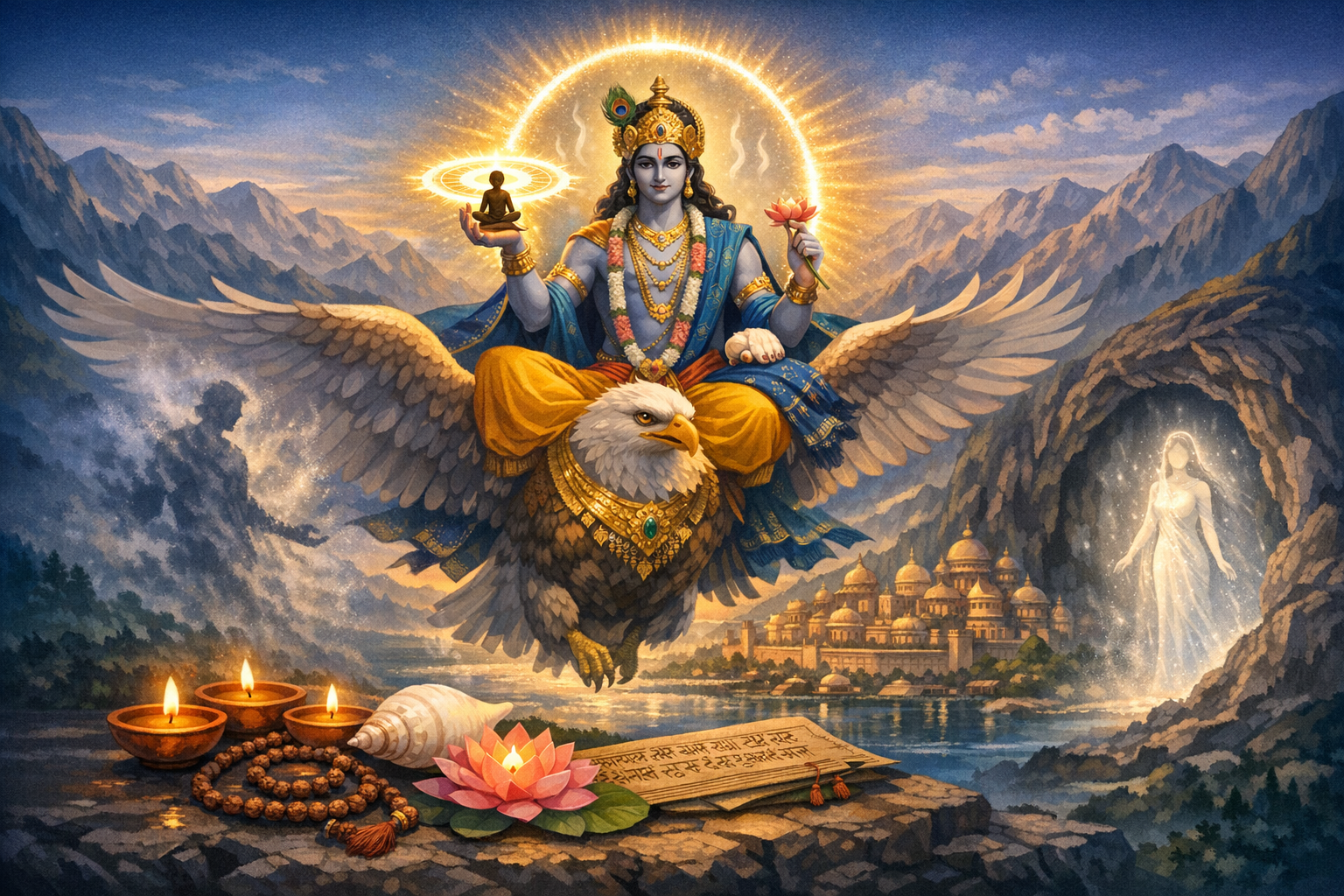
In the Bhagavata Purana’s account, Narakasura fortified his stronghold at Pragjyotisha (often identified with the historical Kamarupa region, broadly corresponding to parts of present-day Assam). Protective ramparts of mountains, moats teeming with fearsome creatures, and layers of illusory defenses formed a labyrinth around the city. Before Krishna could confront Narakasura, Mura—his formidable general—rushed forward. Mura’s assault, described in vivid martial imagery, is repelled when Sri Krishna, mounted upon Garuda, cleaves through the demonic onslaught with the Sudarshana chakra. In this decisive moment, Krishna becomes Murari, the destroyer of Mura.
The fall of Mura in this telling clears the way for the defeat of Narakasura, the recovery of Aditi’s divine earrings, and the liberation of the captive maidens—episodes that together explain the ethical, cosmic, and social dimensions of Krishna’s intervention. The commemoration of Narakasura’s fall is embedded in the observance of Naraka Chaturdashi (on the eve of Deepavali), anchoring the narrative in a living calendar and giving devotees a ritual grammar for recalling the triumph of light over darkness.
The Padma Purana preserves another influential strand by associating Mura’s downfall with Utpanna Ekadashi. Here, as devas are assailed by Mura’s might and sorcery, Vishnu engages the asura in relentless combat. At a turning point, the Lord reposes briefly in a mountain cave; from that repose arises Ekadashi Devi—an embodiment of divine will and sattvic restraint—who slays Mura. Vishnu then honors her with the name Ekadashi and grants that observance of the Ekadashi vrata would secure spiritual merit and liberation. Though the agent of Mura’s death differs in emphasis, the title Murari coheres: the slaying is accomplished by Vishnu’s own śakti, inseparable from Him.
Read side by side, these sources do not compete but complement one another. The Bhagavata Purana foregrounds Krishna’s direct martial triumph and its social-redemptive outcomes; the Padma Purana highlights how ascetic discipline (vrata) participates in and carries forward the same victory. Taken together, they show how narrative, ethics, and practice interlock in the formation of sacred memory.
Theologically, Murari signifies more than a historical or mythic vanquisher. In devotional and contemplative exegesis, Mura is read as a cipher for inner adversaries—pride, anger, greed, attachment, and delusion—that disrupt clarity and compassion. In this hermeneutic, Sri Krishna as Murari becomes the sovereign of inner governance (ātma-niyantraṇa), the one whose presence silences the noise of ego and restores the mind to dharma.
This inner reading resonates across the broader dharmic family. Buddhist traditions name these inner adversaries as kleśas that cloud insight; Jain teachings describe kaṣāyas (passions) to be attenuated through right conduct and austerity; Sikh teachings warn against the five “thieves” (kām, krodh, lobh, moh, ahankār) and elevate gurmat as the corrective. While the narratives and theologies differ, the shared intuition is unmistakable: liberation begins with recognizing, and then overcoming, the inner Mura. In this way, Murari becomes a bridge of understanding among Hinduism, Buddhism, Jainism, and Sikhism—affirming unity in the quest to master the self and serve the world.
The ritual corollary of this unity appears most clearly in Ekadashi observance. Fasting on the eleventh lunar tithi, coupled with japa, study, and ethical restraint, is praised in Vaishnava literature as a means to cultivate steadiness, reduce tamasic inertia, and refine attention. Whether one emphasizes the Bhagavata Purana’s battlefield or the Padma Purana’s ascetic inflection, the lived practice guides householders and renunciants alike toward composure, compassion, and insight—qualities that make spiritual ideals socially transformative.
Culturally, Murari is a beloved name in kirtana, natya, and regional poetry, where it evokes both tenderness and courage. Devotees often recall the name during daily worship, while families invoke it at festivals as a reminder that ethical resolve and divine grace are not opposing poles but partners. In many homes, the refrain of Murari becomes the soundtrack to small acts of self-mastery—choosing truth over expedience, kindness over retaliation, and clarity over confusion.
Historically interpreted, the Pragjyotisha setting anchors the story in a landscape that mattered to early audiences. Kamarupa’s place within the larger Indic imagination—as a frontier of power, pilgrimage, and trade—makes the narrative legible as both a moral allegory and a reflection on social order. That dual register—inner ethics and outer governance—recurs throughout Puranic literature and explains why epithets like Murari carried enduring civic overtones.
From the perspective of Sanskrit semantics, Murari is also instructive. As a compact epithet, it performs what classical poetics calls nāma-rūpa saṅgati, the joining of name and form: the sound “Murari” instantly recalls an entire network of scenes, values, and practices. In liturgy and poetry alike, such epithets compress theology into memory-friendly form, enabling transmission across regions and generations.
For contemporary readers, the name invites practical reflection. What illusions block clear seeing today—ideological rigidity, performative outrage, or the anxious overreach of ego? What disciplines—fasting, study, mindful speech, or service—help transmute those patterns? Remembered this way, Murari is not only about a demon vanquished long ago but about a pattern of living that steadily disarms the “Mura within.”
In sum, Murari bridges text and time. It is historically situated in the Puranas (Bhagavata Purana, Vishnu Purana, Harivamsha) and ritually amplified in the Padma Purana’s Utpanna Ekadashi narrative. It unifies the devotional heart with the contemplative mind and aligns Hindu practice with cognate insights across Buddhism, Jainism, and Sikhism. Invoked in prayer or remembered in silence, Murari names the perennial victory of wisdom over violence, restraint over excess, and luminous awareness over the shadows of ignorance.
Inspired by this post on Hindu Blog.