
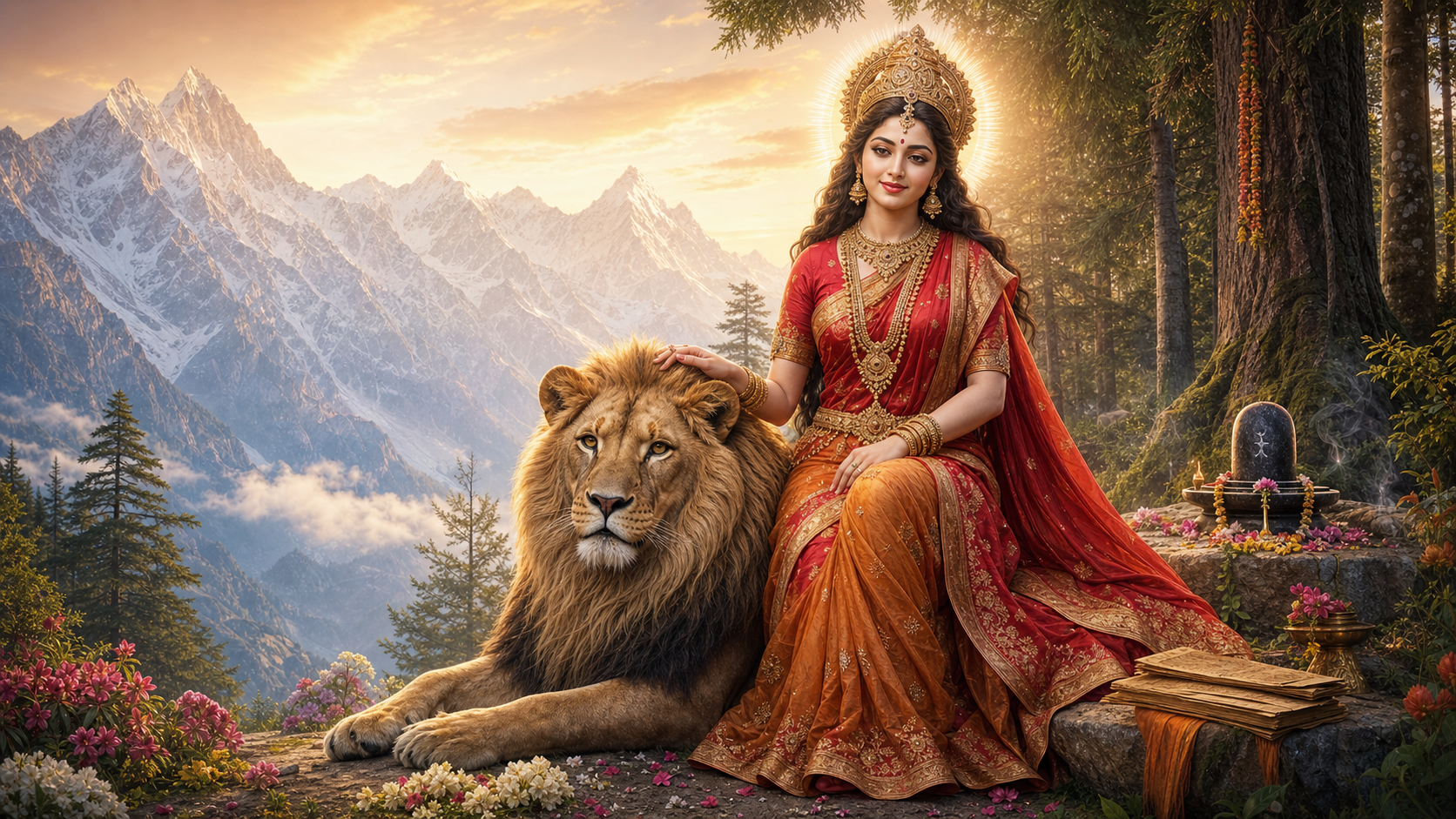
The image of Ma Parvati accompanied by a lion is among the most compelling expressions of divine power in Hindu sacred art. At first sight, the animal may appear to be simply her means of transport. Within Hindu narrative, ritual, and iconography, however, a vahana is far more than a vehicle. It can identify a deity, embody a particular quality of divine action, participate in sacred events, and represent the transformation of natural power through spiritual discipline. The lion associated with Parvati Mata therefore communicates courage, sovereignty, protection, and the possibility that even a dangerous impulse can be redirected toward compassionate service.
The ancient legend of Parvati Mata and the hungry animal
According to the devotional legend, Ma Parvati once obtained Lord Shiva’s permission to leave their divine abode and undertake severe penance in the Himalayan region. The journey into the mountains was not presented as an escape from ordinary duties but as a deliberate act of tapas—the disciplined concentration of body, mind, and intention. Parvati set aside comfort and entered the stillness of the forest, where her attention remained fixed on Shiva and on the spiritual purpose of her austerity.
The Himalayas are especially significant in this account. Parvati is the daughter of Himavat, the personified mountain, and her name is commonly understood as “she of the mountain.” Her return to the Himalayan landscape therefore has both geographical and theological meaning. The mountain represents stability, elevation, silence, and the difficult ascent from distraction toward clarity. In the narrative, the wilderness becomes a sacred laboratory in which instinct, discipline, fear, and compassion are brought into direct relationship.
While the goddess remained absorbed in meditation, a starving lion approached. Driven by hunger, it initially regarded the motionless ascetic as prey. Yet the encounter did not unfold according to the ordinary logic of predator and victim. As the animal came near Parvati, the force of her penance and the radiance of her presence arrested its aggression. The lion that had approached in order to kill became quiet, remained before her, and began guarding the penance grove from other dangers.
When Parvati opened her eyes, she did not respond to the animal’s original intention with fear or vengeance. She looked upon it with compassion. In the popular retelling, she gently touched the lion, relieved its hunger and thirst, and elevated it through her grace. Its predatory energy was not annihilated; it was purified and given a protective purpose. The lion then accompanied the goddess when she returned from her penance and came to be remembered as her devoted companion and sacred vahana. The devotional source narrative further compares the animal’s honored place in the divine household with the position of Nandi, Lord Shiva’s faithful vahana.
What the Shiva Purana actually adds to the story
A careful study requires attention to textual variation. Hindu Puranic literature is not a single standardized biography of the deities. It is a large, layered body of sacred narrative transmitted through Sanskrit compositions, regional recensions, vernacular retellings, temple traditions, oral performances, and devotional explanations. Details can therefore differ without making the underlying theological theme meaningless. In this case, some versions identify the animal as a lion, while a notable passage of the Shiva Purana identifies it as a tiger.
In the Vayaviya Samhita of the Shiva Purana, Parvati returns to a former place of penance, adopts an ascetic mode of life, worships Shiva, and remains unwavering when a hungry tiger approaches with a harmful intention. The animal becomes stiff in her presence and continues looking at her. Parvati compassionately interprets its prolonged attention as contemplation and recognizes that its presence has protected the grove from other threatening animals. Through her mercy, its hunger, impurity, and innate hostility subside, after which it serves as a guardian. This sequence can be consulted in the translated chapter describing how the goddess attains her radiant form.
The following chapter deepens the ethical point. Brahma questions why compassion should be extended to an animal associated with destructive conduct, but Parvati refuses to abandon one that has taken refuge in her. The tiger’s devotion and protective service become more important than its past. It receives the prospect of an elevated position, and Parvati keeps it before her as she proceeds toward Lord Shiva’s abode. The Shiva Purana account of the tiger’s higher status thus emphasizes refuge, loyalty, grace, and moral transformation.
This distinction matters because the Sanskrit terms siṃha and vyāghra ordinarily refer to a lion and a tiger respectively. Treating them as interchangeable can conceal a genuine textual difference. The popular story of Parvati’s lion appears to preserve themes found in the tiger episode—hunger, attempted attack, immobilization by spiritual power, guardianship, compassion, and elevation—while expressing them through the more familiar image of the lion-riding goddess. An academically responsible reading acknowledges this relationship without forcing every version into a single account.
The Skanda Purana and the lion of Siṃheśvara
A separate lion narrative appears in the Skanda Purana, within the account of Siṃheśvara. In that version, a fearsome lion emerges during Parvati’s penance and attempts to devour her but is unable to withstand the power of her austerity. Parvati responds with maternal pity and directs the remorseful creature toward a sacred linga in Mahakalavana. The lion beholds the linga, acquires a divine body, and becomes associated with the shrine called Siṃheśvara.
The chapter explicitly presents the lion as Parvati’s son and declares that it will become her vehicle. This version places the transformation within a network of sacred relationships: Parvati’s compassion, Shiva’s linga, the purifying power of pilgrimage, and Brahma’s recognition of the lion’s new status. The translated Siṃheśvara chapter of the Skanda Purana is therefore one of the clearest textual witnesses for a legend explaining how a lion became associated with the goddess as her vahana.
Another account, found in the Devi Bhagavata Purana, gives a different origin. When the gods equip the great goddess for her battle against Mahishasura, various divine beings offer weapons and ornaments, while the Himalayas present her with a lion as her vehicle. The lion is thus not a converted predator in this episode but a gift from the sacred mountain itself. The Devi Bhagavata narrative connects the animal directly with the goddess’s martial mission and Himalayan identity.
Taken together, these sources reveal not confusion but the richness of Puranic storytelling. One strand emphasizes the conversion of hostility into devotion. Another connects the lion with a sacred place and the purifying vision of Shiva. A third presents it as the Himalayas’ contribution to the goddess before a cosmic battle. The traditions converge on a central idea: the animal’s formidable strength becomes inseparable from divine purpose.
Why a vahana is more than transportation
The Sanskrit word vahana derives from a verbal root associated with carrying or conveying. In sacred representation, however, the vahana should not be reduced to a practical mount. It forms part of a deity’s recognizable iconographic system. Garuda helps identify Vishnu, Nandi accompanies Shiva, the mouse is associated with Ganesha, the peacock with Subrahmanya or Kartikeya, and the lion or tiger appears with several manifestations of Devi. Each pairing creates a visual relationship between divine consciousness and a particular mode of natural power.
A vahana may function simultaneously as companion, guardian, emblem, devotee, and bearer of divine authority. In narrative literature, these animals often possess agency and a history of their own. They listen, protect, fight, carry messages, receive blessings, or attain an elevated condition through devotion. The relationship is therefore reciprocal: the deity directs the vahana’s power, while the vahana makes a particular dimension of the deity visible to worshippers.
In Parvati’s case, the lion conveys the outward force of Shakti. The goddess is not powerful merely because she sits upon a powerful creature. Rather, the lion externalizes an energy already inherent in her. Its physical courage, alertness, commanding presence, and capacity to confront danger become an iconographic language for her protective authority. The composition communicates that spiritual serenity and decisive strength are not opposites.
The spiritual symbolism of the lion
The lion commonly evokes sovereignty and fearlessness. Its place beneath the goddess suggests that immense power has been brought into alignment with wisdom. This is not necessarily a picture of violent domination. The legend specifically makes compassion the instrument of transformation. Parvati does not destroy the animal for having felt hunger, nor does she deny its strength. She converts a dangerous orientation into watchfulness and service.
At the psychological level, the lion can be read as a disciplined form of instinct. Human beings also experience hunger, anger, fear, pride, competitiveness, and the urge to control. Hindu philosophical traditions do not always treat such energies as substances that can simply be removed. They frequently ask how awareness, ethical restraint, devotion, and knowledge can transform the direction in which energy moves. The lion’s journey from attempted predation to guardianship gives narrative form to that process.
This interpretation must remain proportionate to the evidence. Puranic stories support multiple theological and devotional readings, but not every symbol has one universally binding definition. A lion may signify royal authority in one context, martial courage in another, divine protection in a third, or the grandeur of the goddess in all these senses together. Regional art, sectarian theology, festival practice, and oral teaching can legitimately place different emphases on the same image.
Tapas as concentrated spiritual power
The legend cannot be understood fully without the concept of tapas. Often translated as austerity or penance, the term carries the older sense of heat. It describes the concentrated potency generated through disciplined practice, restraint, meditation, worship, and unwavering intention. Parvati’s tapas is not passive suffering. It is purposeful spiritual action that changes the atmosphere around her and reveals the steadiness of her consciousness.
The approaching animal expects vulnerability because it sees an apparently defenseless figure. Instead, it encounters a presence that cannot be disturbed. This reversal is central to the story’s emotional power. Parvati’s stillness is not weakness, and her compassion is not helplessness. She is capable of neutralizing danger without becoming governed by the hostility directed toward her. For readers facing conflict in ordinary life, the episode offers a memorable distinction between reactive aggression and strength rooted in self-command.
Her mercy also demonstrates anugraha, divine grace. The animal does not transform through physical coercion alone. It changes because the goddess sees beyond its immediate behavior and recognizes the possibility of another orientation. In the Shiva Purana, she refuses to abandon the creature after it has taken refuge in her. The narrative therefore places grace beside accountability: destructive conduct has consequences, yet a being that turns toward refuge and service is not permanently imprisoned by its past.
Lion, tiger, Parvati, and Durga
Modern depictions sometimes create uncertainty over whether the goddess rides a lion or a tiger. Both animals occur in Hindu visual and narrative traditions, and the answer can depend on the goddess’s form, region, text, and artistic convention. Parvati, Durga, Gauri, Kaushiki, Chandika, and other manifestations of Devi are related within Shakta theology, but their iconographic details are not identical in every source. A lion in one image and a tiger in another need not be treated as a contradiction that invalidates either tradition.
The distinction nevertheless remains important for textual study. The Shiva Purana episode discussed above repeatedly uses vyāghra, or tiger, for the animal that guards Parvati’s penance grove. The same narrative cycle also introduces a powerful lion as the vehicle of Kaushiki. The Skanda Purana Siṃheśvara account, by contrast, explicitly develops the lion’s elevation as Parvati’s vehicle. Popular retellings can combine these motifs, but a technical explanation should preserve the differences before exploring their shared meaning.
Both animals express concentrated strength, but the enthroned or mounted goddess remains the governing center of the image. She is serene without being passive, protective without being timid, and formidable without losing compassion. The visual hierarchy is theological: animal energy is powerful, but Shakti is the consciousness and purpose that orders it.
The vahana in temple experience
In many Hindu temples, the deity’s vahana occupies a significant ritual and architectural position. Nandi often faces the Shiva linga, while Garuda may stand before Vishnu. Processional festivals can place a deity upon a specially constructed vahana, allowing different aspects of divine power to be contemplated through changing forms. Devotees may offer respect to the vahana before or while approaching the principal shrine, although the precise sequence and obligation vary by temple and sampradaya.
The popular claim that every devotee must always worship the vahana first should therefore be treated as a devotional custom rather than a universal rule governing all Hindu temples. Vahanas can be understood as honored attendants and exemplary servants, but their ritual function differs across regions. Their placement often teaches that the path toward the divine includes humility, loyal service, disciplined strength, and respect for every participant in the sacred order.
A visitor encountering the lion beside the goddess may consequently experience more than admiration for an impressive animal. The image can prompt a practical question: what force within the individual still behaves like an uncontrolled predator, and what would it mean to place that force in the service of protection? This reflective use of iconography preserves emotional relevance without presenting a modern psychological interpretation as the only traditional meaning.
A lesson in compassion, refuge, and Dharmic harmony
The story also contributes to a broader Dharmic appreciation of living beings. Hindu, Buddhist, Jain, and Sikh traditions retain their own scriptures, metaphysical frameworks, disciplines, and devotional languages; their differences should not be erased. Yet each contains influential teachings that value self-mastery, compassion, responsibility, and the ethical transformation of harmful conduct. Parvati’s response to the hungry animal can therefore encourage respectful conversation across Dharmic communities without claiming that all their doctrines are identical.
The animal is neither romanticized nor condemned as permanently evil. Its hunger is real, its intention is dangerous, and its transformation requires contact with a higher order of awareness. That balance is especially relevant to ethical reflection. Compassion does not require denial of danger, just as strength does not require hatred. The goddess protects herself and the sacred grove while also opening a path through which the threatening being can become a guardian.
This dimension makes the legend particularly moving. Many people know what it means to be judged entirely by a past mistake, a moment of fear, or an unrefined impulse. The lion’s elevation suggests that identity need not remain fixed at the level of the worst intention. Transformation becomes possible through refuge, discipline, devotion, and service. At the same time, the story does not celebrate intention without action: the converted animal demonstrates its change by guarding the goddess and accompanying her faithfully.
The devotional invocation
The traditional invocation associated with this retelling is preserved as written:
“OM MA SIMHAVAHINI NAMAHA”
Simhavahini is an epithet of the lion-riding goddess. In devotional use, the invocation offers reverence to the Divine Mother whose power is represented through the lion. Its significance lies not merely in asking for outward victory but in seeking the courage, composure, and moral clarity required to govern one’s own impulses. The goddess who rides the lion becomes a sacred image of power that has passed through compassion and emerged as protection.
The enduring meaning of Parvati Mata’s sacred vehicle
The holy vehicle of Parvati Mata cannot be explained by a single sentence or one uniform origin story. The popular legend, the tiger episode of the Shiva Purana, the lion of Siṃheśvara in the Skanda Purana, and the Himalayan gift described in the Devi Bhagavata Purana preserve different narrative details. Together, they reveal the lion or tiger as guardian, devotee, emblem of Shakti, participant in sacred history, and witness to the transformative force of grace.
The deepest insight is that Parvati does not become powerful by borrowing the lion’s ferocity. Her spiritual authority transforms ferocity itself. Hunger becomes contentment, threat becomes guardianship, and instinct becomes disciplined service. The resulting image joins tenderness with courage and contemplation with action. That union explains why the lion-riding goddess continues to speak so powerfully to devotees, artists, scholars, and anyone searching for a form of strength that protects without surrendering compassion.
Inspired by this post on Hindu Pad.






Leave a Reply
You must be logged in to post a comment.