Among Hindu Stories preserved in the Mahabharata, the account of Sage Jaratkaru offers a piercing reflection on dharma, lineage, and intergenerational duty. It narrates how an ascetic, committed to renunciation and severe tapas, confronted a vision in the forest that redirected his life and, in doing so, rebalanced a cosmos strained by neglect of ancestral obligations.
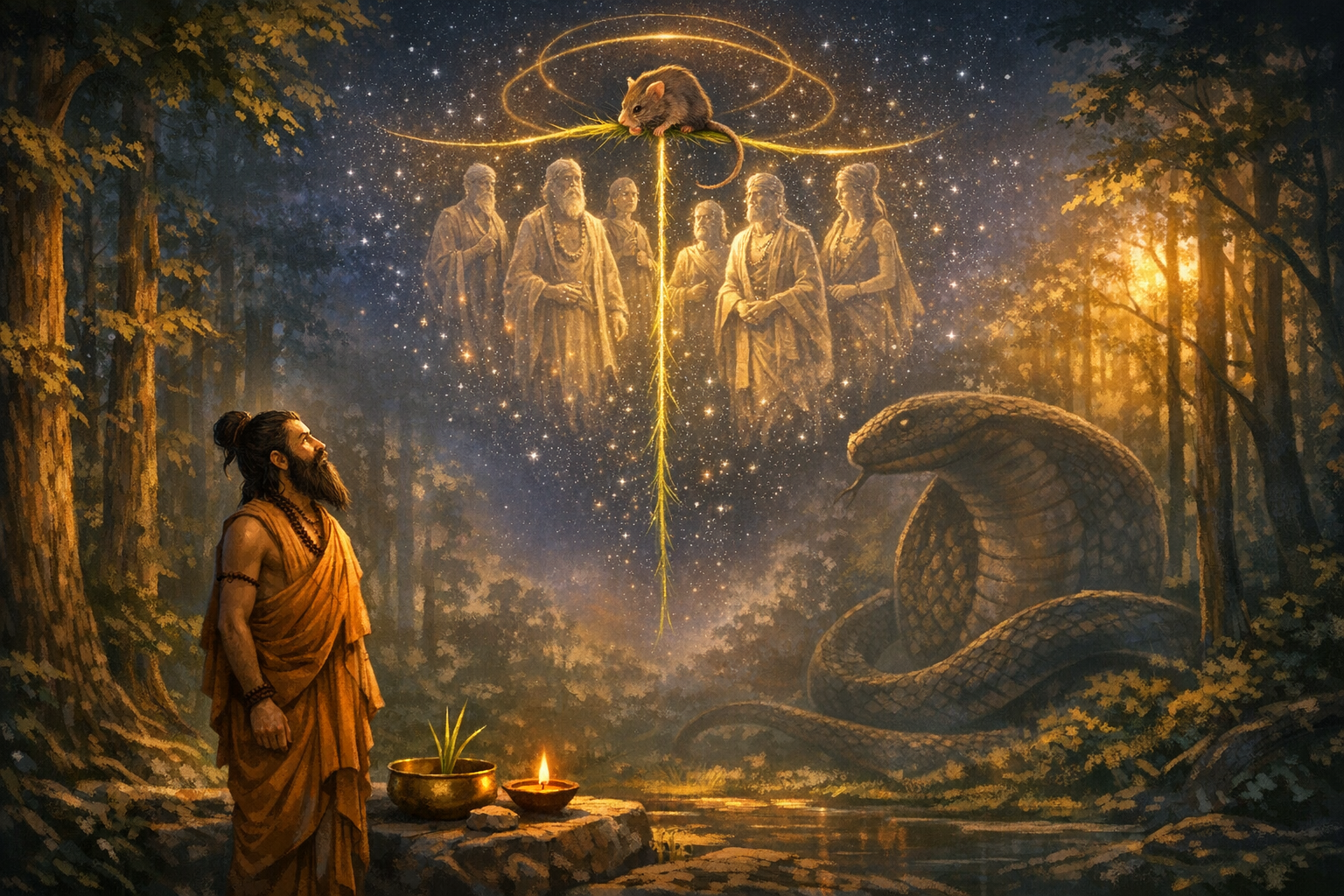
The narrative appears in the Mahabharata’s Adi Parva (Astika-parva), with resonances in later Puranic retellings. Jaratkaru, whose very name connotes emaciation and austerity, wandered through a forest absorbed in contemplation. There, he witnessed a group of ancestors (pitrs) hanging upside down over a dark abyss, suspended precariously by a single fiber of kusa grass. A mouse, emblematic of unceasing Time (kala), gnawed at the lone strandsignaling the imminent severance of his lineage and their descent into oblivion.
Questioned by the sage, the suffering ancestors revealed their identity: forebears of his own line, sustained in part by the continuity of progeny and the ritual offerings that follow. Without a descendant to perform the rites of shraddha and tarpana, and without the stabilizing presence of lineage, their merit would wane. The fragile kusa fiber symbolized the last thread of familial continuity; the mouse, inexorable Time; and the chasm beneath, the fate of a line allowed to end without responsibility accepted.
Moved by the vision and by the ethical clarity it enforced, Jaratkaru resolved to marrynot for personal desire, but as an act of dharma. He framed his decision with precise vows: he would accept a bride only if freely given (not imposing burden), only if she would not obstruct his austerity, and, strikingly, only if she bore the same nameJaratkaru. In a gesture uniting realms, the serpent-king Vasuki offered his learned sister, also named Jaratkaru, in marriage, forging a pact between human and naga lineages that would echo through the epic.
The household episode that followed is remembered for its subtle jurisprudence of vows. Jaratkaru cautioned that if he were disturbed from certain observances, he would depart at once. One evening, his wife roused him at sunset to ensure the duty of sandhya was not neglected. Bound by his prior stipulation, the sage prepared to leave; yet upon learning that she carried a child destined to be extraordinary, he affirmed the course of fate. Their son, Astikawhose very name gestures toward trust in being and truthwas born to reconcile human and serpent worlds and to liberate both lineages from peril.
Astika’s role became pivotal during King Janamejaya’s Sarpa Satra (snake sacrifice). With learning, restraint, and eloquence, the boy-sage brought the sacrificial rite to a halt, saving Takshaka and the naga race from annihilation. In this resolution, the narrative shows dharma not as rigid zeal but as balanced wisdomavoiding excess, honoring vows, and protecting life. The earlier forest vision thus culminates in a public good: reconciliation across realms and restoration of moral order.
Doctrinally, the episode illuminates the Vedic and Dharmashastra teaching of the three inborn debts (rna-traya). These are often expressed as deva-rna (ritual and ethical offerings owed to the gods), rishi-rna (study, teaching, and preservation of knowledge owed to the seers), and pitri-rna (duties to ancestors, including continuity of lineage and remembrance). Jaratkaru’s choice to beget a sonprecisely to safeguard ancestral welfareexemplifies repayment of pitri-rna while maintaining an uncompromised commitment to tapas and truth. The story thereby frames progeny, not as mere biological succession, but as a considered act of dharma situated within a larger moral cosmos.
The householder (grihastha) stage, in the ashrama system, is therefore not a concession but a crucial axis of social and spiritual life. Far from opposing renunciation, it integrates ecological responsibility, ritual continuity, and care for community. As the Bhagavad Gita proposes through the principle of lokasangraha (upholding the world), individual discipline must harmonize with societal stability. Jaratkaru’s marriage is cast in this lightan ethical pivot that affirms that lineage, ritual memory, and knowledge-transfer are themselves forms of yajna.
Importantly, Dharmashastra traditions also preserved ways to honor pitri-rna beyond biological descent. Historical jurisprudence recognized adoption (dattaka) and other kinship arrangements as legitimate means of ensuring continuity and remembrance, with regionally varied practices. Likewise, teaching, social service, and stewardship of knowledge function as cultural and spiritual lineage-building. Within a contemporary frameembracing families formed by choice, adoption, or circumstancethe narrative’s ethical core remains inclusive: gratitude to the past, responsibility in the present, and foresight for the future.
Ritually, the story intersects with the observances of shraddha and tarpana, and the annual cycle of Pitru Paksha, during which families honor forebears through offerings and remembrance. While practices differ across regions, the intent is unified: to acknowledge that one stands within webs of care received from parents, teachers, and elders. Viewed this way, the kusa fiber of the story becomes a metaphor for cultural memorydelicate yet resilient when upheld by knowledge, gratitude, and ethical living.
The episode also resonates across the broader Dharmic familyHinduism, Buddhism, Jainism, and Sikhismeach affirming, in distinct idioms, reverence for lineage and elders. Buddhist discourse (for example, the Sigalovada Sutta) articulates concrete duties to parents and teachers, illuminating a moral economy of gratitude. Jain gṛhastha-dharma emphasizes responsibility, care, and non-violence within family and community. Sikh Rehat Maryada and the daily Ardas retain collective remembrance of Gurus and ancestors, integrating seva, memory, and duty. These shared commitments foster unity in diversity: the spiritual person is both seeker and inheritor, simultaneously engaged with inner realization and intergenerational responsibility.
The forest tableauancestors suspended by a single fiber of kusathus works on several planes: as historical narrative within an Indian epic, as ethical instruction about pitri-rna, and as a symbolic meditation on time, memory, and responsibility. The mouse of Time gnaws at every line unless communities reinforce their strandsthrough learning, care, ritual mindfulness, and social compassion. In this synthesis, ascetic aim and householder duty are not adversaries but allies, together reframing lineage as a sacred trust.
For many modern readers balancing study, career, caregiving, and spiritual practice, the story’s lesson remains clear and humane. Dharma is not a single road but a tapestry of obligations and freedoms, inviting wise prioritization across life stages. Whether through progeny, adoption, mentorship, or sustained acts of remembrance and service, the imperative of lineage is ultimately an imperative of gratitude. And in honoring that gratitude, the ethics of Jaratkaru center unitybetween renunciation and responsibility, between human and more-than-human worlds, and among the diverse traditions of the Dharmic family.
Inspired by this post on Hindu Blog.