
The Six Vedāṅgas: The Living Disciplines That Preserve the Veda
The Bhāratīya knowledge landscape presents the Veda not merely as a body of sacred literature, but as a living oral, intellectual, ritual, and contemplative tradition. Its preservation required more than devotion alone. It required disciplined memory, exact speech, grammatical clarity, metrical awareness, semantic inquiry, astronomical timing, and ritual procedure. These supporting disciplines are known as the Vedāṅgas, literally the “limbs” of the Veda. They are Śikṣā, Vyākaraṇa, Chandas, Nirukta, Jyotiṣa, and Kalpa.
In the traditional view, these six Vedāṅgas are not optional appendices. They form the technical infrastructure through which Vedic knowledge could be preserved across generations without losing its sound, structure, meaning, rhythm, timing, or application. This is one of the most remarkable features of Indian Knowledge Systems: the tradition did not treat sacred knowledge as vague inspiration. It built precise disciplines to protect it from corruption, misinterpretation, and careless performance.
Śrī Madhusūdana Sarasvatī’s account of the Vedāṅgas is especially valuable because it is brief, systematic, and rooted in the classical understanding of how the Veda functions. The Veda is recited, studied, interpreted, and enacted. Each activity requires a corresponding discipline. Śikṣā protects sound. Vyākaraṇa protects linguistic correctness. Chandas protects metre. Nirukta protects meaning. Jyotiṣa protects time. Kalpa protects ritual order.
Śikṣā — The Science of Phonetics
Śikṣā is the Vedāṅga concerned with the correct production of sound. It teaches the pronunciation of svaras, varṇas, and the distinctions of short, long, and pluta quantity. In the Vedic context, sound is not treated casually. A mantra is not only a sentence with meaning; it is also a carefully structured sonic form. Its efficacy depends on accuracy in accent, articulation, duration, and sequence.
The three principal Vedic accents are udātta, anudātta, and svarita. Their correct use matters because Vedic recitation preserves an older layer of Sanskrit in which accent can affect interpretation and ritual result. The varṇas include vowels and consonants, each requiring a proper point and manner of articulation. A slight shift in sound can alter the word, the meaning, or the ritual force of the mantra.
This is why Śrī Madhusūdana Sarasvatī recalls the traditional warning associated with Tvaṣṭā and Vṛtrāsura: “A mantra that is wrong in svara or in any letter, or wrongly used, does not convey its intended meaning; it is a verbal thunderbolt that destroys the sacrificer, like Indra’s enemy because of the mistake in svara.” The point is not superstition but discipline. A tradition that places sacred power in speech must also demand responsibility in speech.
The universal śikṣā attributed to Pāṇini is traditionally described as having five parts, while individual Vedic branches also possess prātiśākhyas, specialized phonetic manuals attributed to different sages. These prātiśākhyas show that Vedic preservation was not abstract. It was branch-specific, school-specific, and technically detailed. The same civilization that produced profound metaphysics also developed a science of articulation accurate enough to sustain oral transmission across millennia.
Anyone who has tried to learn even a short mantra under a trained teacher can recognize the human significance of Śikṣā. The correction is often minute: the tongue moves slightly, the vowel length changes, the breath is steadied, the accent is adjusted. Yet such minute correction trains attention. Śikṣā therefore preserves more than pronunciation. It cultivates humility before sound, discipline before tradition, and awareness before speech.
Vyākaraṇa — Grammar as the Guardian of Correct Expression
Vyākaraṇa teaches sādhutva, the correctness of Vedic words. It allows the practitioner to understand how words are formed, how they function, and how they should be used. In this sense, grammar is not merely a school subject. It is a discipline of clarity. Without grammar, the Veda may be recited, but its language cannot be adequately understood, explained, or transmitted with intellectual integrity.
The most authoritative grammar in this tradition is Pāṇini’s Aṣṭādhyāyī, an extraordinary work arranged in eight chapters and composed through concise sūtras. Traditional accounts connect its origin with the grace of Maheśvara. On Pāṇini’s sūtras, Kātyāyana composed vārttikas, or critical notes, and Patañjali composed the Mahābhāṣya, the great commentary. Together, Pāṇini, Kātyāyana, and Patañjali constitute the central grammatical lineage known as Māheśvara vyākaraṇa.
The importance of Vyākaraṇa is difficult to overstate. Sanskrit grammar is not simply a descriptive record of usage; in the Vedic and śāstric context, it becomes a means of preserving valid usage, interpreting difficult passages, and preventing arbitrary readings. It protects the practitioner from imposing convenient meanings on inherited words. This is crucial in any knowledge tradition, especially one where theology, ritual, philosophy, law, poetry, and metaphysics all depend on precise language.
Other grammars, such as the Kaumāra grammar, may have value for ordinary or worldly purposes, but Śrī Madhusūdana Sarasvatī distinguishes them from the Vedāṅga proper. The reason is functional. A Vedāṅga must serve the preservation and understanding of the Veda. Grammar becomes a limb of the Veda only when it is aligned with that sacred and scholarly responsibility.
In modern terms, Vyākaraṇa may be compared to a rigorous linguistic operating system. It defines how forms are generated, how meanings are connected, and how derivations can be tested. Yet it is more than technical machinery. It trains the mind to respect structure. It shows that freedom of interpretation must be balanced by accountability to form, usage, and tradition.
Chandas — Metre, Rhythm, and the Architecture of Sacred Speech
Chandas is the Vedāṅga of metre. It studies the rhythmic structure of Vedic mantras and poetic expression. In the Vedic world, metre is not ornamental decoration. It is an organizing principle of sacred speech. A mantra has sound, meaning, and rhythm; Chandas protects the rhythm so that the mantra remains intact in recitation and memory.
Major Vedic metres such as Gāyatrī, Anuṣṭubh, Triṣṭubh, Jagatī, Bṛhatī, Paṅkti, and Uṣṇih are not arbitrary patterns. They shape the way a mantra is chanted and remembered. The structure of syllables provides a framework that helps the oral tradition maintain accuracy. In a culture where knowledge was transmitted through disciplined recitation, metre functioned as both aesthetic form and mnemonic safeguard.
The discipline of Chandas reveals the deep connection between poetry and knowledge in the Bhāratīya tradition. Philosophical and ritual knowledge was often carried in metrical form because rhythm helps memory, concentration, and continuity. This is visible not only in the Vedas but also in later Sanskrit literature, stotras, philosophical kārikās, Jain āgamic traditions, Buddhist verses, and Sikh scriptural recitation. Across Dharmic traditions, sacred sound is frequently structured by rhythm because rhythm supports remembrance.
Chandas also carries a subtler lesson. Knowledge that is rhythmically ordered enters the mind differently from prose information. It is easier to remember, easier to chant collectively, and easier to transmit across generations. This is why many traditional learners remember verses long after forgetting prose explanations. The metre becomes a vessel of continuity.
Nirukta — Etymology and the Recovery of Meaning
Nirukta is the Vedāṅga that explains difficult Vedic words through etymology and semantic analysis. Its classical association is with Yāska, whose Nirukta is among the foundational works of Indian linguistic and interpretive thought. If Śikṣā protects sound and Vyākaraṇa protects form, Nirukta protects meaning, especially where ancient Vedic terms have become obscure or layered with multiple possibilities.
The need for Nirukta arises because the Veda preserves archaic vocabulary, symbolic expressions, deity names, ritual terms, and compact poetic constructions. Without a disciplined method of interpretation, such words can be misunderstood or reduced to superficial meanings. Nirukta offers a way to recover meaning through roots, derivations, usage, and context.
This discipline is especially important for preserving the intellectual dignity of Vedic interpretation. It does not allow readers to treat sacred words as empty labels. Names such as Agni, Indra, Varuṇa, or Uṣas carry ritual, cosmic, psychological, and theological significance depending on context. Nirukta helps open those layers without dissolving them into fantasy or forcing them into a single modern category.
In a broader Dharmic setting, Nirukta encourages respectful interpretation. Hindu, Buddhist, Jain, and Sikh traditions all preserve terms whose meanings unfold through lineage, practice, grammar, commentary, and lived experience. Words such as dharma, karma, śīla, ahiṃsā, jñāna, bhakti, and seva cannot be understood well through quick translation alone. They require context, discipline, and sensitivity to tradition.
Nirukta therefore offers an important lesson for contemporary readers. Ancient texts should not be approached with impatience. Their vocabulary often carries centuries of reflection. To understand them, one must slow down, ask how a word is formed, where it appears, how teachers have explained it, and what range of meanings it can responsibly bear. This method protects both scholarship and reverence.
Jyotiṣa — Time, Astronomy, and Ritual Order
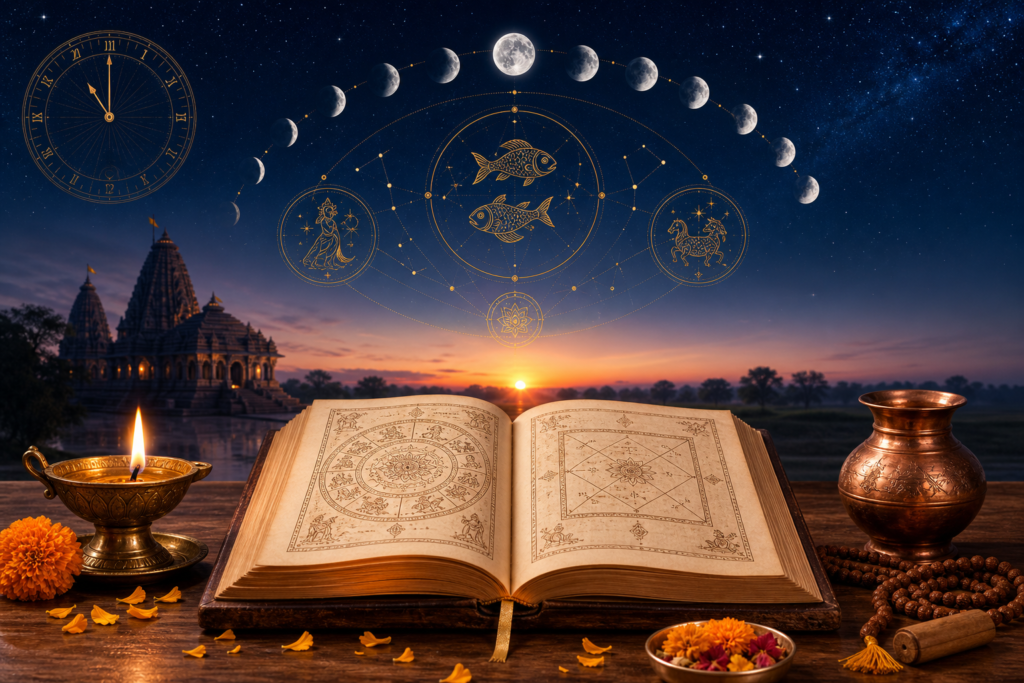
Jyotiṣa, as a Vedāṅga, concerns the calculation of time for Vedic rites. It deals with celestial observation, calendrical reckoning, and the determination of proper moments for ritual performance. Its purpose in the Vedāṅga framework is practical and sacred: a rite must not only be performed correctly in form; it must also be performed at the appropriate time.
The Vedāṅga Jyotiṣa, associated with the ancient calendrical needs of Vedic ritual, reflects a civilization deeply attentive to the relationship between terrestrial life and celestial order. Tithi, nakṣatra, lunar and solar cycles, seasonal transitions, and sacrificial timing all belong to a worldview in which time is not a blank container. Time has structure, rhythm, and qualitative significance.
This does not mean that Jyotiṣa should be reduced to popular predictive astrology. In the Vedāṅga context, its central function is the maintenance of ritual time. It supports yajña, vrata, observances, and calendar-based discipline. The technical ability to calculate time allowed communities to coordinate sacred life, agricultural life, seasonal observances, and collective memory.
There is also a philosophical insight here. Human life becomes more ordered when it aligns with recurring cycles: sunrise and sunset, lunar phases, seasons, festivals, study periods, and vows. Jyotiṣa in the Vedāṅga sense reminds the practitioner that sacred action is not isolated from cosmic order. It is placed within a larger rhythm.
Kalpa — Ritual Procedure, Discipline, and Social Form
Kalpa is the Vedāṅga that sets forth ritual procedure. It explains how rites are to be performed, what sequence should be followed, what materials are required, who performs which role, and how domestic, public, and life-cycle rituals are structured. If Jyotiṣa determines the proper time, Kalpa determines the proper method.
Kalpa literature includes several types of sūtras. Śrauta Sūtras deal with solemn Vedic sacrifices. Gṛhya Sūtras address domestic rites such as saṃskāras and household observances. Dharma Sūtras discuss duties, social norms, and ethical-legal responsibilities. Śulba Sūtras give geometric rules, especially for the construction of sacrificial altars. Together, they reveal the striking range of Kalpa: ritual, household life, social order, and mathematical precision.
The Śulba Sūtras are particularly significant for the history of mathematics. Their altar constructions required exact measurements, geometric transformations, and sophisticated spatial reasoning. This demonstrates how Vedic ritual culture generated technical knowledge. Geometry was not pursued only as abstraction; it was also embedded in sacred construction and disciplined practice.
Kalpa also shows that tradition is not sustained by sentiment alone. Ritual requires procedure. Community requires shared forms. Life-cycle ceremonies require continuity. The details may vary across regions, sampradāyas, and families, but the underlying principle remains consistent: sacred life is strengthened when action is ordered, intentional, and connected to inherited wisdom.
The Vedāṅgas as a Complete Knowledge System
When viewed together, the six Vedāṅgas form an integrated system of preservation. Śikṣā ensures that the mantra is sounded correctly. Vyākaraṇa ensures that its words are grammatically understood. Chandas ensures that its metre is recognized and maintained. Nirukta investigates its difficult meanings. Jyotiṣa places its ritual use in proper time. Kalpa establishes the method of performance.
This integrated design is one of the great achievements of Bhāratīya Jñāna Paramparā. It shows that Vedic tradition understood knowledge as something embodied in practice. Sound, language, rhythm, meaning, time, and action were all treated as interdependent. A mantra was not separated from pronunciation; interpretation was not separated from grammar; ritual was not separated from time; practice was not separated from discipline.
The Vedāṅgas also challenge a common modern misunderstanding. Ancient Indian knowledge was not a loose collection of beliefs. It had methods, classifications, technical manuals, lineages of commentary, and systems of verification appropriate to its goals. Its rigor was not always identical to modern institutional science, but it was rigorous within its own intellectual and spiritual framework.
For contemporary Hindu society, and for the wider family of Dharmic traditions, the Vedāṅgas offer a model of preservation without rigidity. They show how tradition can remain alive when it is studied deeply, practiced carefully, and transmitted responsibly. The goal is not sectarian superiority, but continuity of wisdom. Hindu, Buddhist, Jain, and Sikh traditions all depend in different ways on disciplined transmission, reverence for language, teacher-student lineages, ethical formation, and the careful preservation of sacred memory.
Why the Vedāṅgas Matter Today
The modern reader may ask why such technical disciplines matter in an age of digital archives, printed books, recordings, and searchable databases. The answer is that storage is not the same as understanding. A mantra can be recorded and still mispronounced by the learner. A text can be scanned and still misunderstood. A calendar can be downloaded and still detached from its ritual logic. Information can survive while knowledge declines.
The Vedāṅgas address this problem directly. They teach that preservation requires trained human beings, not merely preserved objects. A book can hold words, but a teacher corrects sound. A dictionary can list meanings, but a tradition explains context. A calendar can mark dates, but a community gives them sacred life. The Vedāṅgas therefore remain relevant because they focus on disciplined transmission.
They also offer a powerful educational model. Learning is not fragmented into disconnected subjects. Phonetics, grammar, poetics, etymology, astronomy, geometry, ritual studies, and ethics all support a larger civilizational purpose. This is precisely why Indian Knowledge Systems deserve serious academic attention today. They show how technical learning, spiritual practice, and cultural continuity can reinforce one another.
At an emotional level, the Vedāṅgas speak to a familiar concern: how does a civilization remain itself while passing through change? The answer offered here is neither isolation nor forgetfulness. A civilization remains alive by knowing how to transmit what matters. It trains speech, memory, thought, interpretation, time-consciousness, and action. It allows devotion to be supported by knowledge, and knowledge to be softened by reverence.
The six Vedāṅgas, therefore, are not relics of a distant past. They are a refined map of cultural preservation. They remind readers that the Veda was protected by a disciplined ecology of learning, and that every living tradition needs such an ecology. Where sound is respected, language clarified, rhythm preserved, meaning examined, time honored, and action disciplined, knowledge can endure with dignity.
Inspired by this post on Hindu Post.






Leave a Reply
You must be logged in to post a comment.