
If you have been told that an uncertain family background makes you unfit to approach Vedic wisdom, Satyakama Jabala gives you a precise case to examine. He does not gain admission by inventing a pedigree. He tells an uncomfortable truth, and his truthfulness reveals the quality of the student standing before the guru.
The lesson is more demanding than the slogan that everyone should be admitted to everything. A guru faced with uncertain ancestry recognizes satya, then requires service, endurance, contemplation, and teachability. That distinction can help you judge whether a learning community is genuinely Dharmic, merely permissive, or unjustly exclusionary.
When ancestry is unknown, do not manufacture certainty

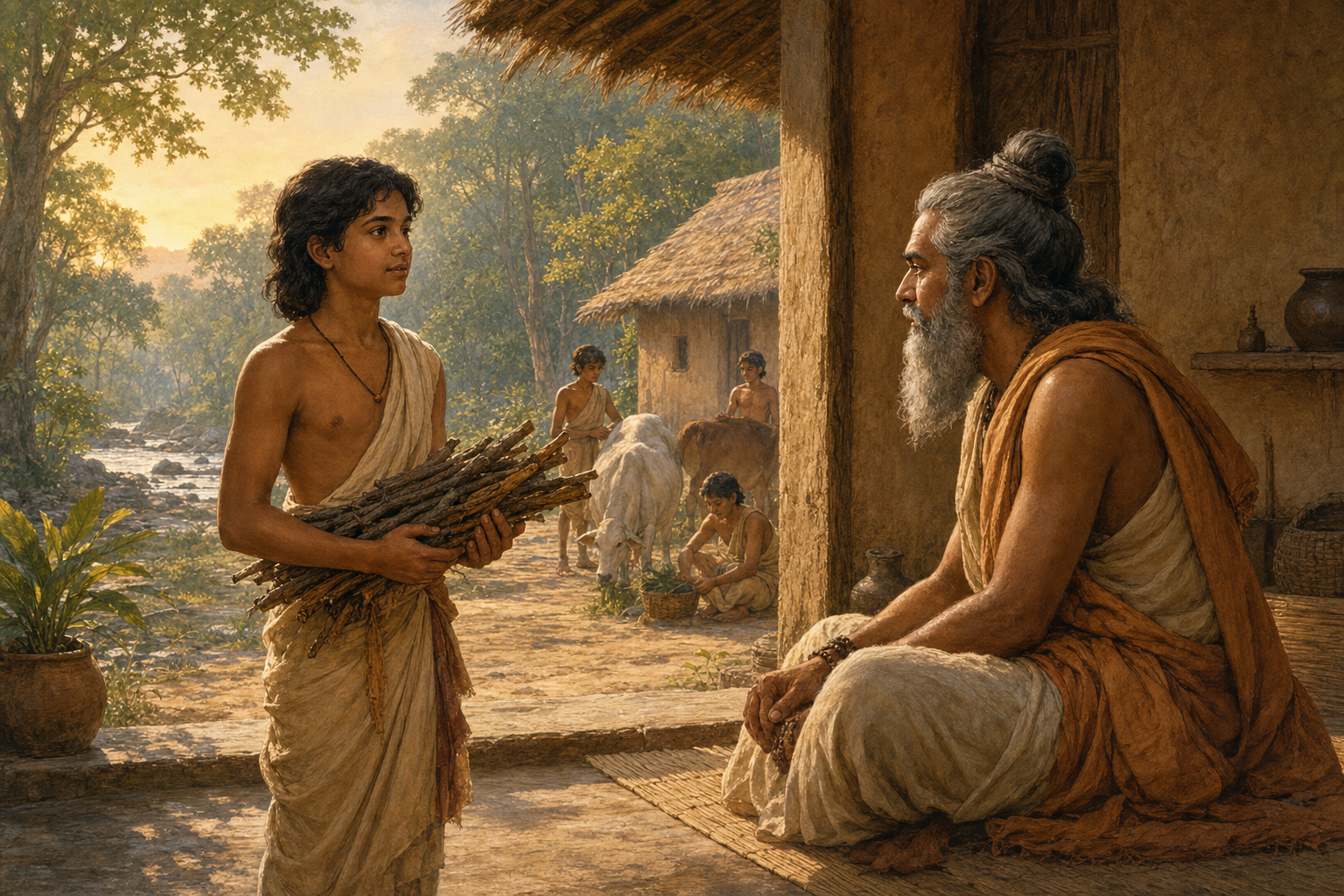
The episode spans Chandogya Upanishad 4.4-4.9. The young Satyakama wants to enter a gurukula, so he asks his mother, Jabala, about his paternal lineage. She answers without disguising the vulnerability of their situation: she does not know who his father was. She tells him to identify himself as Satyakama Jabala.
When the sage Haridrumata Gautama asks Satyakama about his lineage, the boy repeats what his mother told him. He does not invent a father, borrow a prestigious family name, or soften the uncertainty. Gautama treats this candor as evidence of inner fitness and accepts him as a brahmacharin.
Three acts of truth are involved. Jabala refuses to create a respectable fiction. Satyakama refuses to edit her answer for advantage. Gautama refuses to turn missing ancestry into proof of moral inferiority. Inclusion begins because all three remain aligned with what is actually known.
- State what you know. If your family history is incomplete, distinguish established facts from inherited stories and assumptions.
- State what you do not know. An honest unknown is not a spiritual defect. Pretended certainty, however, damages the very quality required for serious inquiry.
- Let conduct answer what pedigree cannot. Show punctuality, steadiness, care in speech, willingness to serve, and openness to correction. These are visible qualities a teacher can actually assess.
This is useful beyond questions of parentage or varṇa. You may be a convert, a member of the diaspora, a student without Sanskrit education, or someone whose family lost contact with its tradition. Do not begin your return to dharma by fabricating credentials. Begin with an exact account of where you stand and a serious willingness to learn.
The passage opens a door without lowering the standard
Inclusive education is often discussed as though there were only two choices: inherited exclusion or admission without demands. Satyakama’s path offers a third model. The door can open on the basis of character and aspiration while the training beyond that door remains exacting.
It helps to separate three levels of claim:
- What the encounter plainly establishes: Satyakama discloses that his paternal lineage is unknown, Gautama recognizes the significance of his truthfulness, and the uncertainty does not prevent his admission.
- What the encounter reasonably supports: spiritual readiness cannot be assessed through ancestry alone. Guṇa, or demonstrated quality, and karma, or actual conduct, have a decisive role in a guru’s discernment.
- What the encounter does not settle by itself: it is not a complete legal code for every historical institution, ritual office, initiatory lineage, or branch of Vedic study. One episode should not be made to carry claims it never explicitly formulates.
This distinction matters whenever the story enters a debate about caste. Readers may disagree about how far its implications for varṇa extend. The strongest argument does not require pretending that every interpretive dispute has disappeared. It rests on the action that cannot be removed from the scene: a guru encounters uncertain ancestry, discerns truthfulness, and initiates the student rather than rejecting him.
Nor does admission amount to instant possession of brahmavidyā. Satyakama receives the opportunity to undergo formation. He is not handed a title, a certificate, or a claim to realization merely because his situation evokes sympathy. The Upanishadic model joins dignity to discipline: no inherited uncertainty should be treated as personal disgrace, but no sincere aspiration should be confused with completed knowledge.
Use that distinction when evaluating an exclusion. Ask whether a requirement protects a real pedagogical or initiatory discipline, or whether it simply converts birth information into a verdict on human worth. The first question may call for patient discussion within a living tradition. The second deserves firm challenge from within dharma’s own language of satya and spiritual fitness.
Admission is only the beginning: the forest is the curriculum
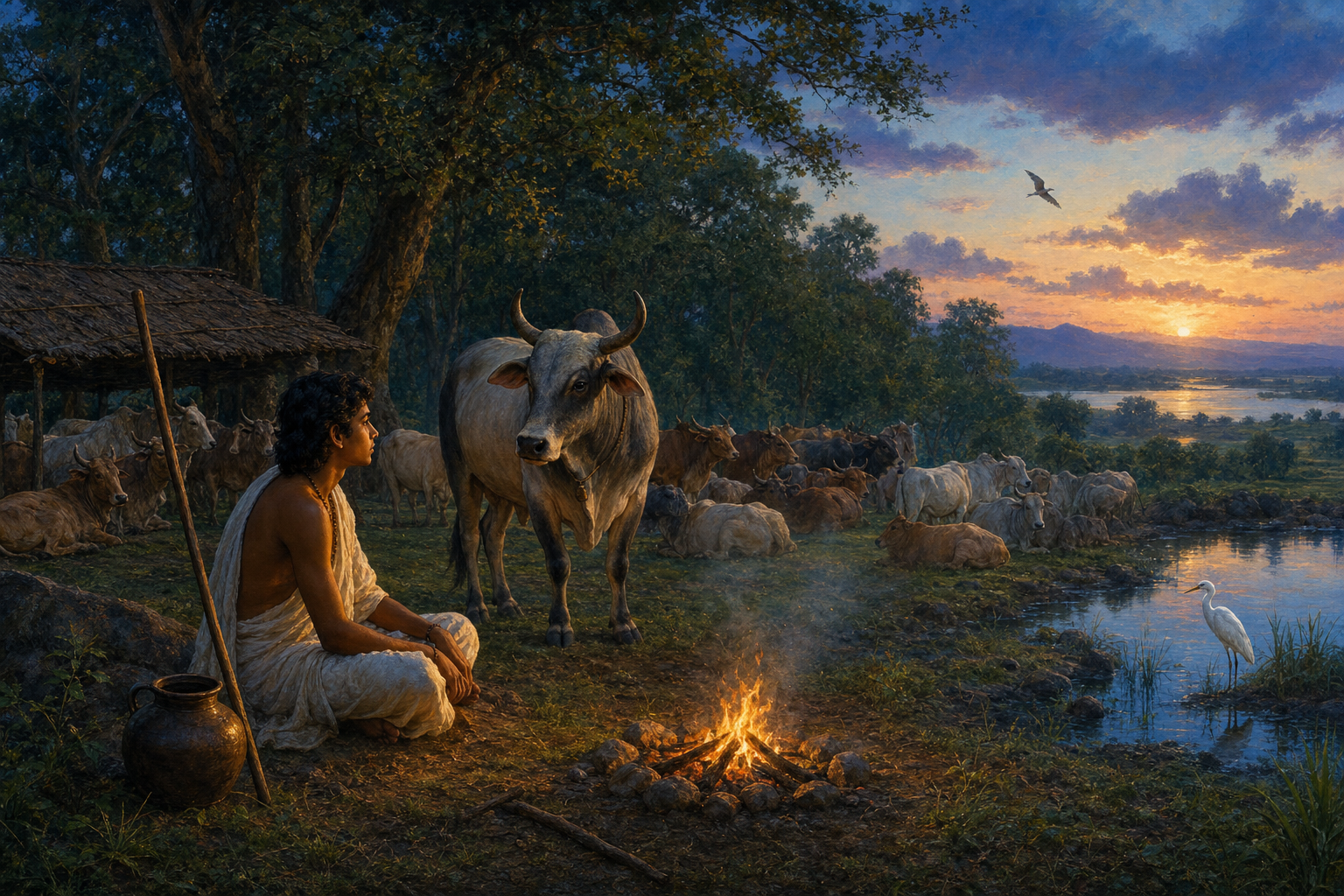
Gautama entrusts Satyakama with four hundred cows and sends him out with the instruction to return when the herd has grown to one thousand. The assignment is not ornamental. Caring for living beings over a prolonged period demands attention, patience, reliability, and acceptance of consequences. The student who entered through truthful speech now has to embody truth in daily conduct.
When the herd reaches one thousand, four non-human teachers instruct him in sequence: the bull of the herd, Agni, a haṃsa, and a madgu. Each discloses a quarter of Brahman. The teachings turn his attention toward directions and vastness, elemental processes, life and movement, natural cycles, and the still ground within change. The world around him becomes a field of upāsanā rather than a collection of objects to be consumed or ignored.
You need not settle every question about whether these voices should be understood literally, symbolically, contemplatively, or through more than one of those registers before grasping the educational design. Solitude has made Satyakama attentive. Service has made him steady. Upāsanā has trained him to perceive unity through diverse forms. He can now receive meaning that an undisciplined mind would overlook.
- Responsibility comes before abstraction. The care of the herd tests whether the student can sustain a duty when no audience is applauding him.
- Time exposes character. A truthful answer at admission matters, but prolonged service shows whether truth has become a way of living.
- Observation becomes contemplation. Directions, fire, living creatures, breath, movement, and stillness are treated as openings into a larger reality.
- Knowledge arrives through more than one mode. Verbal instruction, work, solitude, nature, symbol, and disciplined attention cooperate in the student’s formation.
- The guru still completes the teaching. When Satyakama returns with an evident inner radiance, Gautama gives the culminating instruction. Experience does not make the guru unnecessary, and the guru does not make experience unnecessary.
A contemporary school does not have to imitate the forest assignment literally to recover its principle. It can give students real responsibilities, allow enough time for patterns of conduct to become visible, connect study with service, and require reflection rather than rewarding memorization alone. An institution that opens enrollment widely but treats knowledge as downloadable information has preserved access while losing much of the Upanishadic pedagogy.
Use Satyakama’s standard in an actual learning community

If you are seeking a teacher
- Prepare an honest account of your background. Include what you have studied, what practices you follow, and what you cannot verify. Do not inflate informal exposure into mastery.
- Ask what the prerequisites are for. A serious teacher should be able to connect a requirement to the practice, text, level of instruction, or responsibility involved.
- Distinguish exclusion from preparation. Being told that birth makes you intrinsically unfit is different from being told that you first need language study, ethical discipline, foundational teaching, or greater steadiness.
- Look beyond the lecture. Ask how the program develops attention, service, contemplation, and responsibility. Information alone is not the formation portrayed in Satyakama’s apprenticeship.
- Remain available for correction. Experiences in solitude or nature may be meaningful, but Satyakama still returns to Gautama for completion. Insight should deepen teachability rather than produce premature certainty.
If someone rejects you solely because your ancestry is uncertain, this episode gives you a Dharmic reason to question the criterion. If a teacher asks you to demonstrate patience, honesty, or preparation, do not use the language of inclusion to evade the work. Satyakama is welcomed, and then he undertakes the work.
If you teach or set admissions policy
- Separate inherited information from demonstrated readiness. Record lineage only where it has a defined relevance. Do not allow an unknown answer to become an unstated judgment about character.
- Make room for an honest unknown. If your application process pressures students to manufacture neat identities, it is selecting for presentation rather than satya.
- Publish the path into advanced study. A beginner who lacks family instruction should be able to see which foundations, disciplines, or competencies must be developed next.
- Assess qualities over time. Reliability in service, care with speech, sustained attention, and response to correction reveal more than a polished declaration of spiritual interest.
- Keep rigor after opening access. Inclusion becomes tokenism when students are admitted for appearance but are denied serious instruction, meaningful responsibility, or honest assessment.
A useful curriculum audit needs two columns. In the first, write every condition controlling who may enter. In the second, write every practice that forms the admitted student. Then ask three questions: Which entry conditions are genuinely necessary? Which merely reproduce inherited advantage? Is the formation strong enough to justify the institution’s claim that it teaches rather than merely distributes content?
The same framework can serve a mixed Dharmic learning space without pretending that all traditions are identical. Buddhist attention to right speech, Jain commitment to satya joined with ahiṃsā, and Sikh devotion to Satnam and truthful living all make honesty a serious spiritual discipline. That shared ethical ground can support mutual respect, while each tradition retains its own scriptures, doctrines, practices, and forms of authority.
Key takeaways
- Satyakama does not hide his unknown paternal lineage, and Gautama treats that truthfulness as evidence of spiritual fitness.
- The episode supports access grounded in character, but it does not turn aspiration into automatic mastery or erase the need for a guru’s discernment.
- The movement from four hundred cows to one thousand shows that admission leads into prolonged responsibility, not immediate status.
- The bull, Agni, haṃsa, and madgu make the natural world part of a contemplative education in Brahman.
- A Dharmic institution should make honest uncertainty safe, connect prerequisites to real purposes, and maintain rigorous formation after admission.
Your next step can be concrete. Read Chandogya Upanishad 4.4-4.9 and mark each moment as either access or formation. Then examine the learning community in front of you. If you are a student, replace one embellished claim with an exact truth and ask what preparation comes next. If you are an educator, revise one criterion that mistakes inherited information for demonstrated readiness.
Satyakama’s name should not be used merely to win an argument about the past. Use his standard to shape the next encounter between a sincere seeker and a guardian of knowledge: truth at the threshold, disciplined work on the path, and wisdom conferred without contempt for the person who came to learn.
References
