
What the available reports establish
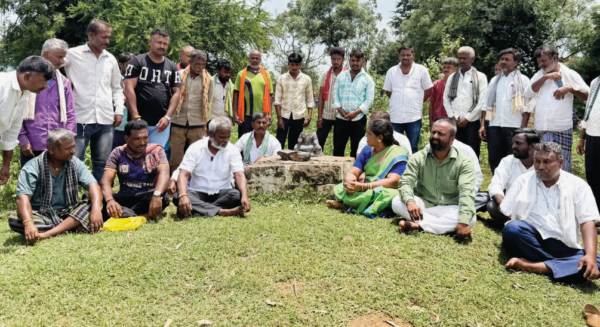
Anguish and anger spread through Amblikoppa village in Dharwad taluk after unidentified persons reportedly damaged the murti of Lord Beeralingeshwara. According to reports by Prajavani and PublicNext, the murti stood on the outskirts of the village at a place where devotees regularly offered prayers. One account described it as approximately 14 years old. Even that relatively brief period can make a shrine part of a community’s inherited landscape, connecting daily worship with family memory and village identity.
The available reports use several English transliterations of the deity’s name, including Beeralingeshwara, Beerulingeshwara, Birlingeshwara and Biralingeshwar. Such variation is common when Kannada names are rendered in English and does not necessarily indicate different deities or sites. Beeralingeshwara is used here for consistency, while the original spellings remain visible in the linked reports.
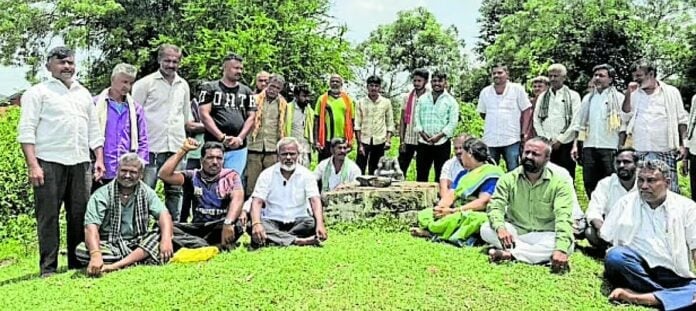
Villagers gathered on Monday to condemn the vandalism and demand stringent legal action, according to local coverage and a video report. Their reaction was not simply a dispute over damaged property. The gathering expressed grief over the interruption of worship, anxiety about the safety of a sacred place and a demand that the state treat religiously significant property with seriousness.
Accuracy nevertheless requires a firm boundary between what has been reported and what remains unknown. The cited accounts establish the reported damage, the location’s devotional use, the approximate age attributed to the murti and the villagers’ protest. They do not, in the material presently available, establish the identity of the offender, the motive, the exact time of the act, the full extent of the damage, the material from which the murti was made, the contents of any police complaint or whether an arrest has occurred. No individual or community should therefore be blamed without verified evidence.
This distinction is especially important because an act can be experienced by devotees as an attack on Hindu faith even before investigators determine why it occurred. The religious impact is real, but impact and criminal motive are separate questions. A credible account must acknowledge the first without pretending that the second has already been proved.
Why Beeralingeshwara worship carries cultural as well as devotional meaning
Beeralingeshwara belongs to a significant regional devotional world in Karnataka. Karnataka Tourism’s account of Dollu Kunitha associates the energetic drum-dance tradition with the worship of Sree Beeralingeshwara, regarded in that tradition as a form of Lord Shiva, and traces the practice to the rituals of the Kuruba Gowda community of North Karnataka. Dollu Kunitha is performed at temple festivals, processions and community celebrations, showing how devotion can be carried through rhythm, movement, oral memory and collective participation.
That broader cultural background helps explain why damage to a Beeralingeshwara murti can resonate beyond the immediate physical site. It would, however, be unsound to infer from regional history that every Amblikoppa devotee belongs to one community or follows an identical ritual system. Village worship frequently brings together families with different social histories, and the precise custodial and ritual traditions of this particular shrine have not been detailed in the cited reports.
Within many Hindu traditions, a murti is not approached as a decorative statue or an interchangeable representation. Ritual practice can establish it as a locus through which divine presence is encountered, worship is offered and darshan is received. Academic research on the concept of rūpa and mūrti in South Indian ritual theology similarly emphasizes the importance of mūrti in experiences of divine presence, meditation and worship. Hindu traditions remain internally diverse, so the exact theology and consecration practices applicable at Amblikoppa should be determined by the shrine’s custodians rather than assumed from a general description.
Indian jurisprudence also recognizes that a Hindu deity or murti may, in appropriate property-law contexts, possess juristic personality and hold endowed property through human custodians. The Supreme Court’s discussion of juristic personality explains that this legal status serves defined institutional and property purposes; it does not amount to a court deciding theological truth. Nor does the general doctrine establish the ownership, endowment status or legal personality of the Amblikoppa shrine without site-specific evidence.
The emotional force of the incident becomes clearer when the shrine is understood as part of ordinary village life. A devotee may pass it while travelling between home and field, pause there before an important undertaking or associate it with festivals, vows and family milestones. Over approximately 14 years, children can grow into adulthood and households can experience births, marriages, harvests and bereavements in the shrine’s presence. These examples are interpretive rather than reported details about particular families, but they illustrate why replacement cost alone cannot measure the loss.
Damage to a continuously worshipped murti can therefore produce several forms of harm at once: material loss, disruption of ritual, distress among devotees, fear of recurrence and uncertainty over whether worship may continue before purification, repair or re-consecration. The collective nature of these effects helps explain why village residents may experience vandalism as a wound to shared dignity rather than as an isolated act against stone or metal.
The protest reported in Kannada Prabha is consequently best understood as a civic demand for recognition, investigation and lawful accountability. Peaceful protest allows devotees to communicate the seriousness of the injury. Its moral authority is strongest when it remains disciplined, rejects retaliation and insists that punishment follow evidence and due process.
The constitutional and criminal-law framework
Protection of sacred sites is grounded in a constitutional framework that applies equally to all communities. Article 25 of the Constitution of India protects freedom of conscience and the right freely to profess, practise and propagate religion, subject to public order, morality, health and other constitutional provisions. Article 26 protects the ability of religious denominations to establish and maintain religious institutions and manage religious affairs within similar limits. Safeguarding a Hindu shrine is therefore neither a discretionary favour nor a licence for communal preference; it is part of the state’s broader obligation to protect lawful religious life impartially.
Section 298 of the Bharatiya Nyaya Sanhita, 2023 directly addresses the destruction, damage or defilement of a place of worship or an object held sacred by a class of persons. The provision requires either an intention to insult the religion of a class or knowledge that the class is likely to regard the act as an insult. It provides for imprisonment that may extend to two years, a fine or both. Whether this section applies in Amblikoppa must be determined from admissible evidence concerning the act and the required mental element.
Section 324 of the same law defines mischief in terms of intentionally causing, or knowingly being likely to cause, wrongful loss or damage through the destruction of or injurious change to property. Its punishment structure varies according to the circumstances and assessed value of the damage. Section 299, concerning deliberate and malicious acts intended to outrage religious feelings, has its own demanding mental-state requirements. Investigators and prosecutors must select provisions on the basis of facts; public anger cannot substitute for proof of statutory ingredients.
A strong legal response therefore has two inseparable components. It must be prompt enough to prevent evidence loss and reassure the affected community, yet methodical enough to avoid wrongful accusation. Calling for stringent action is compatible with due process when stringency means a serious investigation, proper charges where evidence supports them, a fair trial and proportionate punishment after conviction.
What an evidence-led investigation should examine
The first technical priority is preservation of the scene. Because the murti reportedly stood outdoors, wind, rain, soil, animals, visitors and well-intentioned cleaning can quickly alter trace evidence. Access should be controlled without showing disrespect to devotees. Before fragments are moved or ritual cleaning begins, trained personnel should create an overall photographic record, document the position and orientation of each fragment and prepare scaled images of impact points, tool marks and surrounding surfaces.
Investigators should record both the damaged object and its environment. Relevant observations may include displaced stones, disturbed soil, footwear impressions, paint or metal transfer, broken fastening points and the direction in which fragments fell. Any collection must be labelled and documented through an unbroken chain of custody. Untrained handling, gluing or washing can destroy information and may complicate later conservation.
Digital evidence requires similar discipline. Police should identify cameras at the shrine, approach roads, nearby homes or establishments and possible entry and exit routes. Original files are more useful than videos recorded from a playback screen because originals retain resolution, metadata and a more reliable evidentiary history. Investigators should document each device’s clock, compare it with a trusted time source, preserve exports without unnecessary conversion and record who acquired and copied each file. Where technically available, cryptographic hashes can demonstrate that preserved files have not subsequently changed.
Witness interviews should be conducted separately and as early as practical. Investigators need to distinguish direct observation from information learned later in a crowd or through social media. Exact descriptions of sounds, vehicles, clothing, tools, direction of travel and timing are generally more valuable than broad conclusions about identity or motive. Kannada-language statements should be recorded accurately, and witnesses should be given an opportunity to correct transcription or translation errors.
Motive must be tested rather than presumed. Evidence may include the deliberate selection of the murti, words or symbols left at the scene, communications connected to a suspect, earlier threats, a wider sequence of similar acts or an admission whose reliability can be independently checked. In contrast, rumour, anonymous social-media claims or assumptions based on a person’s religious identity are not adequate substitutes for evidence.
A designated police-community liaison can reduce confusion while the investigation proceeds. Devotees should receive a case or complaint reference, a clear contact point and periodic factual updates that do not compromise evidence. Authorities should state what is confirmed, what remains under examination and whether public assistance is required. This approach respects the community without encouraging premature conclusions.
Repairing the murti and restoring devotional continuity
Physical recovery must be coordinated with both forensic and ritual requirements. Investigators should release the site and fragments formally before restoration begins. A qualified conservator can then prepare a condition assessment covering material, fracture pattern, missing portions, structural stability, previous repairs and exposure to weather. This record provides a technical basis for deciding whether physical conservation is feasible.
The ritual decision belongs to the relevant custodians and knowledgeable religious authorities. Depending on the governing tradition and degree of damage, the appropriate response may involve repair, prescribed purification, re-consecration, respectful retirement of the damaged murti or installation of a new one. There is no universal Hindu procedure applicable to every damaged sacred image. Treating local ritual expertise as an afterthought would repeat the error of viewing the murti merely as a material object.
Restoration should also address the social rupture. A carefully organized return to worship can reassure devotees, but it should not become an occasion for inflammatory claims or collective blame. Transparent accounting for repair, documented decisions by the shrine’s custodians and inclusive participation by village families can help rebuild trust while preserving the shrine’s distinct tradition.
Security should be layered, proportionate and maintainable
An outdoor village shrine cannot be protected by a camera alone. Effective security begins with a site-specific risk assessment: when the shrine is unattended, how it can be approached, whether vegetation blocks sight lines, where lighting fails, whether the murti is structurally anchored and how quickly residents or police can respond. The goal is not to turn a devotional place into a fortress but to make intrusion more difficult, observation more likely and response more reliable.
Practical measures may include unobtrusive protective boundaries, improved lighting, tamper-resistant fixtures, overlapping camera views, weather-rated equipment, protected cabling and a locked recorder placed away from the camera itself. A backup power source can preserve recording during outages. Camera positioning should capture faces and routes of movement rather than only a distant view of the murti, and the system should be tested periodically instead of being assumed to work because an indicator light is visible.
Security design also requires information governance. A named custodian should know who can access recordings, how long footage is retained and how an incident export is preserved. Cameras should avoid intruding unnecessarily into private homes or recording areas unrelated to shrine security. Logs of maintenance, outages and access can prevent the common failure in which equipment exists but produces no usable evidence when an incident occurs.
Community presence remains important, but volunteers should not be expected to confront intruders. A written contact tree, visible emergency numbers, routine checks by designated adults and coordination with the jurisdictional police station are safer than informal vigilantism. The village can also maintain a basic shrine register containing photographs, dimensions, inscriptions, custodian details, maintenance history and previous incidents. Such documentation supports both heritage recovery and investigation.
The Nuggikeri comparison requires precision
The original discussion referred to the April 2022 Nuggikeri controversy as background. That episode did involve vandalism at a religiously sensitive location in the Dharwad region, but it was not a reported desecration of a Hindu murti. Contemporary accounts by Deccan Herald and The Indian Express reported that activists allegedly ransacked stalls or pushcarts belonging to Muslim traders near the Nuggikeri Anjaneya Temple. Police registered a case, and the temple administration subsequently decided to bar all vendors from its premises, according to a later Times of India report.
It would therefore be inaccurate to present Nuggikeri as another instance in a demonstrated pattern of attacks on Hindu murtis. The object damaged, the alleged perpetrators, the affected parties and the surrounding dispute were materially different. What the two episodes do share is evidence that property damage around a place of worship can rapidly intensify fear and communal tension. That limited comparison supports even-handed law enforcement; it does not justify merging distinct incidents into a single narrative.
A genuine pattern claim requires more than two dissimilar cases. It requires defined geographic and temporal boundaries, consistent incident categories, verified police records, information about targets and methods, and outcomes showing whether cases were connected. Without that work, the responsible formulation is that Amblikoppa is a serious reported incident whose relationship to any broader trend remains unestablished.
This precision does not minimize the Beeralingeshwara desecration. On the contrary, it protects the case from being weakened by comparisons that cannot withstand scrutiny. The strongest argument for action rests on the reported facts in Amblikoppa, the sacred character attributed to the murti by devotees and the legal obligation to investigate its damage.
Dharmic solidarity and equal religious dignity
The response to Amblikoppa can affirm unity among Hindu, Buddhist, Jain and Sikh communities without erasing their theological differences. These traditions maintain distinct understandings of sacred images, scriptures, relics, institutions and devotional spaces. Their unity need not depend on treating every sacred form as doctrinally identical. It can rest on the civic and ethical principle that no community’s place of worship or revered object should be attacked, defiled or used to provoke conflict.
That principle also demands restraint when the offender’s identity is unknown. Collective accusation can injure innocent neighbours, contaminate witness memory and divert attention from the person actually responsible. Condemning the act while withholding communal blame is not weakness; it is the disciplined position most consistent with truth, dharma and the rule of law.
Visible solidarity from neighbouring religious and civic institutions can help lower fear. Statements supporting lawful investigation, assistance with restoration and participation in peace-focused village meetings can show that reverence for one tradition does not require hostility toward another. Such action is especially valuable when online speculation attempts to transform an unresolved criminal investigation into a confrontation between communities.
A practical four-part response
First, evidence and law: authorities should preserve the scene, register and communicate the legal process, collect physical and digital evidence, interview witnesses independently and pursue charges only where the evidence satisfies the relevant statutory elements. Devotees can assist by preserving original photographs or videos and submitting them directly rather than repeatedly forwarding compressed copies.
Second, ritual and heritage recovery: the shrine’s custodians, ritual authorities and conservation specialists should jointly decide how the damaged murti and fragments are handled after forensic release. Their process should document the condition of the murti, the ritual basis for the chosen response and the arrangements for restoring regular worship.
Third, prevention: the village and local administration should complete a proportionate security review covering lighting, visibility, physical anchoring, cameras, power backup, data retention, emergency contacts and maintenance responsibility. Every measure should have a named person responsible for testing it; otherwise, nominal security can produce a false sense of protection.
Fourth, civic healing: public communication should avoid unsupported claims, inflammatory labels and repeated circulation of distressing images. Village meetings should give devotees room to express grief while reinforcing that justice will be pursued through evidence. Support for the affected Hindu community and respect for uninvolved communities are complementary obligations, not competing ones.
Success should ultimately be measured by more than an initial show of police presence. Meaningful outcomes include preservation of usable evidence, identification of the responsible person if the evidence permits, lawful prosecution, restoration of devotional continuity, a functioning security system and reduced fear among residents. Periodic factual updates are essential because prolonged official silence can allow rumour to become a substitute for information.
The central demand emerging from Amblikoppa is legitimate and powerful: damage to a sacred murti must not be dismissed as ordinary breakage. It deserves a prompt, technically competent and impartial investigation. Yet the gravity of the act also requires intellectual discipline. The offender and motive remain to be established, the Nuggikeri episode is not a direct precedent for murti desecration, and punishment must follow proof rather than speculation.
For Amblikoppa’s devotees, justice will mean accountability, the respectful restoration of worship and confidence that the shrine can remain part of village life without fear. For the wider public, the incident offers a clear lesson: religious dignity is protected most effectively when emotional recognition is joined to careful evidence, constitutional equality, practical security and restraint. That combination can defend Hindu sacred traditions while strengthening the inter-community trust on which lasting peace depends.
Inspired by this post on Hindu Post.










Leave a Reply
You must be logged in to post a comment.