
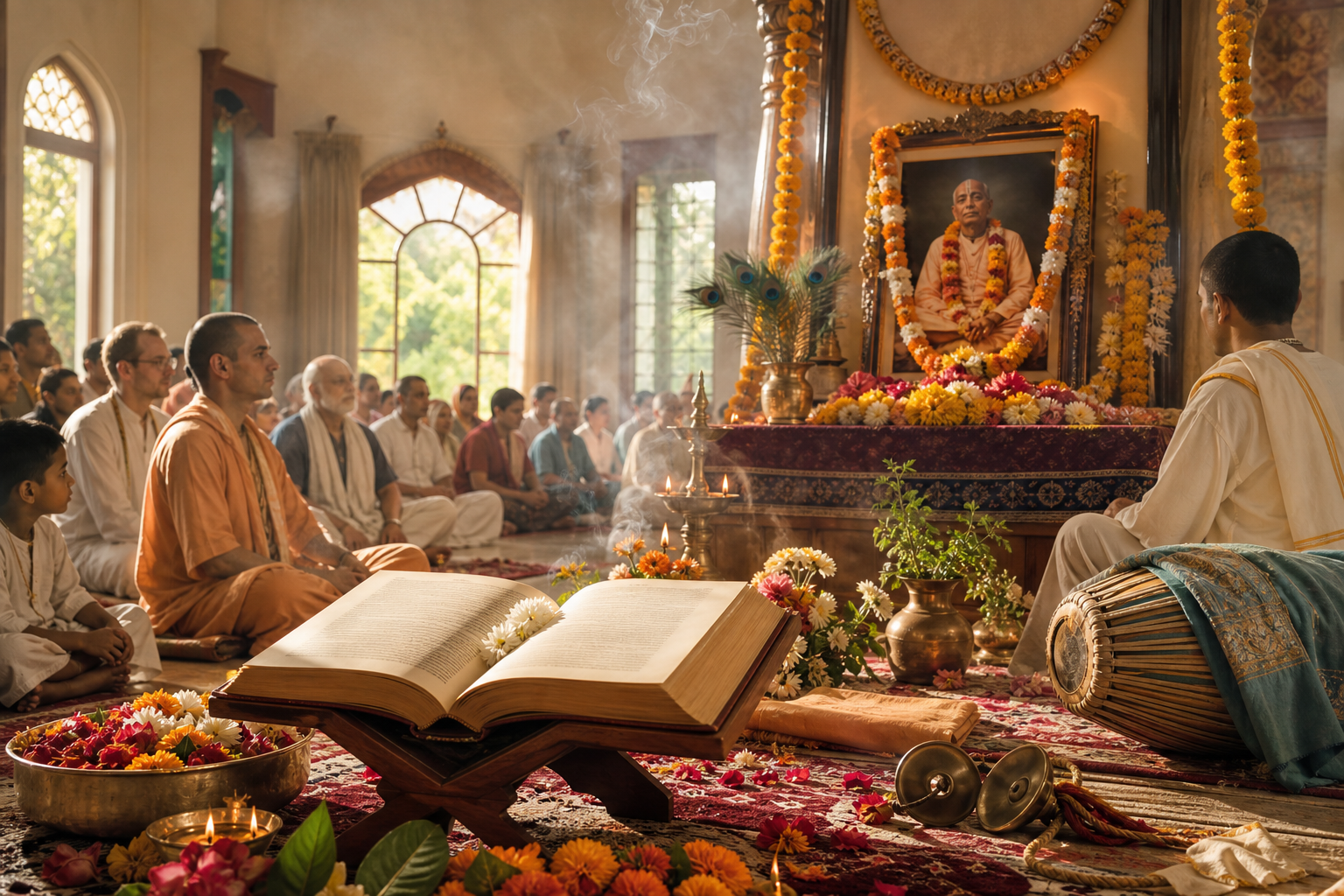
The Sunday morning program titled “Sunday Morning – Guru Puja and Srimad Bhagavatam class by HG Adi Karta Prabhu – 28/06/2026” points toward one of the most recognizable rhythms of ISKCON devotional culture: the gathering of devotees for guru-puja, congregational kirtan, and a class on the Srimad Bhagavatam. The available source material contains only the embedded video thumbnail and event metadata, so the most responsible reading must avoid inventing the exact content of HG Adi Karta Prabhu’s lecture. Even so, the title itself identifies a spiritually dense occasion, one in which ritual, scripture, community, and disciplined listening come together in a single morning practice.
In the Gaudiya Vaishnava tradition, Sunday morning gatherings are not merely weekly religious meetings. They function as spaces of learning, remembrance, service, and ethical recalibration. A person may arrive carrying the ordinary pressures of family, livelihood, fatigue, or inner distraction, yet the structure of the program gradually redirects attention toward Krishna, guru, sadhu, and shastra. This movement from scattered attention to devotional focus is one reason such gatherings remain meaningful for both long-practicing devotees and newcomers who are still learning the language and discipline of bhakti.
Guru-puja, in this context, is a formal act of reverence toward the spiritual master and the disciplic succession. In ISKCON temples, it is especially associated with the worship of Srila Prabhupada, whose role as founder-acharya shaped the global transmission of Krishna consciousness in the twentieth century. The ritual is not simply an expression of admiration for a historical personality. It affirms the theological principle that divine knowledge is received through parampara, a living chain of transmission in which scriptural truth is preserved, explained, embodied, and practiced.
The technical significance of guru-puja lies in its integration of theology and practice. The devotee offers flowers, sings prayers, bows, and participates in kirtan, but each action is meant to discipline the heart away from ego-centered independence and toward grateful receptivity. The guru is honored not as a replacement for God, but as the transparent representative who directs the student toward Bhagavan. This distinction is central to Vaishnava theology because it protects both devotion and philosophical clarity.
Srimad Bhagavatam, also known as the Bhagavata Purana, occupies a foundational place in this devotional landscape. It is revered as a mature exposition of bhakti, presenting theology through narrative, dialogue, cosmology, ethics, poetry, and metaphysical reflection. Its teachings are not limited to abstract doctrine. They examine the human condition: ambition, fear, attachment, grief, pride, surrender, humility, and the longing for a love that is not exhausted by material exchange.
A Bhagavatam class therefore serves a different purpose from a motivational talk or general religious sermon. It is a disciplined engagement with shastra. The speaker is expected to draw from the Sanskrit text, previous acharyas, Srila Prabhupada’s purports, and the lived questions of the community. The listener is also not passive. Hearing, or shravanam, is itself a devotional act. In bhakti traditions, attentive hearing is understood as a transformative practice because sacred sound is not treated as ordinary information; it is a medium through which consciousness can be purified and redirected.
The presence of HG Adi Karta Prabhu as the speaker indicates a class situated within the established culture of Vaishnava instruction, where the honorific “HG” means “His Grace.” Such titles are not ornamental when properly understood. They signal a culture of respect, humility, and service within the devotional community. At the same time, the academic study of such traditions must recognize that respect-based forms of address also serve a social function: they help maintain decorum, continuity, and a shared sense of sacred purpose.
The date, 28 June 2026, places this program within an ordinary Sunday rather than a major festival day indicated by the title. That ordinariness is important. Hindu spirituality, and especially the bhakti stream represented by ISKCON, does not reserve spiritual seriousness only for dramatic moments, pilgrimages, or annual celebrations. It teaches that regularity itself is sacred. The weekly return to kirtan, guru-puja, prasadam, and Bhagavatam study is a form of spiritual architecture, building habits that can sustain the inner life over time.
From a broader Dharmic perspective, the gathering reflects a principle shared across Hinduism, Buddhism, Jainism, and Sikhism: the importance of disciplined remembrance supported by community. The language, theology, and ritual forms differ across these traditions, yet all recognize that human consciousness is shaped by repeated practice. Whether expressed through nama-japa, dhyana, svadhyaya, seva, simran, or samayik, the underlying insight is comparable: the mind requires training, the heart requires refinement, and wisdom deepens when practiced in daily life.
Guru-puja also invites careful reflection on the guru-shishya relationship. In modern discourse, the word “guru” is often reduced to a teacher, influencer, expert, or charismatic guide. In the traditional Dharmic sense, however, guru refers to one who dispels darkness by transmitting realized knowledge. The relationship is not based on consumer preference or personality attraction alone. It is anchored in discipline, surrender, inquiry, and transformation. The student does not lose intelligence; rather, intelligence becomes purified through humility and proper questioning.
Srimad Bhagavatam classes often return to the relationship between knowledge and character. Mere intellectual familiarity with scripture is not presented as spiritual maturity. The Bhagavatam repeatedly tests knowledge against conduct: how one responds to insult, uncertainty, mortality, power, suffering, and temptation. This makes the text enduringly relevant. A modern reader may not share every social assumption of the ancient world, but the psychological and ethical questions remain immediate. How should desire be governed? What is worthy of lifelong service? What survives death? What does love become when freed from possession?
The emotional force of a Sunday Bhagavatam class often comes from this meeting point between scripture and ordinary life. A verse may begin in the language of kings, sages, devas, or cosmic time, yet its conclusion may touch the anxiety of a parent, the fatigue of a worker, the loneliness of a student, or the moral confusion of public life. The temple setting allows these personal struggles to be interpreted through a larger spiritual grammar. This does not make pain disappear, but it gives suffering a framework in which endurance, service, and surrender become possible.
The role of kirtan in such a program should not be treated as a decorative prelude to the class. In Gaudiya Vaishnavism, the chanting of the holy names is itself the central practice for the present age. Kirtan prepares the mind for hearing by softening distraction and creating collective absorption. When guru-puja and Bhagavatam study are placed within a kirtan-centered morning, the result is a complete devotional sequence: sound, reverence, scripture, reflection, and service reinforce one another.
Academically, this sequence demonstrates how Hindu ritual life resists the modern separation of emotion, intellect, body, and community. Devotees stand, sing, bow, listen, ask questions, honor prasadam, and interact with others. The body is not excluded from theology; it participates in theology. The voice chants, the hands offer, the ears receive, and the mind contemplates. This embodied approach is one reason temple culture can communicate philosophical teachings even to those who are not yet ready for technical study.
Srimad Bhagavatam also contributes to the unity of Dharmic traditions by preserving a vast civilizational vocabulary: dharma, karma, avatara, bhakti, vairagya, jnana, yajna, tapas, and moksha. These ideas appear in distinct ways across Hindu, Buddhist, Jain, and Sikh traditions, but they belong to a shared intellectual atmosphere in which life is understood as morally consequential and spiritually purposeful. A Bhagavatam class, when presented with maturity, can strengthen that shared inheritance without erasing theological differences.
The unity of Dharmic traditions does not require sameness. It requires mutual literacy, respect, and the recognition that diverse paths have cultivated ethical seriousness, restraint, compassion, and transcendence for centuries. A Vaishnava Sunday program can therefore be deeply rooted in Krishna bhakti while still contributing to a wider culture of Dharmic solidarity. Such solidarity is especially important in an age when religious identity is often flattened into politics, polemics, or superficial representation.
The Sunday program also carries educational importance for younger generations. Children and youth who attend these gatherings encounter religion not only as belief but as sound, food, language, gesture, story, and community memory. They see elders bowing, singing, serving, studying, and discussing. This intergenerational transmission is one of the most powerful forms of cultural preservation. It teaches that Hindu spirituality is not a museum artifact but a living discipline capable of shaping modern lives.
For adults, the Bhagavatam class can serve as a weekly correction to the speed and fragmentation of contemporary life. Modern culture often rewards reaction, consumption, comparison, and constant self-display. The Bhagavatam repeatedly turns attention toward permanence, humility, duty, and devotion. In that sense, the class becomes a form of resistance against spiritual forgetfulness. It asks participants to measure success not merely by acquisition or status, but by purity of intention and steadiness in service.
The theological heart of such a gathering is Krishna consciousness: the cultivation of remembrance of Krishna as the Supreme Person and the reorientation of life around loving devotional service. This is not merely an emotional preference. It is supported by a philosophical anthropology in which the living being, the jiva, is understood as eternal, conscious, and relational. The difficulty of material existence arises when this relational nature is misdirected toward temporary objects of control and enjoyment. Bhakti redirects relationship toward the divine center.
Guru-puja and Bhagavatam study together make this redirection concrete. Guru-puja teaches gratitude for the channel of grace; Bhagavatam study gives intellectual and narrative depth to that gratitude. Kirtan gives it sound. Seva gives it action. Prasadam gives it hospitality. The Sunday program is therefore not a collection of disconnected devotional items. It is a coherent pedagogical system for training consciousness through repetition, beauty, philosophy, and community participation.
Because the supplied source does not include the transcript of HG Adi Karta Prabhu’s class, no specific verse, quotation, or argument can be attributed to him here. This limitation matters. Religious writing should be reverent, but reverence should not become carelessness. Accuracy is itself a form of respect. The responsible conclusion is that the event title records a Sunday morning devotional program centered on guru-puja and Srimad Bhagavatam, and that its significance can be understood through the established practices and theology of the Gaudiya Vaishnava tradition.
Viewed in this way, the 28 June 2026 program becomes more than a dated video entry. It represents the continuing life of a tradition that depends on hearing, chanting, honoring the guru, studying scripture, and serving the community. Its enduring relevance lies in its disciplined simplicity. A Sunday morning becomes sacred not because it escapes the world, but because it teaches participants how to return to the world with clearer intelligence, softer hearts, stronger ethics, and deeper remembrance of Krishna.
Inspired by this post on Dandavats.







Leave a Reply
You must be logged in to post a comment.