
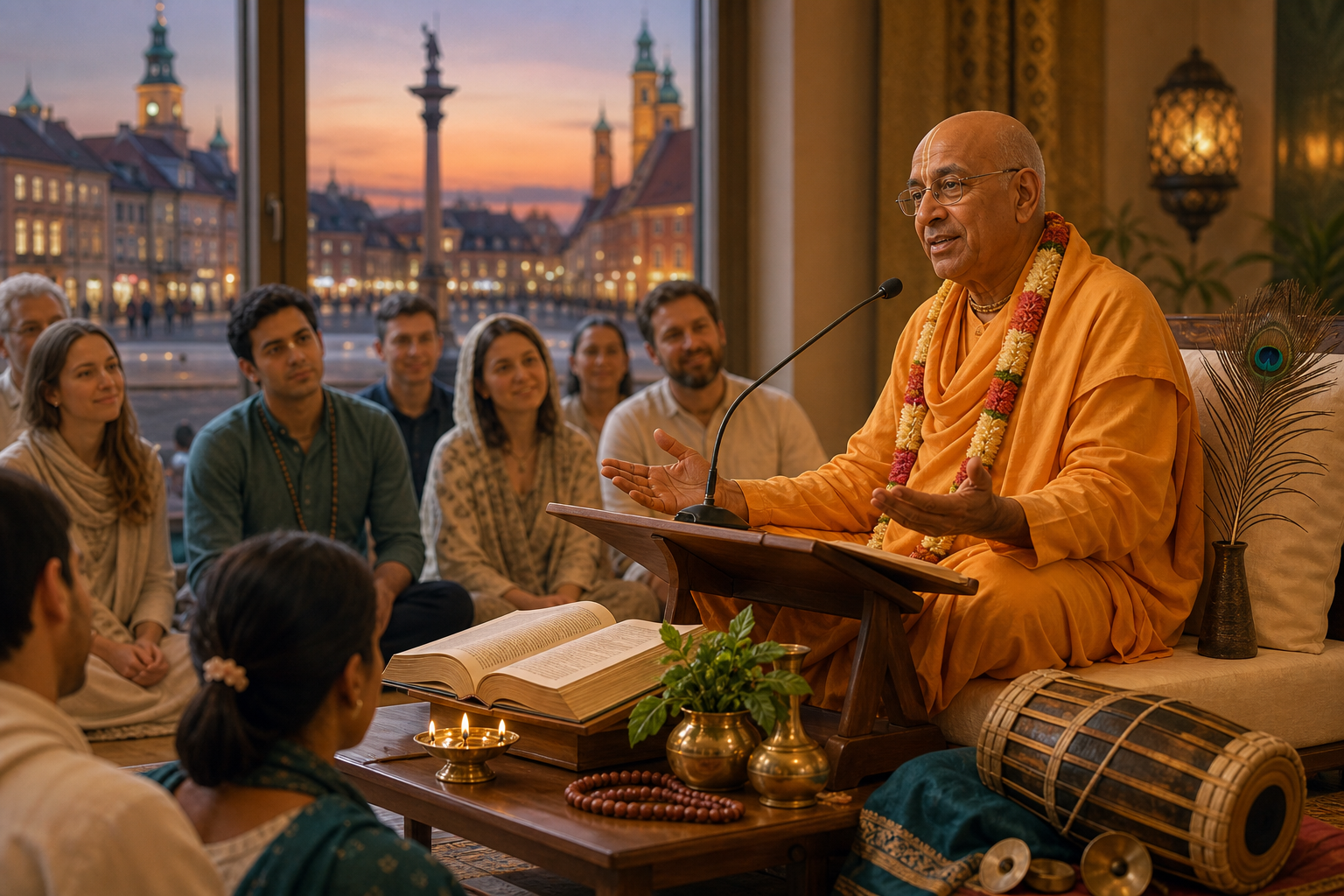
The lecture by H.H. Prahladananda Swami Maharaj at ISKCON Warsaw on 28.06.2026 stands as a meaningful moment in the continuing global life of Krishna consciousness. Its public record identifies a contemporary Vaishnava teacher speaking in a European devotional setting, within the wider mission of the International Society for Krishna Consciousness, commonly known as ISKCON. Even when only the title, date, location, and visual record are available, the event can be understood within a well-established theological, institutional, and cultural framework: the transmission of bhakti, disciplined spiritual practice, scriptural reflection, and community-centered devotional life.
Prahladananda Swami Maharaj is widely known within ISKCON as a senior monk, teacher, and spiritual guide whose work has been shaped by the teachings of Srila Prabhupada and the Gaudiya Vaishnava tradition. His lectures typically belong to a lineage of study that places Lord Krishna, the Bhagavad Gita, Srimad-Bhagavatam, chanting, seva, humility, and practical spiritual discipline at the center of life. The Warsaw lecture therefore has significance not merely as a religious talk, but as part of a larger pattern of dharmic education that has crossed languages, nations, and social backgrounds.
ISKCON Warsaw itself represents an important expression of Hindu spirituality in Europe. A temple or devotional center outside India often becomes more than a place of worship; it becomes a living classroom, a cultural bridge, a kitchen of prasadam, a gathering place for kirtan, and a disciplined environment where philosophical inquiry meets daily practice. For students, families, seekers, and long-time devotees, such spaces make the abstract language of dharma visible through community life.
At the heart of a lecture of this kind is bhakti, the disciplined cultivation of devotion. In the Gaudiya Vaishnava understanding, bhakti is not sentimental religiosity or passive belief. It is a full way of being that includes hearing, chanting, remembering, serving, worshiping, praying, surrendering, and living with conscious responsibility. This makes the lecture format especially important. The spoken word becomes a form of śravaṇa, sacred listening, through which philosophical ideas are not merely received as information but absorbed as guidance for conduct.
The theme of Krishna consciousness is also technical in a precise theological sense. It refers to the reorientation of consciousness from ego-centered identity toward the Supreme Person, Sri Krishna. In this view, the individual self is not reducible to the body, social status, nationality, profession, or temporary emotional condition. The living being is understood as ātmā, spiritual in nature, and capable of rediscovering its relationship with Krishna through sincere practice. This principle gives ISKCON lectures their distinctive combination of philosophy, ethics, and devotional urgency.
A lecture by Prahladananda Swami Maharaj in Warsaw would naturally be heard against the wider background of the Bhagavad Gita. The Gita addresses confusion, duty, grief, moral tension, discipline, and surrender. These are not merely ancient themes. They are recognizably modern. Many people today face overstimulation, loneliness, ethical uncertainty, fragmented attention, and spiritual exhaustion. The Gita’s teaching becomes relevant because it does not ask the human being to deny difficulty; it asks the human being to act with clarity, responsibility, and devotion.
The academic importance of such a lecture lies in the way it preserves oral pedagogy. Hindu traditions, including Vaishnava traditions, have long relied on spoken explanation, question and answer, memorization, commentary, debate, and disciplined listening. A temple lecture continues this older pedagogical model in a modern format. It may be recorded, streamed, or circulated online, but its core remains traditional: a teacher speaks from śāstra, the community listens, and spiritual knowledge is linked to lived transformation.
There is also an emotional dimension that should not be dismissed. For many listeners, a lecture in a temple setting is not an academic exercise alone. It can be a point of return after a difficult week, a reminder that the mind can be steadied, and a quiet assurance that spiritual effort still matters. The sound of kirtan, the presence of devotees, the rhythm of prayer, and the clarity of philosophical instruction together create a form of nourishment that purely intellectual analysis cannot fully capture.
The Warsaw setting adds another layer of meaning. Poland has its own history of religious identity, cultural memory, struggle, reconstruction, and moral seriousness. When Krishna consciousness is taught there, it enters into dialogue with a European cultural landscape rather than merely being transplanted into it. ISKCON’s global growth has often depended on this ability: to preserve fidelity to Vaishnava theology while allowing devotional practice to take root in local languages, communities, and histories.
This is where the principle of unity among dharmic traditions becomes especially valuable. A Vaishnava lecture can be rooted firmly in devotion to Krishna while still honoring the wider civilizational family of Hinduism, Buddhism, Jainism, and Sikhism. These traditions differ in metaphysics, ritual practice, authority structures, and doctrinal emphasis, yet they share deep concerns with discipline, self-transformation, compassion, truthfulness, liberation, and the refinement of human conduct. A mature dharmic outlook does not flatten these traditions into sameness; it recognizes their distinctiveness while encouraging mutual respect.
Within Hinduism itself, the diversity of paths is a major strength. Vaishnavas, Shaivas, Shaktas, Smārtas, Vedantins, yogic lineages, temple traditions, household practices, and regional devotional cultures all contribute to a vast spiritual ecology. ISKCON’s emphasis on Krishna bhakti is one strong stream within this larger river. Its discipline of mantra meditation, deity worship, scriptural study, prasadam, and kirtan gives seekers a structured path, while the broader dharmic framework encourages respect for other sincere approaches to spiritual realization.
Prahladananda Swami Maharaj’s public role as a sannyasi also deserves attention. In the Hindu monastic context, sannyasa is associated with renunciation, teaching, discipline, simplicity, and responsibility toward spiritual education. The saffron-clad monk is not merely a symbolic figure; he is expected to embody restraint, scriptural commitment, and service. In modern society, where authority is often judged by charisma or visibility, the monastic ideal offers a different model: authority grounded in practice, austerity, study, and accountability to parampara.
The word parampara is central here. It refers to disciplic succession, the transmission of knowledge from teacher to student through a recognized lineage. ISKCON understands itself through the Brahma-Madhva-Gaudiya sampradaya, and Srila Prabhupada’s mission was to bring that lineage into global public life through books, temples, chanting, prasadam distribution, and organized community practice. A lecture in Warsaw is therefore not an isolated speech. It is part of a chain of transmission that links contemporary Europe to a much older Vaishnava intellectual and devotional heritage.
The technical structure of Krishna consciousness places great importance on sādhana, or regulated spiritual practice. Chanting the Hare Krishna maha-mantra, studying scripture, honoring prasadam, associating with devotees, avoiding harmful habits, and serving the community are not accidental features. They are methods for reshaping consciousness. The human mind is understood as trainable, but also unstable when left without discipline. Bhakti practice gives the mind a sacred center and the senses a constructive orientation.
Such teachings have practical relevance for modern life. A person may be educated, employed, connected through technology, and socially active, yet still experience inner disorder. The Vaishnava diagnosis is that external success alone cannot satisfy the self. Without spiritual orientation, desire keeps expanding and the mind remains restless. Krishna consciousness does not reject work, family, learning, or social life; it asks that they be aligned with service, humility, and remembrance of Krishna.
In that sense, the Warsaw lecture can be read as part of a wider conversation about spiritual resilience. Communities need more than economic development and social organization. They need rituals of meaning, ethical formation, intergenerational learning, and disciplined spaces where people can ask fundamental questions. Who am I? What is duty? What is the purpose of knowledge? How should desire be governed? How can suffering become a doorway to wisdom rather than bitterness? These are classical questions, but they remain urgent.
ISKCON’s public teaching tradition also highlights the relationship between knowledge and humility. In the Bhagavad Gita, knowledge is never treated as mere accumulation of concepts. It must refine character. A learned person who remains arrogant has missed the purpose of learning. A sincere practitioner, even if socially ordinary, may possess a deeper wisdom through service and devotion. This principle has a democratizing effect: spiritual progress is not reserved for elites, scholars, or ritual specialists alone.
The role of prasadam and community meals is another important dimension of ISKCON life. Food offered to Krishna becomes more than nutrition. It becomes sanctified hospitality, a reminder that material resources can be spiritualized when used in devotion. In many urban centers, including European cities, prasadam distribution has helped introduce people to Hindu spirituality in an accessible and humane way. The table becomes a place where philosophy, culture, and compassion meet.
Kirtan likewise occupies a central role. The congregational chanting of the names of Krishna is a theological practice, a meditative discipline, and a communal art form. It does not require advanced literacy or philosophical training before participation. It invites the voice, breath, body, memory, and emotion into spiritual practice. For many seekers, kirtan becomes the first doorway into a tradition that later opens into scripture, ethics, and disciplined sādhana.
From a broader cultural perspective, lectures like this also challenge simplistic assumptions about Hinduism as merely ethnic, ritualistic, or geographically confined to India. ISKCON’s presence in Warsaw demonstrates that Hindu spirituality can become part of global religious life without losing its Sanskrit vocabulary, devotional identity, or theological depth. The tradition travels not by abandoning its roots, but by making those roots intelligible to new communities.
At the same time, responsible engagement requires accuracy. Without a verified transcript of the 28.06.2026 lecture, specific claims should not be attributed to Prahladananda Swami Maharaj beyond what is publicly indicated by the event title and ISKCON context. The more reliable approach is to interpret the lecture within the established teachings of Krishna consciousness, the public role of the speaker, and the known function of ISKCON temple lectures. This protects both the integrity of the teacher and the seriousness of the subject.
The enduring value of such a lecture lies in its ability to connect śāstra with ordinary life. A devotee may enter the temple with practical worries, intellectual doubts, or emotional fatigue, and leave with a clearer sense of purpose. The transformation may not be dramatic in outward appearance. It may be as quiet as a decision to chant more attentively, speak more kindly, eat more consciously, serve more steadily, or study the Bhagavad Gita with renewed focus.
This is the strength of bhakti as a lived tradition. It does not depend only on grand ceremonies or rare mystical experiences. It grows through repetition, remembrance, association, and surrender. It teaches that the sacred can enter the rhythm of daily life: the morning mantra, the offered meal, the listened lecture, the cleaned temple floor, the respectful conversation, the moment of restraint when anger could have prevailed.
The lecture at ISKCON Warsaw therefore deserves attention as part of a wider dharmic movement of renewal. It brings together guru, śāstra, community, temple culture, and global spiritual seeking. It invites the modern listener to consider that devotion is not an escape from intelligence, but a disciplined use of intelligence in the service of truth. It also affirms that Hindu spiritual traditions can speak with clarity and compassion across borders while contributing to harmony among all dharmic paths.
Ultimately, the significance of H.H. Prahladananda Swami Maharaj’s Warsaw lecture is not limited to one date or one hall. Its importance lies in what it represents: the living continuity of Krishna bhakti, the global reach of Srila Prabhupada’s mission, the educational role of ISKCON, and the possibility of cultivating inner transformation in a fragmented age. For anyone interested in Hindu philosophy, Vaishnava devotion, spiritual discipline, or dharmic unity, this event offers a valuable point of reflection.
Inspired by this post on Dandavats.








Leave a Reply
You must be logged in to post a comment.