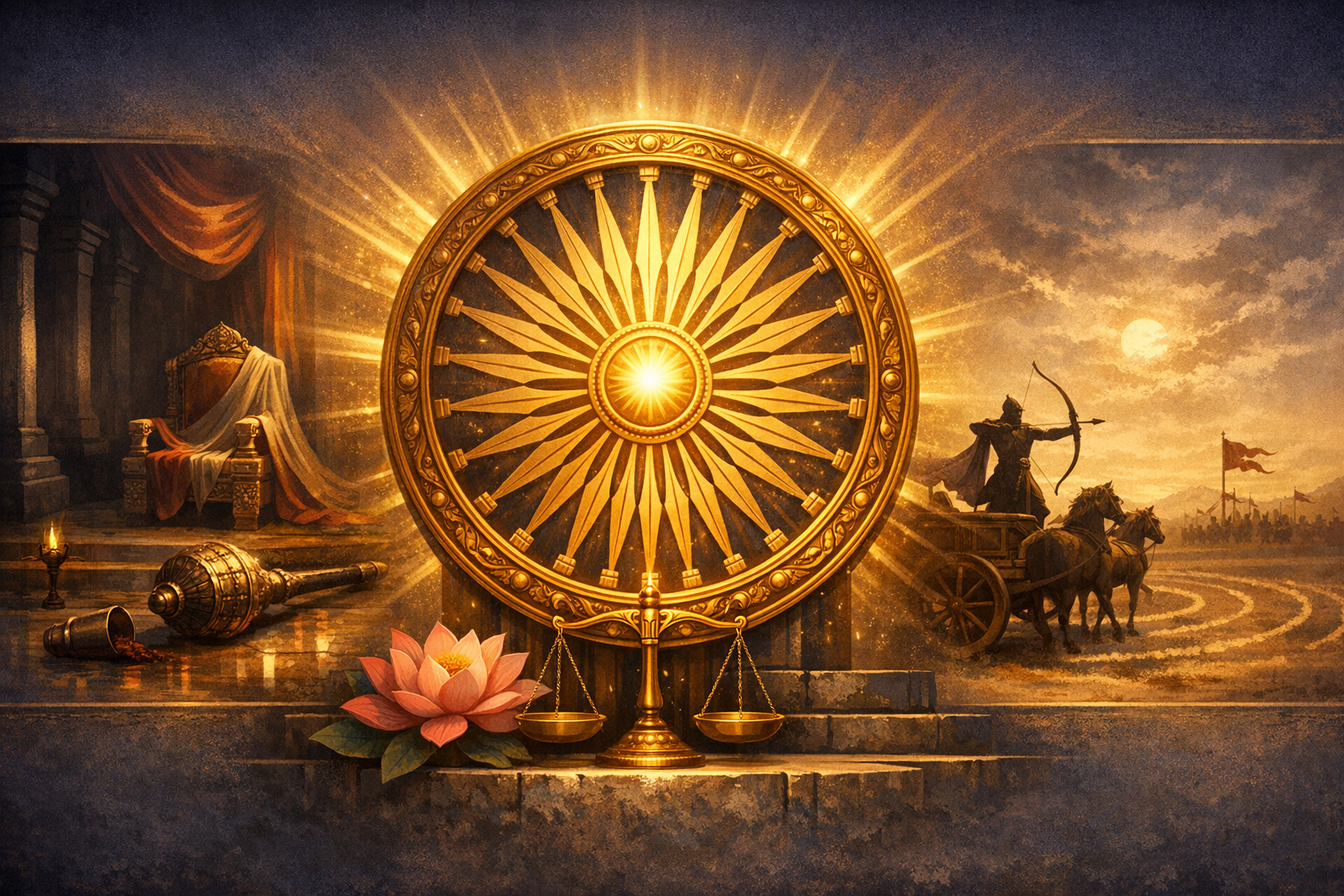
The Mahabharata preserves uncompromising judgments against unrestrained desire, and few episodes illustrate this more starkly than the twin arcs of Jayadratha and Kichaka. Their actions, powered by unchecked kama, elicited swift and exemplary responses grounded in Dharmaresponses that protected dignity, stabilized social order, and warned future generations about the costs of transgression. Together, these narratives illuminate how the epic calibrates justice: humiliation where restraint served a larger ethical purpose, and lethal force where protection of the vulnerable demanded immediacy.
Within the Purushartha frameworkDharma, Artha, Kama, Mokshathe Mahabharata affirms kama as a legitimate human pursuit only when governed by Dharma. Violations of this hierarchy turn desire into adharma, requiring Dandaniti (statecraft of punishment) to restore balance. The fates of Jayadratha and Kichaka showcase this moral machinery in motion, demonstrating how ethical intent, social responsibility, and proportionality inform dharmic judgment.
Two timelines intersect with Draupadi’s honor at their core. Kichaka’s arc unfolds in the Virata Parva amid the Pandavas’ incognito year, while Jayadratha’s story begins in the Vana Parva (with an attempted abduction) and culminates on the Kurukshetra battlefield in the Drona Parva with a fateful oath and a precise execution of justice. Reading them together reveals a coherent ethic: protection of women (stri-raksha) as a nonnegotiable duty, and calibrated remedies that prioritize both compassion and deterrence.
Kichaka, the powerful Suta commander of Matsya, held near-sovereign sway in King Virata’s court. Emboldened by privilege, he repeatedly harassed Draupadithen serving incognito as Sairandhri under Queen Sudeshna. Institutional complicity deepened the harm: courtly power shielded Kichaka, and hesitation by those in authority compounded Draupadi’s humiliation. The epic frames this not merely as personal misconduct but as a systemic failure of Rajadharma.
Constrained by the vow of concealment, the Pandavas could not seek open legal redress without jeopardizing their exile’s final phase. This was an instance of apaddharmaethical decision-making under duresswhere the letter of ordinary protocol yields to the spirit of protection and duty. Yudhishthira counseled restraint to avoid exposure; Bhima, oriented to Kshatra (protector-warrior duty), prepared to end the threat decisively.
Draupadi and Bhima devised a controlled intervention: a late-night rendezvous in the dancing hall that would remove bystanders from risk while ensuring a fair confrontation. Kichaka, accustomed to impunity, misread the silence of Dharma as weakness; he found instead its iron core. In the ensuing combat, Bhima slew Kichaka with overwhelming force, ending a reign of coercion in an act squarely aligned with the epic’s ethic of protecting the vulnerable.
The Dharmashastric classification of atatayinaggressors who set fires, administer poison, brandish deadly weapons, steal wealth or land, or violate another’s wifeprovides a juridical lens for the episode. By this definition, Kichaka was an atatayin; his elimination fits the epic’s principle that force may be used to remove imminent, predatory harm. The aftermath reinforces deterrence: the Upa-Kichakas, complicit kin who sought to burn Draupadi alive, were likewise killed by Bhima, signaling that institutionalized violence against women would meet unambiguous, proportionate justice.
Kichaka’s downfall thus exemplifies Dharma’s swift justice in a setting where formal courts were unavailable and power asymmetry was extreme. The episode upholds three interlocking principles: the primacy of stri-raksha, the legitimacy of force against atatayin, and the careful management of risk under apaddharma to prevent collateral harm. It also demonstrates the Mahabharata’s refusal to romanticize lust as private vice; when weaponized, it becomes a public crime against social order.
Jayadratha’s journey traces a different arcone that moves from reprieve to reckoning. During the Pandavas’ forest exile, he attempted to abduct Draupadi from the hermitage in the Kamyaka forest. Captured and brought before the Pandavas, he faced a divided council. Bhima and Arjuna pressed for death; Yudhishthira, mindful of kinship ties (Jayadratha was married to Dushala, the Kauravas’ sister) and of the political volatility surrounding their exile, imposed humiliation rather than execution.
Shaving Jayadratha’s heada potent sign of disgracewas a calibrated penalty, preserving future stability while marking an unmistakable moral boundary. This earlier leniency, however, did not absolve future wrongdoing. The Mahabharata treats punishment as educative and preventive; when a penitent changes course, clemency is vindicated, but when arrogance escalates to greater crimes, Dharma’s response intensifies accordingly.
Jayadratha chose escalation. Performing austerities, he gained from Shiva a boon allowing him to check the Pandava forces for one dayeveryone except Arjuna. He would use that respite to disastrous effect on the thirteenth day of the war, when the Kauravas formed the Chakravyuha. As Abhimanyu broke into the formation, Jayadratha blocked reinforcement, contributing materially to the young hero’s death.
Abhimanyu’s killingsurrounded, deprived of due combat normstore the moral fabric of the battlefield. In response, Arjuna took a pratijna (vow) to slay Jayadratha before sunset the next day or self-immolate. The vow elevated the matter from battlefield vendetta to a question of Dharma’s restoration; it bound Arjuna’s honor to a time-bound, targeted act aimed at a decisive wrongdoer rather than indiscriminate retribution.
Krishna’s strategy on the fourteenth daymanaging battlefield tempo, marshaling formations, and momentarily veiling the suncreated the narrow window Arjuna needed. Jayadratha, deceived into lowering his guard, fell to Arjuna’s arrow in a precisely executed strike. The epic underscores that such upaya (resourceful means) served not private gain but the reestablishment of just order after a grave breach.
The moral architecture around Jayadratha’s end is complex but consistent. Earlier mercy did not license later atrocity; rather, it heightened responsibility. When Jayadratha’s conduct moved from isolated affront to strategically consequential adharmafacilitating Abhimanyu’s unlawful killingDharma answered with finality. Humiliation had once sufficed; after escalated harm, lethal punishment became proportionate and necessary.
Read together, the Kichaka and Jayadratha episodes map a spectrum of ethical response. Where institutional redress was blocked and a predatory atatayin threatened a woman, Dharma authorized immediate, contained force. Where political stability and kinship argued for restraint, humiliating censure aligned with long-range prudenceuntil the offender’s conduct crossed into grievous public harm, at which point Dharma’s verdict sharpened to annihilation of the threat.
These judgments resonate across dharmic traditions. Buddhism identifies craving (tanha) as the seed of suffering and insists on self-mastery; Jainism emphasizes brahmacharya and ahimsa while recognizing, in narrative literature, the king’s duty to restrain harm-doers; Sikh tradition fuses compassion with the resolve to defend the weak, epitomized by the saint-soldier ideal. Across these paths, ungoverned desire is a destabilizer, while disciplined strength in defense of the vulnerable is a moral imperative.
The Mahabharata also attends to process: intention, proportionality, and the minimization of collateral injury. Bhima’s nocturnal duel with Kichaka isolated the aggressor. Arjuna’s time-bound vow targeted a specific culpable agent rather than demonizing an entire side. Yudhishthira’s earlier clemency toward Jayadratha balanced justice with social cohesion. Such choices reveal Dharma not as rigid code but as principled reasoning amid shifting constraints.
Ethically, the lessons extend beyond antiquity. Leaders are reminded that unchecked power invites predation and that institutions must not outsource women’s safety to individual heroism. Communities learn that mercy must not embolden repeat harm, and that deterrenceclearly communicated and fairly appliedprotects the common good. Individuals see that mastery over desire is not ascetic posturing but civic responsibility.
Terminology from the epic and Dharmashastra clarifies the normative scaffolding: Rajadharma (the ruler’s duty to protect), Dandaniti (just punishment as social medicine), Atatayin (aggressor licitly stopped by force), Apaddharma (contingent ethics under emergency), and Stri-raksha (nonnegotiable protection of women). The Kichaka episode especially foregrounds Stri-raksha, while Jayadratha’s fate exemplifies Dandaniti applied after a public, law-corroding offense.
For readers of the Mahabharata, these episodes function as ethical case studies. Virata Parva shows how Dharma operates under concealment and institutional paralysis; Vana Parva reminds that humiliation can serve as corrective warning; Drona Parva demonstrates that vows, strategy, and precision can reinstate order after grave breaches. In every case, Draupadi’s dignity becomes a litmus test for the health of the polity.
In sum, the fatal lust of Jayadratha and Kichaka is not merely personal downfall; it is Dharma’s curriculum for societies navigating desire, power, and protection. Mercy without blindness, force without cruelty, and strategy without cynicismthese are the epic’s prescriptions. By aligning self-mastery with public duty, the Mahabharata articulates a shared dharmic ethos in which Hindu, Buddhist, Jain, and Sikh values converge: uphold dignity, restrain craving, and defend the vulnerable with clarity and courage.
Inspired by this post on Hindu Blog.