Mahabharata endures as a monumental itihasahistory with ethical purposeoffering an unparalleled exploration of dharma, statecraft, kinship, and spiritual realization. For contemporary readers across dharmic traditions, it remains an intellectual treasury and a moral compass, illuminating how humans navigate duty, desire, power, and compassion in times of peace and conflict.
According to sacred tradition, Maharshi Veda Vyasa composed the Mahabharata, while Lord Vinayaka served as the divine scribe. Philologically, scholars situate its growth over several centuries (roughly 400 BCE–400 CE), culminating in the eighteen-parva structure familiar today. The Bhandarkar Oriental Research Institute’s Critical Edition highlights a layered textual history, yet the epic’s narrative coherenceanchored in the Kuru dynasty and the Kurukshetra Warremains unmistakable. Alongside the main work stands the Harivamsa, often treated as an appendix.
Framed within the sage Vaishampayana’s narration to King Janamejaya during the snake sacrifice, and further relayed by the bard Ugrashrava Sauti, Mahabharata interweaves nested voices to show how truth is recollected, debated, and internalized. This narrative architecture is not ornamentation alone; it models an ethics of listening, reflecting the epic’s conviction that dharma is better discerned through dialogue than decree.
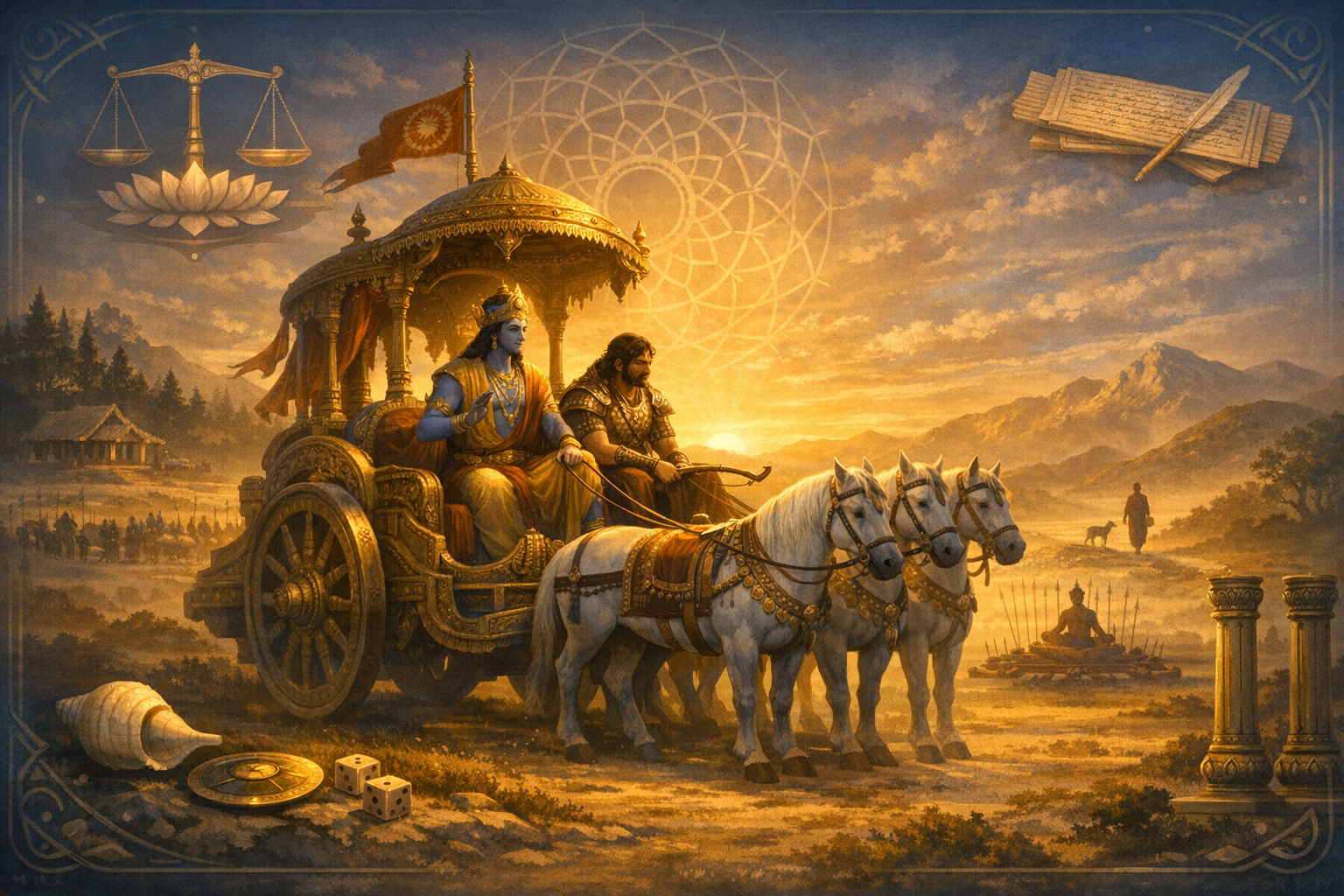
The central conflict pits the five PandavasYudhisthira, Bhima, Arjuna, Nakula, Sahadevaagainst their cousins, the Kauravas led by Duryodhana. Sri Krishna, as Arjuna’s charioteer and guide, shapes the epic’s spiritual horizon through the Bhagavad Gita. Around this axis move formidable figures: Bhishma’s vow-bound rectitude, Drona’s complex loyalties, Karna’s tragic nobility, Vidura’s uncompromising counsel, Kunti’s resolute motherhood, and Draupadi’s indomitable dignity.
Adi Parva introduces the genealogy of the Bharatas, the vows and destinies that precede the protagonists, and the births of the Pandavas and the Kauravas. It establishes the ethical ground: vows bind like armor, yet they can also confine; boons empower, yet they exact cost; and every acthowever privateechoes in public life. The seeds of rivalry and brittle pride are sown here.
Sabha Parva depicts Yudhisthira’s Rajasuya sacrifice and the infamous dice game that strips the Pandavas and Draupadi of honor, sovereignty, and liberty. Draupadi’s interrogation of the courtwhether a man who has lost himself has the right to stake his wifestands as one of world literature’s sharpest legal-moral challenges. The forced exile that follows turns humiliation into a crucible for ethical transformation.
Vana Parva chronicles thirteen years of exile, a period of spiritual instruction and narrative plenitude. Tales such as Nala–Damayanti and Savitri–Satyavan illuminate steadfast virtue under duress. Arjuna’s tapasya and encounter with Shiva (as Kirata) yield celestial weapons that will later test the limits of dharma-yuddha. The forest becomes a university of resilience, where duty is honed rather than abandoned.
Virata Parva captures the Pandavas’ incognito year in Matsya. Draupadi’s courage amid Kichaka’s harassment, Bhima’s protective wrath, and Arjuna’s return to arms during the cattle raid underscore a truth the epic never forgets: dharma requires both forbearance and force, but only in right measure and at the right time.
Udyoga Parva is a study in statecraft under strain. Vidura-niti articulates governance grounded in restraint, truthfulness, and welfare. Diplomatic missionsSanjaya’s report, Krishna’s peace embassyfail against Duryodhana’s intransigence. The parva clarifies a grim threshold: when reconciliation is rebuffed and justice imperiled, readiness for war becomes a duty, not a preference.
Bhishma Parva opens the Kurukshetra War and preserves the Bhagavad Gita: Krishna’s teaching on karma-yoga, jnana-yoga, and bhakti-yoga. The Gita reorients action as disciplined offering, aligning personal duty with cosmic order. Arjuna’s paralysis dissolves not through denial of grief but through clarity about right action without attachment to results.
Drona Parva intensifies the tragedy of necessity. The fall of Abhimanyu within the chakravyuha reveals both strategic brilliance and moral hazard when the rules of war fracture. Drona’s deathprecipitated by a half-truth that breaks his willmarks one of the epic’s darkest reckonings with ethical ambiguity in wartime.
Karna Parva pivots to Karna’s command. His life embodies devotion, generosity, and indomitable spirit, shadowed by social stigma and fateful allegiance. The duel with Arjunatechnical mastery entwined with destinyculminates in Karna’s fall when his chariot wheel sinks and the code of fair battle collides with a higher calculus of justice remembered from Draupadi’s humiliation.
Shalya Parva concludes the main combat. Shalya’s reluctant leadership cannot reverse the Kaurava collapse. Duryodhana’s final duel with Bhima fulfills a long-standing vow, yet only by bending the rule against striking below the waistanother reminder that even just causes can incur ethical wounds.
Sauptika Parva narrates the night slaughter by Ashvatthama, who violates the core injunctions of dharma-yuddha by attacking sleeping warriors and killing the Upapandavas. The moral and ritual aftermathAshvatthama’s cursed existence and the removal of his jewelunderscores the epic’s insistence that victory pursued without restraint destroys the victor first.
Stri Parva centers grief. Gandhari’s lament, Kunti’s sorrow, and the widows’ voices dignify loss as ethical testimony. Mahabharata grants remembrance the status of justice; it insists that policy and power must answer to those who mourn.
Shanti Parva and Anushasana Parva transform the battlefield into a university of governance and ethics. Bhishma, lying on a bed of arrows, teaches rajadharma (duties of rulers), apaddharma (ethics in crisis), and dana-dharma (the economy of giving). The counsel ranges from taxation and justice to non-violence and compassion“ahimsa” upheld even as the epic records war, revealing an ideal toward which societies must continually strive.
Ashvamedhika Parva follows Yudhisthira’s restorative rule and the horse sacrifice, where Arjuna’s campaigns reopen questions about conquest, law, and reconciliation. Krishna’s guidance sustains a social vision in which power must remain yoked to service.
Ashramavasika Parva records the retirement of Dhritarashtra, Gandhari, and Kunti to the forest. Their passing in a forest fireaccepted without fearintimates an ethics of renunciation after responsibility has been discharged.
Mausala Parva chronicles internecine ruin among the Yadavas and the departure of Krishna and Balarama. Even the exemplary Yadava clan succumbs to intoxication, hubris, and destinyan austere meditation on the cyclicality of decline that spares no lineage.
Mahaprasthanika Parva and Svargarohana Parva trace the Pandavas’ final journey toward the Himalaya. One by one, weaknesses unconfessedpride, partiality, vanitycause a fall. Yudhisthira’s fidelity to a dog (Dharma in disguise) at the threshold of heaven enshrines compassion as the highest credential for liberation, surpassing even royal glory.
Across its expanse, Mahabharata advances a sophisticated ethics of context. Dharma is not a slogan; it is an inquiry whose answer depends on role, season, and consequence. The epic distinguishes ordinary duty from apaddharma (emergency ethics), showing that rigid literalism can itself become adharma when it refuses compassion or equity.
On war and peace, Mahabharata outlines the norms of dharma-yuddhano night attacks, no harm to the unarmed, no assault on those fleeing or surrenderingthen documents each breach to demonstrate how moral vigilance is hardest when victory tempts shortcuts. The lesson is not cynicism but accountability: rules must be guarded by inner discipline, not merely outer enforcement.
In governance, Vidura-niti and Bhishma’s lectures recommend policies recognizable in modern ethical administration: prudent taxation, protection of the vulnerable, truth in counsel, the ruler’s restraint, and the primacy of social welfare over personal gain. Leadership emerges not as domination but as stewardship.
Spiritually, the Bhagavad Gita integrates action, knowledge, and devotion into a practicable path for householders and renunciants alike. It resonates with dharmic traditions beyond Hinduism: disciplined compassion aligns with Buddhist kshanti, multi-perspectival reasoning echoes Jain anekantavada, and righteous courage in defense of justice finds kinship with Sikh dharam-yudh. The shared ethical vocabularydharma, ahimsa, self-mastery, serviceunderscores a civilizational unity-in-diversity.
Women’s agency is central and complex. Draupadi challenges injustice with jurisprudential acuity; Kunti steers the moral arc with austere resolve; Gandhari’s grief becomes an ethical indictment of war’s cost. Stri Parva ensures the epic’s memory includes women as moral legislators, not mere witnesses.
Literarily, Mahabharata thrives on layered narration, didactic interludes, and exempla that invite critical reflection. Its meters, predominantly shloka, sustain a cadence suited to counsel and disputation. The tradition that the text evolved from Jaya (8,800 verses) to Bharata (24,000) to Mahabharata (over 100,000) mirrors its widening ethical remitfrom victory, to lineage, to the totality of human striving.
For contemporary readers, the epic offers pragmatic guidance: reconcile principle with compassion; match capability with humility; prefer counsel over coercion; and remember that law without empathy curdles into violence. In public life as in the household, the measure of success is the welfare it confers on others.
As a whole, Mahabharata is less a chronicle of heroes than a mirror for readers. It suggests that every life contains a Kurukshetramoments when clarity, courage, and compassion must converge. In that convergence lies the promise of a just society, a promise shared across the dharmic family as a living inheritance.
Inspired by this post on Hindu Pad.