The narrative of Lava and Kusha chanting the Ramayana occupies a singular place in the history of Indian epics, performance traditions, and cultural memory. Revered as Ādikavi, Maharshi Valmiki not only composed the Ramayana as an itihasa but also curated its very first audience and performance context. The decision to entrust two young disciplesLava and Kushawith the inaugural recital shaped how the epic would be heard, understood, and preserved across generations. In textual tradition and living practice alike, this episode marks the Ramayana’s transition from a composed text to a sung, shared, and spiritually charged experience.
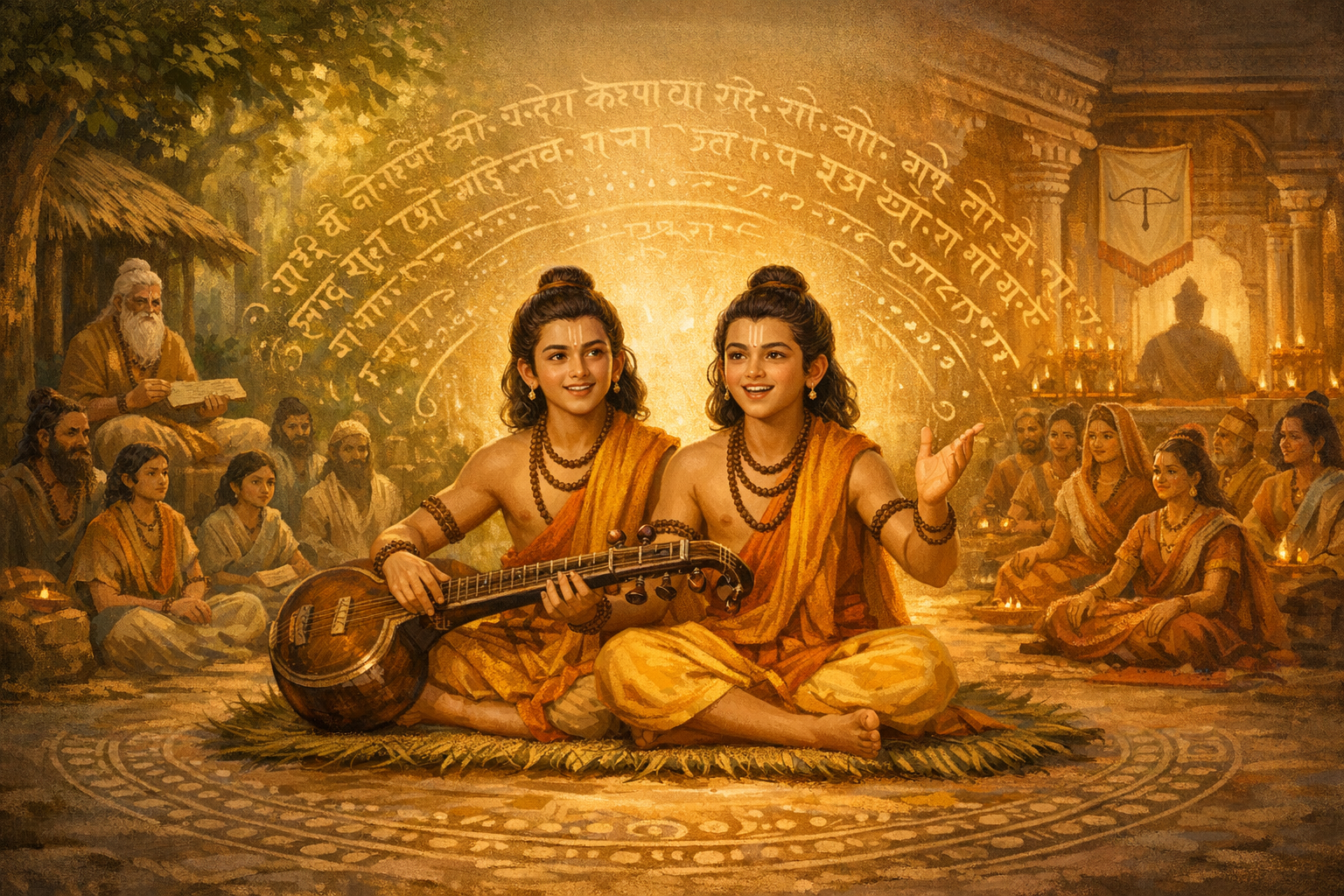
According to the received tradition, after completing the Ramayana, Valmiki faced a consequential question: who should first receive this sacred narrative? The answer emerged within the ashram’s own sanctum. Lava and Kusha, twin sons of Rama and Sita raised in the serenity of the forest hermitage, had been nurtured in discipline, music, and the ethics of dharma. Valmiki taught them not merely the content of the Ramayana but its chandas (metre), svara (intonation), and bhava (emotive force), equipping them to render the epic as living wisdom rather than distant lore.
Tradition emphasizes that Valmiki set the Ramayana in the anuṣṭubh metre, the most pervasive of Sanskrit verse forms, and trained the boys to deliver it with exacting clarity and musical cadence. The teaching encompassed both phonetic precision and aesthetic sensibility, aligning the recital with the rigours of śabda (sound) and rasa (aesthetic relish). Their performance thus fused pedagogy and piety: the Ramayana was to be sung with discipline and felt with devotion.
The ashram community served as the first audience, an intentional choice that foregrounded contemplative listening. Sages, students, and seekers formed a circle around Lava and Kusha as their voices unfolded the story of Rama, Sita, Lakshmana, and the cosmic struggle against adharma. This intimate settingrooted in silence, attention, and shared valuestested the recital’s internal coherence and emotive depth before it encountered the clamour of urban life or royal courts. In this sense, the “birth of the first audience” was simultaneously an ethical and aesthetic act: revelation entrusted to readiness.
From this sanctified beginning, the twins carried the Ramayana beyond the hermitage. The narrative’s early dissemination aligns with the broader Indic practice of oral transmission, in which learning resides as much in the ear and memory as in manuscripts. The figure of the katha-vācaka (storyteller) and the cusilava/kusilava (bard) finds resonance here, underscoring how the epic moved through voices attuned to cadence and conscience. The recital’s power drew from accuracy of text, purity of diction, and a restrained yet affective musicality.
Accounts preserved in later tradition situate a pivotal performance in Ayodhya, often associated with the period of the aśvamedha. There, in a public and royal setting, Lava and Kusha chanted the Ramayana before Rama himself. The ethical poignancy of this moment is striking: the sovereign hears his own life rendered as itihasa, subject to the same evaluative gaze as any exemplar of dharma. The recital thus becomes a mirror, reflecting royal duty, the limits of power, and the binding force of truth.
In these performances, audiences reportedly responded not only to the narrative’s moral arc but also to its performative rigour. The twins’ enunciation and prosody, their command of chandas, and their cultivated restraint evoked both devotion and trust. These qualities consolidated the Ramayana’s authority as śāstra-adjacent itihasateaching through story, and persuading through beauty. From this point forward, the epic spread as a sung scripture, a living practice that travelled with bards, mendicants, temple singers, and householders alike.
The episode also illuminates a key hermeneutic: audiences are co-creators of sacred meaning. By listening with concentration (ekāgratā) and feeling, the sages and citizens of Ayodhya participated in the sanctification of the text. Their responsestears, silence, approvalfunctioned as social proofs of the recital’s fidelity to dharma. The Ramayana’s moral authority, therefore, was not imposed but consented to through collective recognition, a notable feature of Indic epistemologies that value lived verification (anubhava) alongside textual testimony (śabda-pramāṇa).
From a performance-studies perspective, Lava and Kusha’s training exemplifies a synthesis of grammar, music, and ethics. The sons of Rama were instructed in svara for tonal steadiness, tāla for rhythmic balance, and dhvani (suggestion) for layered meaning. The result was not theatrical excess but distilled poise: an elegance of delivery that invited reflection. Such training likely influenced later katha and kīrtana lineages, where the craft of speech and the discipline of breath become vehicles for transmitting sacred memory.
Comparative dharmic perspectives highlight how this model of oral transmission resonates across traditions. Buddhist communities preserved the Dhamma through communal recitation of suttas and gāthās; Jain traditions curated Ramayana retellings such as Vimalasūri’s Paumacariya; Sikh practice sustains katha and kīrtan as living exegesis. In each case, ethical instruction is inseparable from shared sound. This cross-traditional consonance points to a civilizational commitment: unity through disciplined listening, diversity through interpretive nuance, and mutual respect through shared performance ethics.
Textually, the motif of the twins’ recital persists across Ramayana recensions and regional retellings, even as emphasis and detail vary. Northern (Śāradā and Devanāgarī) and Southern (Grantha, Telugu, Malayalam, Tamil) manuscript traditions, as well as later works such as the Adhyātma Rāmāyaṇa and Kamba Rāmāyaṇam, affirm the centrality of performance in sanctifying narrative. Whether in temple mandapas, village squares, or royal assemblies, the Ramayana’s authority was extended by how it was sung as much as by what it said.
The Ramayana’s status as itihasa rather than śruti positions it uniquely: it teaches dharma through exemplary narrative, while inviting ethical self-scrutiny. Lava and Kusha’s role as first public exponents clarifies this frame. Their recital turns the abstract into the audible, guiding audiences to evaluate conduct, social duty, and compassion. It is thus fitting that the earliest stewards of this tradition were also its most disciplined studentsyouth trained to hold both fidelity to text and sensitivity to audience.
In the centuries that followed, the template set by Lava and Kusha inspired a durable culture of communal listeningranging from pravachan and harikatha to classical dance-dramas and bhakti kīrtans. These practices encourage intergenerational continuity: elders transmit, children receive and recite, and communities re-knit themselves around shared ideals. Across Hinduism, Buddhism, Jainism, and Sikhism, this ethos sustains unity without erasing distinct paths, affirming that dharmic traditions flourish when narrative, music, and ethics move together.
For contemporary readers and listeners, the twins’ recital offers practical insights. Accurate memory, careful speech, and humble delivery deepen trustwhether in religious discourse, civic life, or education. The first audience at the ashram and the wider audience at Ayodhya model receptive attention as a social virtue. In an age of distraction, the image of two disciplined voices, carrying an epic with serenity and strength, remains a compelling pedagogy of both knowledge and character.
Ultimately, the story of Lava and Kusha chanting the Ramayana is not only about how an epic began its journey; it is about how truth is best stewardedthrough devotion anchored in method, beauty in service of ethics, and performance that builds community. As long as audiences gather to listen with care, the first recital continuesechoing beyond a single ashram or city, into the vast, plural, and harmonious field of dharma.
Inspired by this post on Hindu Blog.