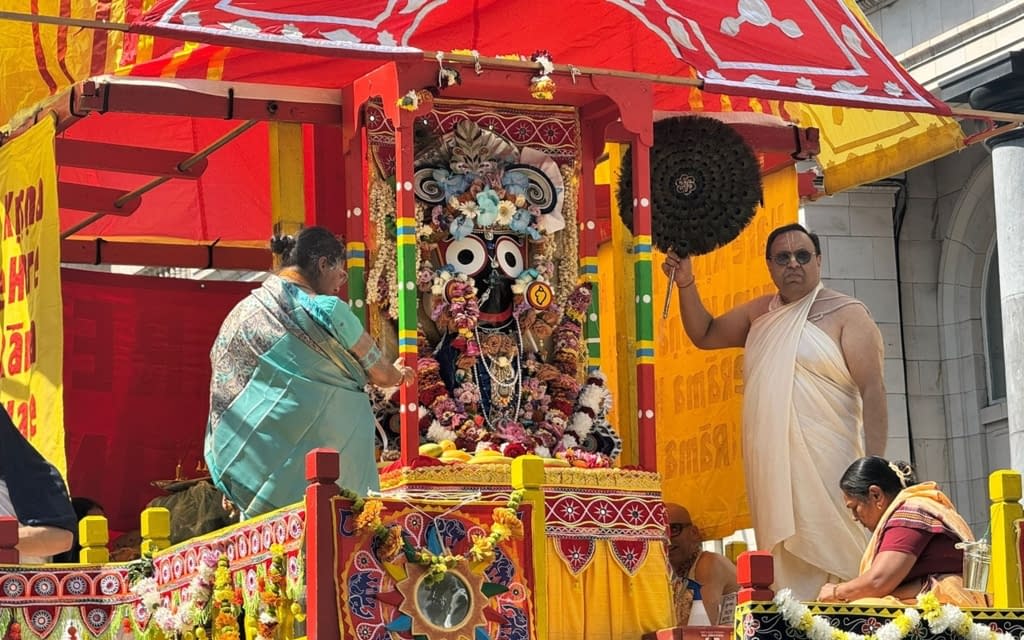
This study distills key insights from a live discourse delivered at ISKCON Ljubljana — Hare Krišna center (Duhovni program iz Hare Krišna centra v Ljubljani) by HH Krishna Kshetra Swami under the title: “Predavanje: Lord Krishna enters the wrestling arena / Gospod Krišna vstopi v rokoborsko areno (Srimad Bhagavatam 10.43.17).” Anchored in Srimad Bhagavatam Canto 10, Chapter 43, Verse 17, the presentation examines Lord Krishna’s entrance into the royal wrestling arena in Mathura and the multi-layered meanings this moment carries for theology, ethics, aesthetics, and lived spiritual practice.
Situated at a pivotal juncture in the Bhagavata narrative, this episode follows the Dhanur-yajna and Krishna’s routing of Kuvalayapida at the city gates, before advancing to the public amphitheater where Chanura and Mushtika await. The scene functions as a narrative hinge: it transitions from clandestine tyranny under Kaṁsa to open dharmic confrontation in a public forum, preparing the ground for a just resolution that restores social and cosmic order (dharma).
Srimad Bhagavatam 10.43.17 inaugurates a celebrated series of verses in which the assembled onlookers perceive Krishna and Balarama through radically different lenses. Gaudiya Vaishnava commentators such as Sridhara Swami, Jiva Goswami, and Visvanatha Cakravarti Thakura read this polyvalence as scripture’s deliberate pedagogy: perception reveals the perceiver. The text thus becomes a mirror for consciousness, disclosing how one’s inner bhava (disposition) frames the very reality one sees.
Context clarifies the moral stakes. Kaṁsa’s calculated invitation, masked as royal sport, instrumentalizes spectacle to normalize state violence. By first vanquishing Kuvalayapida, Krishna subverts that spectacle’s intimidation, turning fear into hope for the citizens of Mathura. Entering the arena is therefore neither theatrical bravado nor impulsive aggression; it is the publicly accountable step of a restorer of justice.
The Sanskrit semantic field around the “arena” (ranga, malla-ranga) signals more than sport. It is a stage where competing claims—tyranny and truth, fear and freedom—are adjudicated before a discerning sabha (assembly). Drums, conches, banners, and the ordered seating of dignitaries and townspeople frame a conscious ritualization of civic life, reminding that public order must serve truth, not terror.
The chapter’s hallmark is its phenomenology of seeing. Wrestlers behold an indomitable opponent; the common citizens, a guardian of justice; the elders, their cherished scion; saintly persons, the Supreme Truth; young women, the most beautiful of beings; the impious, a threat to be eliminated; and Kaṁsa, his own doom. Bhagavatam allows each gaze to be accurate and inadequate at once—accurate because it registers an aspect of Krishna’s person; inadequate because no single perspective exhausts the whole.
Aesthetically, this orchestrated plurality enacts classical rasa theory. The wrestlers taste vīra-rasa (heroism); the terrified relish bhayānaka only to see it transmuted; the devotees savor śṛṅgāra, dāsya, sakhya, and vātsalya; the righteous experience adbhuta (wonder). The narrative composes a symphony of affect in which the same divine presence yields distinct rasas according to the beholder’s samskara and intention.
Theologically, the episode illustrates acintya-bhedābheda—simultaneous oneness and difference. Krishna is at once the intimate friend of the cowherds, the nephew to the Yadus, the beauty that captivates, and the transcendental Lord beyond all material qualities. The coexistence of these modalities resists reductionism and affirms that Absolute Reality can be personal, relational, and supremely free even while immanently engaged in worldly affairs.
Ethically, the entrance exemplifies dharmic courage. Far from glorifying violence, the text frames force as a last-resort response to institutionalized harm. Krishna’s readiness to confront Chanura and Mushtika answers a specific moral emergency produced by Kaṁsa’s predation. In the classical Hindu idiom, this aligns with dharma-yuddha—action disciplined by justice, proportion, and the protection of the vulnerable.
Read through the broader dharmic family, the scene resonates with Jainism’s principled ahimsa (applied with contextual discernment), Buddhism’s Right Action within the Noble Eightfold Path, and Sikhism’s dharam yudh, where defense of the oppressed is an ethical imperative. The Bhagavatam’s lesson thereby scales beyond sectarian borders, encouraging Hindu, Buddhist, Jain, and Sikh readers to recognize a shared commitment to compassion guided by wisdom and responsibility.
From a social-psychological angle, the passage models “selective perception.” The wrestlers’ professional conditioning primes them to see only an adversary; courtiers trained in power-politics see a political disruptor; the saint, having cultivated inner stillness, recognizes the Ground of Being. Scripture thus doubles as a study in cognitive framing, showing how identity, training, and desire contour vision.
Philologically, terms like malla (wrestler), ranga (arena), sabha (assembly), and dhvaja (banner) situate the narrative in a regal-ritual register. The sonic landscape—bheri (kettle drums), śaṅkha (conches)—heightens liminality: public sound marks the passage from ordinary time into a charged moral moment, where truth stands forth for collective appraisal.
Classical commentaries enrich the reading. Sridhara Swami underlines that the plurality of visions affirms Krishna’s sarva-kāraṇa-kāraṇam (cause of all causes), present to each as capacity allows. Visvanatha Cakravarti emphasizes that this is not illusion but gradation; the Absolute condescends to be known in relationally appropriate ways. Jiva Goswami notes that this elastic accessibility is an index of supreme compassion.
Historically, the Mathura amphitheater evokes the material culture of urban polities—planned spaces where sovereignty was performed and contested. The Bhagavatam leverages this architecture to disclose that sovereignty is legitimate only when it harmonizes with dharma; when it does not, divine order exposes and reorders it.
Within the arena, Chanura and Mushtika are more than athletes; they are functionaries of state coercion. Their skill, severed from ethics, becomes an instrument of oppression. Krishna’s engagement reframes skill as service: technique is dignified when aligned with truth and community welfare.
Cosmologically, the arena can be read as a miniature universe in which beings of varied dispositions meet the Supreme. What unfolds publicly reenacts an inner drama: each person “wrestles” with attachment, fear, and pride. Victory in that subtler contest requires surrender of ego, cultivation of sattva, and a steady remembrance (smarana) that anchors duty in devotion.
Practically, the passage invites contemplative assimilation. Visual meditation on Krishna’s entrance—attending to breath, posture, and the surge of sound—can stabilize attention, soften reactivity, and orient conduct toward courage tempered by compassion. In this way, aesthetics, ethics, and mindfulness converge into a single transformative discipline.
Analogically, contemporary “arenas” include classrooms, clinics, courts, boardrooms, and streets. The text counsels moral clarity without rancor: stand firm, protect the vulnerable, and restrain harm, all while refusing to demonize persons. The target is adharma, not the irredeemable caricature of an opponent.
For intercultural and interreligious dialogue, this episode offers a template: shared ethical horizons can be discerned without collapsing doctrinal distinctions. The unity sought is not uniformity but consonance—Hindu bhakti, Buddhist karuṇā-prajñā, Jain ahimsa, and Sikh seva converging in the lived commitment to truth and care.
HH Krishna Kshetra Swami’s Ljubljana presentation underscores this integrative horizon: a rigorous textual exegesis that simultaneously nurtures spiritual interiority and social responsibility. The result is an academically sound, devotionally rich exploration in which scripture speaks with both historical specificity and perennial relevance.
Taken together, SB 10.43.17 becomes a luminous guide to perception, courage, and community. It shows how the same Reality appears as friend, judge, beauty, or threat according to the beholder’s heart—while inviting every heart to deepen, refine, and ultimately harmonize vision with dharma. The wrestling arena, then, is not only about a contest of strength; it is about a public revelation of truth that heals, protects, and unifies.
Inspired by this post on Dandavats.