
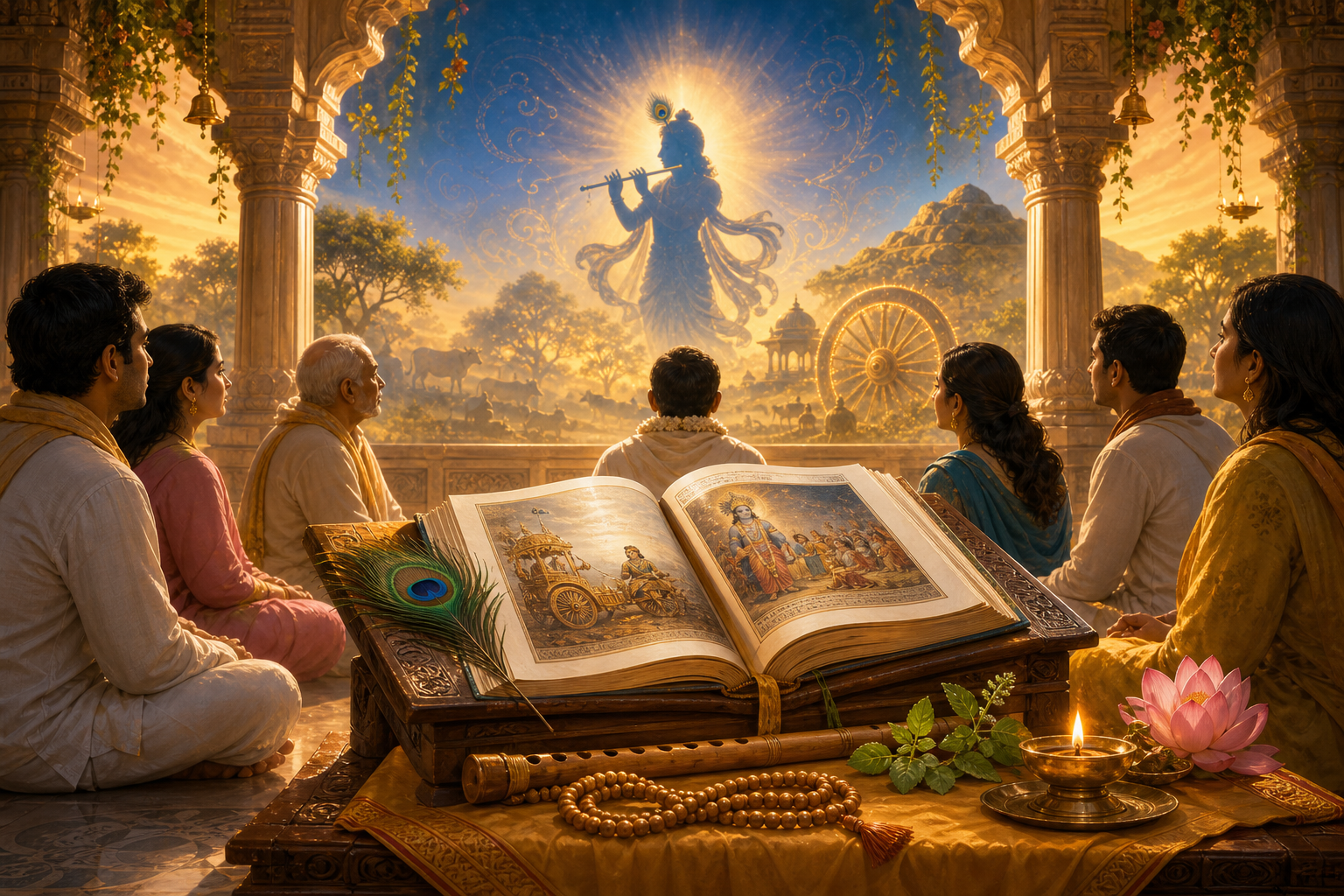
Krishna Katha, the sacred narration of the names, forms, qualities, pastimes, teachings, and devotees of Sri Krishna, occupies a central place in the living practice of bhakti. The session titled Krishna Katha | H.G. Vijaya Dasa | 2026-06-28 | ISV points toward a devotional setting in which scriptural reflection is not treated as distant theory, but as a disciplined means of spiritual education, ethical refinement, and inner transformation. Since the available source material contains only the title, date, speaker, and associated image, the discussion must remain anchored in the broader theological and cultural meaning of Krishna Katha rather than attributing specific statements to the speaker.
In the Vaishnava tradition, Krishna Katha is not merely storytelling. It is a structured spiritual practice rooted in śravaṇam, the attentive hearing of divine subject matter. This principle appears prominently in the Bhakti tradition, where hearing about Bhagavan is understood to purify consciousness, redirect attention from anxiety and ego-centered identity, and cultivate remembrance of the Divine. The practice has emotional depth, but it is not anti-intellectual. It combines theology, poetry, ethics, philosophy, aesthetics, and contemplative discipline into a single mode of learning.
The term “Katha” carries a significance that is easily underestimated. In ordinary usage it may mean narration, account, or discourse, but in Dharmic spiritual culture it often indicates a sacred mode of transmission. A Katha is heard with reverence, interpreted through parampara, and applied in life through reflection and conduct. Krishna Katha therefore becomes a bridge between scripture and experience. It brings the Bhagavad Gita, Srimad Bhagavatam, Harivamsa, Vishnu Purana, and the devotional commentarial traditions into the moral and emotional realities of daily life.
At the heart of Krishna Katha is the figure of Sri Krishna as both intimate and supreme. This dual aspect is one of the distinctive features of Krishna-centered bhakti. Krishna is approached as Bhagavan, the Supreme Reality, yet also as the beloved child of Yashoda, the friend of the cowherd boys, the guide of Arjuna, the protector of devotees, and the object of Radha’s highest love. This theological intimacy gives Krishna Katha its unusual power: it allows metaphysical truth to become emotionally accessible without reducing it to sentimentality.
The Bhagavad Gita provides one of the most technically important foundations for Krishna Katha. In the Gita, Krishna does not present spirituality as withdrawal from responsibility. He teaches Arjuna to act with clarity, detachment, devotion, and alignment with dharma. This teaching remains deeply relevant because modern life often produces a split between inner aspiration and outer duty. Krishna’s instruction resolves this tension by showing that work, family obligations, social responsibility, and spiritual growth need not be enemies when action is performed with purified intention.
Krishna Katha also draws heavily from the Srimad Bhagavatam, especially its presentation of bhakti as the highest perfection of consciousness. The Bhagavatam does not frame devotion as a narrow sectarian identity. It presents devotion as the natural function of the purified heart. Through narratives of Prahlada, Dhruva, Ambarisha, the gopis, Uddhava, Akrura, and many other figures, Krishna Katha shows how spiritual maturity appears differently according to temperament, stage of life, and circumstance. This diversity is important for the unity of Dharmic traditions because it reminds practitioners that spiritual life cannot be reduced to one external form alone.
Within the wider family of Hindu, Buddhist, Jain, and Sikh traditions, sacred narration has always carried educational force. Hindu kathas, Buddhist Jataka stories, Jain accounts of the Tirthankaras, and Sikh janam-sakhis all demonstrate that truth is often transmitted through lived examples rather than abstract doctrine alone. Krishna Katha fits naturally within this Dharmic pattern. It uses narrative to teach discipline, humility, compassion, courage, surrender, and discernment. In this sense, it supports not only devotional identity but also civilizational memory.
A technical reading of Krishna Katha must also consider rasa, the refined devotional mood through which divine relationship is experienced. Vaishnava theology describes relationships with Krishna through moods such as śānta, dāsya, sakhya, vātsalya, and mādhurya. These are not casual emotional states. They form a sophisticated spiritual psychology in which the soul’s relationship with the Divine is understood through purified affection. The purpose of Katha is therefore not entertainment, but transformation of taste: from distraction toward remembrance, from consumption toward service, and from egoic emotion toward devotional love.
For many listeners, the immediate attraction of Krishna Katha comes through its emotional warmth. A story of Krishna stealing butter, lifting Govardhana, dancing with the gopis, or guiding Arjuna can feel close to the human heart because it touches familiar experiences: childhood affection, friendship, danger, confusion, loyalty, longing, and the search for guidance. Yet the same narratives also carry profound metaphysical meaning. Govardhana-lila, for example, is not only a charming pastoral event; it reveals divine protection, ecological reverence, critique of pride, and the principle that sincere devotion is superior to external display.
The ethical dimension of Krishna Katha is equally significant. Krishna’s life and teachings repeatedly challenge simplistic morality. In the Mahabharata and Bhagavad Gita, dharma is not presented as a mechanical rulebook. It requires context, wisdom, courage, and alignment with the ultimate good. This is why Krishna’s counsel to Arjuna remains one of the most studied passages in world philosophy. It addresses the painful human problem of action under moral complexity. It teaches that paralysis is not spirituality, and that duty performed for divine purpose can become yoga.
Krishna Katha also educates the listener in humility. The characters surrounding Krishna are not spiritually powerful because they dominate others; they are powerful because they love, serve, remember, and surrender. Yashoda’s maternal love, Sudama’s simplicity, Arjuna’s willingness to be corrected, and Uddhava’s reverence for the gopis all reveal that spiritual greatness is measured by receptivity to truth. This has practical relevance in an age where knowledge is often confused with self-display. Krishna Katha restores learning to its sacred purpose: purification of consciousness and refinement of conduct.
The practice also has a communal function. When devotees gather to hear Krishna Katha, the act of listening becomes collective sadhana. The community is trained to honor scripture, respect the speaker, reflect together, and carry the teachings into daily life. This pattern preserves parampara, not as rigid repetition, but as living continuity. A healthy devotional community does not simply consume spiritual content; it becomes shaped by what it hears. Over time, repeated hearing influences speech, priorities, relationships, and moral imagination.
In the contemporary context, Krishna Katha has gained renewed relevance because modern attention is fragmented. Digital life rewards speed, reaction, and emotional stimulation, while sacred listening requires patience, concentration, and humility. A Krishna Katha session quietly resists the culture of constant distraction. It asks the listener to slow down, to hear deeply, and to allow meaning to settle. This is not nostalgia; it is a disciplined response to one of the most urgent problems of modern life: the inability to remain inwardly steady.
From a theological perspective, the act of hearing Krishna Katha is itself devotional service. Bhakti traditions often emphasize that divine sound is not separate from the Divine. The names and narrations of Krishna are understood to carry spiritual potency when received with sincerity. This does not mean that every listener will experience the same emotional response. Rather, the practice works gradually, shaping attention, softening pride, and reorienting the heart toward seva, remembrance, and gratitude.
Krishna Katha is also important for children and families. Dharmic education has historically depended on stories told in homes, temples, ashrams, festivals, and pilgrimage spaces. Through these narrations, children encounter models of devotion, courage, friendship, and truthfulness in a form that is memorable. When presented responsibly, Krishna Katha does not encourage escapism. It gives young minds a symbolic vocabulary for understanding duty, temptation, love, loyalty, and divine presence. It helps them see spirituality as a living inheritance rather than a distant subject.
The cultural role of Krishna Katha is vast. Indian music, dance, poetry, painting, temple architecture, folk performance, and classical aesthetics have all drawn deeply from Krishna’s life and teachings. Bharatanatyam, Odissi, Kathak, Carnatic music, bhajans, kirtan, miniature painting, and temple festivals all preserve forms of Krishna remembrance. This cultural richness shows that Krishna Katha is not confined to lecture halls. It lives in sound, gesture, image, pilgrimage, food offerings, seasonal festivals, and the shared memory of communities across regions and languages.
At the same time, responsible Krishna Katha requires intellectual care. Sacred narratives should not be flattened into casual moral slogans, nor should they be detached from their scriptural and commentarial contexts. Academic seriousness and devotional reverence can coexist. A thoughtful approach examines Sanskrit terms, narrative structure, philosophical background, historical reception, and theological interpretation while still honoring the lived faith of practitioners. This balance protects both scholarship and devotion from distortion.
Krishna’s teachings also illuminate the relationship between devotion and freedom. In the Bhagavad Gita, Krishna does not force Arjuna into blind obedience. After teaching, he asks Arjuna to deliberate and act as he thinks best. This moment is spiritually profound. It shows that authentic guidance respects moral agency. Bhakti is not coercion; it is the voluntary turning of the heart toward truth. This insight is especially valuable for inter-Dharmic harmony, where unity must arise from mutual respect rather than uniformity.
The unity of Dharmic traditions is strengthened when Krishna Katha is understood in this generous and principled way. Hinduism, Buddhism, Jainism, and Sikhism differ in metaphysics, practice, and historical development, yet they share deep concerns with discipline, liberation, compassion, karma, ethical living, and the transformation of consciousness. Krishna Katha contributes to this shared civilizational conversation by emphasizing devotion, dharma, self-mastery, and divine remembrance. It can inspire respect for difference while preserving the integrity of its own Vaishnava foundation.
One of the most practical lessons of Krishna Katha is that spiritual life must enter ordinary conduct. A person may hear profound narrations, but the fruit of hearing appears in patience, truthfulness, compassion, restraint, and service. The Bhagavata tradition repeatedly teaches that devotion matures into character. If hearing about Krishna does not make the heart more humble, more attentive, and more compassionate, then the listening remains incomplete. This point gives Krishna Katha a strong ethical seriousness.
Krishna Katha also speaks to suffering. The world described in Dharmic literature is not naive about pain, conflict, exile, betrayal, death, or moral confusion. Krishna appears in such a world not as an ornament, but as a source of guidance and shelter. For listeners facing grief, anxiety, or uncertainty, Krishna Katha offers a framework in which suffering can be met with remembrance, service, and trust. It does not deny human pain; it places pain within a larger spiritual horizon.
The date attached to the session, June 28, 2026, situates the event within the ongoing life of contemporary devotional communities. Such gatherings show that Krishna Katha is not merely a preserved artifact of the past. It continues to be spoken, heard, discussed, and lived. Each generation receives the same sacred subject matter under new historical conditions. The continuity of Krishna Katha lies not in mechanical repetition, but in faithful re-presentation: the eternal message is brought into the needs of the present without losing its scriptural grounding.
H.G. Vijaya Dasa’s named association with this Krishna Katha session indicates the role of the speaker as a transmitter of devotional learning within a recognized community context. In traditional settings, the speaker’s responsibility is significant. Katha is expected to be accurate, reverent, practical, and aligned with parampara. The listener’s responsibility is equally important: to hear without cynicism, to question with sincerity, and to apply the teaching with steadiness. Sacred learning is most fruitful when both speaker and listener approach it as service.
In an academic and cultural sense, Krishna Katha deserves careful attention because it joins philosophy and emotion in a disciplined form. It is not reducible to mythology in the dismissive modern sense, nor to performance in the merely aesthetic sense. It is a living hermeneutic practice: scripture is interpreted through devotion, community, memory, and ethical application. This is why Krishna Katha remains meaningful across centuries. It gives language to the soul’s longing and structure to the mind’s search for truth.
The enduring power of Krishna Katha lies in its ability to make the highest truths approachable without making them shallow. It speaks of the Supreme through the intimacy of relationship. It teaches duty through crisis, love through separation, wisdom through dialogue, and surrender through lived example. For the modern seeker, the practice offers more than inspiration. It offers a method: hear sacred truth regularly, contemplate it carefully, associate with sincere practitioners, and allow devotion to reshape the heart.
Ultimately, Krishna Katha stands as a luminous expression of Sanatana Dharma. It preserves memory, deepens bhakti, clarifies dharma, and strengthens the bonds of community. When approached with sincerity and intellectual honesty, it becomes a source of spiritual wisdom for individuals and a cultural resource for society. Its message is not limited to one moment or one gathering. It continues wherever Krishna’s names, teachings, and pastimes are heard with reverence and carried into life through humility, service, and love.
Inspired by this post on Dandavats.








Leave a Reply
You must be logged in to post a comment.