
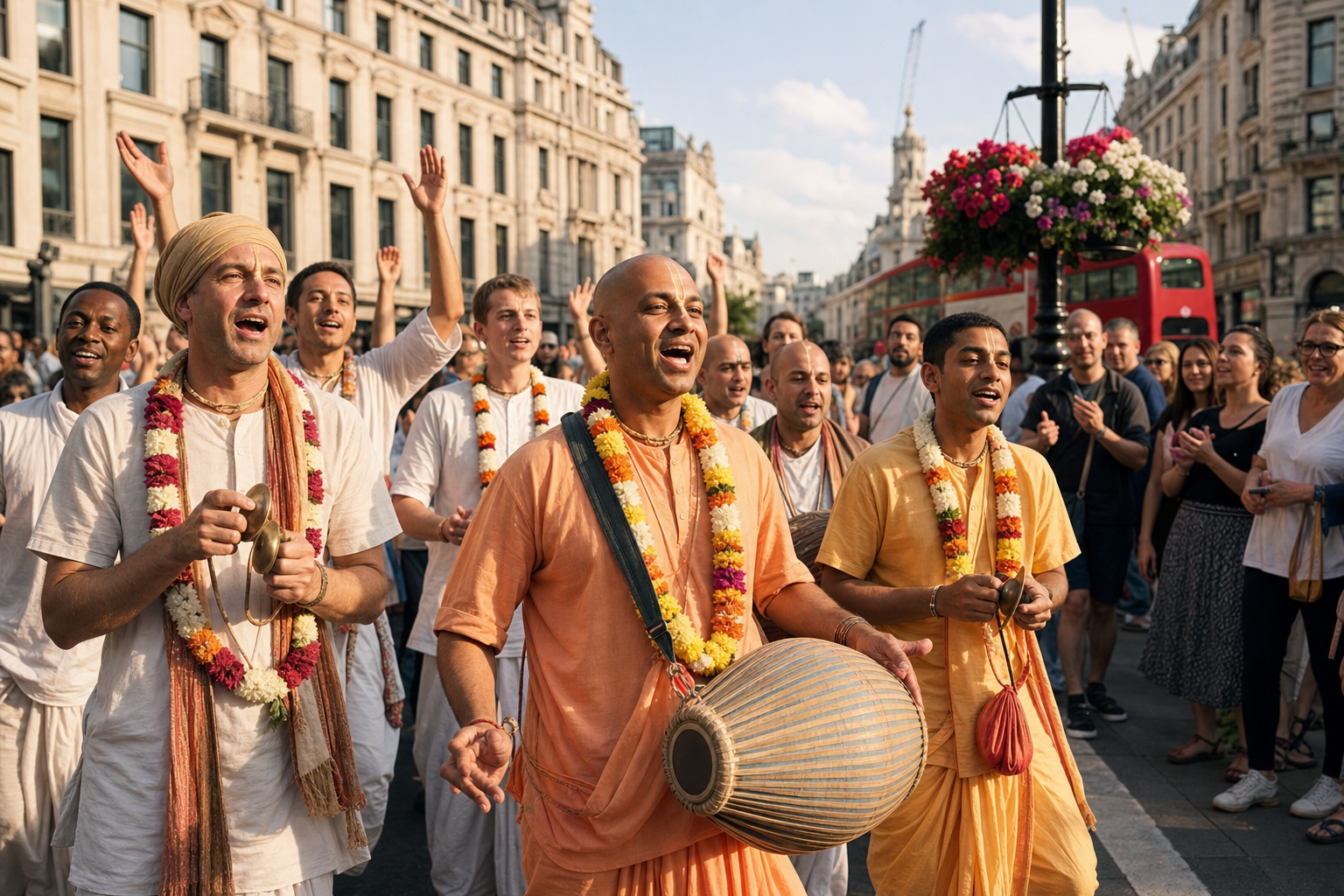
On 27 June 2026, the sight of Hare Krishna devotees singing, dancing, and moving through London’s streets offered more than a cheerful public spectacle. It became a compact study in how devotional practice, migration, music, urban space, and community identity can meet in a modern global city. The brief visual record of saffron robes, cymbals, drums, raised hands, and public participation points toward a much larger story: the continuing presence of Krishna bhakti in the United Kingdom and the ability of kirtan to transform an ordinary street into a shared cultural and spiritual space.
The phrase “Hare Krishnas turn London streets into a dance party” captures the immediate visual impact, but it also risks understating the depth of the tradition behind the moment. What appears at first like spontaneous street celebration is rooted in the Vaishnava practice of sankirtana, the collective chanting of the divine names. Within the Hare Krishna movement, formally associated with ISKCON, public chanting is not merely performance. It is devotional service, theological expression, community outreach, and embodied spiritual discipline.
The central chant, commonly called the Maha Mantra, is “Hare Krishna Hare Krishna Krishna Krishna Hare Hare, Hare Rama Hare Rama Rama Rama Hare Hare.” In the Gaudiya Vaishnava tradition, this mantra is understood as a direct invocation of divine presence through sound. Its repetition in public spaces makes the practice both inward and outward: inward because chanting is meant to refine consciousness, and outward because the sound is deliberately shared with all who pass by, regardless of background, belief, nationality, or social position.
London is an especially significant setting for such a scene. The city has long been a meeting ground for Indian diaspora communities, global religious movements, students, workers, tourists, seekers, and curious pedestrians. Public kirtan in London therefore operates in a layered environment. It is devotional for practitioners, nostalgic for some members of the Indian diaspora, culturally intriguing for visitors, and unexpectedly joyful for people who may have no prior connection with Hindu traditions. The street becomes a temporary commons in which sound softens boundaries.
The Hare Krishna movement’s British history gives this moment additional meaning. ISKCON’s presence in the United Kingdom grew visibly from the late 1960s onward, supported by the global spread of the teachings of Srila Prabhupada and the wider interest in Indian spirituality during that period. London became one of the important Western centers for Krishna consciousness, not only because of its Indian community but also because its cultural openness allowed devotional music, vegetarian food distribution, temple worship, publishing, and street chanting to become recognizable parts of urban religious life.
Music is the primary social technology at work in such a gathering. The mridanga drum establishes rhythm, hand cymbals add brightness, voices carry the chant, and the repeated call-and-response structure makes participation simple. Unlike many religious formats that require textual knowledge or formal initiation before involvement, kirtan lowers the threshold for entry. A passerby can listen, clap, smile, dance briefly, or simply move through the sound. This accessibility explains why Hare Krishna street chanting often creates a festive atmosphere even for those who encounter it unexpectedly.
From an academic perspective, the event also demonstrates how religion can be embodied rather than confined to doctrine. The devotees are not only stating beliefs; they are enacting them through coordinated movement, rhythm, dress, repetition, food culture, and public hospitality. Dance here is not an entertainment add-on. It is a physical expression of bhakti, the devotional relationship between the individual soul and the Divine. The body becomes a participant in worship, and joy becomes a legitimate mode of religious communication.
The public character of the gathering matters. Modern cities often separate religion into private belief or designated buildings, yet dharmic traditions have historically included processions, pilgrimages, festivals, temple streets, and shared sacred sound. A London kirtan revives that older public grammar in a contemporary setting. It does not require the street to become a temple permanently; rather, it briefly reveals that civic space can hold devotion, art, and community without losing its openness.
Such scenes also show why Hindu cultural traditions abroad cannot be reduced to private identity markers. In diaspora settings, practices like kirtan, Ratha Yatra, prasadam distribution, temple festivals, and community gatherings help preserve memory across generations. Children who see devotional music in a major Western capital learn that Hindu spirituality is not hidden, marginal, or embarrassing. It can be confident, disciplined, aesthetic, and generous in public.
At the same time, the event can be read as more than a Hindu diaspora expression. Hare Krishna public chanting has historically attracted participants from many ethnic and national backgrounds. This is one reason it fits the wider objective of dharmic unity. The movement’s vocabulary is Vaishnava and Krishna-centered, yet its practical message often resonates with broader dharmic values: devotion, self-discipline, compassion, vegetarian ethics, sacred sound, humility, service, and the search for spiritual realization beyond consumer identity.
The relationship between Hinduism, Buddhism, Jainism, and Sikhism is not one of sameness, and any serious account must respect their doctrinal differences. Yet public devotional events can still support mutual recognition among dharmic communities. The emphasis on disciplined practice, reverence for spiritual teachers, ethical living, inner transformation, and community service creates shared moral ground. A joyful kirtan in London can therefore be appreciated not only as a Vaishnava act but also as part of a broader civilizational pattern in which sound, movement, and community become vehicles of spiritual culture.
The emotional force of the scene lies in its contrast with the normal mood of a busy city. London streets are often associated with hurried commutes, commercial activity, traffic noise, and social anonymity. Into that environment enters a group whose rhythm asks people to slow down, look up, and respond. Even when observers do not understand the theology of Krishna consciousness, they can recognize sincerity, collective joy, and the unusual sight of people celebrating without intoxication, aggression, or commercial spectacle.
This is where the description “dance party” becomes both useful and incomplete. It is useful because the energy is real: people dance, smile, and gather around sound. It is incomplete because the inner logic is devotional rather than recreational. The purpose is not escapism but remembrance. In bhakti traditions, joy is not treated as shallow distraction; it is a sign that the heart can be redirected from isolation toward relationship with the Divine and with community.
Hare Krishna kirtan also carries a subtle critique of modern loneliness. Many urban societies possess high connectivity but low intimacy. People move beside one another without shared rhythm or shared language. Public chanting temporarily changes that condition. The mantra gives strangers a common sound. The drum gives them a common beat. The circle of dancers gives them a visible invitation. For a few minutes, the street no longer functions only as a corridor; it becomes a place of encounter.
The practice also reflects the long-standing Hindu understanding that sacred sound has transformative power. Vedic and post-Vedic traditions place great emphasis on mantra, recitation, vibration, meter, and disciplined listening. In the Hare Krishna tradition, the name of Krishna is not viewed as a symbolic label alone but as spiritually potent. This theology helps explain the confidence with which devotees bring chanting into public spaces. The sound is considered beneficial even when listeners are casual, skeptical, or unfamiliar with its meaning.
In cultural terms, the London gathering demonstrates the durability of Indian spiritual forms in global settings. Migration can weaken inherited practices when traditions become detached from language, place, and family structure. Yet it can also intensify them when communities consciously organize festivals, temples, food programs, and public rituals. The visibility of Hare Krishna devotees in London suggests that dharmic traditions continue to adapt without necessarily dissolving into vague spirituality.
There is also an important aesthetic dimension. The robes, tilaka markings, flower garlands, instruments, and rhythmic movement create a visual grammar that communicates identity before any explanation is offered. Such aesthetics are not superficial. In Hindu ritual culture, beauty, color, fragrance, sound, and gesture often serve as pathways into reverence. Public kirtan carries that temple sensibility outward, allowing the city to witness a small fragment of sacred aesthetics in motion.
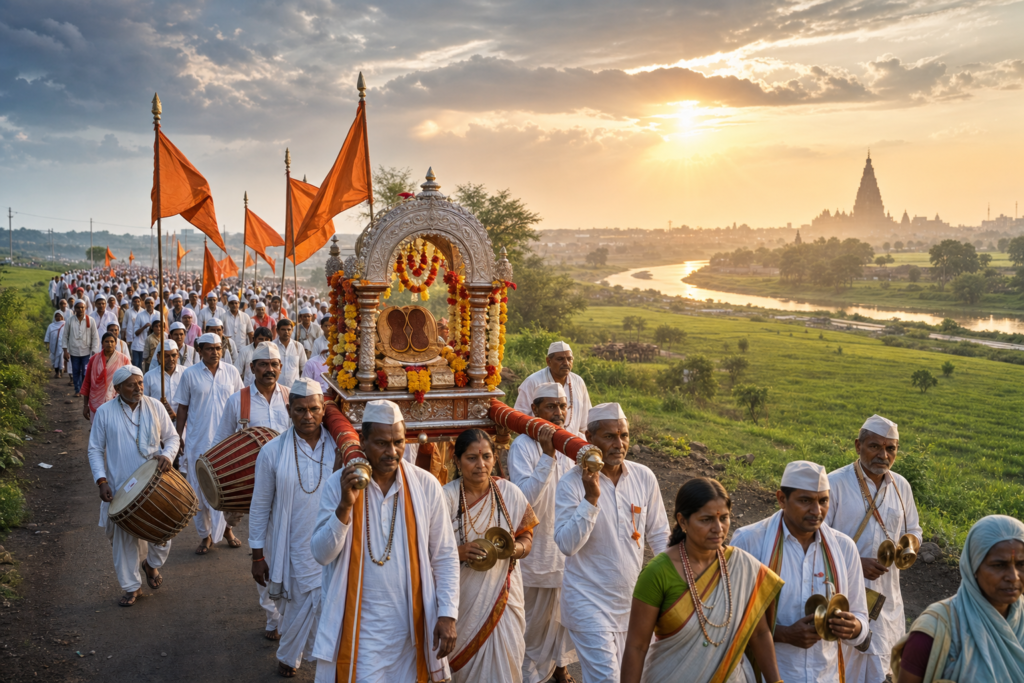
For observers familiar with Ratha Yatra and other Hindu festivals, the London scene naturally evokes the broader festival culture associated with Lord Jagannath, Krishna, and Vaishnava devotion. London Rathayatra has long been one of the city’s notable Hindu public celebrations, and Hare Krishna street chanting often shares its atmosphere of music, procession, prasadam, and open participation. Even when a particular street gathering is smaller than a formal festival, it belongs to the same devotional ecosystem.
The public response to such events is often shaped by curiosity rather than formal religious commitment. Some people record videos, some clap along, some ask questions, and others simply smile while passing by. This matters because cultural continuity in plural societies depends not only on legal rights but also on everyday familiarity. The more people encounter dharmic traditions as living, peaceful, and joyful practices, the harder it becomes to reduce them to stereotypes or distant abstractions.
At its best, a Hare Krishna gathering in London models a form of public religion that is non-coercive, participatory, and transparent. It does not hide its identity, yet it does not demand conformity from bystanders. It invites rather than imposes. This distinction is essential in multicultural societies, where strong religious expression can coexist with civic openness when it is grounded in respect, service, and disciplined conduct.
The event also illustrates how devotional movements survive through repetition. A single chant on a single day may appear small, but traditions are sustained through repeated acts: chanting again, gathering again, cooking again, teaching again, serving again. The continuity of Krishna consciousness in London is not maintained by spectacle alone. It is maintained by daily sadhana, temple routines, volunteer labor, publications, festivals, family participation, and the willingness to bring sacred sound into ordinary life.
For younger generations, especially those growing up between cultural worlds, such moments can be deeply formative. Public Hindu and dharmic expression helps resolve the false choice between inherited identity and modern citizenship. A young person can see that devotion to Krishna, respect for Sanatana Dharma, and participation in British civic life need not be in conflict. The street itself becomes evidence that tradition can travel, adapt, and still remain recognizable.
There is a wider lesson here for cultural preservation. Traditions remain alive when they are practiced with confidence and made intelligible through experience. A lecture can explain bhakti, but kirtan allows people to feel something of its rhythm. A book can define sankirtana, but a London street filled with chanting shows how it works socially. A temple can preserve sacred forms, but a public procession or street chant demonstrates that devotion can move through the world without losing its center.
The 27 June 2026 scene therefore deserves to be understood as more than a viral-friendly moment of music and dancing. It reflects the living continuity of Hare Krishna devotion, the adaptability of Hindu cultural traditions, the role of ISKCON in global religious life, and the enduring appeal of sacred sound in a noisy age. In a city shaped by speed and diversity, the chant created a temporary field of attention, joy, and shared humanity.
Ultimately, the significance of Hare Krishnas dancing through London lies in the way the event brings theology down to street level. Krishna consciousness is not presented as an abstract idea locked inside a book or a distant memory tied only to India. It appears as rhythm, voice, movement, discipline, and hospitality. The result is a public expression of bhakti that strengthens Hindu cultural confidence while also inviting wider appreciation across dharmic and non-dharmic communities alike.
Inspired by this post on Dandavats.





Leave a Reply
You must be logged in to post a comment.