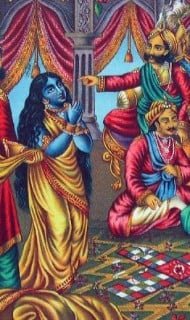
The Jalandhara Katha, preserved in the Puranas and widely retold in cultural memory, narrates the rise of the powerful asura Jalandhara, his cosmic war with Lord Shiva, and the subtle intervention of Lord Vishnu. Set against the vastness of the sea, the story interweaves devotion, valour, and moral complexity, inviting a measured reflection on Dharma and Adharma. For many devotees, this narrative evokes the cadence of childhood recitations during Kartika observances and Tulsi-related rituals, affirming its enduring place in Hindu folklore and spiritual discourse.
According to the Padma Purana and allied traditions, Jalandhara emerged from the brilliant radiance (tejas) of Lord Shiva, which entered the ocean and was nurtured by Varuṇa. Bearing a name that evokes mastery over waters, Jalandhara rose as king among asuras and commanded immense power from the maritime realm. His conquests unsettled the devas, creating a prolonged stalemate that challenged the balance of the three worlds.
Central to his strength was the unyielding fidelity and tapas of his wife Vrinda (also associated with Tulsi), whose chastity generated a protective spiritual merit. In many retellings, Lord Vishnu’s grace is intertwined with this merit, functioning as a boon that rendered Jalandhara effectively invincible so long as Vrinda’s vow remained intact. Counsel from preceptors such as Shukracharya further fortified Jalandhara’s confidence, enabling him to push the devas to the margins and lay claim to dominion over vast realms.
Jalandhara’s challenge ultimately turned toward Lord Shiva, initiating a confrontation of elemental force and transcendent will. The battle between Shiva and Jalandhara is depicted as a Dharma-Yuddha of cosmic magnitude—mountains quivered, oceans surged, and the heavens bore witness to the clash of deific power and demonic ambition. Yet, as the conflict intensified, it became clear that brute strength alone could not resolve a struggle sustained by the subtle power of Vrinda’s virtue.
To restore cosmic balance without unbounded devastation, Lord Vishnu employed a profound stratagem. Assuming a deceptive semblance associated with Jalandhara in certain versions, Vishnu tested the sanctity that shielded the asura. When Vrinda’s vow was inadvertently broken, the spiritual armor protecting Jalandhara dissolved. In the aftermath, Vrinda’s curse reshaped sacred memory—linked in tradition to the sanctification of the Tulsi plant and to the Shaligram, integrating Bhakti, penance, and divine reciprocity into the narrative’s ethical core.
With the protective merit lifted, Lord Shiva brought the conflict to its decisive close, striking down Jalandhara with the trident (triśūla) and restoring cosmic order. The seas calmed, the devas recovered their stations, and the tejas from which Jalandhara arose returned to its rightful equilibrium. The episode concludes with a solemn recognition that untempered power, even when formidable, falters before the harmonized forces of devotion, wisdom, and righteous strength.
Beyond its dramatic arc, the Jalandhara Katha offers a layered meditation on Dharma. Power must be aligned with humility; strategy must be anchored in the welfare of the whole. The interplay of Vrinda’s tapas, Vishnu’s compassionate yet complex intervention, and Shiva’s resolute guardianship illuminates how multiple paths converge to uphold order. In the broader dharmic family—Hinduism, Buddhism, Jainism, and Sikhism—the tale resonates as an allegory of inner conquest over ego and attachment, affirming shared values such as self-restraint, truthfulness, courage, and responsibility toward the common good.
In cultural practice, the narrative often surfaces during Kartika observances and in reflections surrounding Tulsi, reinforcing devotional life with ethical insight. As a piece of Hindu mythology rooted in the Puranas, the Jalandhara Katha continues to guide seekers toward discernment, reminding readers that lasting victory is achieved not merely on external battlefields but within the disciplined heart.
Inspired by this post on Hindu Pad.