The episode of Hanuman’s honeybee form, deployed to outwit Mahiravana in the underworld of Patala, belongs to the vibrant stratum of later and regional Ramayana traditions rather than the Valmiki Ramayana’s critical core. Yet it endures with compelling force across devotional, performative, and iconographic spheres because it powerfully dramatizes two enduring dharmic themes: unshakeable bhakti (devotional loyalty) and ingenious yukti (skillful means). On the war-torn shores of Lanka, when Ravana fears imminent defeat, he seeks aid beyond the terrestrial field of combatturning to Mahiravana, the sorcerer-king of Patala Lokathus shifting the theater from conventional warfare to the esoteric domains of mantra, tantra, and hidden cosmologies.
Textual attestation for this episode appears most prominently in later compendia and regional retellings such as the Ananda Ramayana and the Bengali Krittivasi Ramayana, and in performative traditions including Yakshagana, shadow puppetry (Tolu Bommalata; Ravana Chhaya), and localized kathas. Some traditions distinguish between Mahiravana and Ahiravana (twin sorcerer-kings), whereas others collapse them into a singular adversary. The honeybee (bhramara) transformation and the celebrated Panchamukhi Hanuman denouement serve as the dramatic and theological pivots that enable a rescue narrative at once tactical and transcendental.
To appreciate the episode’s intellectual texture, it helps to outline the cosmological background. In Purāṇic cosmography, Patala denotes the nether regions composed of layered realmsAtala, Vitala, Sutala, Talatala, Mahatala, Rasatala, and Patalareplete with naga domains, jeweled cities, and siddhic arts. Mahiravana’s dominion belongs to this subterranean matrix where sorcery, protective yantras, and labyrinthine architecture amplify the challenge far beyond normal martial prowess. The move into Patala is thus a narrative shift from kṣatra-dharma on the battlefield to adhṛṣya (unseen) warfarestrategy, cognition, and spiritual countermeasures.
According to these sources, Mahiravana abducts Rama and Lakshmana through deceptionoften by assuming a trusted guise and bypassing camp vigilanceand spirits them to Patala to be offered in a sacrificial rite to a Devi (variously named as Kali or Chandika). The abduction reframes the moral stakes: the rescue must now defeat not only a sorcerer’s physical defenses but also ritual structures that bind life, direction, and flame through occult contracts.
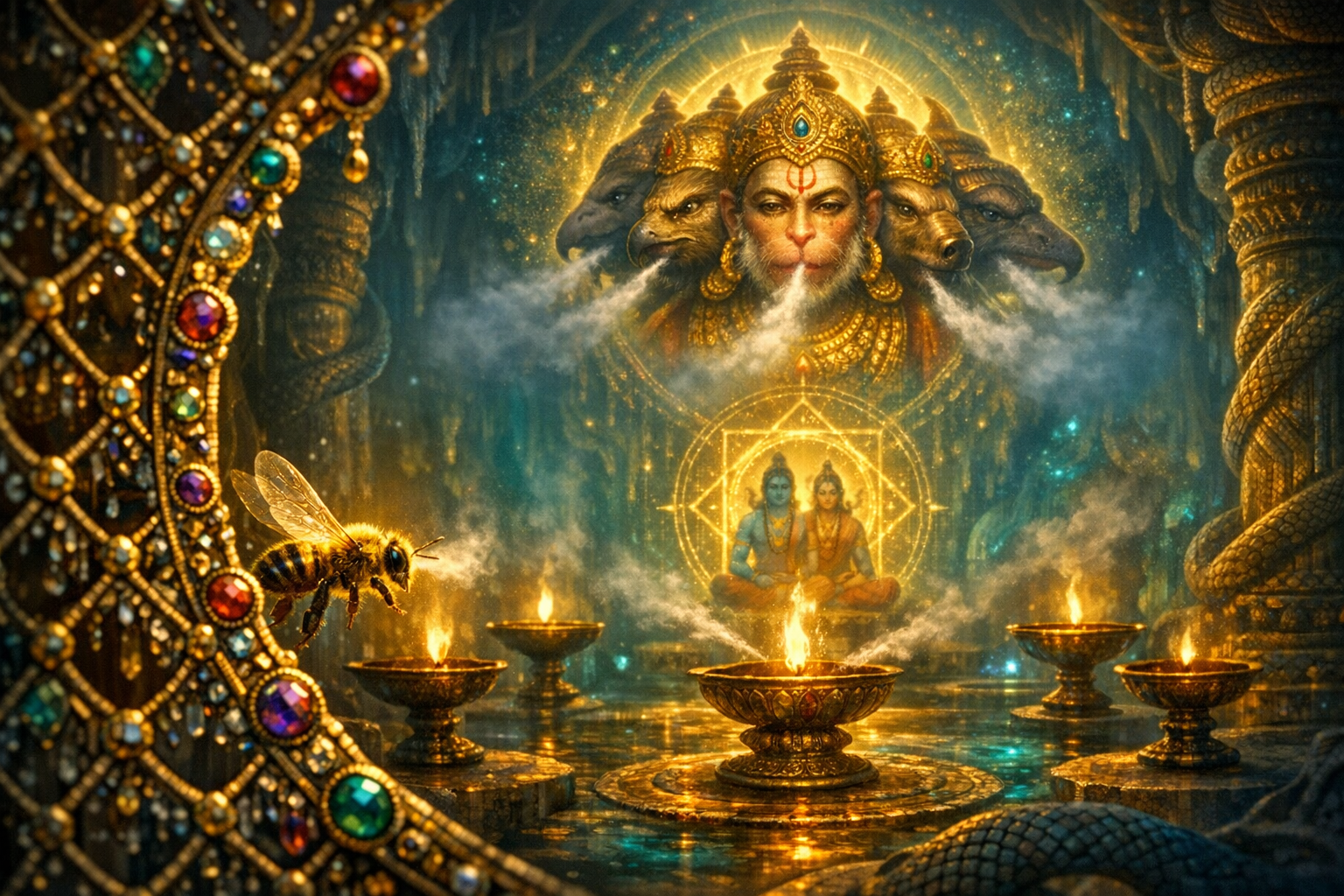
Hanuman’s responseportrayed as both immediate and methodicalbegins with reconnaissance. In several retellings, he adopts the honeybee form (bhramara-rupa) to infiltrate Mahiravana’s stronghold, evading traps keyed to size, sound, or scent. As a bee, he eludes mechanical wards, passes through minute apertures, and discreetly observes the rites without disturbing ritual thresholds or attracting sentries attuned to gross movements. The vehicular choice is not incidental: in Indic poetics and soteriologies, the bee symbolizes a mind concentrated upon nectarhere, the nectar of Rama-bhakti and the essence of right knowledge.
From a tactical standpoint, the honeybee stratagem exemplifies upāya-kaushalyaskillful means to neutralize a superior position without commotion. Patala’s built environment, imagined as a palatial maze of enclosures, hidden doors, and spell-bound passageways, is precisely the kind of terrain where smallness, silence, and selective presence confer decisive advantages. The bee’s flight-path, discontinuous yet purposeful, figures as a metaphor for insight-led movement through uncertaintyan apt emblem for dharmic intelligence at work.
Within the sanctum where the sacrifice is prepared, the core problem emerges as a ritual-energetic knot: Mahiravana’s life is tethered to five oil lamps, each facing a cardinal or vertical direction. These “life-lamps,” a familiar motif in tantric-inflected narrative, cannot be extinguished sequentially; they must be snuffed out simultaneously. The ritual logic fuses space (dik), vitality (prana), and flame (agni) into a single defensive systema system that demands multi-point, co-temporal intervention.
The solution precipitates Hanuman’s assumption of the Panchamukhi formfive faces representing distinct deific aspects and directional command. In widely circulated iconographies and stotras, these faces are identified as Hanuman (east), Narasimha (south), Garuda (west), Varaha (north), and Hayagriva (upward/akasha). Each face governs a vector of protection and knowledge; together, they embody sovereignty over space, breath, and mantra. Theologically, Panchamukhi Hanuman signals a convergence of Vaishnava and Shaiva energies in dedicated sevā to Rama, collapsing sectarian boundaries in a higher unity of dharma.
By expanding into Panchamukhi, Hanuman achieves simultaneity: five visages, five glances, five breaths, five extinguishings. When the lamps go dark in unison, Mahiravana’s ritual contract is broken and his invulnerability dissolves. The sorcerer is subdued, and the sacrifice fails. Rama and Lakshmana are released from the binding yantras, and Hanuman escorts them safely back to the terrestrial warfront at Lanka. The narrative closes with the restoration of moral order through a synthesis of devotion and design.
Read symbolically, the episode is a lesson in aligning bhakti (faith) and buddhi (discernment). The honeybee form represents a mind refined by devotion to move with precision and restraint. The Panchamukhi expansion represents integrated intelligenceethical, strategic, and spiritualacting across multiple planes at once. Bhakti without yukti might lack efficacy; yukti without bhakti might lack right orientation. Together, they achieve what neither could alone.
Comparative motifs enrich the picture. The bee has a long life in Indic literature as a sign of focus, sweetness, and aesthetic longing (śṛṅgāra), while in Shākta traditions the archetype appears with formidable force in the figure of Bhramari Devi, who in the Devī Bhagavata Purāṇa unleashes swarms of bees to subdue arrogant forces. These resonances do not conflate Hanuman with Bhramari Devi; rather, they reveal a shared symbolic lexicon in which small, many, or subtle agents confound the grandiose and the violentan ethical grammar legible across Hindu, Buddhist, and Jaina narrative sensibilities that celebrate skillful, non-profligate means.
The tale’s continued presence in performance traditionsYakshagana in coastal Karnataka, shadow puppetry in Andhra and Odisha, and popular North and East Indian katha circuitsconfirms its cultural embeddedness. Performers emphasize the stealth of the bee, the luminous menace of the ritual lamps, and the awe of the Panchamukhi theophany, translating metaphysical stakes into visual and musical registers that remain accessible to diverse audiences.
Iconographically, Panchamukhi Hanuman temples and murtis across India memorialize the directional mastery at the heart of the story. In devotional centers such as Rameswaram’s Panchamukhi Hanuman shrine, the imagery aligns with the narrative’s focus on protection, swift intervention, and the triumph of dharma through steadfast service to Sri Rama. The five faces, often crowned and armed according to their associated aspects, function as an embodied theology of multi-directional guardianship in a single, undivided presence.
Ritually, the episode animates stotras and kavachas dedicated to Panchamukhi Hanuman and underwrites popular practices that seek comprehensive protectionphysical, psychological, and spiritual. Recitation patterns and vrata observances emphasize concentrated attention, ethical restraint, and remembrance of Rama-nama as the “nectar” that steadies the practitioner’s inner bee-like focus amid external complexity.
From a philological angle, careful readers note that the Mahiravana episode is not part of the Valmiki Ramayana’s critical edition, yet its wide circulation in post-Valmiki literature, regional Ramayanas, and temple iconography marks it as a living strand of the broader Ramayana tradition. Indian narrative culture has always harbored plurality without rupture, inviting comparative reading rather than competitive exclusion. In this ecosystem, the honeybee stratagem and the Panchamukhi resolution serve as vehicles for teaching, contemplation, and communal remembrance.
The episode also offers insight for a cross-dharmic ethic. The blend of compassion (karuṇā), wisdom (prajñā), and skillful means (upāya)a triad revered in Buddhist thoughtechoes through Hanuman’s actions. Jaina reflections on many-sidedness (anekāntavāda) similarly resonate with the Panchamukhi image: truth and efficacy often require multi-angled apprehension. Sikh exemplars of sevā and shaurya (selfless service and valor) find a narrative analogue in Hanuman’s unwavering readiness to risk and act for the righteous cause.
Ethically, the story reframes strength. Power here is not brute domination but the acuity to choose the smallest adequate intervention for the greatest protective outcome. The honeybee need not roar; its very nature encodes precision. The five-faced expansion does not vaunt multiplicity for spectacle; it solves a real technical constraintsimultaneity across vectors. In this union of subtle entry and expansive resolution, the narrative commends disciplined creativity guided by dharma.
As cultural memory, Hanuman’s honeybee form and Panchamukhi victory offer an interpretive toolkit for contemporary challenges: observe with humility; study the terrain seen and unseen; align means with ends; act decisively when the moment arrives. Such counsel is neither sectarian nor exclusionary; it is consonant with the shared moral imagination of Hinduism, Buddhism, Jainism, and Sikhismtraditions that honor wisdom joined to compassion in the defense of life and the pursuit of truth.
Thus, the descent into Patala is more than a mythic rescue. It is a meditation on how devotion equips intelligence to navigate occulted spacespersonal, social, and metaphysicalwhere crude force cannot reach. By invoking the bee and the five faces, this narrative teaches a grammar of attention and integration: become small to learn, become many to save, remain one in purpose. In that unity of purpose lies the heart of dharma and the lasting appeal of Hanuman’s most ingenious rescue.
Inspired by this post on Hindu Blog.