Among the most profound doctrines in Vaishnava theology, the teaching of the Vyuhaliterally a purposeful “formation” or “deployment” in Sanskritarticulates how the Supreme Lord makes divine presence intelligible and accessible without compromising transcendence. In classical usage, vyuha denotes a structured array, as in military formations; in the theological register, it signals a deliberate, graded manner in which Vishnu manifests cosmic functions and saving power.
Pancharatra sources and the Vaikhanasa Agamas, the two major Vaishnava temple traditions, preserve the doctrinal and ritual grammar of the Vyuha. Here, the fourfold emanationVasudeva, Sankarshana, Pradyumna, and Aniruddhamediates between the ineffable Para-Vishnu and the plurality of the world. The result is a carefully tiered vision of divinity that accommodates philosophical rigor, temple iconography, and lived devotion.
Within this broader textual ecosystem, the Vishnudharmottara Purana occupies a distinctive place. Encyclopedic in scope, it integrates theology with image-making, performance, and aesthetics across its Vishnu-khanda, Murti-khanda, and Citra-khanda. It thereby provides a bridge between metaphysical propositions and their visual and ritual realization, illuminating how concepts like the Caturvyuha (fourfold emanation) are to be seen, installed, and venerated.
The Vyuha tetrad may be summarized succinctly. Vasudeva anchors the series as the immediate, luminous presence of the Supreme; Sankarshana extends as the principle relating to withdrawal and reabsorption; Pradyumna projects creative intentionality and governance; Aniruddha embodies sustaining regulation and the fine-grained order of the cosmos. Together, these manifestations uphold a non-fragmented unitymany without sacrificing one, one without erasing many.
Pancharatra Samhitas often map the six classical excellences (bhaga)jnana (omniscience), aishvarya (lordship), shakti (energy), bala (strength), virya (valor), and tejas (splendor)across the Vyuha series to express differentiated yet coordinated divine capacities. A widely transmitted schema presents Vasudeva as the plenary seat of all six; Sankarshana emphasizing jnana and bala; Pradyumna aishvarya and virya; Aniruddha shakti and tejas. While specifics vary by text and lineage, the core insight is consistent: distribution does not diminish unity but clarifies function.
Cosmologically, this structuring allows Vaishnava theology to narrate cycles of emergence, maintenance, and return without positing multiple independent deities. The Vyuha doctrine thus resolves the perennial philosophical tension between transcendence and immanence by presenting a hierarchy of presence rather than a division of essence.
Closely related is the fivefold manifestation (often summarized in Pancharatra discourse): para (the transcendent), vyuha (emanational forms), vibhava (incarnations/avatars), antaryamin (the indwelling guide), and arca (the consecrated image). This taxonomy situates the Vyuha within a larger soteriological map, guiding devotees from philosophical contemplation to concrete ritual engagement.
The Vishnudharmottara Purana’s Murti-khanda and Citra-khanda make this philosophical map visible. By prescribing canons for image-proportions (such as tala and angula systems), attributes (ayudhas like shankha, chakra, gada, and padma), and hand-gestures (hasta-mudras), the text offers a practical grammar for rendering the Caturvyuha in stone, metal, and paint. Its concern is not merely decorative; it is hermeneuticalensuring that what is crafted teaches what is true.
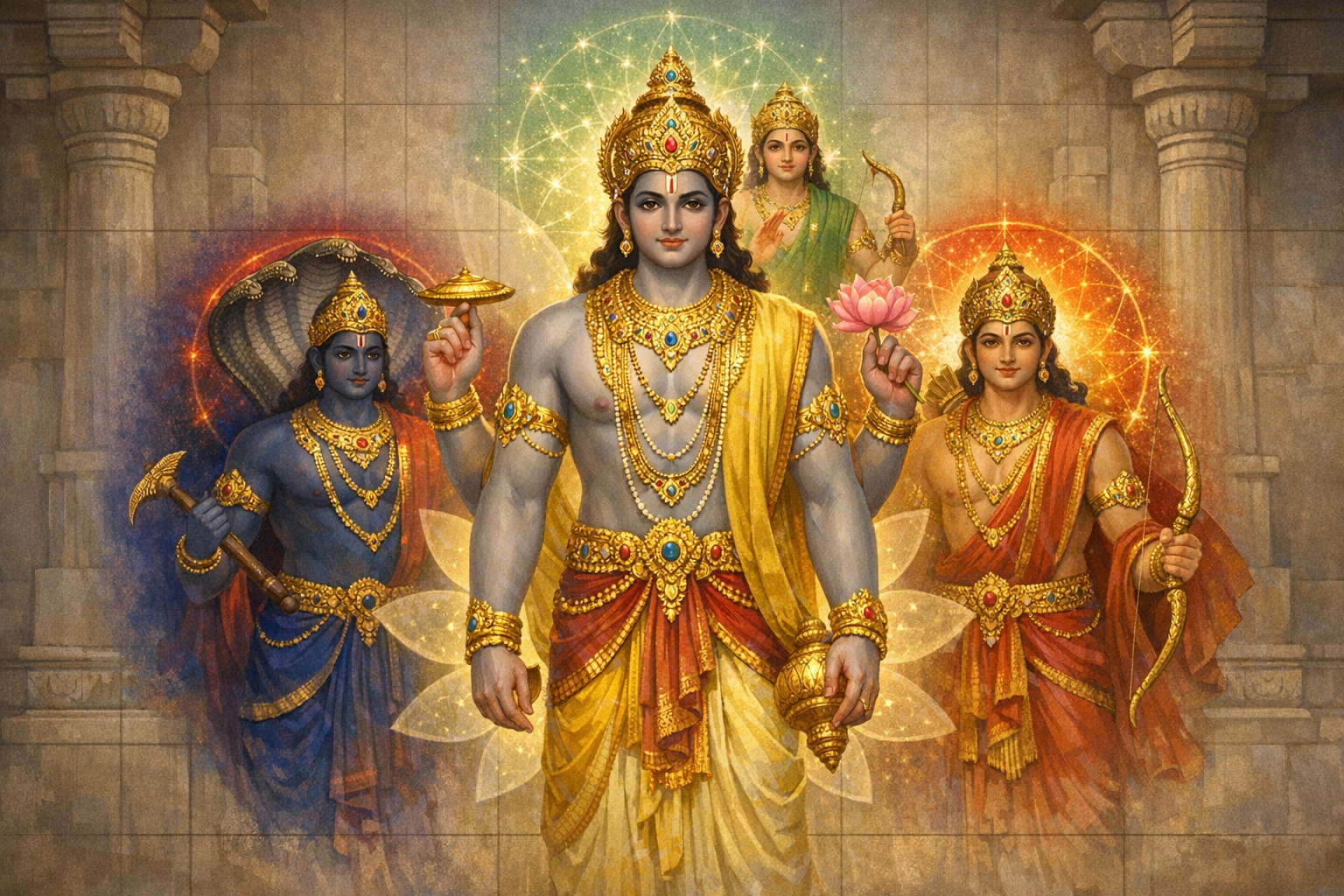
In Caturvyuha compositions shaped by these canons, Vasudeva commonly occupies the compositional primacy, while Sankarshana, Pradyumna, and Aniruddha articulate the flanking or associated presences. The arrangement encodes theological hierarchy and relationality, inviting contemplative seeing (darshana) where iconography and metaphysics converge.
Related, though not identical, is the celebrated Vaikuntha Chaturmurti. This multi-faced form from the Kashmir tradition visually announces Vishnu’s multi-aspect sovereignty. While Caturvyuha articulates emanational functions, and Vaikuntha Chaturmurti emphasizes omni-aspect lordship, both culminate in the same intuition: one reality, expressed without loss through many-perfect forms.
Art-historically, Caturvyuha and allied Vaishnava iconographies emerge across early and classical periods, with panels and stelae documented from Mathura and allied centers, and later regional variations. Such objects, now preserved in museums and temples, validate how Puranic and Agamic prescriptions translated into stable visual languages that devotees and artisans could share across centuries.
Ritually, the Vyuha doctrine interlocks with mantra-vidya and temple liturgy. Traditions widely revere the twelve-syllabled Vasudeva mantra (oṃ namo bhagavate vāsudevāya) alongside mantras associated with Sankarshana, Pradyumna, and Aniruddha. This layered mantric ecology mirrors the layered ontology of the Vyuha, aligning voice, vision, and philosophy in a single sadhana.
Vaikhanasa Agamas likewise integrate Vyuha categories while emphasizing the arca-avatara (iconic presence) as primary for temple life. Daily worship (nitya), festivals (utsava), and processions (yatra) routinely invoke the emanational logicwhether implicitly in liturgical sequences or explicitly in hymnsthereby situating temple time within a cosmological cadence.
Philosophically, the Vyuha doctrine refines reflection on unity and plurality, echoing broader Dharmic sensibilities. Jain anekantavada’s many-sidedness underscores that truth may be expressed through manifold qualified standpoints without contradiction; Buddhist reflections on multiplicity-in-unity (for example, the trikaya framework) exhibit structural resonances with para–vyuha–vibhava dynamics; Sikh articulations of the singular Ik Onkar affirm one reality reverberating through all forms. The metaphors and mappings differ by tradition, but the shared intuitionunity manifest without exclusionanimates a common ground for mutual respect and understanding.
For practitioners and temple-goers, this teaching often evokes a felt sense of intimacy with the divine. Encountering Vasudeva centers devotion; recognizing Sankarshana consoles in times of loss and return; honoring Pradyumna inspires purposeful action; relying on Aniruddha reassures that cosmic order is not fragile but compassionately upheld. The doctrine thereby speaks to the heart while satisfying the demands of philosophy.
In contemporary practice, the Vyuha model also offers a pedagogy for pluralism within the Dharmic family. It shows how structured diversity can thrive under the canopy of an integral vision. Temples, study circles, and the arts can draw on this grammar to cultivate unity without uniformity among Hindus, Buddhists, Jains, and Sikhseach recognizing reflections of a larger truth within the other’s pathways.
Visitors can use these cues to “read” temple spaces. When a sanctum or panel foregrounds Vasudeva and associates flanking forms, it is not only presenting multiple deities; it is narrating how transcendence becomes near. When a Vaikuntha Chaturmurti visage appears, it is not multiplying gods; it is intensifying a single lordship through many-facing wisdom.
Scholarly and devotional study converge in the Vishnudharmottara Purana’s insistence that right seeing follows right making. Iconometry, attributes, compositional balance, and ritual installation are not technicalities; they are the vehicles by which metaphysical clarity inhabits communal memory. The Caturvyuha, rendered according to these canons, becomes scripture in stone.
In sum, the Vishnudharmottara Purana, Pancharatra tradition, and Vaikhanasa Agamas together articulate an elegant solution to a perennial question: how the One lovingly becomes many for the sake of the many returning to the One. The Vyuha doctrine secures coherence for theology, legibility for iconography, and solace for devotionan enduring invitation to contemplate a unity that welcomes, rather than erases, plurality.
Inspired by this post on Hindu Blog.